There and Back Again: An AI Story
Should we toss this current iteration of AI into Mount Doom?
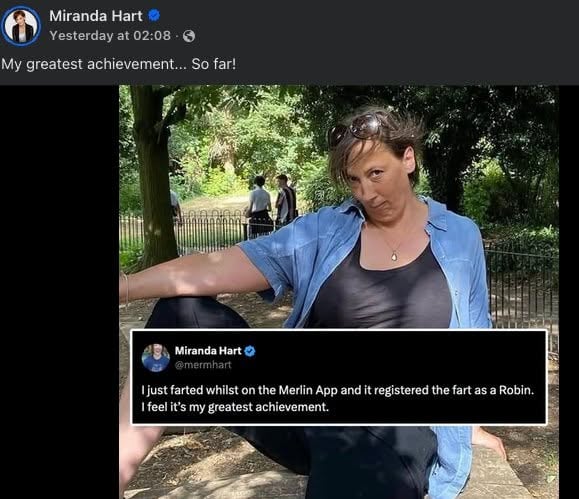
(Read to the end for Kristen Koopman’s AI resistance fiction recommendation and a heroic Merlin App user.)
Because I'm a science journalist, I learned about large language models long ago, back when I wouldn't have dared put that jargon in a first sentence, because no one would have known what it was. I'm not sure exactly when I began to have a deep daydream (har) about an LLM that had been fed all my past work and that I could brainstorm with. Maybe mid-2010s? I was curious: What kind of lede would all the past versions of me, amalgamated, write? What kinds of writing habits would I notice? I'm getting to the point in my career where I can remember that I wrote something about a topic but I don't remember when or where or what it was. How nice would it be to query my entire body of work, notes included, whenever I wanted? This deep daydream LLM would be a fun navel gazing endeavor and occasionally genuinely useful. (Side note: I know that one can build such an LLM, but I don't know how, nor do I have the time to learn. I'm open to audience suggestions, though.)
You know what I never would have considered putting in my deep daydream LLM? Other people's work. Not if I was going to use it to brainstorm writing. I would have thought that that was a violation of copyright. I was shocked when in 2022, ChatGPT launched as a writing tool that had scraped much of my past work, as well as most of my colleagues' works--at a time when most of us were enduring record layoffs on top of decades of wage stagnation. Soon, we would also be dealing with record funding cuts.
My first thought when ChatGPT launched, was: "Really, guys? Read the room. We just went through a pandemic, and no one wants another upheaval that makes public health, climate change, public education, higher education, mis/disinformation, journalism, and basically all service- and information-oriented jobs, worse." Friends, I don't think they read the room. In fact, I don't think they thought the room mattered, at all. Tech bros had been getting away with shoving bad ideas onto the public in the name of profit and progress, democracy and society be damned, for decades.
Over time, though, I also started trying out these generative AI tools. In my line of work, I have to keep up with tech changes. And, as they say, keep your enemies close. I wanted to know what I was up against. Plus, as a new freelancer building my first business, I was intrigued by the idea of shortcuts that could save me all the unpaid time I put into administrative tasks. If they were going to use my work, and all these other bros and their companies were using it to get ahead, should I? Tech companies have been getting away with crappy behavior for so long, and everyone just goes along with it. I had little faith that enough people would fight back. What’s one more pointless pivot?
In July, when Hank Green’s audience was ready to pillory him for one use of “I appreciate the pushback”—a phrase that they associated with AI slop writing, even though he says that his usage didn’t originate there—I was surprised, heartened, and a little sorry for Hank. He’s just a little older than me. We’ve both been pointlessly pivoting while tech bros profit for decades, even though he has a far bigger following to show for it. Hank Green responded with an apology and an AI use policy.
Even though Hank says he did appreciate the pushback genuinely, he also admitted to a relationship with AI that was “not healthy.” Other science writers are also grappling with how to use AI. In a recent podcast, Derek Thompson said that as a sole creator, using AI for copyediting was helpful. I relate, guys. I do not use AI for copyediting, and you can tell. I wish I could pay a copyeditor, but I can’t even pay myself to work on this newsletter yet.
Like Derek, I’m old enough to know what it is like to be developmentally edited, line edited, copyedited, fact-checked, mentored, and reviewed by a team of humans. I know what it’s like to brainstorm, research, and coauthor with humans. I fucking love it. The catharsis of building something novel as a creative team is what keeps me in this game. I have also watched those teams in academia and journalism erode over the course of my career.
Today, I am often stuck creating content alone (OK, Kristen usually helps here pro bono, thank God), even though I know how much better my thinking and writing is when a human team stands behind it. In many aspects of my remote work, I have no way I can pay or tap into a human team. Or, maybe I could find someone, but it’s unclear who’s available and wouldn’t mind my ping. In my Boromir moments over the past couple years, sitting alone in my home office in front of my screen with a blinking cursor, I turn to generative AI when I want a human but one isn’t immediately available. So I just ask ChatGPT or Claude or Gemini my mentorship question or request for brainstorming help or need for quick research summaries. I am at times impressed with the output, but I just as often feel weirdly disconnected and manipulated. Not only is the answer often disappointing, but also I end up feeling disappointed in myself.
That discomfort has only grown as the deeply concerning environmental and health effects have come to the fore. Data centers’ fossil fuel use and air pollution are at a scale so big that they are hard to comprehend—we have no point of comparison. On top of all that, we have the Hugging Face hack and the AI employees saying they are building robots that will kill us. I’ve heard all sorts of takes on how seriously to take these last two incidents, but suffice it to say that they haven’t been reassuring.
That’s why, after my initial curiosity, I have been using generative AI less and less. There are now calls to boycott this tech that are gaining far more momentum than I thought possible. It has become a unicorn bipartisan issue.
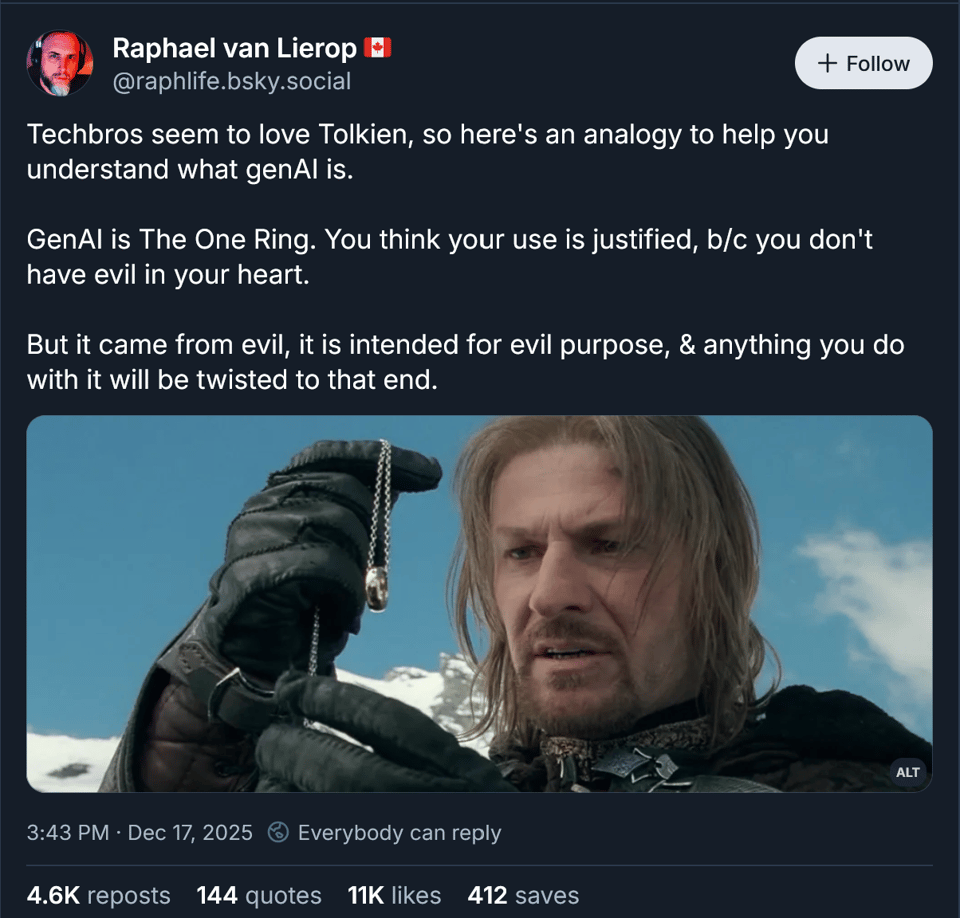
If we run with the metaphor that genAI is Tolkien’s One Ring, the appropriate thing to do is toss it in Mount Doom. I still want my deep daydream LLM, but the Mordor monster I got instead is not it. Would we be better off scrapping this slop and starting over?
This all could have gone differently. Tech ethicists have known what to do all along; the companies simply weren’t incentivized to prioritize safety, consent, and the public good. I am skeptical we can put this genie back in the bottle (or bubble?), but I would love to see what we can accomplish if we try.
I am leading two discussions this fall that grapple with the promise and peril of AI use. One is a webinar for AHCJ about how journalists can cover the health impacts of data centers. The other is a session at AHCJ’s Fall Summit about AI use in disaster management and response.
At the same time as all this pushback (we appreciate it, after all), generative AI has been improving. You can’t necessarily detect its savvy use in writing, although there’s also plenty of obvious slop to go around. I have editing clients who are dead set against using AI and others who are exploring its application for research and summaries. After reading this article, I added an AI disclosure to my editing contracts, because I want to know how the authors I edit use it and they deserve to know how I use it, seldom as that is. It’s time to include an AI use policy for this newsletter, too.
A newsletter is an intimate thing. I take seriously that my emails land in your inbox next to ones from your mom or your closest friends. That’s why Kristen and I do not use and never have used AI to write and edit this newsletter. This is a human-to-human correspondence. I do sometimes use AI to transcribe interviews. Still, I’m curious, dear reader, what you think. Many newsletters use AI; most probably don’t even disclose it. Comments are open on this newsletter. Where’s that line for you?
Recent Things I Wrote or Did:
- Climate Change Is Outpacing America’s Flood Data, American Scientist
- Science on Tap: Environmental changes in your backyard, Virginia Tech Center for Communicating Science
Recent Things I Recommend:
- Doctors are finally starting to agree on when obesity is a disease, by Tara Haelle, National Geographic
- Not Throwing Away My Shot, Act 3 of the episode “I Know What You Need,” Miki Meek, This American Life
- The Wrong Kind of American, Julia Curlee, The Atlantic
- The News, Season 8 of Scene On Radio by John Biewen and Chenjerai Kumanyika
- NPR spent 2 years tracking deaths from heat. We found a staggering hidden toll, Alejandra Borunda, NPR
- Trump Attacks Academia—and Grad Students Ask if It’s Worth Saving, Lauren Chambers and JP Flores, Inside Higher Ed
Koopman’s Corner:
Many of my colleagues in STS have done work on how algorithmic systems replicate or sometimes even enhance existing inequalities, many of my colleagues who are writers have watched the value (both philosophically and financially) of their work take a nosedive, and, as someone who grew up in the age of Clippy, I just hate it on principle when a piece of software tries to tell me it knows what I'm doing better than I do. I am absolutely the kind of person who gets rid of Copilot out of sheer spite as soon as I see it installed. (I didn't install it! I didn't want it! How did it get in here and how do I make it leave!!!)
But mostly, for all that I'm a bit of an introvert and a homebody, it actually means a lot to me to know that there's a person on the other end of a piece of communication or art. I care what people think. I don't care what a Large Language Model's algorithm has determined is statistically likely to be the set of words that will get you to keep paying for a subscription. I want the weird stuff, the unexpected flashes of insight, the weight and heft of all the time and effort that goes into interacting with a fellow sentient being.
I also, to be fair, want clean water and a breathable atmosphere, but we don't have time to get into all the environmental issues around generative AI. (I also want RAM for computers and for my retirement account not to crash, two more things generative AI is ruining or about to ruin that we don't have time for!)
So let's look at some recommendations instead. I've got two serious pieces about AI in education to recommend, and then something funny to make us all feel better. Then I sneak in a little self-promotion, which I'm actually not sorry about.
Talk To Your Children About Two-Tongued Jeremy, by Theodore McCombs in Lightspeed
This story about an AI educational aid has stuck with me since I read it when it first came out. It's long but absolutely worthwhile, painting a vivid picture of how "AI" systems can go wrong.
For A Student Who Used AI to Write a Paper, by Joseph Fasano
I find myself returning to this over and over again, particularly in the classroom. In times like these, it's important to hold on to the fact that there is joy to be found in the inefficiencies of working on something that you love.
Mrs. Davis, Peacock
How can I describe this show? I really can't, and if I tried, I would ruin it. So instead I'm just going to say: You should watch this, and you should do that without looking up anything about it. Maybe a promo image if you have to. (Yes, that's a nun; yes, it makes sense; no, I'm not going to tell you anything else.)
And a bonus that has little to nothing to do with AI: Generic State University Pivots to Dark Academia, by me! Look, I've been laughing at McSweeney's since I first stumbled across FAQ: The "Snake Fight" Portion of your Thesis Defense in my first year of grad school, so I'm going to take a victory lap.
Tell Us What You Think
Please tell us here what sorts of content and subscriber perks you suggest. In the meantime, please subscribe to the free version and buy me a coffee here.
Something Fun:
About Me:
Add a comment: