2025 Reflection, Part 2
On moving from the Horizon202 swing-lens camera to the Hasselblad XPan, and finding beauty in the industrial.
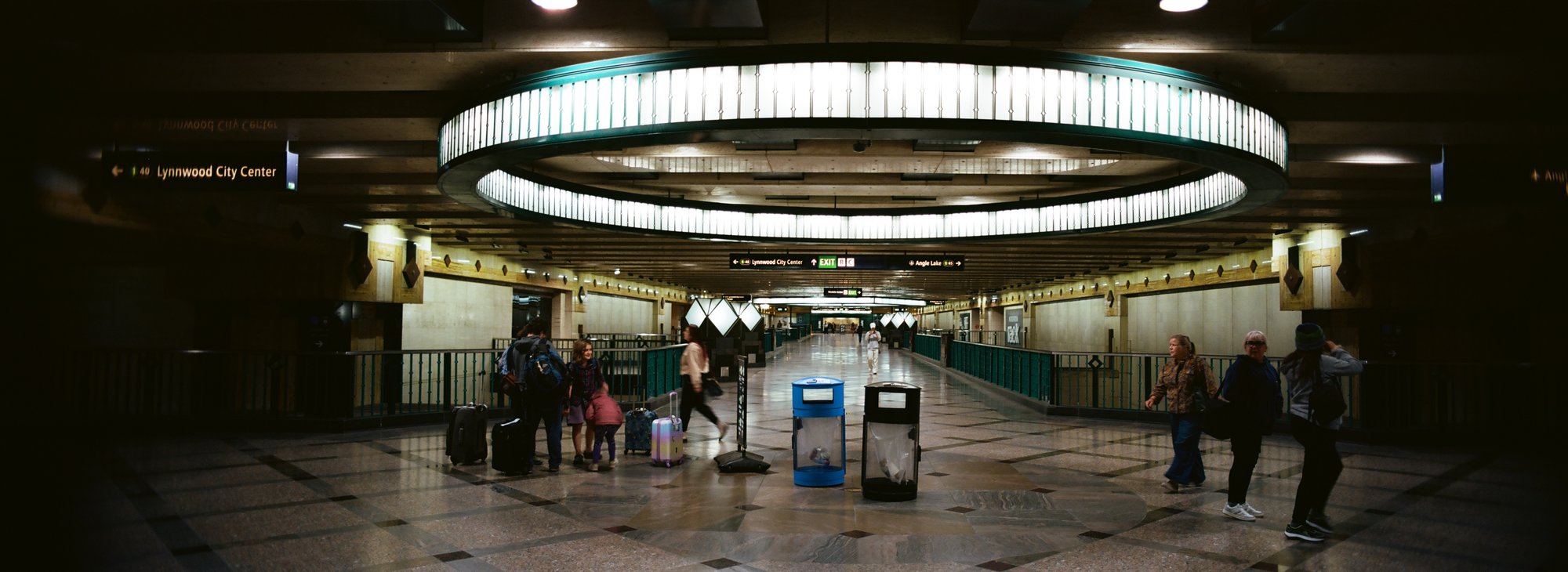
Seattle is quiet, and not big enough to create the complex geometry and dense spaces I’d really enjoyed capturing in Europe. Our metro stations are quite new, and many were originally designed quite spaciously for buses. Lots of dead visual space, and quite dim, too. The Horizon’s viewfinder fell flat when in front of my eye—Everything was too far away.
from 2025 Reflection, Part 1.
In the fall of 2024, I’d tried the Horizon on the Washington State ferries and found the images I got out of it to be fun, but ultimately not captivating.
In the winter of 2025, I sat at home thinking. What did I most want to photograph with my new toy? Where can I find lots of motion, visually confusing but emotionally charged subjects, and interesting textures in high-contrast, close-quarters environments? What am I in particular uniquely suited to capture?
New York, New York
So. In early April, my friend Lisbeth went to New York City for work. After begging her for weeks, she very kindly agreed to let me share her hotel room.
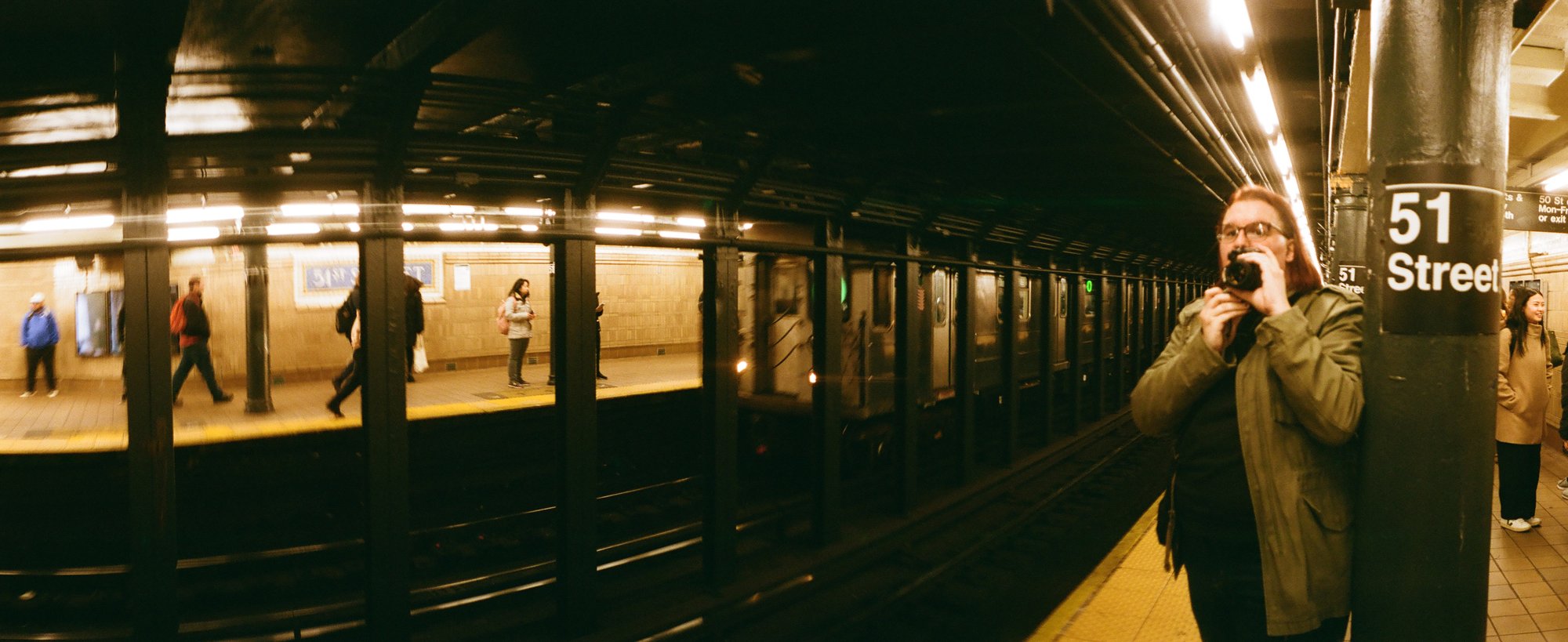
Every spare evening, I rode the subway alone, frantically trying to find interesting compositions for the Horizon. Subways worked before, so maybe they would again!
One of the things I find deeply comforting about New York is the rhythm. I understand how to move there, weaving through crowds, turning my shoulders to squeeze through tight spaces, reading fractions of a sign in the subway for a hint of which stairwell I need to make my transfer, feeling the rush of air as a train enters the station and knowing I need to pick up my pace. My brain feels saturated with information on a deep level, and my body loves the exercise. My heart races. I find it intoxicating.
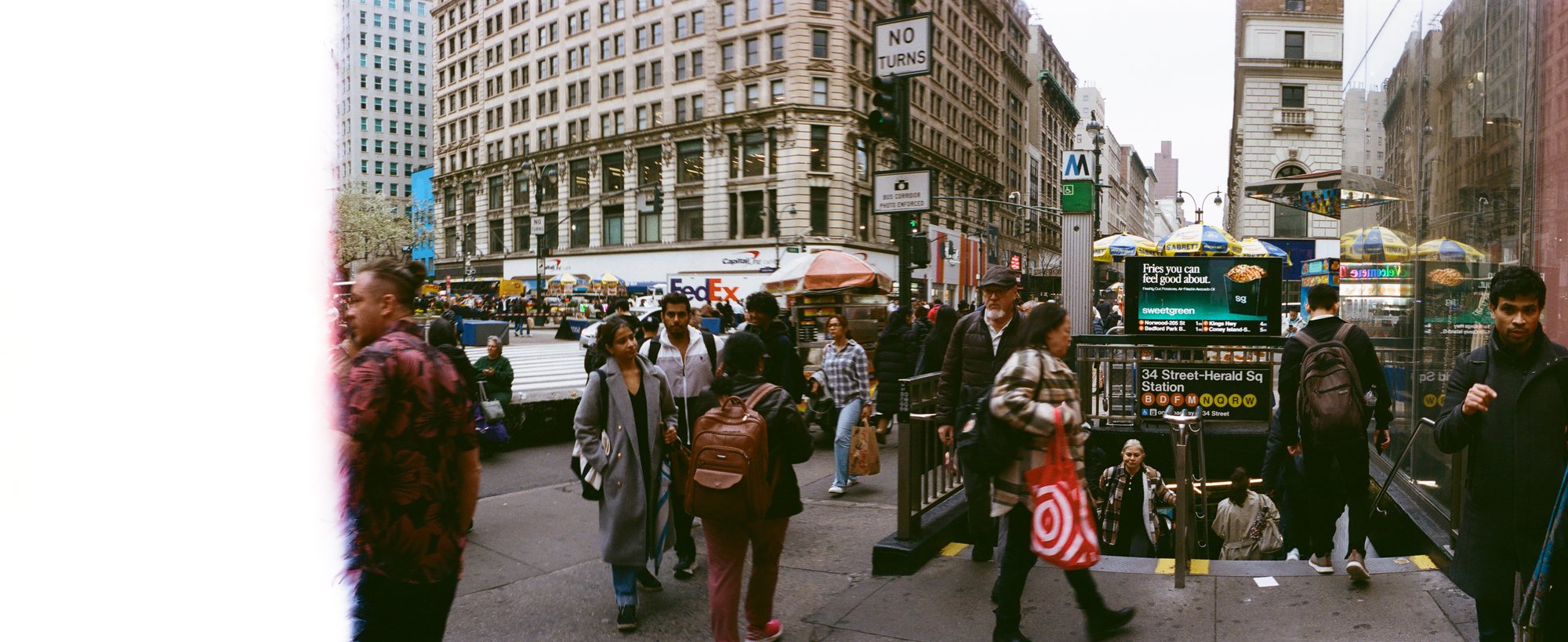
With the Horizon, I captured my movement on narrow platforms, I pushing right through the middle of people, bumping shoulders with everyone else waiting for a train. The movement of the cars creating exaggerated blends of color just as they had done so interestingly in London and Berlin, leaving long trails of light if the train travelled left-to-right along with the the fixed direction of the swing-lens’s motion, or compressing them into smushed shapes in the opposite orientation. The darkened spaces of Chambers Street captured the same ominous mood I’d loved from some of my photos in Berlin and San Francisco. Lonely photos late at night moved me deeply. Grand Central felt like a paradise with its scale, detail to be found in every corner. Busy crowds raced every which way, and with one swing of my lens, I’d capture them, before hopping on another train to go across town and find more busy people to lovingly get right in the way of.
Many of the photos surprised me. For one in particular, which I titled “2048,” I’d taken a risk with the shot, and assumed the result of it would be one big smear of silver or beige train car.
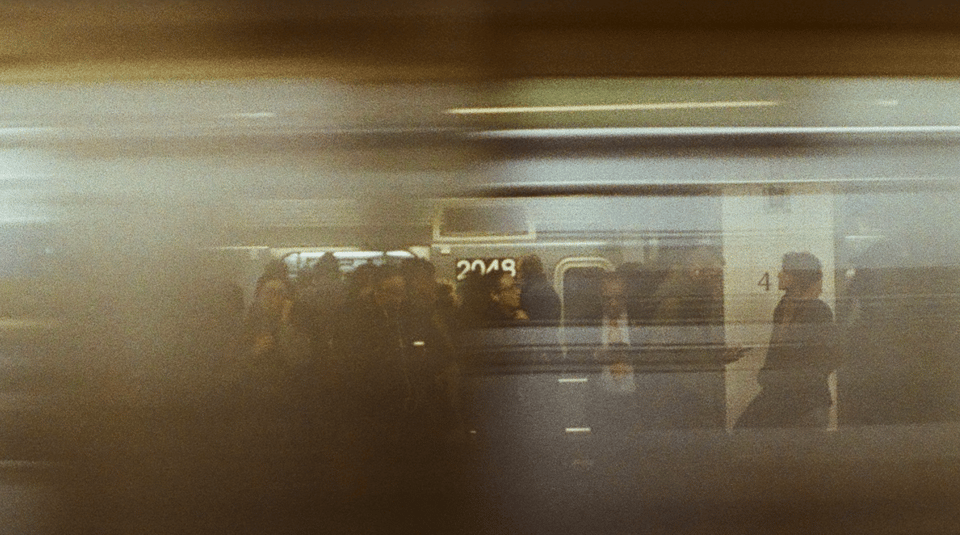
Instead, I was rewarded with this intimate little view of commuters on the opposite platform of the 6 train at Grand Central–42nd Street station, just barely visible thanks to a gap between the cars passing in front of me. It felt vague and impersonal, full of movement, and interesting color. A unique perspective, the feeling of that platform on any day, not just that day.
I posted this photo to Glass, and people responded to it! My friends loved it, and I was featured on the site’s “Explore” page. At the time, this was always a nice confidence boost that someone else agreed that what I was seeing was beautiful. People close to me had long been encouraging, but I was never sure if they were discerning with their praise. Now, I was beginning to find my confidence in myself and in my work.
Problems with swing-lenses.

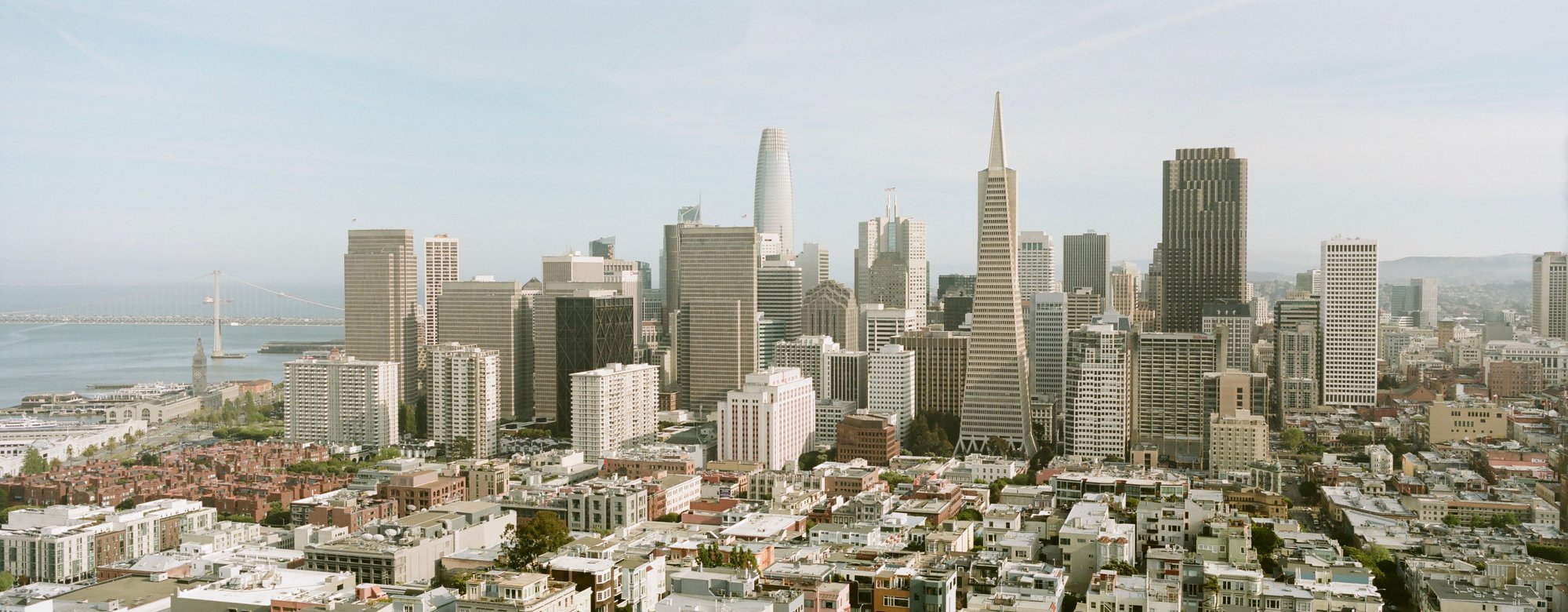
One nagging problem was left. Composing with the swing-lens was always difficult. In practice, I found that many of my compositions worked for the aspect ratio, but not the distortion of the lens mechanism. Using the camera outdoors felt all but impossible to me. One of my best results was a photo of Cafe Zoetrope and the Transamerica Pyramid slowly becoming shrouded in afternoon San Francisco marine layer, but it still had problems which frustrated me. The building in the center, my subject, is distanced by the design of the camera. Instead of my intended subjects, the buildings which take up most of the room in this photo are the ones at the edges, which the swing-lens draws inward and enlarges. They present no marvelous subject matter. With a standard 4:3 aspect ratio camera and an ~85mm lens, I could take a better photo of this moment, where my subjects feel nearer, legible, and you can observe the detail. I could line up the architecture much more easily without worrying about which streetsigns on the edges of a 120º field-of-view are intruding on the image. The side-streets on the left and right edges bend upwards towards the sky, and even for San Francisco’s hills, I find it a bit nauseating.
Further still, shoot at even a slight up or down angle, or even worse, hold it a little bit askew, and almost always, it just doesn’t work. The image’s horizon is all over the place, even in a small space like a subway car, and it’s difficult to correct for afterwards.
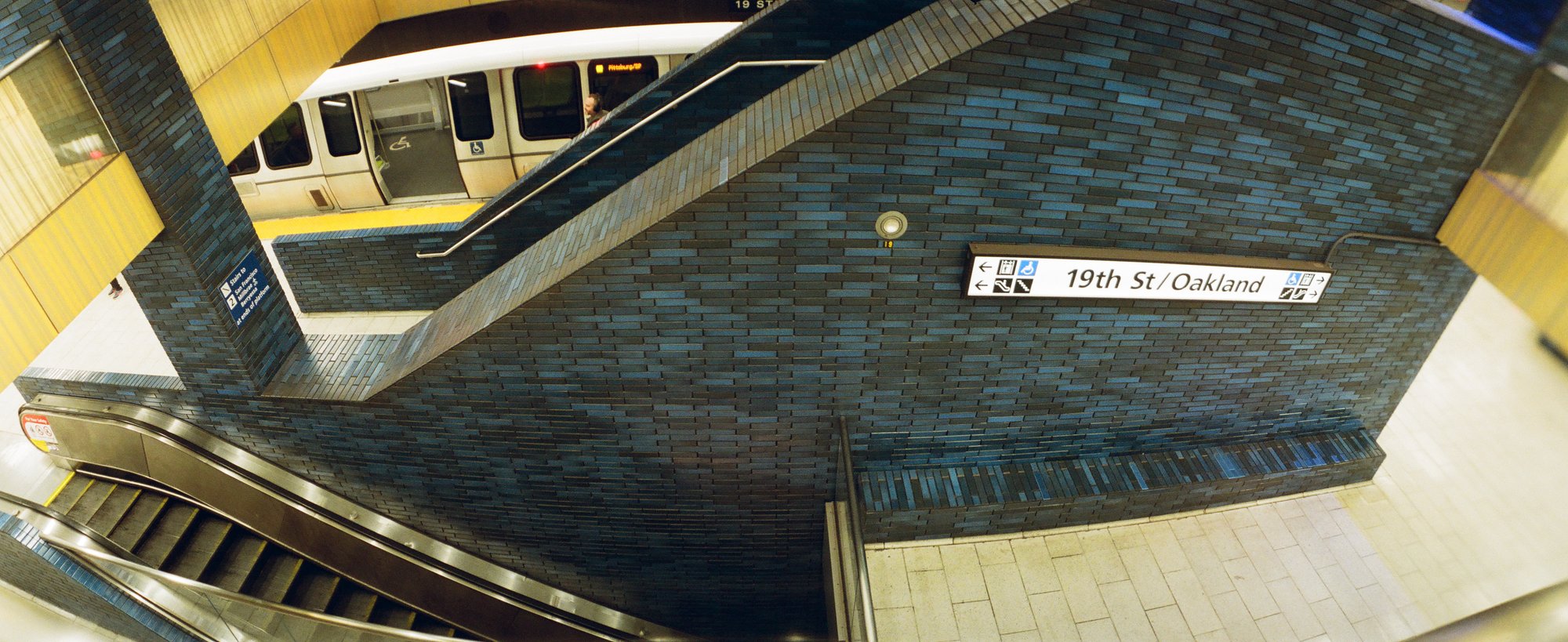
This photo from Berlin’s Alexanderplatz illustrates what I find the most frustrating about the Horizon, however, which bothered me right from the beginning. With the right camera, it would be a fantastic composition in a wide aspect ratio photo (though it could stand to be a bit busier, more people would help) but the curved film plane warps the horizontal lines of the architecture and station signage, which we intuitively know to be flat.
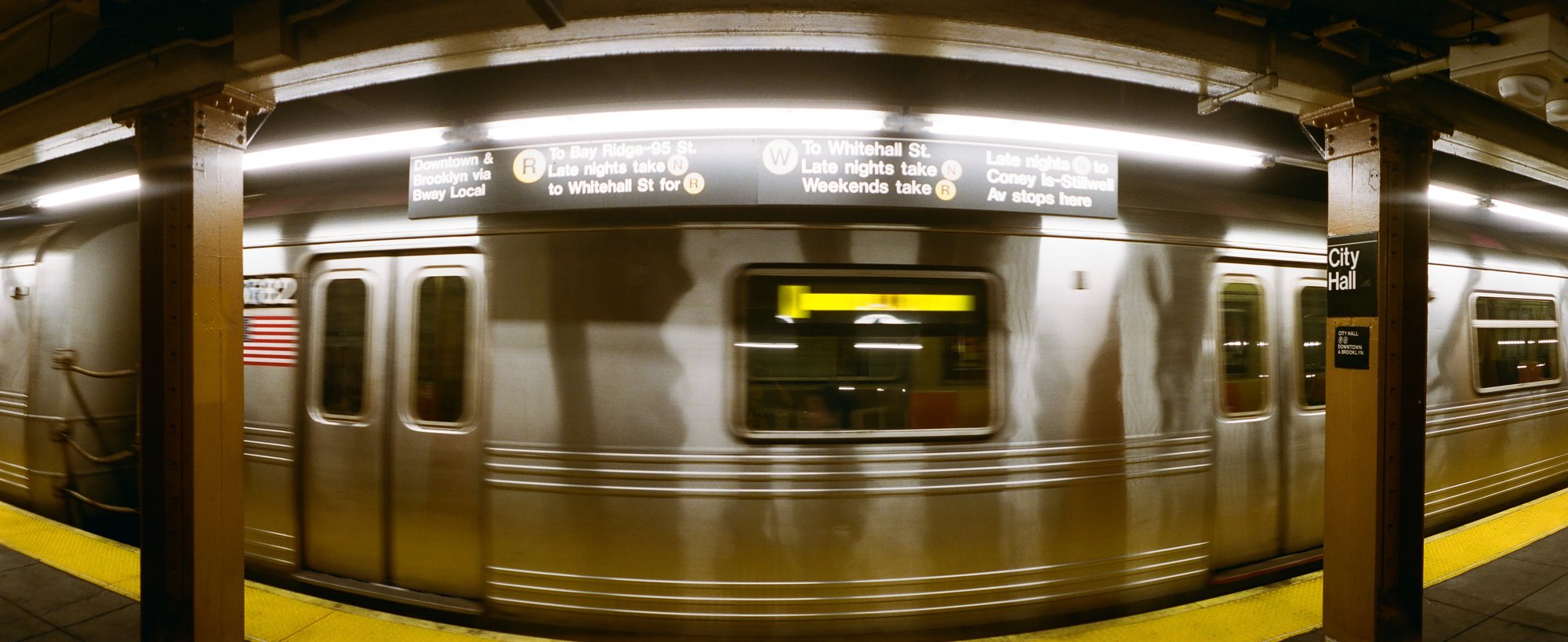
In New York, I found this problem especially bothersome. I always envision signage as it would be on a page in a graphics standards manual, an idealized 2-dimensional navigational instruction. To me, the iconic graphical language of the MTA, designed by Massimo Vignelli, is an incredibly important piece of the environment that I wanted to capture. But the Horizon202 is incapable of presenting flat graphics in the correct perspective, because the film plane itself is curved. In a lot of photos I wanted to take, the warp created by my camera’s mechanism just looked wrong.
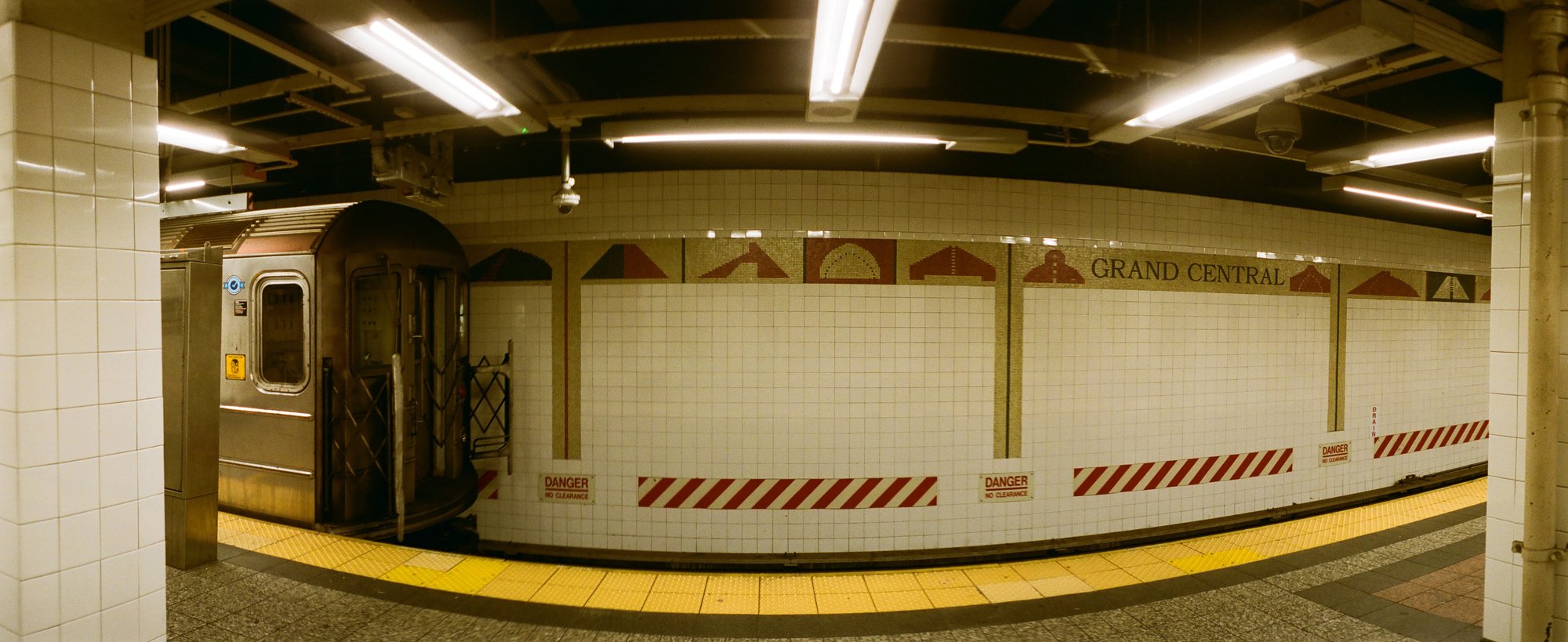
On top of that, the subway is full of beautiful tile details and murals which all ended up looking distorted, or worse, far away. As I got scans back from my photo lab, I found support columns intruding on the sides of images, blurred bits and pieces of things in the corners, and all sorts of distractions I could have pushed out of frame if I’d just taken one step more forward. Composing a wide, curved image is inherently difficult, especially with such a cheap plastic viewfinder as is built into the Horizon. I was proud of what I’d done, but I wanted something else.
I have a bad habit of browsing the used section of my local camera store the night before I’m supposed to fly somewhere. In April, before going to NYC, I bought a NIKKOR 35mm PC shift lens. The lens, designed for architectural use, allows you to take photos at an angle without having the straight lines of your image converge by shifting the glass up, down, or to the sides. This lets your film plane stay in line with the subject, even if it’s a bit above or below you. “Perfect for NYC”, I thought. Neat, lucky me!
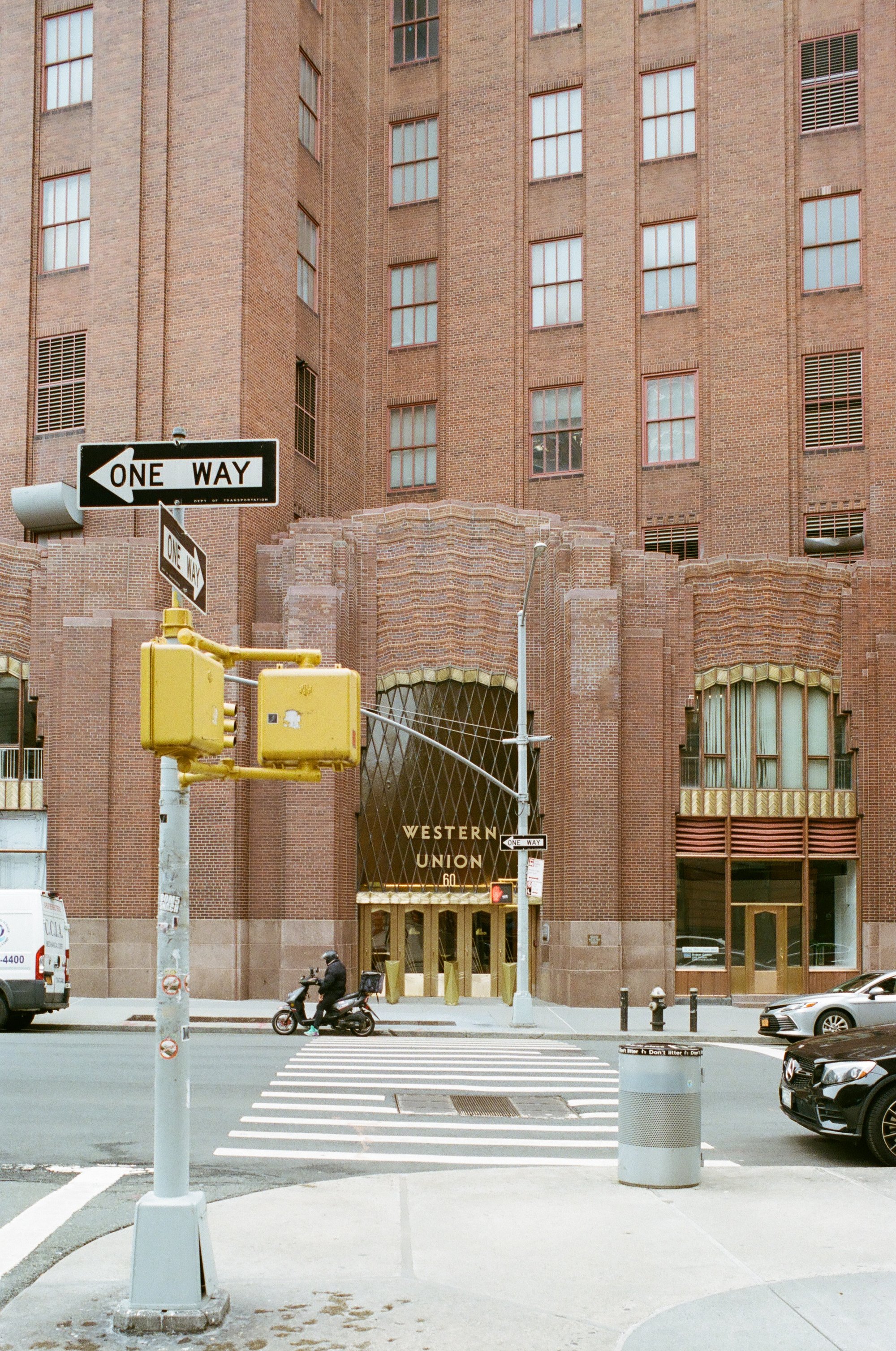
At the end of April, I went to San Francisco with my partner for a few days. The night before I left, I looked at my local used camera listings again.
Enter: the Hasselblad XPan.