
Tangible Tuesday #16 Absolutely Harmless to Humans
Five layers of engineering keep an infrared remote working & Four Microbit projects for reading and cloning the remotes on your coffee table.
> Tangible Tuesday is a free newsletter for the upcoming book Designing the Tangible Interface. Past issues in the Archives Want to support? Just forward this email to someone who would enjoy it.
Tuesday Tune: "Nissodia" by Idrissa Soumaoro
Five layers of engineering keep an infrared remote from firing on sunlight — plus four Microbit projects for reading and cloning the remotes on your coffee table.
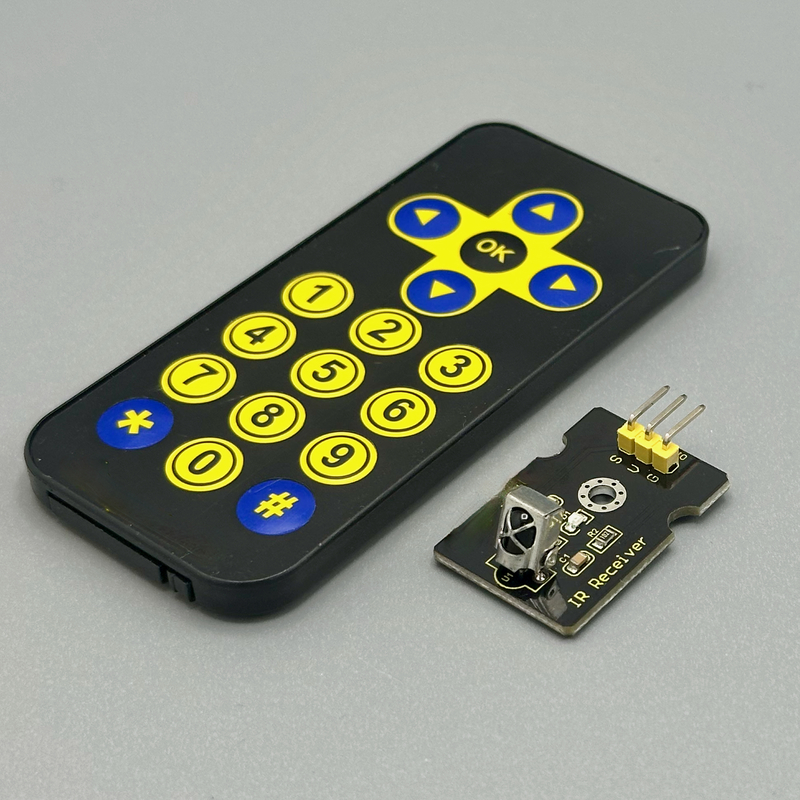
Infrared communication is the closest thing we have to sending telepathic messages, at least from your couch. Remote controls surround us; most coffee tables have two or three. These are surprisingly open standards that designers can use to create interfaces with equipment that isn’t otherwise open or hackable. However, the dream of a “Universal” remote has been attempted many times; it tends to fail for a few practical problems.1
Infrared signals are found in almost every remote, but how do they work?
Before infrared remotes, there was the Zenith Flash-Matic (“Absolutely harmless to humans.”)2, a flashlight styled like a Flash Gordon ray gun. It didn’t work so well: the simple photoresistors in the TV would get triggered by direct sunlight. The Zenith Space Commander that replaced it tried sound instead.
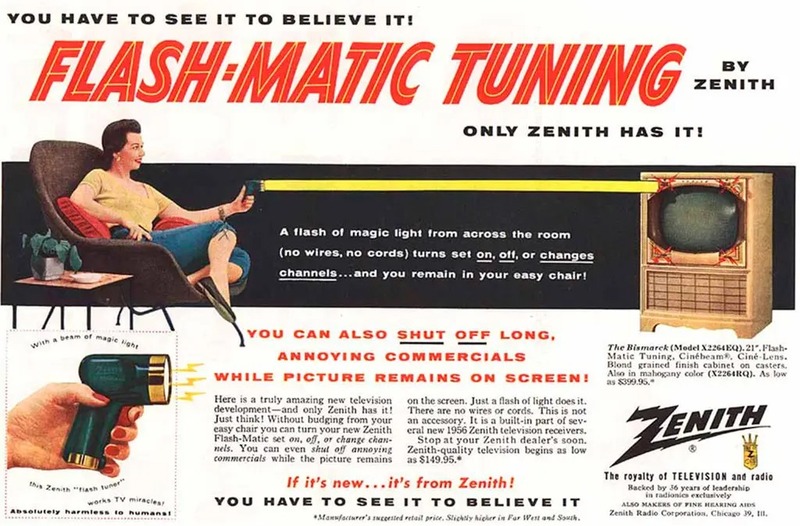 Zenith Radio Corporation advertisement, reproduced in the New York Times.
The problem of accidental triggers, aka “noise,” never went away. Clever engineers designed five layers of solutions on top of each other, and you can see them at work in the NEC protocol driving the projects ahead.
- Engineers switched to the near-infrared spectrum, the not-heat part, which has less ambient activity and, being invisible, doesn’t bother people. They designed around the photodiode, a simple component that reacts to light. An infrared photodiode can be tuned to respond only to certain infrared frequencies, filtering out all the other colors. A standard 940 nm infrared LED can drive almost any consumer remote receiver (TVs, stereos, AC units) because they all use the same basic type of light.
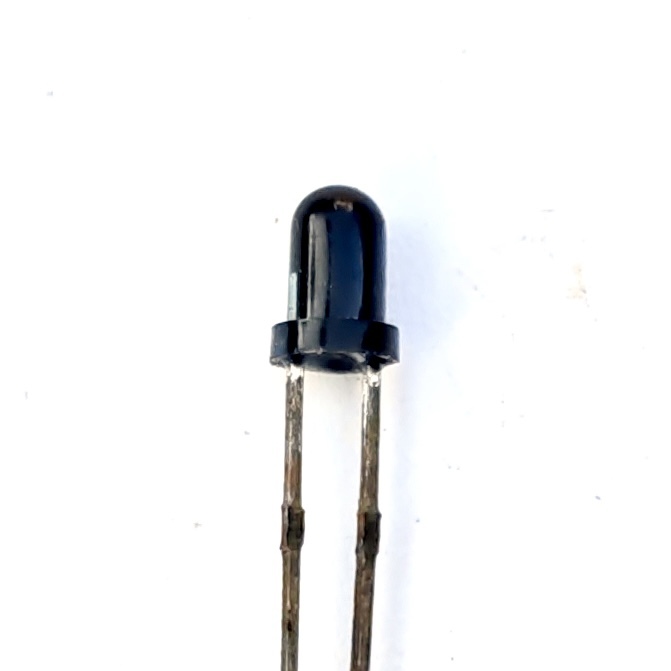 Photo by Suyash Dwivedi, CC BY-SA 4.0, via Wikimedia Commons.
- The real innovation was adding an on/off pulse frequency. An erroneous flash of ambient light is unlikely to land at exactly the right frequency, so it gets rejected. That frequency was standardized around 38,000 pulses a second — way too fast to see even if it were visible light. This “modulation” is done by the remote’s electronics, and just as easily by a microcontroller like the micro:bit. The small black receiver chip (TSOP4838 / TSOP38238 for high end, or cheaper clones VS1838B/TL1838/HX1838) converts the raw infrared signal into a clean series of binary pulses, or “demodulation”. Your electronics doesn’t need to do much to read IR, which is convenient.
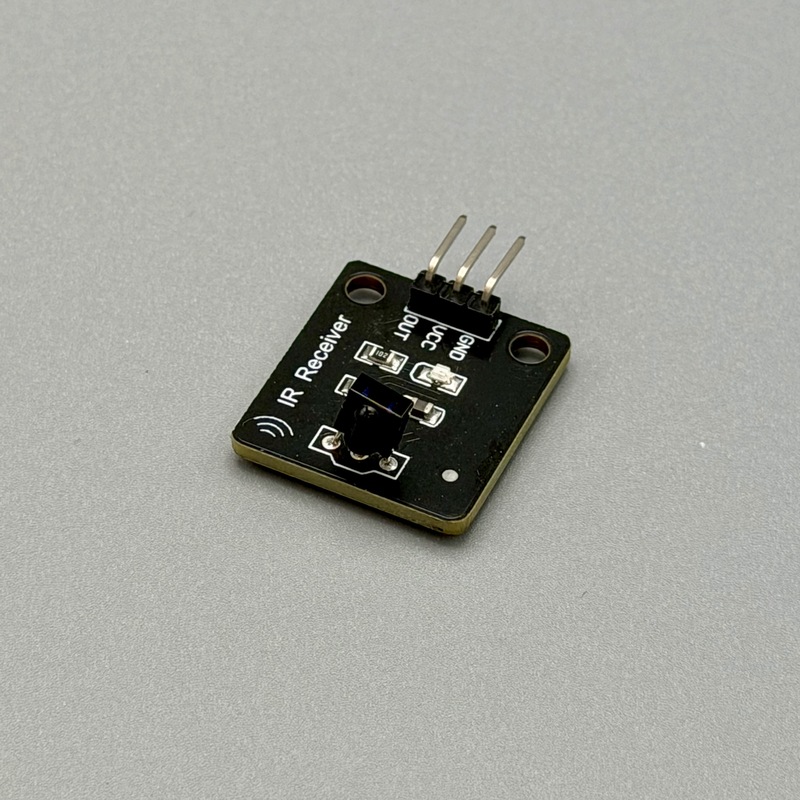 Photo by the Author.
- Accidental pulses still happen, so a third layer catches them: an error check built into the message itself. NEC’s version is simple — every byte gets sent twice, once straight and once inverted. Flip a bit in transit and the two copies stop matching; the receiver throws out the whole message rather than risk acting on a corrupted one.
- How does a receiver find the start of a message in a soup of ambient infrared? NEC opens every transmission with a distinctive long burst — 9 milliseconds on, 4.5 milliseconds off — before a single data bit. Nothing natural produces a pulse shaped like that, so the receiver can find the start of a real message and count exactly 32 bits from there.
- How do you stop a TV remote from also switching the stereo’s input? Split the message into a device address, naming who should listen, and a command, naming what to do. Every device on the coffee table hears every signal; each one just ignores whatever isn’t addressed to it.
Put them together and you get a “protocol,” a shared grammar both sides agree on before a single bit gets sent. Electronics companies don’t collaborate on standards; a standard just happens to be whichever approach wins. In the 1980s, NEC (Nippon Electric Company), maker of many remote controls, defined the de facto standard for consumer electronics remotes anyway. The result today is many vaguely similar but distinct protocols, each defined by a different manufacturer. There is no global registry for address values, so collisions happen, and many device protocols are still unpublished — which is exactly what makes universal remotes so difficult.3