
Tangible Tuesday #10 Artificial Taste - Chemical Sensors
> Tangible Tuesday is a free newsletter for the upcoming book Designing the Tangible Interface. Past issues in the Archives Want to support? Just forward this email to someone who would enjoy it.
Tuesday Tune: "GOLDEN BROWN" by TAKE VIBE E.P.
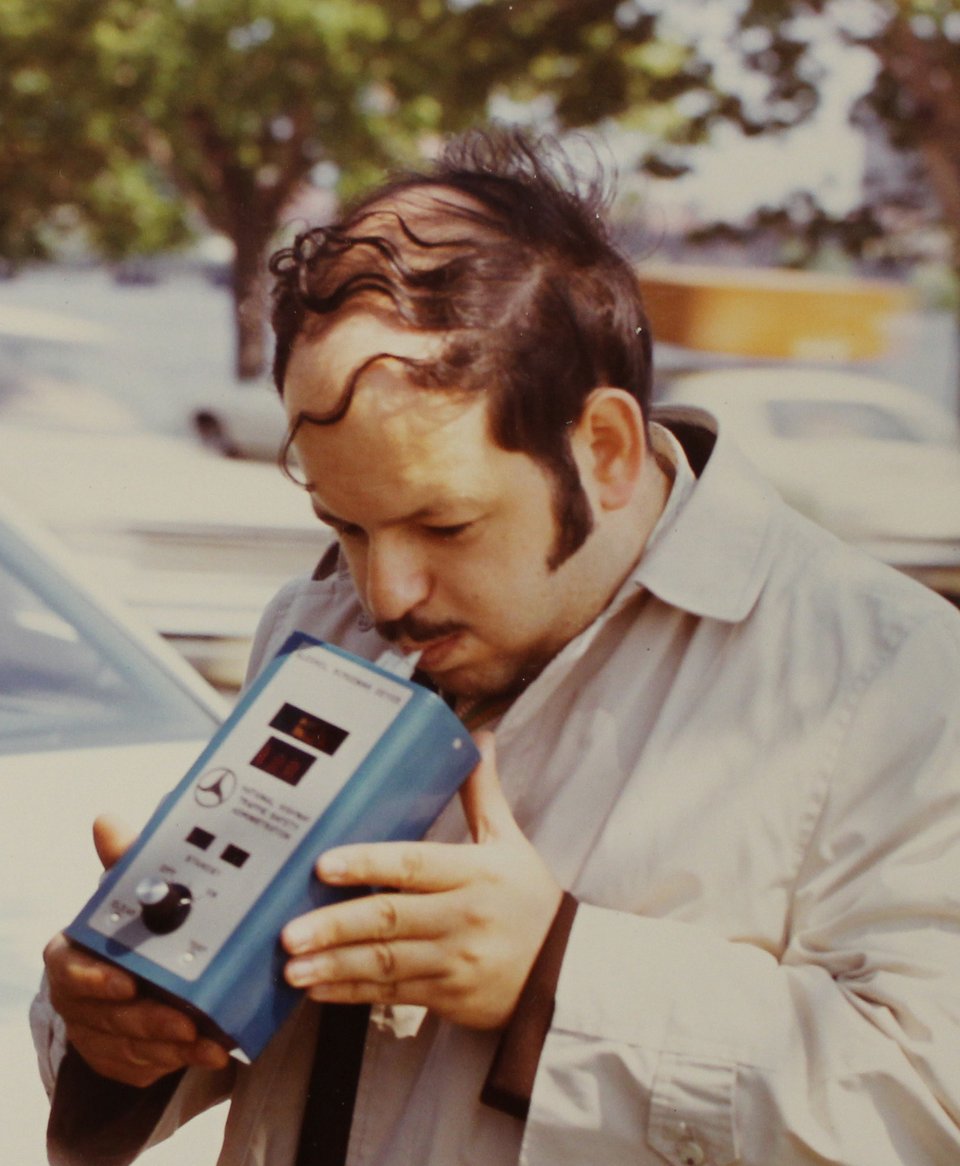
Building on last week's research into Taste and Smell, let's look at the technology of chemical sensors, especially the controversial use of breathalyzers.
Chemical Sensors Overview
The MQ series is the most widely used family of cheap metal-oxide semiconductor (MOS) chemical/gas sensors for hobbyists and basic industrial monitoring.
The setup is very simple: 5V power to two pins heats up a special metal disk with a chemical. When heated (~300-400°C), oxygen molecules react with the surface chemical, creating high resistance across two measurement pins. When target gas enters, it reacts with the chemical, lowering resistance.
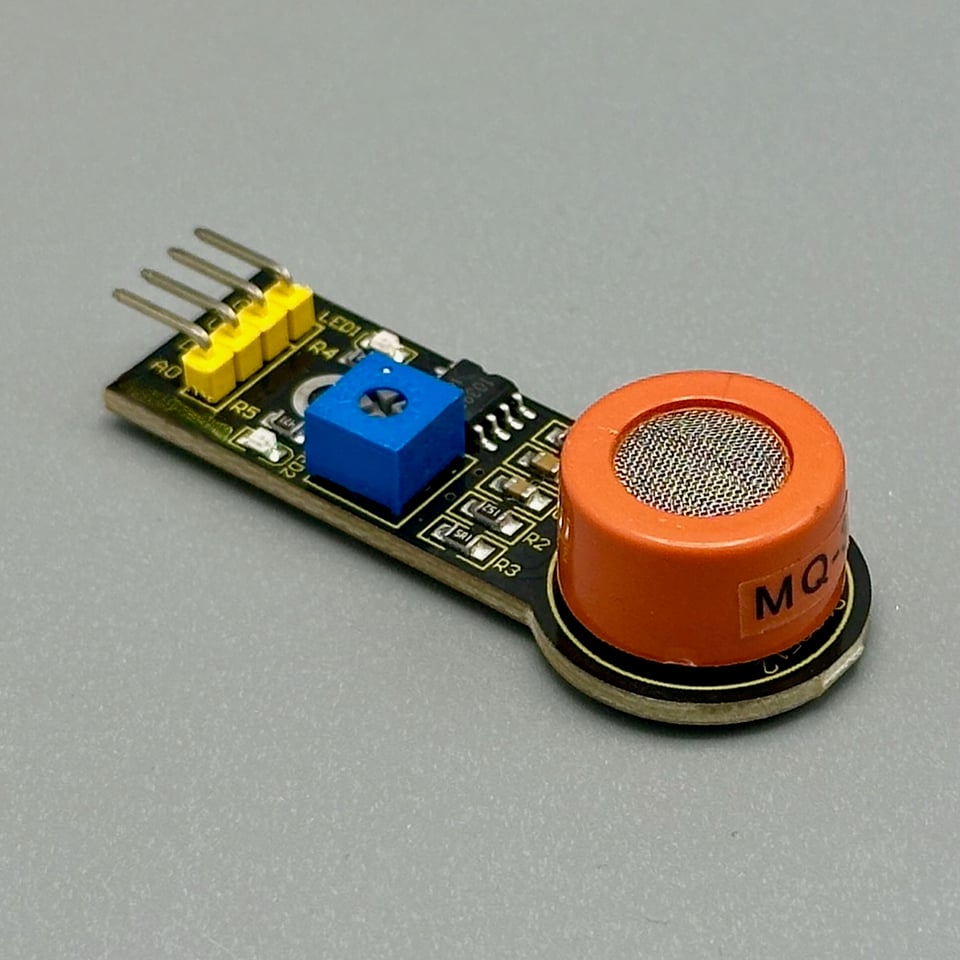
The resistance can be measured like any other analog input; that said, it's best to start with a mini breakout board that handles the voltage dividing and reduces the voltage to 3.3V that a Microbit uses. They also often have a digital output (Gas/no Gas), which has a tiny adjustable resistor that sets the threshold.
| Sensor | Target Gas(s) | Key Use |
|---|---|---|
| MQ-2 | Methane, butane, LPG, smoke | Smoke detectors, flammable gas |
| MQ-3 | Ethanol (alcohol), smoke | Alcohol detectors, breath |
| MQ-4 | Methane, CNG (primary); | Methane/natural gas |
| MQ-5 | LPG, natural gas | LPG/natural gas |
| MQ-6 | LPG, butane | LPG |
| MQ-7 | Carbon monoxide (CO) | CO detectors, exhaust gas |
| MQ-8 | Hydrogen (H₂) | Hydrogen |
| MQ-9 | CO, flammable gases | Dual CO/flammable gas |
| MQ-135 | CO, ammonia, benzene, alcohol, smoke | Air quality |
| MQ-136 | Hydrogen sulfide (H₂S) | Toxic gas |
| MQ-137 | Ammonia (NH₃) | Toxic gas |
There are a number of issues with these sensors - they are fairly imprecise, and have unique characteristics to design around:
- Heat-up/warm-up time: First-time use requires 24–48 hours to stabilize; after that, 5–10 minutes is enough between readings. During warm-up, readings start high and gradually decrease until stable.
- They're not accurate for precise measurements: MQ sensors give rough "is gas present?" readings, not precise "parts per million" (PPM) concentration values.
- Cross-sensitivity (respond to multiple gases): Every MQ sensor detects multiple gases, not just its "target" gas. For example, MQ-2 responds to LPG, alcohol, propane, hydrogen, CO, and methane. You can't tell which specific gas triggered the reading.
- Temperature and humidity affect readings: MQ sensors work best indoors with stable temperature and moderate humidity. Don't use them outdoors in extreme temperatures; it significantly changes sensor output.
- Calibration drifts over time: You must calibrate in clean air to find the "R0" reference value, but this drifts after storage or environmental changes. Sensors need re-calibration periodically and after being stored for a month+.
- They draw significant power and get hot: The internal heater needs 5V and gets noticeably hot during operation. Don't touch the sensor while powered, and use a separate 5V power supply. Obviously, be careful measuring air temperature and humidity around it.
- The sensor does wear out: MQ sensors typically last a few years of use. They are not repairable, so consider a modular design so the whole product is not thrown away.
It is amazing they last as long as they do; it is the heat stress that breaks them. The chemical reaction is reversible, not destructive; it reacts when heated and reverts when it cools, like a sponge absorbing and releasing water.
This sensor overview is meant to be very general, please don't do anything life threatening! You may ask yourself: is this even worth doing with all of these limitations? The answer comes down to your project. These are essential measurements to solve real world problems; there's no way to interact with the real world without real world constraints.
MQ-3 Analog Alcohol Sensor
The MQ-3 alcohol sensor detects alcohol vapor in the air. There are various types of alcohol; Hand sanitizer is a good test material. The sensor 'works': it detects alcohol. It also demonstrates the extreme difficulty of engineering a device with life and death consequences. When you test it, you will see that the device takes a few minutes to warm up and stabilize the baseline analog reading. The sensor takes a minute or so to respond to alcohol vapor and another minute or so to "de-respond" to the baseline. The sensor needs a dependable "clean" baseline to compare a sample to. The device will always report a reading but the designer can't simply say "an analog reading above 700 = drunk" because the sensor reading needs to be compared to the air in the room. If that room is a biker bar, you will get a different base measurement than outside. As noted, temperature and many other factors affect the vaporization of alcohol.
Even professional machines have been shown to have engineering errors. This is not to say the sensor does not 'work' but that the way they work is often a complex and under-defined question that a designer needs to engage deeply with.
Breathalyzer: A Case Study in Precision Theater
Drunk driving is a serious public safety problem, causing about 11,904 deaths in the U.S. in 2024; about 32 deaths per day. source Roadside surveys showed about 3% of drivers are legally impaired at any particular time, but between 1AM–6AM on Saturday and Sunday mornings about 14% of drivers are drunk. source source
A drunk driving law was passed in the US as early as 1906 source, but had limited practical enforcement, as drunkenness needed to be proved in a court of law.
One defining challenge of being drunk — perhaps also a benefit — is not knowing how drunk you are; likewise, it is difficult to predict from the outside which drivers are drunk enough to cause a car crash.
Field sobriety tests source (having a suspected drunk driver walk a line, etc) depend greatly on the skill of the officer, and are open to interpretation. The "Breathalyzer," source originally a brand name, was developed by inventor Robert Frank Borkenstein in the 1950s. The hope was that science and technology could solve a persistent problem.
The intent is good, but the use of a sensor in a product has inherent flaws worth considering. Machines marketed as precise to three decimal places were found to produce results that were sometimes 40% too high. NY Times Article "These Machines Can Put You in Jail. Don't Trust Them."
- Breathalyzers do not measure blood alcohol content (BAC); they estimate by measuring ethanol in breath and calculate blood alcohol via a fixed ratio. The real ratio varies person to person by up to 15%, and varies in the same person based on body temperature, lung capacity, and many other biological factors. Holding your breath versus hyperventilating can change the result by over 20%.
- Common compounds used in factories produce false positives: acetone, paint fumes.
- Acid reflux, certain medications, some mouthwashes contain or produce alcohol. Diabetics can produce acetone naturally without impairing their driving.
- The devices need careful and very regular calibration or the readings drift. In 2018 the New Jersey Supreme Court threw out 20,000 breathalyzer results because the devices hadn't been properly calibrated. The police officer was charged with falsely certifying that he had followed proper calibration procedures. source
- Breathalyzers are a product, sold by businesses to police departments and may reflect inherent biases. The source code is proprietary — courts or the public have had limited ability to audit it. The evaluation of the Draeger Alcotest 7110 source code (released in 2007 after a court order), found serious issues in the code, including disabled error detection, substituting lower readings when measurements might be an error, and had a math mistake averaging the readings that would fail an elementary school kid.
The breathalyzer is not just a technical sensor — it is a legal instrument. The gap between "what the sensor measures" and "what the number is treated as meaning" is enormous; the number it shows can take away someone's freedom, or let a drunk driver off the hook.
Electrochemical Fuel Cell Sensors (Professional/Law Enforcement) Used in: Law enforcement roadside breathalyzers, court-admissible devices, substance abuse centers, and high-end personal breathalyzers Alcohol in breath reacts with a platinum electrode, producing an electrical current proportional to alcohol concentration Accuracy: ±0.005 at 0.100 BrAC (very high) Pros: Extremely high accuracy, high specificity (resistant to false positives from non-alcohol compounds), stable calibration Cons: More expensive Lifespan: Sensors last ~1000 tests or 1 year before replacement
Semiconductor Oxide Sensors (Consumer/Personal) Used in: Budget personal breathalyzers (like MQ-3 based devices) How it works: Uses tin dioxide (SnO₂) — similar to MQ-3 sensor — that heats a film and measures resistance change when alcohol hits it. Pros: Cheap, portable Cons: Less accurate, more prone to false positives from other compounds (acetone, smoke, etc.)
Infrared Sensors (High-End Forensic) Used in: High-precision forensic and legal settings How it works: Measures how much infrared light alcohol molecules absorb in a breath sample Pros: Highest accuracy, preferred for legal/forensic use Bottom line: Professional/law enforcement breathalyzers use fuel cell sensors exclusively for court-defensible results. Consumer breathalyzers often use cheaper semiconductor sensors (like MQ-3) but are less accurate.