Going Global and Interdimensional
Hello Adventurers,
Extremely excited to share that we were featured on EN World’s Morrus’ Unofficial Tabletop RPG Talk podcast today! I have been listening to this show for years, so to have something I created be shown on it was an amazing experience.
Feature of the Week: Language Filters
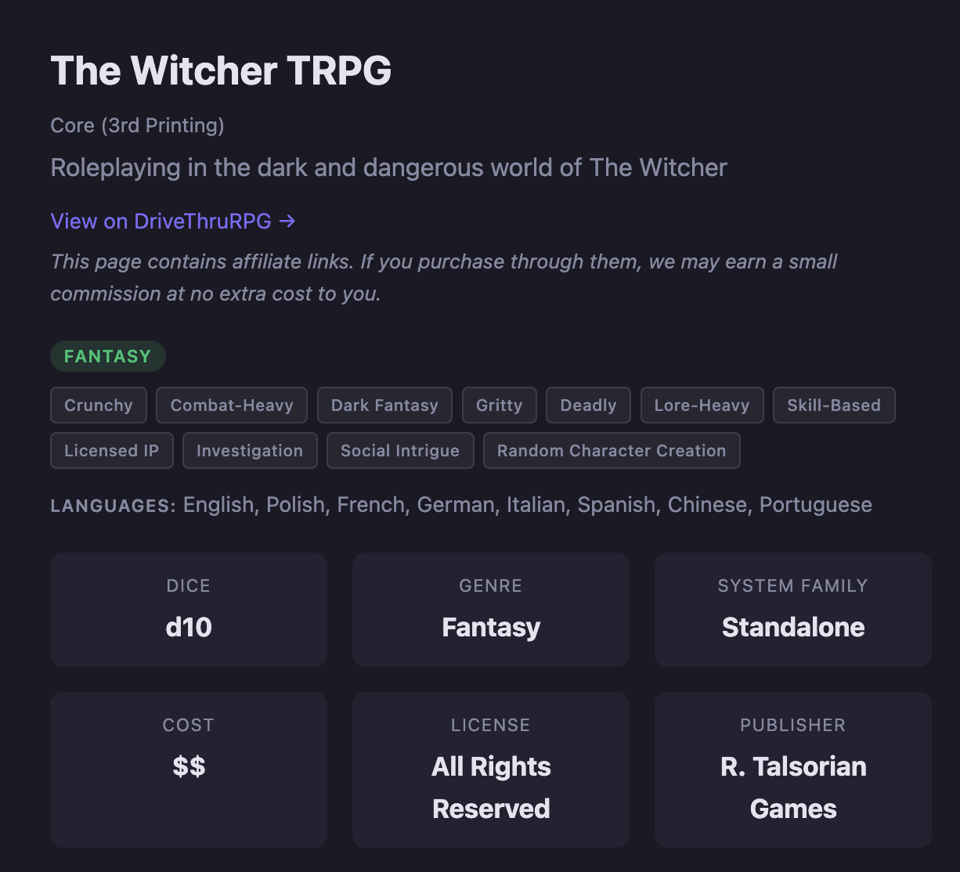
I noticed when I was reviewing the website metrics that almost half of the audience was international (shout out to my Poland visitors for claiming the top international spot) I began to think of ways that we could better serve our non-english speaking visitors, as despite english being the lingua franca of TTRPGs it is always easier to get new players invested in a system written in their native tongue.
With that in mind, I went to work on creating a way to track the published translations for each system. First I had to add the field for languages and decide where to put it (currently it is below the playstyle tags). Then I had to go about finding the data. I am trying to focus on officially published translations if at all possible as while I understand there are fan translations out there, trying to judge the ‘completeness’ of something not official in a language I don’t understand would be an impossible task.
Languages have been added across the full catalog, and you can use the drop down filters to sort by the languages you speak. If you spot a missing translation for a system you know well, drop a note in the /ttrpgwiki correction thread or use the form on the site.
Indie System of the Week: Aurora The Roleplaying Game
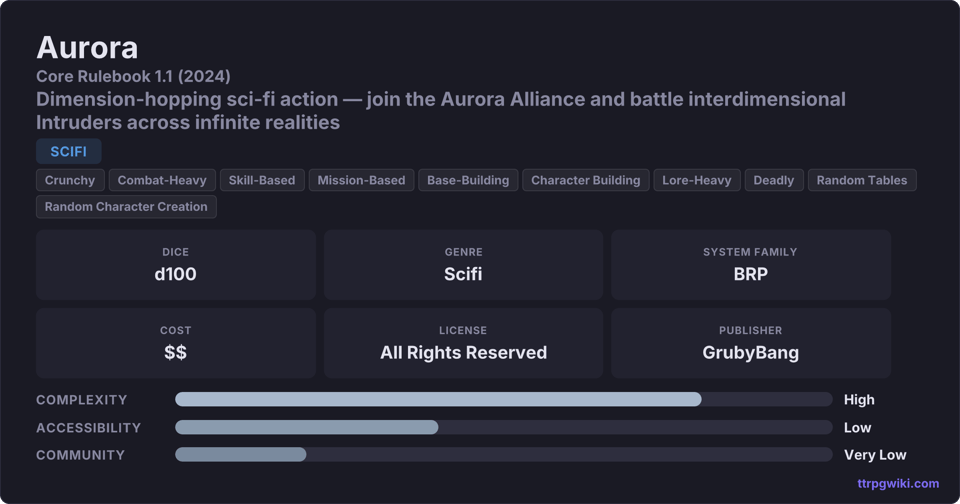
Aurora is a Polish Indie game, designed by Mateusz Filipiak. Given the point above that Poland has been one of the site's strongest international visitors since launch, it felt fitting to put this one in the spotlight.
I have always been fascinated by d100 systems, even though I have had yet to run one. The concept of the players knowing exactly what their chance of success is seems to be a no brainer in promoting player agency and confident decision making. You don’t need to do any complicated math or try to guess odds from non-standard dice (looking at you Genesys); the character sheet clearly lays out that if you want to jump across that pit of lava you’ve got a 63% chance of making it.
Aurora is a d100 system built on Chaosium's Basic Roleplaying engine, and pushes it into a sci-fi dimension-hopping setting set in 2157. You play Operators, members of an elite organization called the Aurora Alliance. Standard play includes traveling across dimensions to fight the Intruders: mysterious entities destabilizing realities.
The character creation system is notably deep, with 20 specializations and a two-tier power structure. All characters have access to Superpowers, a broad pool of abilities including elemental control and teleportation. Characters who invest in the Aurora Effect skill unlock a second, more advanced layer of powers that function more like the magic systems you'd find in fantasy games. It's a real build decision.
The rulebook is honest about being a small two-person indie release. It has AI-generated art and occasional language translation issues. If that kind of rough-around-the-edges indie energy and crunch is something your table gravitates toward, Aurora is worth a look.
You can check out Aurora on the wiki here!

Add a comment: