Spider-Verse Too: Two Much Spider-Verse
Spider-Verse Too: Two Much Spider-Verse
 No one is more disappointed to be writing this review than me.
I loved the 2018 film Spider-Man: Into the Spider-Verse. Loved it. That movie was a breath of fresh air in an increasingly stale cinematic superhero landscape- artistically and stylistically bold, pushing the boundaries of what was possible with computer animation by blending 3D with traditional hand-drawn techniques and comic book conventions, while telling a simple, straightforward but emotionally rich and refreshingly earnest coming of age story. It poked at the narrative tropes of the Spider-Man mythos while introducing new wrinkles and creating a new path forward for the character, one in which anything was possible, where Spider-Man could go places and do things that we had never seen before. It made Miles Morales, a terrific character that hadn’t yet broken into the public consciousness, a household name. It’s one of my favorite films of the last decade, and I could not have been more excited for the eventual sequel.
Which is why it pains me to say that this thing is a giant fucking mess that doesn’t hold a candle to the first one.
And I realize that I’m gonna be in the minority on this one. How could I not be? The movie makes a pretty strong case for itself on the big screen. Make no mistake, visually, this is every bit the first movie’s equal, even occasionally surpassing it in terms of sheer inventiveness. From the flowing pastel painted look of Gwen Stacy’s world to the erratic, crumpled comix zine newsprint of Spider-Punk to the Jackson Pollock nightmare of The Spot, the movie is constantly throwing out new ideas, new avenues of expressionistic visual storytelling. And it’s so exhilarating to watch, such a breathtaking work to behold, that anyone (even myself) is going to get swept up in it on a first watch.
But underneath that visual inventiveness, we have a script that plays into just about everything I’ve come to hate about both modern superhero storytelling and modern blockbuster cinema, dressed up in a more respectable and prestigious and “self-aware” manner, but nevertheless as derivative and insular and recursive as these things come, with a woefully poor narrative structure more concerned with encouraging repeat business than giving moviegoers a cohesive, satisfying, emotionally fulfilling work in the here and now.
I’m gonna have to get into spoilers here, because I want to just get to the major problems, but I’ll take a moment here to say that there are a few things that worked for me. I think the major beats of Gwen’s arc that bookend the film are great. I don’t know that the film totally earns the resolution there, but it’s the one thing in the entire movie that hits emotionally and it’s the only thing set up at the beginning that actually pays off by the end, so I’ll give it to ‘em. The voice cast across the board are fantastic. Daniel Kaluuya’s Spider-Punk is far and away the best new character. Some of the cameos got me on a first viewing in a very “jangling keys” way (what can I say, I imprinted on this shit at an early age, seeing my blorbos on screen is always gonna fire off the endorphins a little bit). That’s about it.
The most glaring structural problem here is that it is not a complete film. It just isn’t. It’s half a story. People will tell you that it completes its own internal arcs while leaving hooks for the sequel, ala Empire Strikes Back or The Matrix: Reloaded (and trust me, we’ll talk Matrix: Reloaded), and I’m here to tell you that those people are liars. Both of those movies have self-contained structures, that build to a climax in which narrative and character threads crescendo and resolve, and end on a final note that promises more but nevertheless wraps up the story at hand. Luke goes to Dagobah, learns that the world is more complex and morally fraught than he was initially led to believe, goes to challenge Vader anyway and is punished for his hubris, while Han and Leia’s reluctant romance finally blossoms within a moment of tragedy, and the characters are left to ponder their fate, changed by their journey. Neo starts out confident in his place as The One, learns that much of what he was told about the role was a lie, that he is merely a cog in a self-fulfilling prophecy, and, in a pivotal moment, chooses to reject his role in this system in favor of his love for Trinity, and we get to see the power and consequence of that decision in one of the most moving climaxes of any action film. Across has no such climax. It doesn’t even really have a third act. The actual plot doesn’t really begin until the movie’s nearly over, the final setpiece doesn’t resolve anything, and the last thirty minutes are all extended prologue for the next film. There’s a moment where it looks like Miles’ arc is going to pay off, but then the movie pulls a cruel bait and switch and renders that moment meaningless for the sake of cliffhanger setup. This movie is the first two acts of a five hour film, it does not even attempt to tell a complete story, and frankly I don’t think what we do get has the depth to warrant being one of the longest animated films of all time. This thing is not short, and rather than feeling like it’s taking advantage of that extra real estate for narrative effect, it feels like the writers have allowed themselves to bloat this thing beyond all reason, stretching the setup of this threadbare plot past the breaking point, interminable conversation after interminable conversation where the first movie had quick, simple, concise visual storytelling. All the while, despite all the excess, the main villain of the piece (who, you guessed it, is all setup and doesn’t actually do a damn thing in this film, because we’ve gotta keep you on the hook for part 2!) ends up being the most underwritten Marvel movie villain since Gorr the God Butcher. The Spot may be a spectacle to look at, but he’s an insultingly thin character, more mcguffin than man, a character built on a cheap call-back to a gag in the first film that this one inexplicably expects us to take seriously after a collective five minutes of screentime, all the while completely flushing him out of the movie at the hour mark. Could the next movie suddenly imbue him with depth? Sure! But I haven’t seen the next movie, and I won’t see it for another nine months, I’ve just seen this one two hour and twenty minute film that I paid fifteen dollars for in which nothing is done with this character.
But then, of course, one could argue that the real villain of this picture is Miguel O’Hara, Spider-Man 2099 (played impeccably by Oscar Isaac) and his multiversal Spider-Society. And this is where we get into the real meat of this thing, the real point at which the whole thing goes off the rails, the rot at the center of this whole project that swallows up every good idea that exists here.
So the conceit here is that, across the multiverse, there are certain immutable moments- Canon Events, as the movie calls them- that must happen to every Spider-Person in order for their story to continue as planned. If a Canon Event is disrupted or prevented, their entire reality risks collapse. There are logistical holes I could poke in this premise, ones that the movie itself introduces and then doesn’t acknowledge, but really what we’re supposed to cling to here is the meta commentary of it all- that Spider-Man is defined by tragedy, that his story is defined by specific tragedies that occur over and over again across stories, across mediums. The movie is asking us to confront that idea, to question it, to ask ourselves if it is worth sticking to this rigid canon or forging a new path. It’s not a bad idea! It’s certainly a familiar idea, though. Because we just explored this idea two years ago in Spider-Man: No Way Home, another movie where a young, inexperienced Spider-Man is exposed to the multiverse and the archetypes of his own narrative and chooses to reject the path laid out by his predecessors and build a better one. We did this already. Miguel might as well quote Doctor Strange’s “grand calculus of the multiverse” line word for word (we already have the third goddamn scene where someone spouts the same exposition about how the multiverse works while staring at that same goddamn glowing tree branch from the Loki show in as many years, you might as well go all the way). But this movie presents it as if it’s the most novel thing that’s ever been done in a Spider-Man movie, a mind blowing twist on the old story, because this one, rather than leaving the meta narrative as subtext the way No Way Home did, opts to spell it out literally, showing us clips and comic panels and discussing these things in the same terminology fans use on twitter.
See, the conflict here is that one of these canon events is the death of a police captain close to Spider-Man. In Miles’ case, that’s his dad, who’s recently been promoted to Captain. Everyone in the Spider-Society gathers together to stop Miles from saving his dad from certain death, which they all know is coming in a matter of days, in order to preserve the canon, and Miles rejects the premise and chooses to save his father, damn the consequences.
First of all, to get the obvious out of the way, this is The Matrix: Reloaded. It just is. It’s not a riff on Matrix: Reloaded, it’s not an homage to Matrix: Reloaded, it just lifts that movie’s plot and conflict wholesale. The hero confronted with the truth that his role is to be complicit in a monstrous system who rejects that destiny to save a loved one. The villain who was a cog in the machine in the first film who has gained cosmic awareness and seeks to escape his reality and seek revenge on the protagonist (which is left as a cliffhanger instead of getting wrapped up). The hero paying for his choice by being trapped in another world, with the supporting cast setting out to rescue him while gearing up for an all-out war. This is a beat-for-beat copy of the Wachowskis’ film with a peppering of the thematic elements of No Way Home.
But hey, the meta commentary could be interesting, right? The idea that someone doesn’t have to face some formative tragedy to become Spider-Man, that they can break away from that old, worn out narrative?
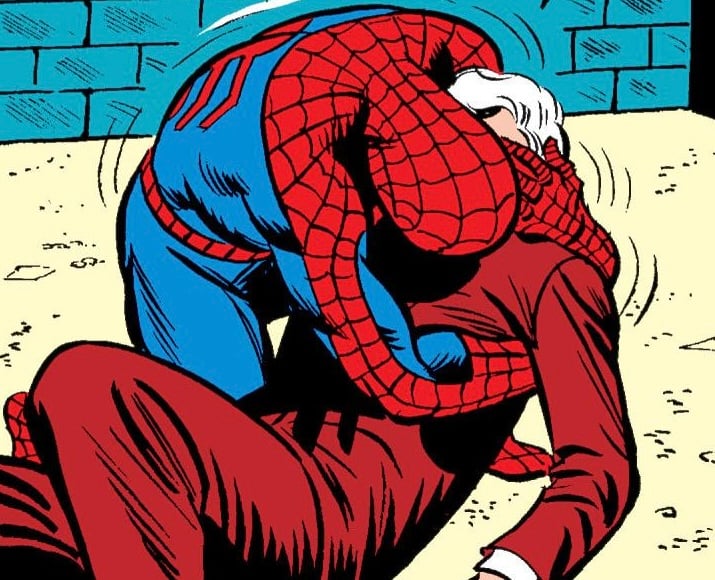
Well sure, that would have been a great way to go if they hadn’t already given Miles that formative tragedy twice over in the first film. He has two Uncle Ben moments in that first film- once when the Peter of his earth dies, and Miles is left with the knowledge that he died protecting him, that if he hadn’t been bit and gotten himself into danger, Spider-Man would still be alive, and again at the top of the third act when his Uncle Aaron dies, choosing to sacrifice himself rather than take his nephew’s life for the Kingpin. That first movie remixes the familiar Spider-Man beats in a way that makes them feel distinct, but make no mistake, it hit those beats all the same. That ship has already sailed. Asking “why must a Spider-Man story be this way?” rings pretty damn false when you, yourself, already told a Spider-Man story that way last time. And so instead, this movie has to hinge this whole premise on the Death of Captain Stacy from Amazing Spider-Man #90, an (admittedly iconic) comic book story published in 1970 that this movie presents as a universal constant among Spider-Men, one of the single most defining moments in the entire cross-media canon, such that all the tragedy and loss Miles faced in the first movie is moot if he does not go through this one, singular event so core to the character’s mythology that, among all of the cinematic, animated, and interactive adaptations of the property, it has happened a grand total of one time (two if we’re stretching). They have a scene where Josh Keaton’s Spider-Man from the Spectacular Spider-Man cartoon reiterates the importance of this event to Miles, and it never even happened in that show! They have to retroactively say it did! “Of course this was a pivotal, formative event for me, it was just over there, happening off screen.” And this is where it all falls apart for me, because everything, everything in this movie revolves around you finding this observation Extremely Clever, thinking the way it pokes at this oddly specific deep cut to be Very Insightful. All characterization, all plotting, everything that this movie builds to (which, as I’ve said, is ultimately not much) is subservient to the idea that they’ve hit on some fundamental truth about Our Understanding of Spider-Man, and I’m sorry, my reaction to this is just the world’s biggest jerk-off motion. We have to build an in-universe conflict around this metafictional premise, so we’re going to set up that every Spider-Man you’ve ever known except for Miles (including Peter B. Parker, another character from the first film who’s drastically underserved here) is totally cool with being a brightly-colored jackbooted enforcer for Miguel O’Hara’s agenda of algorithmically driven mass death (we can imagine infinite possible worlds in these multiverse stories, but apparently one where the borders of reality aren’t governed by some kind of fascist regime is beyond the imagination). Does that square with anyone’s understanding of Peter Parker? It doesn’t square with mine, but if we don’t rig it that way then we can’t have the Very Clever commentary, so into the meat grinder he goes. And I hate making this argument, because the idea that these characters and their personalities are set in stone is so often weaponized by the worst kind of reactionaries, clinging to their toxic nostalgia for what they imagine these stories have to be (which this movie, in its way, is trying to comment on). But this movie’s take on this conflict feels so phony to me, so contrived, because it requires you to ignore both what you instinctively know about Spider-Man as a character and the actual content of the first movie for a conflict that makes no emotional sense and only barely makes sense on a meta level. For a story that wants to flex its knowledge of the multimedia Spider-Canon (there are some truly embarrassing cameos in this, real groan worthy second act of Multiverse of Madness stuff), it asks for an enormous amount of cognitive dissonance from anyone familiar with this stuff to make its plot work.
Most egregiously, though, I think it fails Miles Morales. The most exciting thing about the ending of the original film, to me, was the promise that we were going to see Miles come into his own, forge his own identity. We were going to see what a Spider-Man story untethered from everything that came before could feel like. And instead, we once again have a story in which Miles is defined entirely in relation to Peter, and Peter’s history. The comics had this problem for a long time, but even they’ve moved past this by now- Saladin Ahmed’s run might have lost its stride by the end, but for a couple of years there, he was building out a totally new supporting cast and rogue’s gallery for Miles that didn’t rely on what had been done before with Peter. Cody Ziglar just wrapped up a pretty great five-issue arc exploring and recontextualizing Miles’ origin while creating yet another new villain for him, all without ever referring to Peter at all. That’s what I hoped for from a sequel to Into the Spider-Verse. I’m done with stories about Miles becoming Spider-Man, I’m ready for stories about him being Spider-Man. Which is why it’s immensely disappointing to me that, with one of the most talented and innovative animation teams in the industry at their disposal, instead of forging a new narrative identity for Miles, instead of telling a Spider-Man story that no one has ever seen before, we have yet another story in which Miles is merely a lens through which to view and analyze Peter, and even worse, one that sets in stone that this entire trilogy is going to be about Miles in relation to Peter. And even then, disappointing as that pitch is, the salt in the wound is that it doesn’t even have anything particularly novel to say about Peter. It’s a retread of a 2021 film that was itself a retread of the original Spider-Verse film that “borrows” plot elements liberally from an unrelated 2003 film and whose primary thematic concern is litigating the narrative importance (or lack thereof) of a single comic book issue published in 1970. This is beyond the snake eating its own tail. The snake has fully imploded at this point, taking any of the simple, relatable charm of the first film with it. Sitting with this movie after watching it, letting the surface pleasures of the, once again, unbelievable filmmaking wash away, the joy of seeing the work of these incredible artists on screen fading into memory, what I’m left with feels like a crossing of the rubicon, a breaking point where we have imbued these simple pulp stories for children with so much more cultural weight than they were designed to bear that the line has finally snapped, that the whole goddamn thing is plunging into the abyss and that, maybe, there’s no pulling it back out.
Do I think the next movie will be better? Well, it would almost have to be, just by virtue of actually having an ending. But even if it’s better, even if it somehow wraps this all up in a way that’s fulfilling and satisfying based on what was set up here, I just can’t help but be disappointed that this is the throughline they landed on for this trilogy, that this is what these movies ended up being. Clearly it’s resonating for people, so maybe there’s something I’m missing here. Or maybe I’m just finally, truly getting too old for this shit.