I Read All of One Piece, and You Should Too
I Read All of One Piece, and You Should Too
Folks, I have been One Piece-pilled.
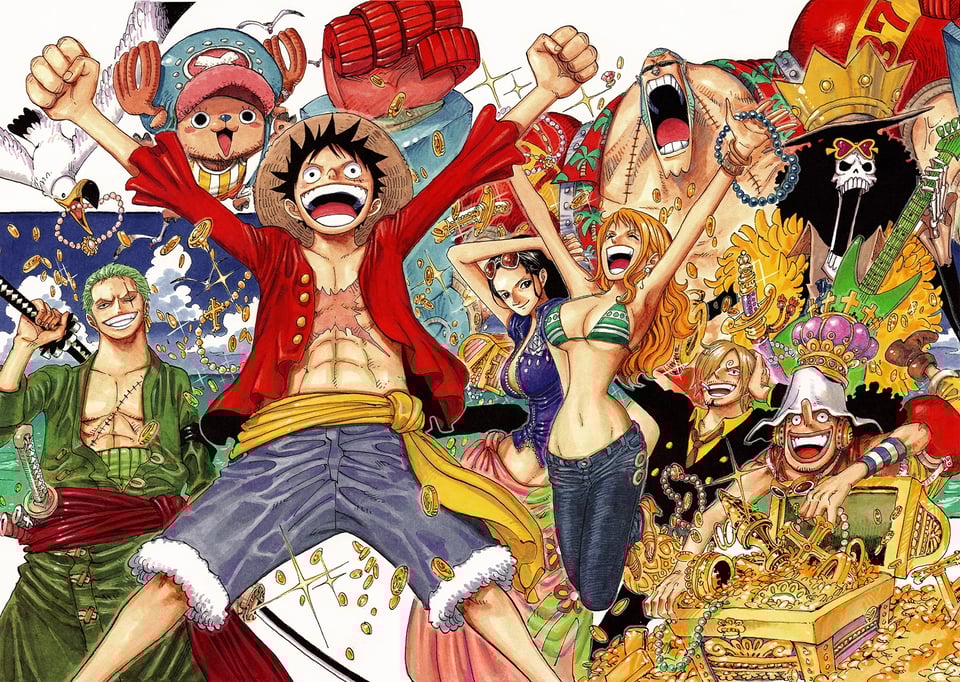
I've been a casual fan of One Piece for years- I was a Shonen Jump subscriber as a kid, and while Naruto was my series of choice at the time, I devoured everything in that magazine, which meant I was always at least aware of the broad strokes of what was going on in Eiichiro Oda's sprawling shonen saga. Around 2010, when the series left the magazine for a few months and Viz pumped out five volumes a month to get US readers caught up with where the series was in Japan (we had just wrapped the Alabasta arc, ending in volume 23, while the Japanese serialization was well into the Marineford arc which runs from volumes 57-60), I kept up with those interim volumes through my local library, which thankfully was always on the ball when it came to purchasing new comics. Which is all to say that, while I had a fondness for the series, at the time it struck me (an edgy 13 year old) as the more fun, goofy alternative to the Real, Hardcore shit happening in Naruto. As I grew older, and moved away from keeping up with the goings on in Jump, I fell off of One Piece (the last arc I read in full, during its English serialization, was Punk Hazard, back in 2013-2014). But a combination of renewed interest from the announcement of the live action series on Netflix, and the... gentle nudging of several irl friends who have been deep in the One Piece fandom for years (think Jehovah's Witnesses, but more persistent), I decided last year to finally take the plunge and read/reread the whole thing, from the beginning, and get caught back up to the current chapters.
And now that I've done it, I have seen the light. I don't care that it's a comic aimed at 12 year olds, a shonen battle manga in the Dragon Ball vein, I am here to tell you folks that One Piece is one of the great comics of the 21st century, hell, one of the great works of literature of the 21st century. If you love comics, if you love adventure stories, if you love sick ass fights and big emotional speeches and exotic locales, if you like seeing fascist tyrants get decked in the face, you owe it to yourself to go on this journey. I promise you, the 1095 chapters (at the time of this writing) will fly by.
This is probably not the first sales pitch most of you are seeing for One Piece, so I'll spare you some of the most common refrains- yes, the worldbuilding is dense and intricate and infinitely rewarding, yes, Oda's skill at foreshadowing and use of continuity is second to none, yes, the fights are big and explosive and hype the way you want them to be in a series like this. But to me, the real magic of this series is the sheer heart that it has, a deeply sincere belief in its absurd world and its ridiculous characters, to such a degree that it's near impossible to not get swept up in it. Protagonist Monkey D. Luffy's unshakeable enthusiasm and determination are positively infectious, and just as each member of the Straw Hat crew is gradually won over and recruited to his cause, so too is the reader.
But that sincerity is also Oda's greatest weapon. One Piece's colorful, cartoonish exterior belies a deeply moving, and overtly political, story of friendship and solidarity in the face of overwhelming systematic oppression and tyranny. One Piece's world may be full of fantastical locales and eccentric weirdos, it's also teeming with a very real darkness- war, class divisions, racism, colonial violence, genocide. And the story doesn't just pay lip service to these themes- heroes and villains alike are given extensive backstories that show the lived reality of all these things. The magic trick Oda pulls here is making these themes integral to the story without subverting the typical shonen tropes- a happy-go-lucky hothead protagonist, the overwhelming power of friendship and dreams- but rather, using the political dimension to heighten the tropes, to give them a newfound weight and meaning and emotional resonance. Luffy, much like Son Goku before him, doesn't see himself as a hero- he loves adventure, he loves a good fight, and he'll do anything to protect his friends. But he, and by extension, the series itself, believes so strongly in a very universal idea of freedom- freedom to pursue one's dreams, freedom to be or become the person you want to be, without fear of persecution- that he simply can't help but stumble into situations in which he takes on the role of anti-fascist liberator. He'll do anything to protect his friends, and he'll become friends with anyone who offers him a good meal, and if the thing he needs to do to protect his newfound friend is topple an entire authoritarian regime, then by golly he's gonna do what he's gotta do, and he won't think twice about it. It's a tonal balance that shouldn't work- the simple idealism of the shonen protagonist confronting the real life ideologies that drive people to commit unspeakable evil- and yet, it never feels glib about the sensitive topics it's touching on, never cheapens these conflicts. When Luffy does come to blows with the series' absolutely stellar murderer's row of antagonists, the fisticuffs are imbued with real meaning. You can feel the clash of ideologies in every punch, and it hits like no other battle manga can.
And even aside from all of that, it just nails the basics that you want out of this genre. It's incredibly imaginative- every island the Straw Hats visit feels like a fully-realized place, all with a distinct visual identity and culture and sense of geography. The characters, main cast and hundreds of side characters alike, all have strong personalities and designs and interesting quirks and flaws and relationships with each other. The art, while definitely an acquired taste at first, is charming and expressive, and you can see Oda grow in real time throughout the series to become an incredibly confident and accomplished visual storyteller. It's heartwarming, it's heartbreaking, it's hilarious, it will have you pumping your fist and screaming "LET'S FUCKING GOOOO" at two in the morning. It is, quite simply, everything you could want in an adventure story, all in One Piece.
And there's no signs of it slowing down! It's still going as strong as ever! There has never been a better time to get in! Go to the website right now and start reading!
...ok, are the uninitiated gone?
Good. From here on, these are just gonna be some random spoiler thoughts. Brief arc overviews, observations, etc. Ignore this section until you've read all of One Piece.
-I said on Twitter that I think the live action One Piece is basically "what if the East Blue arcs were as good as the rest of One Piece", and I stand by that statement- with the exception of Arlong Park, which I like in the live action version, but still remains the point where the manga first levels up from good to great, and I don't think there's a proportional bump in quality in OPLA (for the record, my favorite arc of the live action is Baratie, which is wild because I consider that a relatively middling arc in the manga outside of the Zoro/Mihawk fight, which the writers and showrunners of OPLA wisely turned into the centerpiece of the entire arc)
- The moment in Alabasta where Luffy gets stabbed is still such a fantastic "oh shit" moment, and it happens at just the right time in the series. Mihawk was the first indication of just how much more dangerous the Grand Line was going to be than the East Blue, but you need that humbling moment for your protagonist, and it's done so well here.
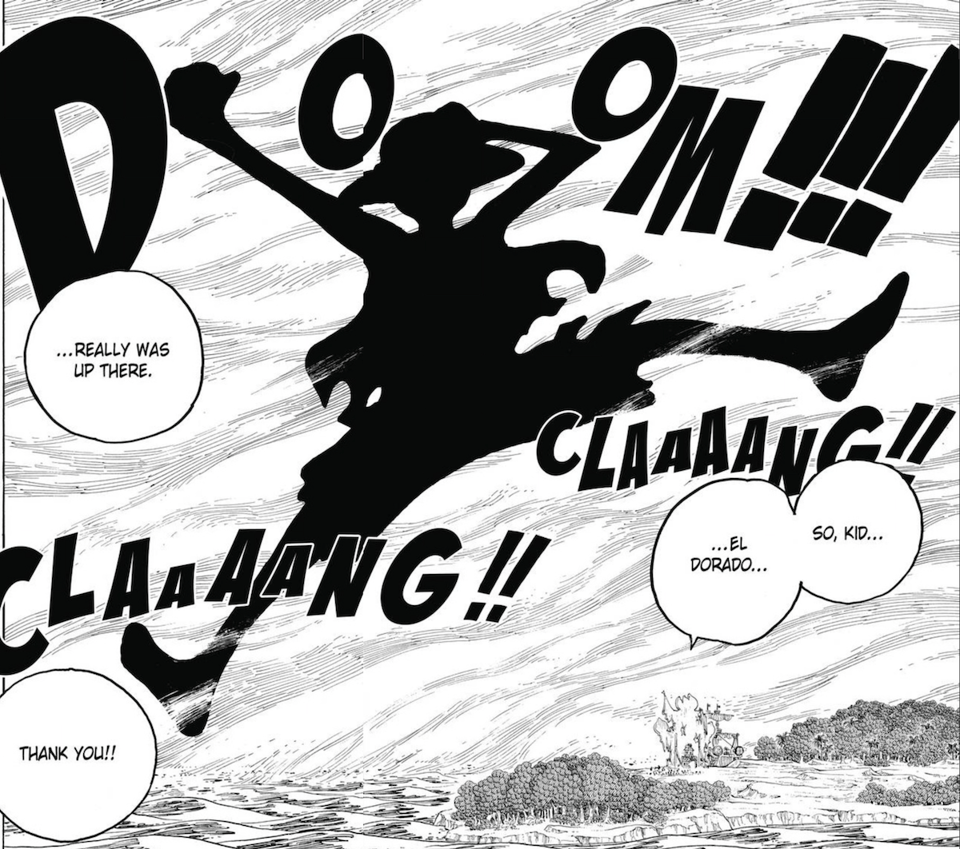
- It is patently insane that people used to tell you to skip Skypiea. aside from the obvious- it lays massive thematic groundwork for the Nika reveal, it furthers the Ancient Weapons/Poneglyphs plot, it planted seeds with Eneru that still haven't blossomed yet, but are absolutely in play- it's just a banger of an arc. The story of the war between the Shandians and Skypieans is one of the most effective and weighty flashbacks in the series (and, while unintentionally, is suddenly extremely relevant in 2023), Eneru is a great antagonist, the reveal that Luffy's powers render him immune to Eneru's attacks is one of Oda's most brilliant comedic beats, and come on, this moment is just undeniable.
-Oda's been on an uninterrupted ten-ish year hot streak since the beginning of Dressrosa, but man- how fucking good is Water Seven? Still the pinnacle of the series, still one of the best stories ever told in a shonen manga, even if the series had been immediately cancelled after this arc Oda could still hold his head high as one of the best to ever do it.
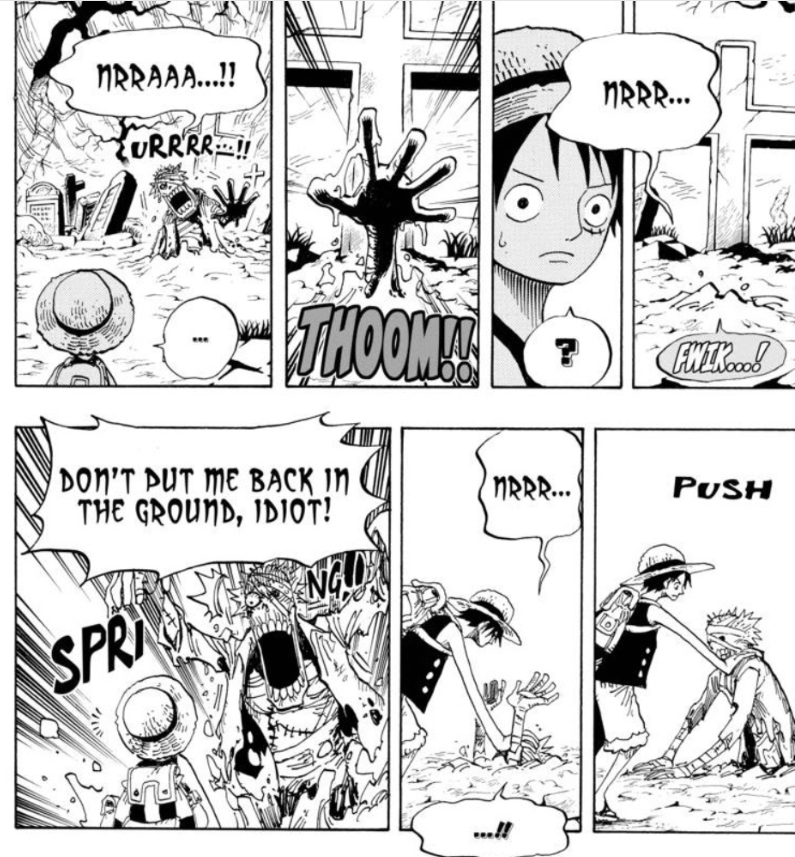
-Thriller Bark's a relative comedown from Water Seven, there's stuff in there I actively dislike (Absalom can die in a hole), but Brook is great, and I actually really like the ideological confrontation between Chopper and Doctor Hogback. Chopper's such a Cute Mascot character that it's easy to forget just how seriously he takes his role as ship doctor, so it was nice to see him really lay into someone for performing unethical medical research. Also this is one of my favorite gags
-Sabaody gives us our first glimpse of the Celestial Dragons, and man, has there ever been a more hateable group of villains? Insane sicko shit that halfway through his big shonen fight manga epic, Oda introduces the true evil at the heart of the world, and it's just dumbass racist old money shitheads.
-I wrote a brief thread on twitter about the idea of friendship and solidarity in One Piece (kind of workshopping ideas for this piece), and one of the big examples is Bon Clay in Impel Down. It's set up much earlier in the series, but I love that, despite having met as enemies, Luffy and Bon Clay just genuinely like each other and see each other as friends, with zero resentment for the role Bon Clay had to play in Baroque Works, to the point that he's willing to give his life to help Luffy save Ace. It's touching stuff from a character that could have just been a one-note joke.
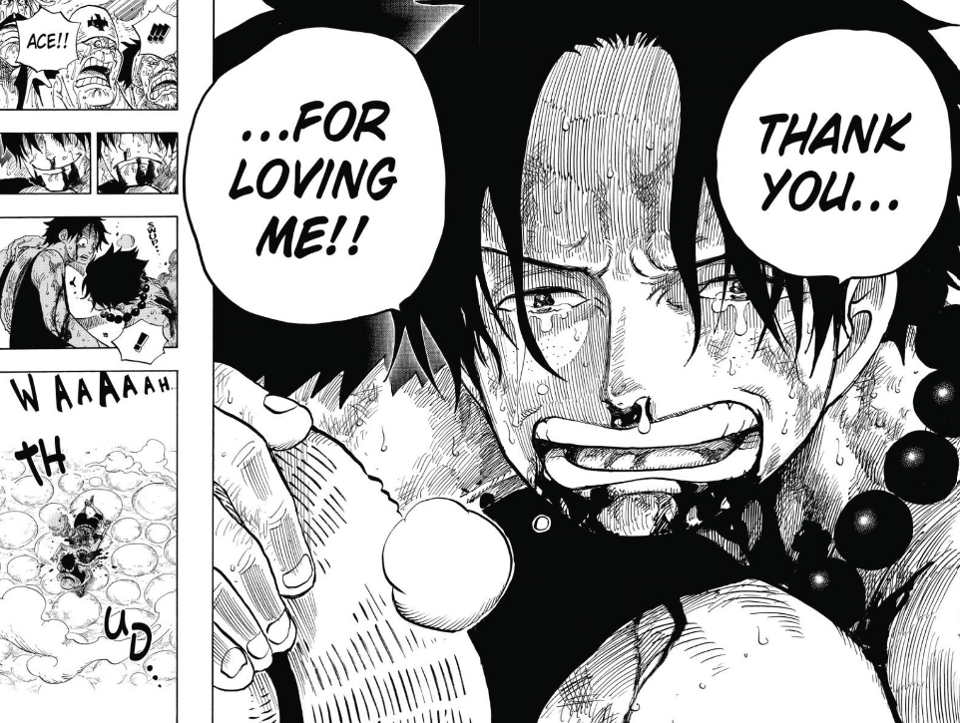
-And to continue that theme, structuring two whole arcs around Luffy rescuing his brother, only to end in abject failure- Ace AND his adoptive father, Whitebeard, dead- could have, in lesser hands, felt entirely unfulfilling, but on a reread the stakes are never whether or not Luffy will succeed in saving Ace, which, at his current level, was simply never possible, but whether or not he could give him that one final moment of genuine love, that despite all the hatred and derision flung his way for his entire short life for reasons outside of his control, his life had meaning, that he mattered, that he had people who accepted and cared about him. His death is as tragic as it was inevitable, but it still sends him out on a note of bittersweet peace and dignity. It's a beautiful and emotionally complex moment.
- Don't tell the newbies, but Queen Otohime/Fisher Tiger flashback aside, Fishman Island really is as much of a dud as everyone says it is. Hody Jones is easily the weakest main antagonist of any arc across the entire series (I'm not even a big Don Krieg or Kuro defender, but I'll take em over this guy), Vander Decken suuuuuuuuucks, none of the Straw Hats really get a big moment that feels impactful, which you would think would be the whole point of a post-timeskip arc in which they fight considerably weaker bad guys than the folks who came before, and good god did they massacre my boy Sanji. It's a necessary hurdle to get to the really good shit, but a hurdle nonetheless
-Punk Hazard is pretty good as a transition arc, but I have to shout out Caesar Clown, a villain who, in a series full of antagonists with complex relationships to power and nuanced motivations for their crimes, is just a true-blue scumbag weasel without a single redeeming quality. hilarious character.
-Dressrosa is the kick-off to what continues to be an unbelievable stretch of consistent quality. This became my second favorite arc in the entire series as I was reading it. It eventually was unseated by Wano, but Wano is right there with Water Seven as one of Oda's greatest achievements as a storyteller, so that's nothing to sneeze at. Doflamingo is probably my favorite villain in the entire series, a terrifying cocktail of childhood trauma and insane privilege turning him into a genuine monster the likes of which we had only briefly glimpsed with the Celestial Dragons up to this point.
-Whole Cake Island can feel like a lesser arc while reading it just because it's sandwiched in between two all-time greats, but make no mistake, it's entirely relative- this arc, too, is a banger. after a weak showing in Fishman Island, this arc returns Sanji to his rightful place as one of the best Straw Hats, actually convincingly delving deeper into his psychology, why he's been Like That this whole time, and giving him the opportunity to confront the source of the trauma that shaped him. Luffy's fight with Katakuri, which on first glance seems a little disconnected from that focus on Sanji, is actually deceptively thematically coherent. Both Sanji and Katakuri were, from a young age, made to be something they're not due to pressures from their family- Sanji was bred to be a weapon for the Vinsmoke family, and, when he couldn't measure up to his siblings, was subjected to horrific abuse, while Katakuri, an easy-going, donut-loving kid with a messed up face, willingly took on the Brooding Anime Tough Guy persona to protect his siblings, literally hiding his true self behind a mask. In both cases, in different ways, Luffy frees them from those pressures, allows them to throw away the masks.
-What can I even say about Wano? It's the most structurally ambitious arc Oda's ever attempted. It's a massive saga in and of itself. It's the point where the themes that Oda's been building up over the course of the series finally explode into the forefront, with Luffy literally becoming the Warrior of Liberation, an ancient dream of freedom made manifest. If I can zero in on any one thing, I like to think of this as kind of a mirror arc to Dressrosa. In that arc, the people of Dressrosa have been living in an uneasy peace, the subjugation of the kingdom's lower classes taking the form of literal invisible and forgotten people, allowing those in relative positions of privilege to live in ignorance. The arc's climax forces the people of Dressrosa to confront the realities of their kingdom and band together to give Luffy the time he needs to defeat Doflamingo. It's the people setting aside their ignorance and taking an active role in their own liberation. Meanwhile, the people of Wano are acutely aware of the oppression of their day-to-day existence. The cruelty of Orochi and Kaido is inescapable, down to the smallest child. And so the climax of the arc, in which Luffy has to defeat Kaido and prevent him from dropping Onigashima on top of the people of Wano and killing them all in the midst of their yearly Fire Festival, in which the entire country mourns their dead. It's the single day of celebration and peace afforded to these people, and Luffy's objective throughout the fight is to not only save them from their oppressors, but to do it without putting them through further suffering, the entire battle happening just over their heads while they are none the wiser, sending lanterns into the sky marked with prayers begging for the very liberation that Luffy is fighting to provide. Frankly I think it's a toss-up between this and the final battle between Luffy and Rob Lucci in Enies Lobby for the best fight in all of One Piece.
- Egghead is still in progress, but the revelation (at least for now it's a revelation, it's presented as a theory but I think it's where Oda's going) that the Devil Fruits are, in fact, the dreams of humanity given form simultaneously flips the entire series on its' head, and also immensely deepens what was already there. Also, with the Kuma flashback that's currently ongoing, I feel like we're starting to see some pretty clear-cut connections between various hints we've gotten up to this point about the events and major players of the Void Century- if the Buccaneer people, which the world government is intent on wiping out, are all of a similar size to Kuma, then it stands to reason that the giant Straw Hat in Imu's freezer likely belonged to a Buccaneer, which, given the evidence, was most likely Joyboy. It's surreal to finally be closer than ever to the answers to some of these longstanding mysteries. That said, if Oda decided he wanted to stretch this out for another ten years, I'd be right there along for the ride.