Tkhines Songwriting Cohort (and a vort about the news)
Tayere ale,
If you are a Yiddish speaker and songwriter, the Yiddish Tkhines Songwriting cohort application is open, and due on February 5th! {please apply through this link}
Before sharing more about the songwriting cohort, I want to briefly talk about what is going on across occupied Turtle Island/ the US. Just within this fresh new year, I.C.E has murdered nine human beings (that we are aware of) both in detention centers and in the streets. They are wreaking havoc all across the US, in Minneapolis most visibly. Families are being torn apart, and people of all ages are being stolen away into detention centers that lack basic necessities, and are being medically neglected.
People who have lived here for decades and built entire lives in the US are being deported.
Two days ago, we marked the 81st international holocaust remembrance day, the day auschwitz was liberated. My grandfather z’l, who was a survivor of auschwitz, passed away a few days before our current president first entered office 9 years ago. At the time, we felt that he chose to leave this world before having to experience another explicitly fascist leader rise to power.
Over the past few weeks, people have been connecting the surge of kidnappings and the visibility of what ICE and this administration is doing to what happened during der khurbn (the holocaust). In response, some conservative politicians and organizations like the US holocaust museum are claiming that “there is no comparison”. That the oppression of Jews in the khurbn was somehow “unique”, and that we shouldn’t be conflating today’s fascist usa to that of nazi germany. I find this exceptionalism to be extremely dangerous and not truthful to how oppression works.
If you look at history, fascists tend to borrow ideas from other fascists, and repeat cycles of exploitation and oppression. Many years ago, an Indigenous elder (that wishes to remain anonymous) who had survived the siege at the second wounded knee of 1973 requested to meet my grandfather. When they met, they each shared and listened to each others’ stories of survival. My grandfather, who had dementia, asked, “wait, which camp were you at again?” I reminded him that this man wasn’t Jewish, and what he was sharing about happened here in the US. He responded, “Here? In America? Unbelievable.” At some point, the Indigenous elder shared that the nazis were inspired by jim crow laws— they studied and borrowed some of the racist american policies used against Indigenous and Black communities in the US. Colonists rounded Indigenous people up into boarding schools and reservations, shaved their heads knowing that long hair was spiritually significant, and gave them numbers to replace their names before the nazis used the same dehumanizing tactics on Jews, Roma, and other marginalized people. When he left, my grandfather turned to me and said, “for me, it ended after a few horrible years. For him and his people, it never ended.”
I’ll never forget my grandpa’s words.
Our oppressions are deeply entwined and interconnected, which means that our liberation is also interconnected and entwined like a deep strong root system.
B’H we learn from the resilient and organized people of Minneapolis, we learn from our elders and ancestors (chosen and bio) that showing up for our neighbors, ourselves, and each other is the only way to survive. That forming hyper-local mutual aid networks, building trust, sharing skills and resources, zogn tkhines—praying with our full hearts, and disrupting business as usual is resistance.
Please donate to whatever local groups exist in your area, as well as Powderhorn Families in Crisis in Minneapolis, MN. And FYI tomorrow, January 30th is a an anti-ICE general strike!
Ok, now on to this year’s Yiddish Tkhines Songwriting Cohort. Do you want to create new tkhines songs from scratch, or find words or sentences from old yiddish tkhines books and turn them into antifascist prayers (or whatever you want)?
Calling songwriters of all levels and lower-intermediate to advanced students of Yiddish to apply for The Spring Yiddish Tkhines Songwriting Cohort! Applications are due on Thursday February 5, 2026
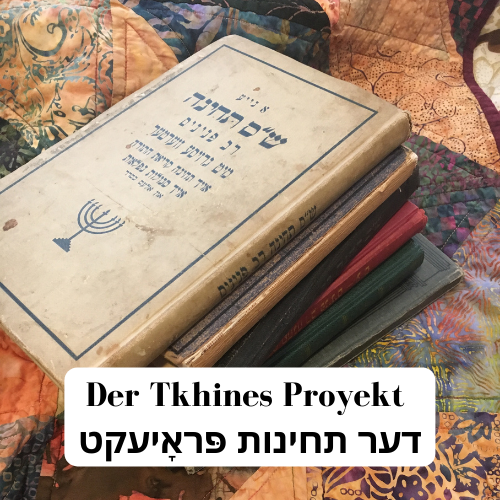
Yiddish Tkhines are Ashkenazi supplications that were/are regularly written and prayed by, and centered the experiences of women, trans, and gender non-conforming people. Der Tkhines Proyekt offers resources and interactive workshops which teach new melodies paired with old Yiddish tkhines, and uplifts the tradition of zogn tkhines, of speaking and writing spontaneous prayers as practiced by generations of Jewish grandmothers and trAncestors.
When: Wednesday evenings, 5-6:30pm ET on zoom. (You can pick other dates and times to meet with your khevruse) The Cohort begins on Wednesday, February 11 -- March 25th.
Who:
+ People of all ages who move with mentshlekh and anti-oppression values
+ People who can engage with the Yiddish language at an intermediate to advanced level. (We will be reading original, mostly untranslated yiddish tkhines)
+ People who have any amount of songwriting experience creating new melodies or lyrics.
+ Two people can apply together as a khevruse/team if one has Yiddish language skills, and the other is interested in creating new Yiddish songs, yet is not at an intermediate Yiddish level. (Please indicate that you are applying together!)
What we will do together:
+ Dive into untranslated Yiddish Tkhines in order to glean teachings and potential songs
+ Learn about what tkhines are, the textures of tkhines and unaccompanied Yiddish song, vocal ornamentations, and how to apply techniques to your songwriting
+ Work in khevruse (pair study) with other cohort members
+ Create and record at least 2 new tkhines songs, and include them on the tkhines soundcloud https://soundcloud.com/tkhines
+ Perform and share your songs with the public for a live zoom concert around peysekh/passover time, which will also serve as a fundraiser for both Der Tkhines Proyekt and Rad Yiddish
Time commitment:
+1.5 hours per week to meet as a full cohort to learn about tkhines, songwriting, and group translation of yiddish tkhines
+ Around 1 hour per week of self-directed time with your khevruse (study partner)
+ You will be encouraged to attend specific outside learning opportunities related to Yiddish singing
+ As much solo time as you need to create new melodies and songs
Location: Our sessions will be online via zoom. If your khevruse (study partner) is local, you are welcome to meet in person.
Cost: Sliding scale $150—$375. Please email and be in touch if this cost is not financially accessible. (notaflof)
This will be a learning space welcome to all applicants, especially ones who are on the margins. This includes but is not limited to: people who are BIPOC, Sephardi, Mizrahi, Ashkenazi, trans, queer, gender-expansive, single, women, disabled, immunocompromised, neurodivergent, fat, poor, working class, converts to Judaism, Jewish, non-Jewish, anti-imperialist/anti-zionist, and people who have politically leftist leanings, etc.
The application process will strive to challenge dynamics of nepotism and in-group favoritism. If you are newer to the yiddish/klezmer/songwriting/Ashkenazi cultural scenes: barukh haboh (welcome) and we are glad to have you!
Please email zogtkhines@gmail.com with any questions about the spring cohort, and check out www.spontaneousprayer.com for more general info about Der Tkhines Proyekt Applications are due on Thursday, February 5, 2026.
Apply to the Yiddish Tkhines Songwriting cohort here!
Thank you for reading this newsletter!
a sakh brukhes/blessings,
Noam on behalf of der tkhines proyekt
Please consider donating to sustain this project and future offerings!