
DEVLOG 3 - Designing an Environment
Hi hi!
We’re back! I’m teaisfortoby, the developer of the mystery puzzle game PATIENCE IS A VIRTUE. I’ve been quite busy recently, so let’s get to it!
WALLPAPER
It’s not October just yet, but this month’s free wallpaper is a little spooky…

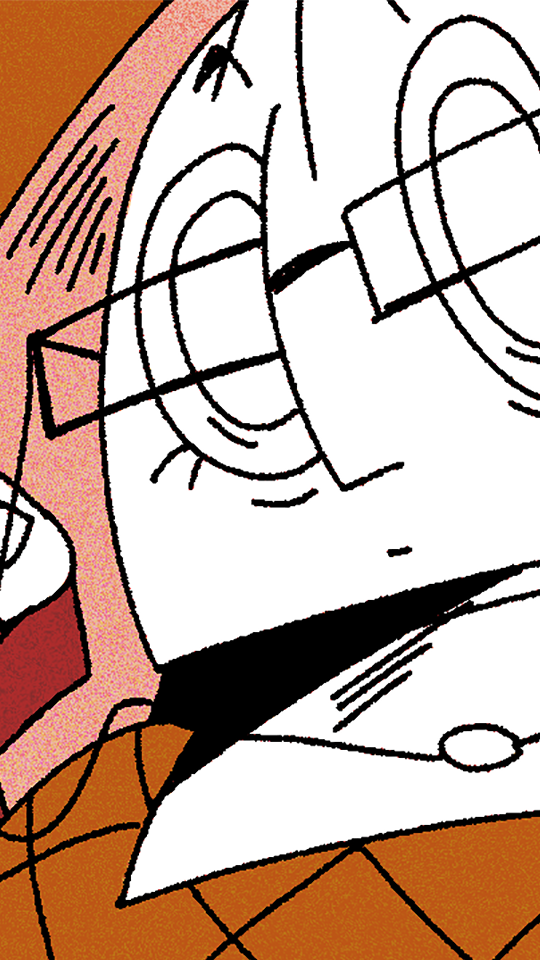
Hope you enjoy! Remember you can check the newsletter archive to grab any wallpapers you might’ve missed. Another one’s coming in September.
NEWS
It’s been a pretty hectic month for me personally, but development is still going strong. Mostly, I’ve been squashing bugs and rigorously testing the full release. All of this is to say: I don’t have anything to announce yet, but I’m still hard at work!
I did send out a postmortem about my other game, A field of broken glass, so check that out if you’re interested.
DESIGNING AN ENVIRONMENT
This month, I’m talking about environment design, something I was Very Afraid Of before making this game. I am a character artist first and foremost, so anything else was quite intimidating for me. I’d like to think I’ve improved since I started development, and I wanted to show off one of my favorite environments in the game. Let’s take a look at the interior of the Wattsburg Historical Society!
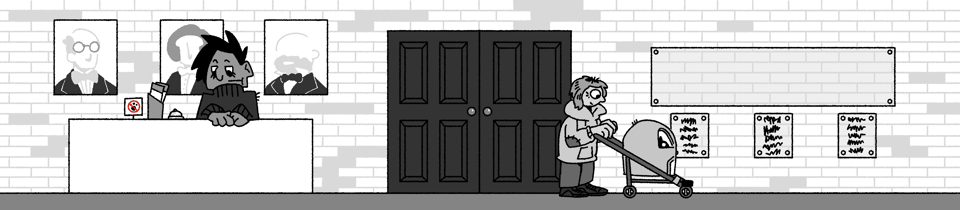
Designing the environments went hand-in-hand with writing the game’s story, especially because the mystery is linked with the local town history. As a result, the Historical Society was one of the last screens I illustrated, so that I had enough time to properly develop the said history. To give a little bit of context, Wattsburg is a northwestern* city riiiight near the edge of the coast. It’s become a popular tourist spot thanks to some pushes by the local government, and they want to flaunt their (quite small) military history as much as they can to attract those tourists. All of this will contribute to the design of the new area!
*You might be wondering, “northwestern? Isn’t Wattsburg in Pennsylvania?” Well, the Wattsburg in PATIENCE IS A VIRTUE is, in fact… unrelated to the real-life city in Pennsylvania. I came up with the name Wattsburg on my own (trying to evoke images of energy to contrast with waiting)… and then found out much, much later it was the name of a real place. It’s a pretty tame example, but a good reminder: you should always look up your made-up words before you use them in your writing!
My goal was to make a place that felt quite different from the rest of town — where Wattsburg has visible growing pains, clutter, and is constantly changing, its Historical Society is organized, polished, and static. I’s an area that I wanted to ask, “how does the town want to be perceived? What does Wattsburg display, and what do they lock behind closed doors?”
I ended up doing a lot of outside research for this part. I knew generally what the exterior of the building would look like, but the inside was a lot trickier. Well, what better way to find out what historical societies display than to look inside actual historical societies? I was able to go to a local historical society in-person, but for the rest I ended up doing a lot of virtual tours. This taught me that there were LOTS of different kinds of displays, so I tried to include a variety of historical pieces — there’s clothes, old technology, photography, and bits of art. The key was that all the types of displays supported the town’s self-imposed narrative of being energetic fighters. The exhibits have cannons, guns, photographs of generals, and more to support that vision.
With a general understanding of what would be present, I now needed to focus on the function of this area in-game. Without getting too much into spoilers, the sequence where players get to explore this area is quite linear. My goal was to keep players moving to the left, allowing them to explore at their leisure while traveling in the same direction. To do that, I used a lot of horizontal lines, encouraging the eye to move in the direction I want.
I used a similar technique on the first screen I drew (the interior of Louis’s work), but my reasoning there was a little more specific: while I am trying to guide the player to the door, I’m also trying to make Louis look as passive as possible. A lot of the time, horizontal lines are often considered “passive” (think landscapes), whereas vertical ones are considered “active” (think portraits). Hopefully, this contributes to how players see Louis at his job; as a passive, overlooked part of his own environment!

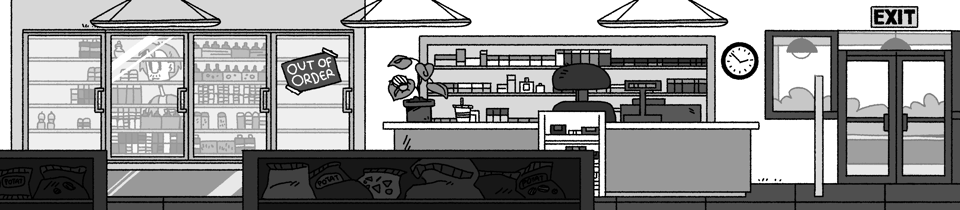
Even after drawing up all three screen for the area, I still wasn’t done! I needed to design the audio of this area as well. I wrote a new BGM for the Wattsburg Historical Society, pulling instruments and leitmotifs from the main Wattsburg theme itself. This new song is the most orchestral of the game in terms of instrumentation, to try to add to the area’s pretentiousness.
On a playtester’s suggestion (thank you, Victoria!), I added one final detail to bring it all together: some reverb on Louis’s footsteps made it sound more like he was walking on stone. The echo will hopefully make players feel little more isolated from the rest of town, like they’re in a self-contained bubble.
Overall, there’s a lot of small details that go into making an environment feel cohesive in a game. I hope you enjoy investigating here in the full game!
Thanks for reading. Have you wishlisted the game? Have your friends wishlisted the game? Have I wishlisted the game? We should all go wishlist it! See you next month!
