
We Should Have Seen This Coming
Who gets to be apolitical at the Olympics?
I was one of many people watching the 2026 Milan Olympics that felt a little weird about cheering for the United States. After all, we currently live in a country where masked federal government agents kidnap and murder people in the streets while our social services are systematically dismantled from within.
For the most part, I was able to separate the athletes from the government. In fact, the USA is one of the only major Olympic competitors that does not directly publicly fund its elite athletics at all. The figure skaters (famously alt, gay, and from New Jersey), speed skaters, curlers, sledders, skiiers, and snowboarders all had absolutely nothing to do with Trump, no matter how much he tries to attach himself to sports. I was especially excited to watch women’s ice hockey, which has fought an uphill battle over decades to finally professionalize and have the ability to pursue their sport full-time.
In the gold medal game against Canada, Team USA (and Seattle Torrent) captain Hilary Knight broke the all-time Olympic US women’s ice hockey scoring record to tie it up, and Megan Keller wired home the overtime winner to put them over the top. The tournament was a coming out party for NCAA stars like Caroline Harvey and Leila Edwards, and Boston Fleet goalie Aerin Frankel let in only two goals across the entire tournament.
This was a team I was happy to celebrate, their success and their incredible games acting as a perfect advertisement for the Professional Women’s Hockey League, only in its third year but growing quickly.
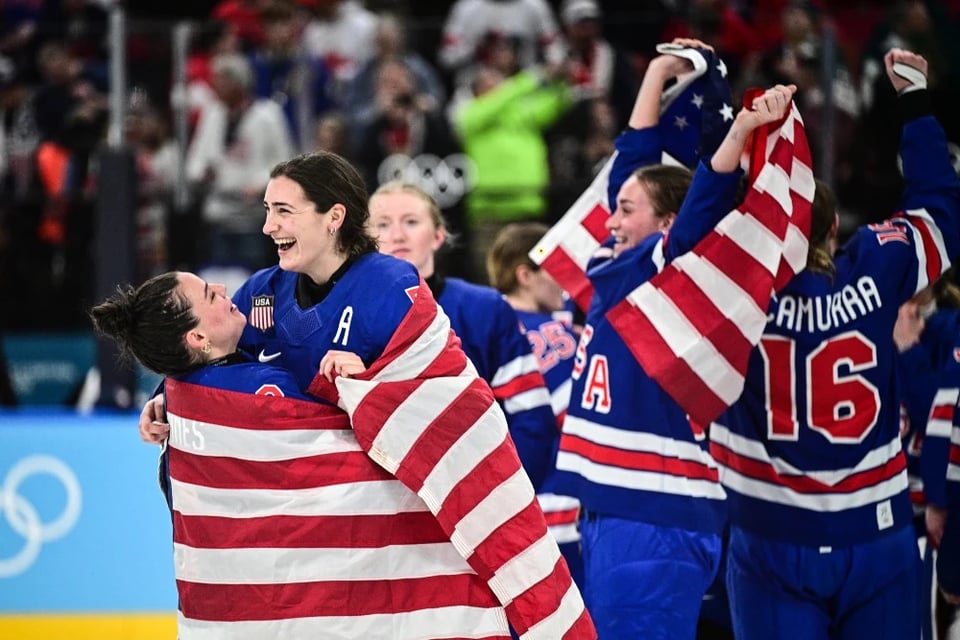
A few days later, the US Olympic men’s ice hockey team won their gold medal game against Team Canada in a suspenseful overtime victory. It was a momentous upset that continued the biggest national rivalry in the sport, and it marked the first time the USA men’s team had won gold since 1980. Gloves and sticks and helmets went flying as a couple dozen sweaty bodies crushed into a pulsating mob of pure joy. Occasionally, NBC’s camera cut to shots of sad looking, unmoving Canadians, before going back to fixing the camera on Jack Hughes’ gappy smile, having lost a couple teeth to a high stick earlier that game.
And as I watched from my couch, I was happy for them, but the pit in my stomach didn’t really compel me to, as one of my friends did, yell “Suck it!” at the closest Canadian. And over the next couple of days, my instinctual dread was proven right.
The men’s team chugged beers on camera with FBI Director Kash Patel, who notably is in the middle of covering up a global child sex trafficking conspiracy. Another video shows the team huddled around Patel’s phone, hanging on President Trump’s every word as he invited them to the State of the Union address, then boisterously laughing when Trump said he would have to invite the women, too. Someone in the room yelled, “Close the northern border!”
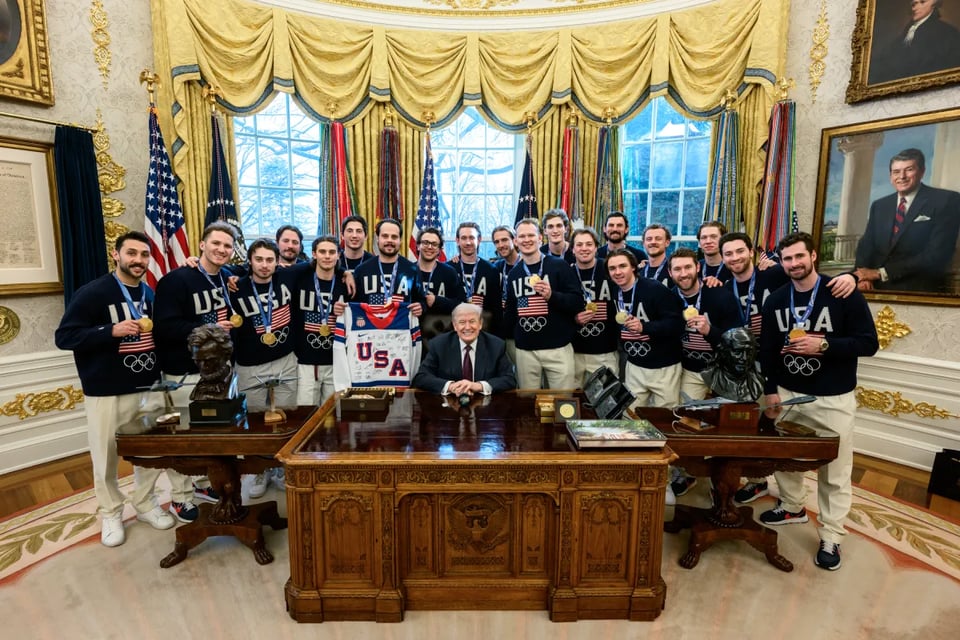
At one point, Matthew Tkachuk put his gold medal over Patel's head, a gesture he would soon repeat in the Oval Office, symbolically inviting Trump and Patel into the team’s brotherhood and their victory. Yet another video showed the team singing the national anthem in a Miami strip club. 20 of the 25 athletes met with Trump in the White House, and 17 also attended the State of the Union that night.
The backlash across the internet was fierce. But if you’ve been paying attention to hockey’s politics like me, you probably already suspected that something like this was going to happen.
It started just about a year ago at the Four Nation Face-Off. Instead of an All-Star Game, the NHL hosted a mini-tournament with national teams composed of the league’s American, Canadian, Finnish, and Swedish players.
I covered the history of Canadian international relations via hockey and the Four Nations Face-off in much more detail in the very first edition of this newsletter, so this piece will not be going into as much depth on that facet. The gist is that the financial and cultural dynamics of the National Hockey League (NHL) and the International Ice Hockey Federation (IIHF) mirror the broader relationship between Canada and the US. Canada, with a much smaller population and economy, is trapped in the role of little sibling to the States, which consistently siphons off top Canadian talent and innovations. American cultural dominance, arrogance, and its disregard for its neighbors, all continuously generate anti-American and pro-Canadian sentiment.
This resentment has hit an all-time high in the second Trump administration, especially because of new 25% tariffs and Trump’s imperialist rhetoric about making Canada the 51st state. And these two issues were piping hot last February, when Team Canada and Team USA were set to compete in the final of the Four Nations Face-Off, meaning that the game would be imbued with a lot of cultural tension.
The night before, the team dined with the 1980 Olympic team that had beaten the Soviet Union in the “Miracle on Ice.” Team USA general manager Bill Guerin also went on Fox News to promote the game and publicly invite Trump to attend. He framed the ongoing tensions as “a little bit of political flare” that the players could use “for inspiration.” “we would love it if President Trump was in attendance,” he went on, “We have a room full of proud American players and coaches and staff.”
Trump was not able to attend, but called Guerin the morning of the final, who brought the President, on speaker phone, into the locker room to speak with the players. He compliments their skill and talent, proclaims himself a “big hockey fan” and tells them, “no pressure,” to “go out and have a good time tonight,” but also to “bring it home.” Most of the players sit and listen with neutral faces, but some, like Matthew Tkachuk, are grinning. Guerin reiterates how proud of Americans everyone—everyone, he makes sure to emphasize—are. At the end of the call, the team applauds.
The only reason why Team USA wasn’t shaking hands with Trump at the White House last year was because they lost to Canada in that final game. The stage was already set. Guerin and the team are openly on board with Trump, and they have been for a while. The phone call was even aired on ESPN.
After two tournaments where the Miracle on Ice has been invoked over and over again, the athletes were primed to interpret their hockey victory over Canada as its spiritual successor. That 1980 team went to the White House, and so do most major sports league champions. They don’t even see it as being political. In their many statements to the media as of writing, only one player on Team USA (Charlie McAvoy) has apologized for their reaction to the sexist joke, none have expressed any regret about going to the White House, and multiple have complained about the situation being “politicized.”
This incident highlights, for the nth time throughout these Olympics, the strange contradictions of categorizing some things as “political” while others aren’t. Some athletes evidently believe that meeting with the president (the most important politician in the country), shaking his hand, and attending his political rally where he talks about politics for almost two hours, are not political actions. But when professional athletes across many different sports speak about their identities, struggles, or communities, they’re often told to “stay out of politics.”
The IOC itself has extensive regulations about political speech at the games in its charter. Rule 50, introduced in 1975 in response to protests from Black American athletes against racial injustice during medal ceremonies in 1968 and 1972, reads: “No kind of demonstration or political, religious or racial propaganda is permitted in any Olympic sites, venues or other areas.” This includes the field of play, the Olympic Village, and any related ceremonies. Athletes are, of course, allowed to express their opinions, but only in press conferences, interviews, team meetings, or in other media.
“The focus at the Olympic Games must remain on athletes’ performances, sport and the international unity and harmony that the Olympic Movement seeks to advance,” says the IOC Athletes’ Commission in the guidelines set out for the 2020 Tokyo Olympics, “It is a fundamental principle that sport is neutral and must be separate from political, religious or any other type of interference.”
There are a number of problems with this framing, especially the assertion that sport is neutral. I won’t go on my “everything is political” spiel here, but the foundations of modern sports specifically were developed at upper-class British boarding schools and consciously used as a tool of colonialism. Baron Pierre de Coubertin, the founder of the modern Olympic Movement, was directly inspired by these schools and even at one point wanted to use the Olympics to bring “civilization” to Africa.
Furthermore, the Olympics explicitly have athletes competing for their country, under their flag, usually wearing their country’s colors. When they win a medal, everyone has to listen to their national anthem. The opening ceremony is nakedly nationalist performance art projecting the history and values of the host country. In what world is none of this political symbolism? Is nationalism suddenly apolitical?
The IOC has clearly taken pains to try to curb its politicization through these regulations, but unfortunately, the headlines generated by censorship often travel farther than the original political statement would have. Even the acceptable political content based on nationalism gets them into hot water, like with their decision to allow Taiwan to compete separately from China, but only under the name Chinese Taipei. Any signs referencing “Taiwan” are therefore also considered political protest, but the name Chinese Taipei is apparently “neutral.”
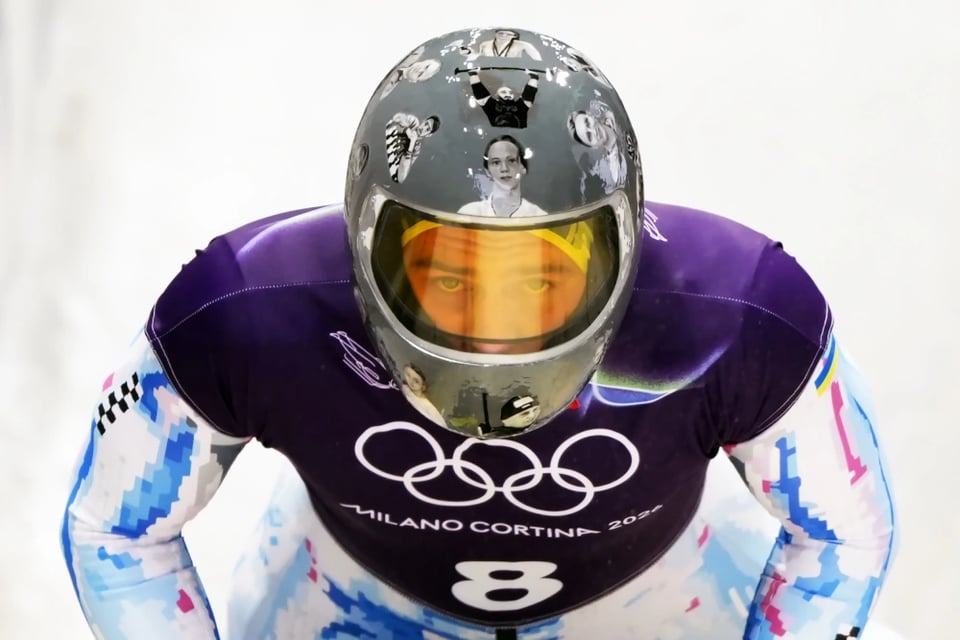
At this year’s Olympics, Ukrainian skeleton racer Vladyslav Heraskevych was disqualified because his helmet depicted athletes who had been killed in the Russian invasion. Many other athletes also dedicated their performances to fallen friends or family, but none of these were considered political. Interestingly enough, another skeleton racer, Israeli Jared Firestone, raced wearing a kippah bearing the names of the 12 Israeli Olympians killed in the 1972 Munich Olympics massacre by the militant organization Black September. Why are some deaths political while the others aren’t?
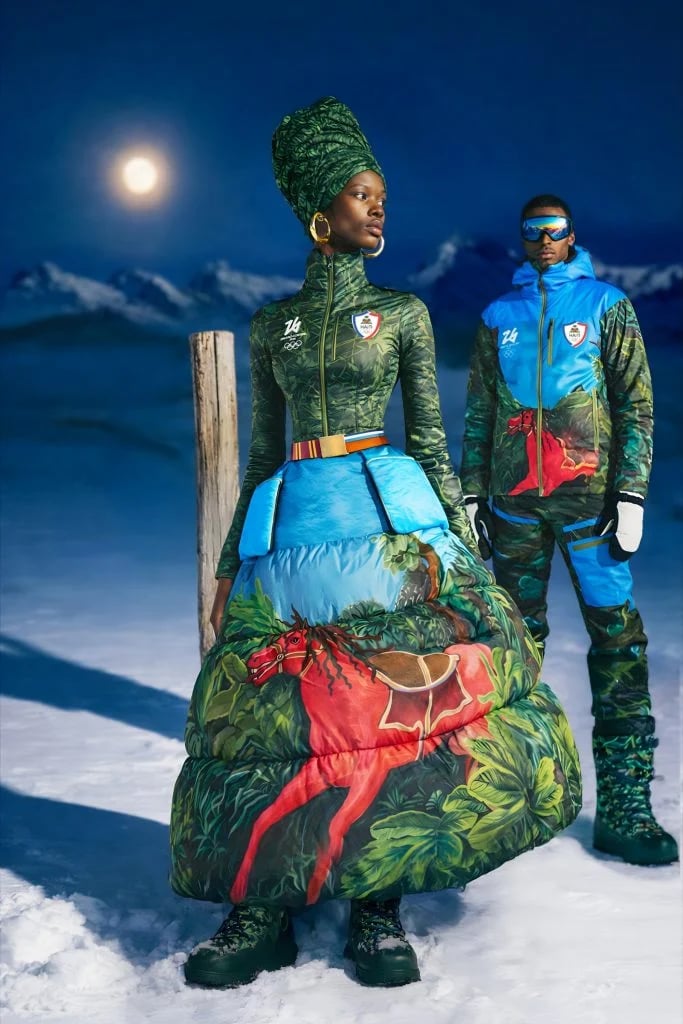
Another censorship incident at these Olympics concerned Team Haiti’s opening ceremony outfits. Designer Stella Jean’s ski suits featured a hand painted landscape with the central figure of Toussaint Louverture, Haiti’s revolutionary founder, riding a horse. The IOC disapproved, yet again citing political symbolism, and the team had only a day to adapt, repainting the outfits to remove Louverture but keeping his horse. Why are flags, anthems, colors, and other symbols like stars, crowns, and even a bald eagle on Team USA’s iconic long puffer wrap skirt okay, but the visage of a country’s founder not?
The Overton Window, a broad range of policies and beliefs acceptable to the mainstream of a given society at a given time, helps us understand the IOC’s choices. Beliefs and identities that sit within the window are considered neutral or apolitical, but anything outside of it is painted with the brush of politics. For instance, if a TV show depicts the president of the United States as a white man, it wouldn’t draw much attention, but if the president is a black woman, that would be a political statement, and the show would probably be considered “woke.” There’s nothing inherent about a black woman that makes her more political than a white man, but because our society has made white men the default, neutral, assumed option, any change in itself becomes a political statement. Because black women are discriminated against, their mere presence in predominately white male spaces challenges the default, evoking power structures, or in other words, politics.
Having one’s every move be considered political is exhausting and more than a little unfair for the people carrying that burden. Laila Edwards’ Olympics made her the first black woman on Team USA for ice hockey, a fact that she has been asked about in almost every single interview I’ve seen her do. It’s hard to be the only member of a certain group on that large of a stage because, like it or not, her performance was suddenly representative of all Black Americans. Edwards’ father recently said to NBC that she’s “been working it out in terms of what it means to her,” wanting to make sure she doesn’t do anything “offensive” while also not “minimizing or mitigating” the importance of her achievement. Having to carefully consider her actions, speech, and tone through this lens is difficult, and the penalties in today’s era of social media harassment are harsh.
The women’s team more broadly has been dealing with a similar problem in the aftermath of the men’s team’s choices. Every player is asked about the situation at least once in each interview they’ve done since, and have to—not as hockey players, but as women hockey players—navigate between excusing the joke and potentially burning bridges with the men. The athletes consistently try to redirect the conversation back to celebrating their win, revealing how in the internet outrage, while ostensibly rebuking the men for not celebrating the women enough, now has contributed to that very same problem by pulling attention away from their win.
The actions of straight cis white men, sitting at the epicenter of societal standards and therefore neutrality, are much less likely to be perceived as making political statements through their actions. As Louis Althusser says, ideology is invisible as long as you’re within it; we always consider our own views to be the default and everyone else’s beliefs to be products of a distinct type of ideology. Championship winning sports teams have been going to the White House to celebrate their wins consistently for decades, and it’s generally only a big story when they decline. Just as the men’s hockey team—like the Olympics—thought it was politically neutral to wear a Team USA jersey and, hand on heart, sing the American national anthem on the podium and in that strip club, I think most of them truly thought the White House visit was not political.
But as our country continues to slide into fascism and the leopards begin eating more and more people’s faces, being apolitical is not a luxury that most Americans have access to.