
Re: Why the United Kingdom SUCKS at Hockey
One day last March, the Youtube algorithm recommended me a particularly enticing video. The thumbnail image depicted the shape of the UK with first the National Hockey League shield, and then a big red ‘X’ layered atop it. To the right of this lovely composition, block letters proclaimed “NO NHL PLAYERS.”
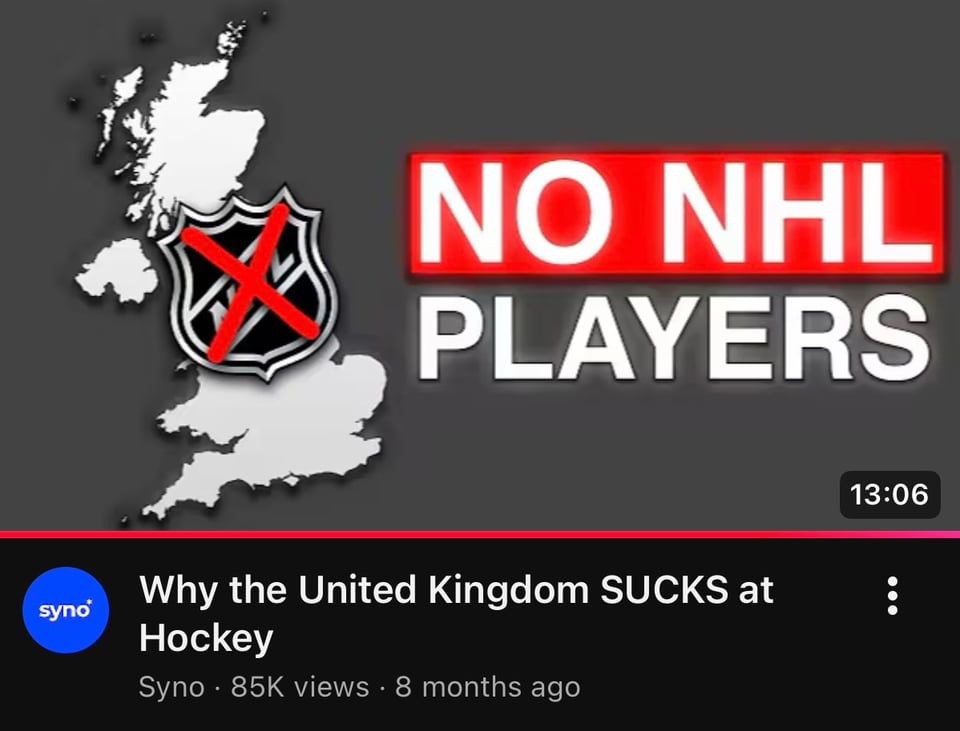
The video was “Why the United Kingdom SUCKS at Hockey” by hockey video essay creator Syno. In it, he details the early successes of British ice hockey, then asks why this trend didn’t continue. The UK men’s national team was a founding member of the International Ice Hockey Federation (IIHF) in 1908, and they even won gold once at the 1936 Olympics. However, as Syno points out, this team was mostly populated by Canadian Brits who came up in the Canadian hockey development system.
Today, the English national team sits on the fringes of elite international competition, regularly being relegated down to a lower tier only to earn another short-lived promotion. Only a small handful of players in the history of the NHL were born in the UK, and the ones that were have been exclusively raised and trained somewhere else.
Syno proposes three main arguments for why the UK sucks at hockey. First, he says that the UK “simply does not have a hockey culture,” pointing to football’s cultural dominance as a major barrier for hockey. Second, there is the issue of accessibility and expense. The UK does not have very many ice rinks, so paying inflated prices for ice time alongside buying all the needed equipment is not very compelling to parents who can just give their kid a ball and drop them off at the park. Finally, the media is completely disinterested in hockey. Even though thousands of fans come to watch the English Ice Hockey League (EIHL) play, sports media organizations prefer to cover lower-tier football matches with only a few hundred fans in attendance.
None of this is incorrect. I even agree with most of it. But it’s not the whole story.
The premise of this video felt almost perfectly crafted to draw me in. By the time I watched it I was already six months into researching my political science honors thesis on British sport policy, and so I know exactly why the UK sucks at hockey.
Syno is absolutely correct that there isn’t enough infrastructure, both physical and orgnizational, to support an elite hockey program. But that’s not random; it isn’t even necessarily caused by the lack of a “hockey culture.”
It’s a policy choice.
When Syno points out that ice rinks are rare in the UK, with less than 60 permanent facilities in the whole country, he’s on the right track, but he doesn’t look deep enough. He says it’s “because the demand for hockey is relatively low,” positioning the problem of sports facilities within free market economic dynamics. But that’s not usually how sports facilities work.
In most countries around the world, including the UK, local and national governments invest in these kinds of projects for the social good of the country. Participating in sports is generally good for the bodies and minds of the populace, and so sport accessibility has even been considered a crime reduction tactic (that’s a future newsletter topic that I have downloaded a lot of research on but haven’t had the time to get into yet).
The Sports Council, a UK government department formed in 1972, spent the rest of that decade pouring a modest but respectable 7-figure budget into the construction of public ‘leisure centers,’ which housed facilities for a wide range of sports. Near the end of the ‘70s, the Sports Council also began establishing ‘centres of excellence,’ hubs for elite athletes to train in and benefit from the public investment (it was taboo at the time to directly fund elite athletic programs and athletes, but that’s a whole different story).
Breezing through the ‘80s, when Margaret Thatcher cycled through five different Sports Ministers in quick succession and continuously cut the Council’s funding, the ‘90s brought about the beginnings of current-day British sport policy. Conservative prime minister John Major wanted to bring back the glory days of British international sporting dominance. He established the National Lottery in 1994, from which some 200 million pounds in proceeds would annually go toward funding sport. The Sports Council was split into Sport England, covering community sport and recreation, and UK Sport, which funded and controlled elite sports development using the lion’s share of governmental sports funding.
A 2002 policy document called Game Plan outlined UK Sport’s mission: generating as many medals in international competition as possible, ideally ones of high ‘quality.’ To define what ‘quality’ means in this context, the report read:
‘Quality’ can be taken to be the extent which victory produces the the feelgood factor and national pride (as these are the main public benefit of high performance sport). If it is accepted that the more popular the sport, the greater the amount of feelgood which follows, then ‘quality’ medals are those obtained in the most popular sports. (qtd. in Grix & Carmichael 2012)
Medal quality and the likelihood of reasonably being able to win a medal were the “twin-track” criterias used to target elite sports funding. Sports that were both already popular in the UK and where peak athletes had good chances of winning medals were awarded the most funding, while sports that lacked these attributes received much less.
With this knowledge, it’s clear why elite ice hockey has not flourished in the UK. While youth participation in the sport and viewership of the EIHL are currently both at all-time highs, that barely matters on the level of institutional funding. Ice hockey is still not popular enough to be an especially high quality medal, and with Canada, the USA, and Russia usually atop the podium (with countries like Sweden, Germany, Finland and Latvia not far behind), the reasonable likelihood of the UK winning an Olympic medal in ice hockey is very low. In the most recently released UK Sport funding awards, ice hockey received 900,000 pounds. Field hockey, on the other hand, got 14.425 million.
As private equity continues moving in on youth sports across the US, I think it’s useful to compare how other countries handle sport policy. Should the point of youth sports be to pump out enough world champions to spruce up the national mood, or to extract as much money as possible from paying parents, or to fight the obesity epidemic, or those strange intangible benefits that are hard for scientists to quanitfy but are instantly recognizable to anyone who has enthusiastically participated? Whatever we choose, we should do it actively.
Syno’s recommendations for how the UK could improve at hockey were: “more investment in rinks, better media coverage, and a stronger development system for young players.” Two of the three would be directly fulfilled by UK Sport elevating ice hockey from the ‘National Squads’ tier to being a ‘World Class Programme.’
Sport is deeply intertwined with governance and bureaucracy. The advent of modern sport was characterized by an increase in record keeping, building complex league and tournament structures, and even just writing down the rules of games to standardize them. A couple months ago I posted an essay on here about how western sport was used as a form of colonialism in order to introduce Africans to the hierarchichal bureaucratic structures they’d need to navigate in colonial life.
It’s simpler to think of sports as an activity and an entertainment product removed from these kinds of concerns. You can escape the stresses of life by putting on a game. But as soon as you get invested enough to do something like tracking your team’s prospects, you’ve already caught a glimpse of the enormous organizational machinery of the sports world. In my view, that’s the point where governance, bureaucracy, and politics of many different kinds are inseparable from the game. And that’s not an insignificant part of why I’m interested in it.