
The Hidden Costs of Your Shrimp
Dear Reader,
This week, The Xylom collaborated with Behan Box to publish “Wage Cuts, Broken Security: US Tariffs Squeeze Women in India’s Shrimp Industry”. I asked my counterpart, Bhaskar Basava, to share what motivated him to do this reporting, and what’s at stake for the women in the shrimp export industry. Check out his thoughts below.
The best way you can support more cross-border investigations like this is to upgrade to a paid newsletter membership. Like what you read? Join our community now:
Upgrade nowWarmly,
Laasya Shekhar
Managing Editor
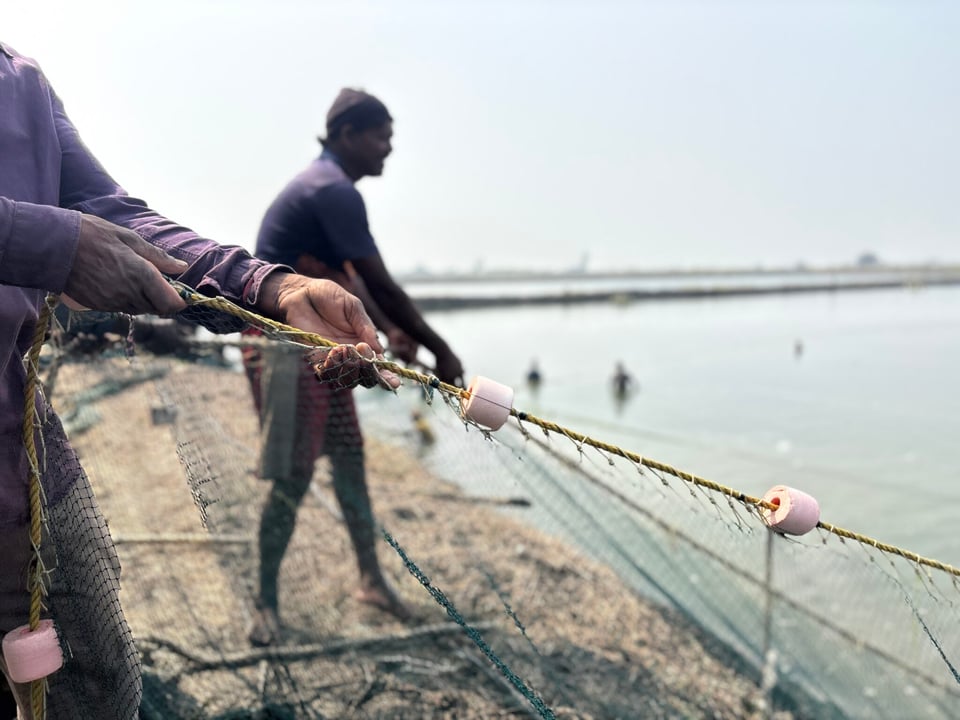
Shrimp and Bhimavaram are hard to separate. Curry, pickle, or powder — the form could be different, but if you are from this coastal town in Andhra Pradesh, India, it is on your plate almost every day.
On one such reporting visit, a shrimp meal was served to me on a vistaraku (an eco-friendly leaf plate), along with the unforgettable maryādalu (hospitality). What a memorable meal it was. I saw the woman who cooked it only at the end. Her husband sat with me the entire time. She asked me not to clear the leaf, but to fold it and leave it as it was, then showed me where I could wash my hands. I thanked her and asked about the food. Her friend, who works at a nearby shrimp processing unit, had given her the shrimp.
On the bus ride back, shrimp ponds stretched for miles, broken now and then by coconut groves and patches of farmland. As the breeze came in through the window, my mind returned to that small moment after the meal. Having grown up on my grandparents’ stories from nearby villages, I knew how deeply this region values the local culture. But are the women who uphold the economy and culture getting their fair share of respect?
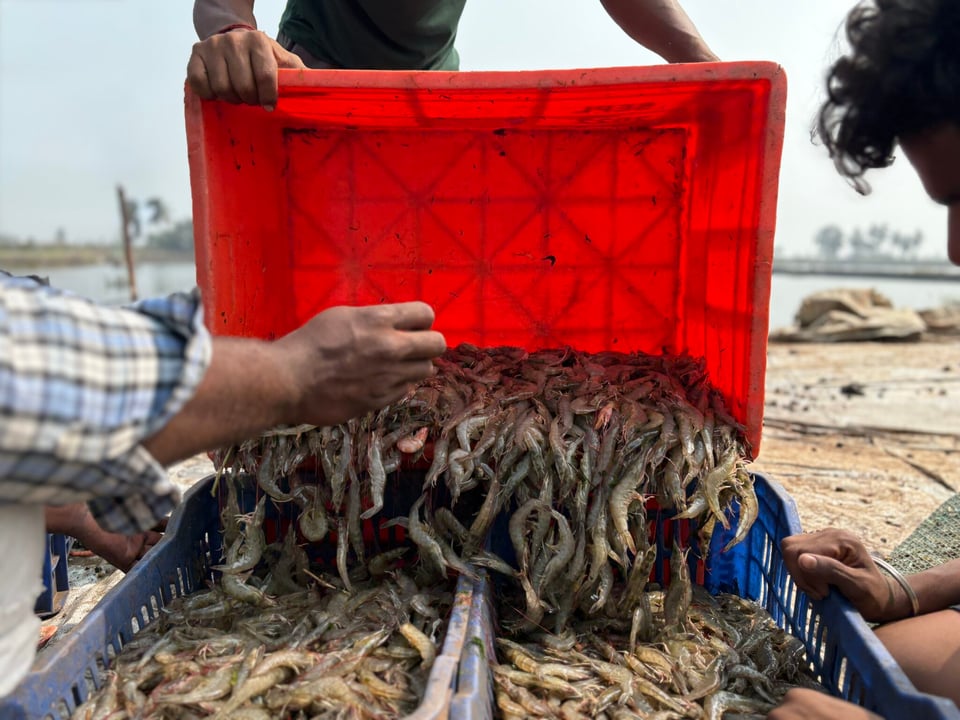
Some time later, global trade tensions and tariff policies under Donald Trump were being discussed for their impact on aquaculture exports. Bhimavaram returned to the spotlight and to my thoughts. There was plenty of discussion about farmers, exporters, and industry losses. Far less was said about the women. That was when I remembered the woman who had cooked my meal. She received neither attention nor credit for her labour. I began to wonder if this was the same pattern playing out again in the middle of a trade war. A few searches and phone calls made it clear: women form the backbone of the shrimp industry and yet remain largely absent from the conversation.
That was when I began reaching out to understand what their stories might reveal. What struck me early on was how they were absorbing the shock of a trade war while already navigating low wages and workplace exploitation. Over the next couple of months, my colleague Laasya Shekhar and I tried to speak with several women. It was not easy. There were refusals, delays, and long waits before a few agreed to speak.
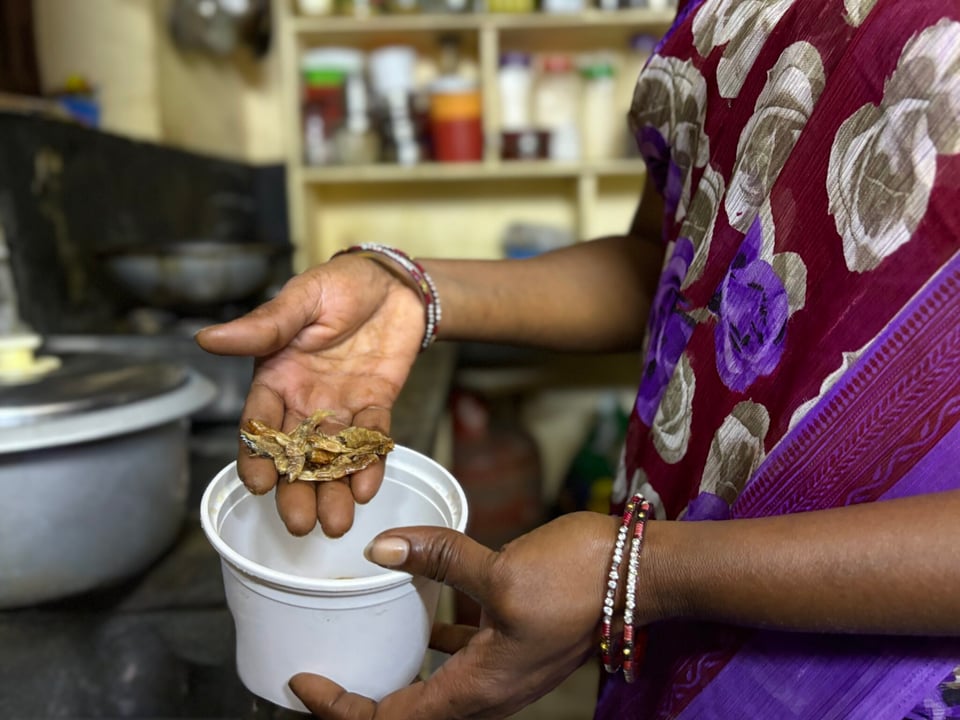
Despite constraints, some women were open and generous in sharing how these tariff shifts were affecting their lives. Only a couple of them had Android phones, and none had active data packs. Others could speak to us only in the evenings, when their husbands returned from work or from the liquor shop, and the phone became available. Fixing appointments at their convenience and navigating to their homes using Google Maps required patience. Also, you had to arrive fully prepared. If you missed even a small detail, it was difficult to clarify it later or make another trip to the field.
After all, we are only human. We missed details and had to follow up, thanks to the women who spoke to us late at night, after their husbands had returned. These conversations eventually led to a story produced by Behan Box, co-published by The Xylom and republished by More to Her Story. Seeing the story finally find space on the right platforms and the response from readers across them came as a quiet relief.
♨️ HOT OFF THE PRESSES: Pushed Overboard and Left to Drown: Inside Southeast Asia’s Fishing Industry
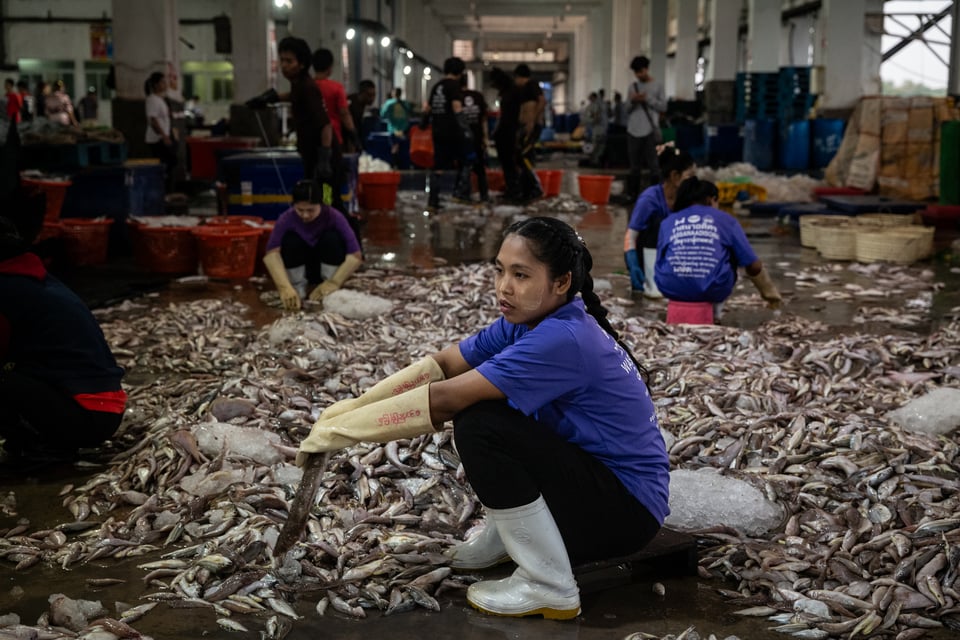
From debt-bonded crews to violence at sea, Photojournalist Nicole Tung’s reporting reveals the hidden human and environmental costs behind global seafood. Before her exhibition, ‘Overfishing in Southeast Asia, An Ecological and Human Crisis’ opened at the Bronx Documentary Center in New York, she sat down with our Editor-at-Large Kang-Chun Cheng to discuss what she saw and what she captured. Read More here.
Like this newsletter? Share it with a friend and subscribe below!
Subscribe now✨ NEWS BEHIND THE NEWS
💸 Welcome to our three new members and two new donors who joined our community this week! ICYMI, we are still 12 new members short of meeting our March target; support our independent reporting here.
📘 Paola Rosa-Aquino, a member of The Xylom’s advisory board, is one of the contributors to the upcoming book, The Best Science Stories and How They Work. Edited by Siri Carpenter, the guide brings together eleven standout works of science journalism from a range of publications such as Scientific American, Nature, The Atlantic, and The New York Times Magazine. You can preorder the book here.
📢 ICYMI: Join our WhatsApp channel and help reach users who stay off social media (share this with your friends).
🍑 A SOUTHERN FLAIR
OKLAHOMA CITY — Oklahoma’s governor picks energy executive Alan Armstrong to fill US Senate seat through end of year (Sean Murphy, The Associated Press)
“The truth is, it’s gotten very, very hard to build large-scale infrastructure, and it is so critical to our country’s competitiveness in the long term,” says Alan Armstrong.
WOODBINE, Ga.— Judge, expressing doubt on abortion murder charge, grants bond to Georgia mother (Jabari Gibbs, The Current)
“Today’s decision is a reminder that justice is not served by accusation alone. Our system works best when courts carefully weigh the facts, uphold constitutional protections, and safeguard the rights of every person who comes before them. Public defense exists to make those protections real,” Don Plummer, the press officer, The Georgia Public Defender Council, wrote in a statement.
ATLANTA — Opinion: Atlanta’s World Cup dream has a public bathroom problem (Dr. April M. Ballard for The Atlanta Journal-Constitution)
A car-dependent city will suddenly become a walking city for hundreds of thousands of visitors spending hours in fan zones, transit hubs and streets that currently lack infrastructure to support them. When there aren’t enough bathrooms, people improvise. Atlanta’s global reputation should not depend on how quickly we can pressure-wash sidewalks.
🗺️ WHAT ELSE WE'RE READING
BETHESDA, Maryland — ‘No kings, just vaccines!’: demonstrators gather at NIH headquarters to protest against cuts to medical research (Melody Schreiber, The Guardian)
“What I see is one person trying to run science like a king, deciding which research is acceptable based on political ideology rather than scientific merit,” said Michael Green.
Green received an early-career fellowship from the NIH for his work on discrimination in healthcare. But in 2025, that research was terminated in the sweeping cuts enacted over the past year.
The frantic, high-tech fight to stop climate-fueled dengue fever (Zoya Teirstein, Grist and Salud con Lupa)
“It’s not often you come across a proposal to release mosquitoes when our entire history of disease prevention was to fight against the mosquitoes,” Ana Eppinghaus, health surveillance coordinator at the Municipal Health Foundation of Niterói, said at the time. “We accept the challenge.”
The Energy Supply Shock of the Iran War Changes Everything (Matthew Zeitlin, Heatmap News)
“The most likely outcome from this war is one where Iran is weakened but has not collapsed — where it retains the capabilities to threaten traffic through the strait and to threaten [Gulf Cooperation Council] states,” says Greg Brew, an analyst at the Eurasia Group.
China’s deep-sea mining fleet may also track US submarines (Elizabeth Claire Alberts and Kara Fox, Mongabay and CNN)
“These gaps are significant,” Mark Douglas, an analyst for Starboard Maritime who is also in the New Zealand naval reserves, told Mongabay and CNN in an email. He said the Chinese ship “demonstrates a deliberate pattern of operating in sensitive areas, outside the view of traditional tracking systems.”
From Chile to the Philippines, meet the people pushing back on AI (Daniela Dib and Rina Chandran, Rest of World)
“We are building a movement where digital labor is visible, valued, and organized, and where the human foundation of AI is finally recognized as central, not peripheral, to innovation,” says Joan Kinyua, who started a job at data annotation contractor Samasource in 2016.


Add a comment: