
It's Not Just Us
Why wildlife stories have always felt personal for our Managing Editor
Before you dig into the newsletter…
This week, The New York Times publisher A.G. Sulzberger voiced a new ad encouraging listeners to support any news organization dedicated to original reporting — even if it’s not the Times. Thank you to those of you who have stepped up so far: Jennifer Wong, Christine Morrison, and Billy Riech!
We are still rebuilding our $30,000 rainy day fund after recording a significant deficit last year. There’s strength in numbers. Will you join us?
Count me in! I’ll donate to The Xylom today.Dear Reader,
Happy World Wildlife Day! I found myself reflecting on why telling stories about wildlife has always felt personal.
In January 2024, a brief news item about the discovery of a new butterfly species in the Western Ghats made me inquisitive. This doesn’t happen a lot; a decade of reporting experience teaches you to recognize patterns.
Certain outcomes are predictable: the poor air quality on Diwali day in the Indian capital of New Delhi, or Donald Trump walking out of the Paris Climate Agreement. While investigating sexual abuse cases, for instance, I often find delays in filing police complaints and prolonged court proceedings. Reporting on a river restoration project might reveal that laws exist but are poorly implemented. Corruption, bureaucratic apathy, political interference, and entrenched power dynamics — the same patterns emerge again and again.
But nature always manages to surprise me.
While gathering facts about the newly discovered butterfly, the Meghamalai silverline, I came across such delightful details that I felt like a child again. My eyes sparkled, and I imagined standing amid a swarm of these butterflies, their wings flashing azure blue and silver.
While most butterflies lay eggs on leaves, this one chooses odd yet secure spaces. A species of ants — Crematogaster wroughtonii — adopts the caterpillar, forming a remarkable symbiotic relationship. “It was fascinating. The female lays eggs only near these ant colonies. The caterpillar releases nectar when tickled by the ants. They feed on it and, in return, bring food for the caterpillar and even build protective enclosures around it,” said Ramasamy SRK, one of the discoverers of the Meghamalai silverline.
How could I have ever anticipated such an extraordinary biological detail? That sense of wonder awakened my desire to cover wildlife.
When I first joined The Xylom as a contributor, I wrote a two-part series, “No Place To Call Home,” on human-wildlife conflicts in India due to a changing climate. The first part explored whether an Indian state government’s decision to sterilise leopards to control their population and further mitigate the conflict is indeed a rational solution. The second part looked at my hometown, where I grew up reading snippets of news items that informed us only about the number of humans killed by elephants.
After a long hiatus, I am now working on an article about white-winged ducks — critically endangered on the International Union for Conservation of Nature list but receiving attention from scientists worldwide who are trying to increase their numbers in the wild.
Wildlife is another area where global health and environmental disparities manifest. Marginalized groups, especially those in conflict zones, are less likely to have safe access to nature; the same policies that make our communities poorer, sicker, and dirtier also have long-lasting effects on wildlife and ecosystems.
Despite the predictability of bad actors, I am rooting for the positive impact our reporting has on humans and wildlife. Give nature a fighting chance, and it will continue to amaze and inspire.
Warmly,
Laasya Shekhar
Managing Editor
♨️ HOT OFF THE PRESSES:
These Drones Are Not Built to Kill
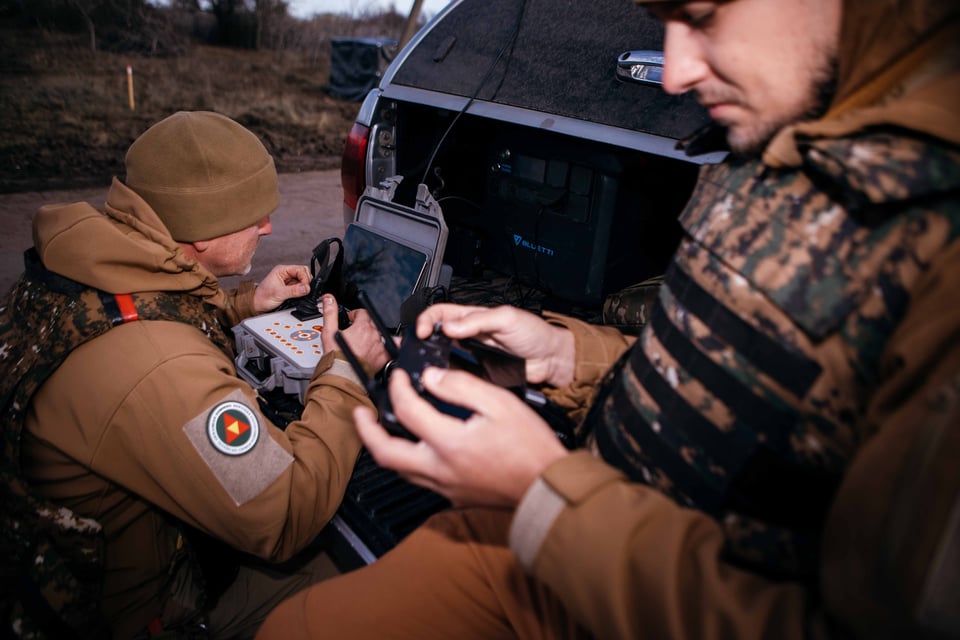
Ukrainian deminers are deploying drones to clear the remnants of Russia's full-scale invasion—protecting communities and reclaiming land.
This dispatch by our Editor-at-Large Kang-Chun Cheng is produced by Icarus Complex Magazine and co-published by The Xylom.
Like this newsletter? Share it with a friend and subscribe below!
Subscribe now✨ NEWS BEHIND THE NEWS
🌍 Our Editor-at-Large KC Cheng will be sharing her experiences reporting for us from Ukraine (see above) to South Sudan in the #SEJ2026 panel session, “Making Global Environmental Stories Matter to U.S. Audiences in the Trump Era”. If you are in Chicago between April 15th and 18th, please say hi!
📚 ICYMI: We just launched our bookshop, filled with staff picks and featured reads, as an Amazon-free alternative that gives back to local bookstores! Grab your favorite books and e-books now.
🍑 A SOUTHERN FLAIR
RICHMOND, Va.— Virginia House Delays Action on Bill Banning Paraquat (Charles Paullin, Inside Climate News)
Jim Jones, a former U.S. Environmental Protection Agency pollution prevention official who worked to pass the bill, said the effort will come back next year. “By then, a couple of other states will likely have taken action, which I think will make it a little easier for the Virginia legislature to not be the first out of the gate,” he said.
ASHEVILLE, N.C. — A hotter, wetter South is becoming a breeding ground for mold(Katie Myers & Laura Hackett, Grist)
“For people with chronic respiratory illnesses or conditions like asthma, substances produced by fungi may worsen their symptoms. That’s what we’re trying to understand,” said Asiya Gusa, a microbiologist at Duke University.
CLAREMORE, Okla. — Man Opposing Data Center Arrested for Speaking Slightly Too Long (Matthew Gault, 404 Media)
Darren Blanchard showed up at a Claremore City Council meeting on Tuesday to talk about public records and the data center. When he went over his allotted 3 minutes by a few seconds, the city had him arrested and charged with trespassing.
“There are major concerns about the public process in Claremore,” Darren Blanchard says, referencing compliance documents and irregularities he’d uncovered in public records.
🗺️ WHAT ELSE WE'RE READING
Regulators rely on fossil fuel industry data. How often is it wrong? (Shelby Webb, E&E News by POLITICO)
“The district engineers and their staff are so understaffed, unless somebody’s calling up and saying, ‘Hey, there’s a big problem on Jones No. 11 in Brooks County. You really need to check that’ — they don’t check it,” said Ted Borrego, an adjunct professor at the University of Houston Law Center and an oil and gas attorney. “They look to the east and say, ‘Please God, don’t let there be a problem.’”
Prisons have an extreme temperature problem. Are HVAC investments the solution? (Karen Fischer, The Gumbo Pot)
“One person who was imprisoned in New Mexico told me about how the prison was fully air conditioned, but the guards would blast very low temperatures in the 40s and 50s that left people shivering, and needing coats and scarves. This was often used in solitary confinement,” says Ufuoma Ovienmhada, Postdoctoral Research Associate in Climate Change and Human Resiliency at the University of Arizona.
“This is thermal violence used to punish people. Some prisoners committed suicide in these environments because it’s just torture.”
JOHANNESBURG, South Africa — 'Let them shower in hotels': Johannesburg Premier faces backlash amid water crisis (Kate Bartlett, NPR)
"The fact that you're going to a hotel means you are special bro," says stand-up comedian Linde Sibanda. "The average person… if we don't have water we just stink, we just smell."
"This is wrong bro, not the fact that he does that, we know he does that, but don't throw it in our faces and try act like you're one of us."


Add a comment: