
How A Plant’s Survival Strategy Lands Patients in Emergency Wards
Our Ferriss–UC Berkeley Psychedelic Journalism Fellow, Saugat Bolakhe, shares what drove him to report about "mad honey".
Dear Reader,
Psychedelics were not my beat. But the world finds them alluring.
Marijuana consumption is legal for adults in New York; psilocybin is actively being investigated for its antidepressant effects, and LSD is being explored for its potential to reduce anxiety disorders.
So, when I saw an opportunity to apply for the Ferriss–UC Berkeley Psychedelic Journalism Fellowship, I was keen to bring a narrative lens to an underreported story in this space. Even though I was based in New York at the time, as someone hailing from Nepal, I was drawn to the idea of reporting a story from the Himalayan country with a global connection.
Nepal is a treasure trove of psychoactive and hallucinogenic compounds. In the lowlands of the country, magic mushrooms sprout from cow dung after monsoon rains. The alkaloids in the Datura plant, which possess hallucinogenic effects, are used in tantric rituals, while wild cannabis — a psychoactive plant — is part of many cultural and religious practices.
But to find a truly unique plotline, I worked closely with The Xylom’s Publisher and Editor, Alex Ip.
That was when I recollected the wild tales surrounding mad honey. People spoke of being hospitalized after consuming just a couple of teaspoons. My family narrated known cases of mad honey poisoning. An uncle from the neighbourhood had even written an entire blog recounting his sobering experience of risking his health for the sake of a fleeting “honey high.”
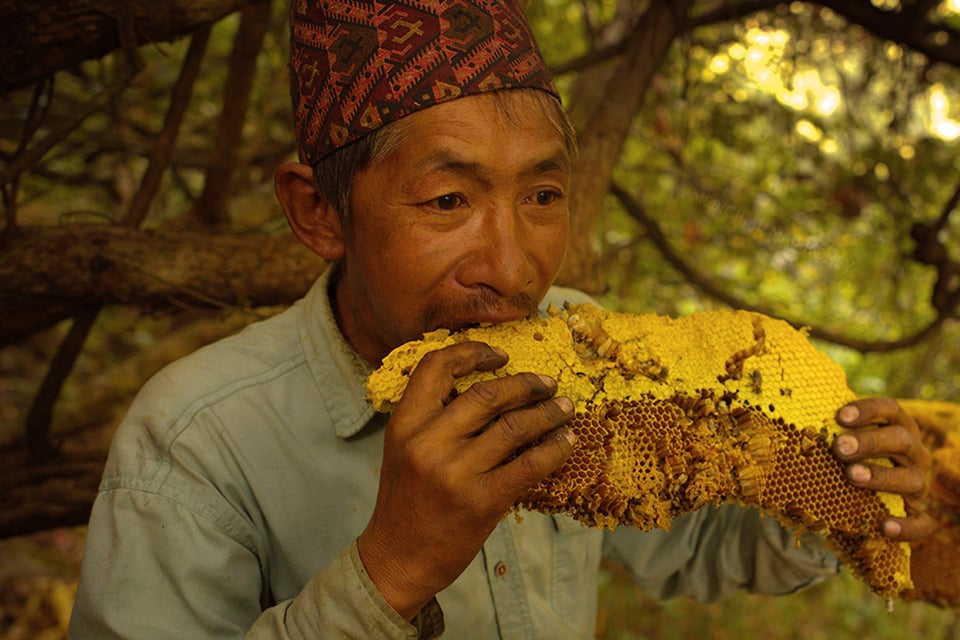
I turned to medical journals and, to my surprise, found numerous documented cases. When combined with alcohol or certain medications, mad honey has caused severe adverse effects — even death.
What flabbergasted me was how mad honey was projected as an exotic psychedelic in U.S.-based podcasts and documentaries, without even a hint of the very real dangers involved. Some of these videos had millions of views, with young audiences commenting enthusiastically about wanting to try the substance themselves. They glorified the daredevil adventures involved in harvesting mad honey, while failing to caution viewers about its toxic effects.
I began to see mad honey as existing at a unique intersection of indigenous culture, traditional medicine, fragile ecological systems, and a misinformed audience driven by influencer culture. It was a major gap that my reporting could fill in.
During the investigation, I spoke with several doctors about their case studies, patients, and clinical experiences, as well as honey dealers and regulatory bodies in Europe grappling with the challenges of studying a culturally embedded compound through rigorous scientific frameworks. Along the way, I began to understand the many nuances this substance carries.
The most fascinating part of the reporting process was uncovering the evolutionary and ecological dimensions of grayanotoxin, a naturally occurring toxin found in plants of the rhododendron family.
This compound essentially serves as an ecological filter to keep out unwanted insects, pollinators, and thrips — so that only big pollinators, such as the Himalayan giant honeybee, can access the rhododendron’s nectar. The bees ingest the toxin and later deposit it in their honey. This is a straightforward ecological phenomenon, mirrored in many other insect–flower relationships.
Yet, it is just bewildering to realise that the same toxin creates an entire culture, societal rituals, stories, and misguided followings with a cascading effect. A rhododendron’s survival strategy for pollination is linked to a patient's debilitating condition in a hospital's emergency ward.
The story helped me understand how science and society are interlinked. Only by combining scientific rigor with respect for indigenous knowledge can we build a well-informed society—one that forms opinions based on sound science rather than blind influence.
Yours sincerely,
Saugat Bolakhe
Like this newsletter? Share it with a friend and subscribe below!
🍑 A SOUTHERN FLAIR
TEXAS — Texas Clears the Way for Petrochemical Expansion as Experts Warn of Health Risks (Staff, Public Health Watch)
“It’s the worst possible situation you can imagine,” says John Beard, a Port Arthur native and founder of Port Arthur Community Action Network, an environmental advocacy group. “You’re living in a toxic atmosphere that with every breath is potentially killing you.”
SULPHUR, La.— Grassroots Air Monitoring Helps People Track Pollution In Their Own Backyards. Those Efforts Are Under Threat in Louisiana. (Illan Ireland, Mississipi Free Press)
“Anybody living in this area is impacted,” says Cynthia Robertson, whose father died of heart disease after working as a chemical engineer at one of the Lake Charles facilities. “I knew moving back here that I would be getting into a massive pollution situation.”
🗺️ WHAT ELSE WE'RE READING
CAPE TOWN — Renfrew Christie Dies at 76; Sabotaged Racist Regime’s Nuclear Program (Adam Nossiter, The New York Times)
Dr. Christie acquired his fierce antipathy to apartheid at a young age, growing up in an impoverished family in Johannesburg.
Many of his family members fought with the Allied forces against the Germans in World War II, and “I learned from them very early that what one does with Nazis is kill them,” he said at a 2023 conference on antinuclear activism in Johannesburg. “I am not a pacifist.”
CHINA — How is the Chinese public engaging in climate adaptation? (Niu Yuhan, Dialogue Earth)
“Climate mitigation can be managed through top-down planning and industrial regulation, but adaptation is more urgent and grounded in local realities. To be effective, it must involve meaningful public participation,” says Shiran Victoria Shen, an assistant professor in the Department of Political Science at Washington University in St. Louis.
IRAN — Iran’s Regime Has Survived War, Sanctions and Uprising. Environmental Crises May Bring It Down. (Katie Surma, Inside Climate News)
“Scientists and activists have been repressed by the state because what they were saying was inconvenient,” says Eric Lob, Carnegie Middle East Program nonresident scholar.
“These individuals were trying to do their jobs—articulating the urgency of the issue and raising public awareness—and they were punished for it.”
CAHOKIA HEIGHTS, Ill.— Poor communities threatened by aging sewers see crucial aid slashed under Trump (Tammy Webber, Michael Phillis and M.K Wildman, The Associated Press)
“It is just bad,” Patricia Johnson says. “I am just sad because I have never experienced water being such a problem as it is out here.”
SOME OF OUR RECENT STORIES
🤖🌱 AI Promises Cleaner Farming in Tanzania — and the World. Now Comes the Real Test.
Plant pests are a major cause of crop losses across Africa. As a response, local researchers have leveraged AI to help smallholder farmers identify crop diseases, reduce pesticide use, and improve harvests. Can their efforts scale and survive political corruption? A dispatch from our Editor-at-Large Kang-Chun Cheng:
🍯 ‘Podcast Bros’ Are Embracing the Other ‘Maha’ Madness
For millennia, Himalayan tribes have scaled cliffs to obtain psychoactive honey for its medicinal properties. But in recent years, the honey has been culturally appropriated by “podcast bros” such as Joe Rogan, leading to public health and ecological crises.
This story was supported by The Ferriss – UC Berkeley Psychedelic Journalism Fellowship and co-published by The Himalayan Times.
🧠 How Immigrant Trauma Rewires A Child’s Brain: An Interview with Harvard’s Martin Teicher
Dr. Martin Teicher, a psychiatry professor at Harvard Medical School, explains how immigrant trauma and family separation act as toxic stressors, permanently rewiring a child’s brain, reducing IQ, and increasing the risk of lifelong mental health challenges.
This story is the second part of an investigative series produced by MindSite News and co-published by The Xylom.


Add a comment: