
Climate Change is (Still) Wrecking Your Daily Coffee
Dear Reader,
I have always been a tea lover. I am sure you are familiar with green tea, but have you ever tried cardamom tea, masala tea, or biriyani tea? It is definitely not for the faint-hearted. Making tea was my little experiment, and my friends dreaded coming over during tea time.
But ever since I became a mother two years ago, I switched to coffee. I needed a strong dose of caffeine to stay awake and nurse my son.
My routine involves a cup of black coffee after breakfast. It stops the wave of sleep from swallowing me and helps me get through my work (including writing this newsletter, haha). In the evening, after I’ve finished the day’s work, I reward myself with a cup of milk coffee.
But when I go to my hometown, where coffee decoction is always brewing, I love to drink it whenever I’m offered a cup. My stepmother makes it tenderly, carefully measuring the exact ratio of coffee beans and chicory — the aroma that awakens the entire house for that fresh cuppa. It requires precision because the decoction can turn watery if you let it boil for too long.
Bringing home special coffee powders and coffee makers from our travels has become a tradition. Now, for my sore throat (which I truly deserve and happily embrace after drinking a cosmopolitan last weekend despite having a cold), I drink coffee laced with a pinch of dry ginger powder.
My happy coffee bubble burst (again) this week after a new analysis from the nonprofit Climate Central found that “climate change is increasing the number of days with coffee-harming temperatures across the world’s major coffee-growing regions, reducing recent harvests, and contributing to higher prices for consumers.”
This validated what our contributor, Gina Errico, saw in Costa Rica three years ago, before I joined The Xylom.
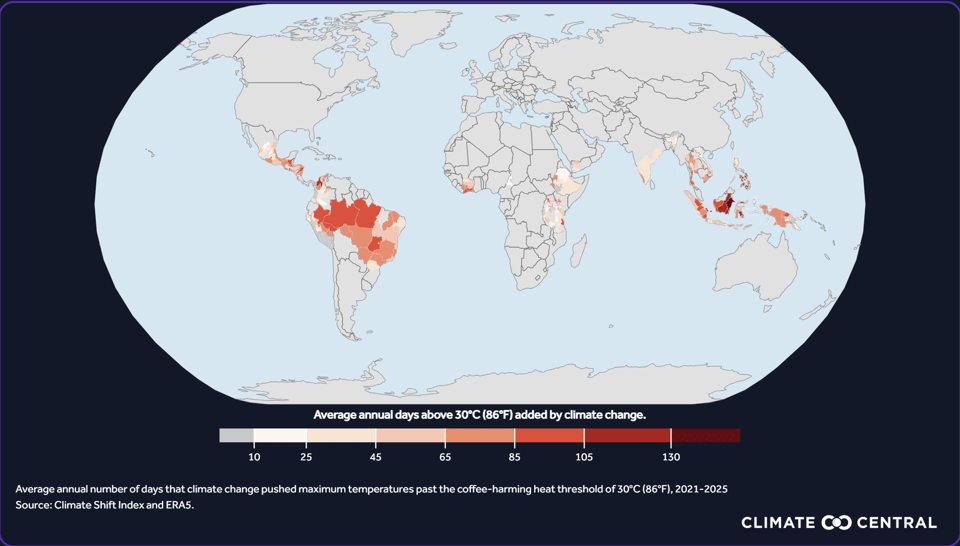
When temperatures rise beyond a threshold, coffee plants undergo heat stress, which can reduce yields, affect bean quality, and make plants more vulnerable to disease. In a nutshell, climate change is the reason why your coffee prices shot up. In the U.S., the median monthly price of a regular coffee cup on restaurant menus in December 2025 was $3.61, up 3.4% compared to December 2024.
Akshay Dashrath, Co-Founder and Grower at the South India Coffee Company, told Climate Central that the impact is felt on their coffee farms. “At Mooleh Manay, our farm, climate change isn’t something we’re predicting, it’s something we’re measuring every day. Our on-ground sensors show longer stretches of high daytime temperatures, warmer nights, and faster soil moisture loss than what coffee here has historically depended on,” he says.
Climate Central also quoted Dejene Dadi, General Manager of Oromia Coffee Farmers Cooperatives Union (OCFCU), in the report. OCFCU is a smallholder cooperative that is one of the largest coffee producers and exporters in Ethiopia, said, "Coffee farmers in Ethiopia are already seeing the impact of extreme heat. Ethiopian Arabica is particularly sensitive to direct sunlight. Without sufficient shade, coffee trees produce fewer beans and become more vulnerable to disease,” Dadi says.
So, the next time someone tells you that climate change is all about rising sea levels or melting glaciers and doesn’t affect them, tell them that it is coming straight for their morning cup. It might hit them harder.
Warmly,
Laasya Shekhar
Managing Editor
Like this newsletter? Share it with a friend and subscribe below!
✨ NEWS BEHIND THE NEWS
💸 Thank you to a new donor who chipped in $20 to help keep our lights on! ICYMI, we are still nine new members short of meeting our February target; support our independent reporting here.
🏆 An investigation by our contributor Abdullahi Jimoh last October on how bureaucratic lapses led to Nigeria's paraquat crisis with global consequences has received a Jury's recommendation at the KAS Media Africa Award for Local Journalism. Congrats!
🎉 Congrats to our contributor Rohini Subrahmanyam, who has been named one of three 2026 early-career fellows by The Open Notebook! Check out this feature she wrote for us about the renewed debate on which came first: sponges or comb jellies.
💀 What are the biggest climate polluters near you? Check out this awesome resource compiled by our alum Karin Kirk for Yale Climate Connections.
🔥 Listen to this three-part podcast series on the impact of Los Angeles wildfires on the lives of five USC professors who lost their homes and communities. Our advisory board member, Rhysea Agrawal, designed the artwork, directed the special season, and served as one of the two associate producers in her current capacity as the USC Annenberg Center for Climate Journalism’s engagement coordinator.
🏹 A SOUTHERN SPARTAN FLAIR
SPARTA, Ga. — Georgia Is Letting a Railroad Seize Land a Black Family Has Owned For 100 Years (Adam Mahoney & Aallyah Wright, Capital B)
“This happens to be Black History Month, and we were looking at our culture and our heritage and how his grandparents and great grandparents got this land,” said Diane Smith, a member of the Smith family.
“We’re fighting against a man whose wealth came from slavery,” her husband, Blaine, added.SPARTANBURG COUNTY, S.C. — Mom of 7-year-old hospitalized with brain swelling from measles: ‘I still wouldn’t have given my son the vaccine’ (Rhian Lubin, The Independent)
You don't get measles encephalitis unless you have measles, and we have a very good vaccine for measles. As somebody who treats the worst of these encephalitis cases, it's hard to swallow that we have a vaccine-preventable infection and we're seeing encephalitis from that.
— Dr Kiran Thakur, Herbert Irving associate professor of neurology at Columbia University Irving Medical Center, New York Presbyterian HospitalAlso from SPARTANBURG COUNTY, S.C. — South Carolina Hospitals Aren’t Required to Disclose Measles-Related Admissions. That Leaves Doctors in the Dark. (Jennifer Berry Hawes, ProPublica)
“We don’t think we are getting an accurate picture at all of how these illnesses are impacting our community,” Linda Bell, the South Carolina state epidemiologist, said at a briefing last month. “We’re just not getting a picture of that now with the small number of hospitalizations that are known to us.”
🗺️ WHAT ELSE WE'RE READING
KYIV, Ukraine — How Ukraine Is Turning to Renewables to Keep Heat and Lights On (Paul Hockenos, Yale Environment 360)
“Attacking decentralized solar power installations is not economically rational,” says Ukrainian energy expert Olena Kondratiuk. “Missiles and drones are expensive, and significantly disrupting such systems would require a large number of strikes, while the overall impact on the energy system would remain limited.”
PORTLAND, Ore. — Federal agents keep deploying tear gas near kids. We have no idea what it does to their health. (Barbara Rodriguez, The 19th)
“People have to realize these chemicals are not safe,” said Dr. Afif El-Hasan, a pediatrician and member of the American Lung Association’s board of directors. “We don’t know the long-term effects. We don’t understand their effects on children. Assume that children should have zero exposure to these chemicals.”
CAMBODIA — The quest to warn everyone on Earth about deadly weather (Rebecca Hersher, Ryan Kellman, and Tat Odoum/ NPR)
The solution they came up with was simple. When a flood is coming, local officials in Prek Touch and another village that received U.N. support hook up their phones to their car speakers and drive through town broadcasting the warnings at high volume, so people who don't have cellphones can hear the details of the warning firsthand.
The Olympics are ditching PFAS waxes — and the ‘ridiculous’ speed they gave skiers (Joseph Winters & Tik Root, Grist)
“Any time you’re breathing in fumes and smoke, no matter what it is, it’s probably not great for you,” says Tim Baucom, wax technician for the United States’ cross-country ski team.
We tested the government’s official new AI nutrition tool: Grok (Sarah Todd, Stat News)
“I think the use of AI holds promise for providing tailored nutrition advice in a way that is convenient and low-cost,” says Alyssa Moran, a nutrition policy researcher and epidemiologist at the University of Pennsylvania. But she notes that generative AI, just like human health care providers, tends to perpetuate stereotypes about eating and weight, such as stigmatizing obesity.


Add a comment: