
Yearning for the Apocalypse

As chaos and violence break out across the Middle East in a war led by the US with Israel as junior partner, I wanted to revisit my research on Christian apocalyptic prophecy. This adapted excerpt from my book Wild Faith talks about the evangelical Christians eagerly looking forward to the end of the world—and influencing foreign policy to bring it closer. It’s difficult to conceive of willful courting of disaster for religious reasons, but decades of modern Christian prophecy eagerly foresee mass bloodshed in the Middle East as a prelude to Christ’s triumphant return. Evangelicals of this stripe form a crucial part of Trump's base and governing coalition.

In October 2023, war broke out in Israel. Beginning with the slaughter of more than a thousand Israeli civilians by the terrorist group Hamas and continuing with bombardments, invasion, and starvation of the fenced-in Palestinian enclave of Gaza, the conflict was a devastating humanitarian crisis that drew the attention of the entire world. For some American evangelicals, however, the slaughter was an occasion for celebration.
“Does the ongoing bloodshed in Israel point to a potential fulfillment of Bible prophecy?” asked the evangelical Christian Post on October 10, 2023, three days after the initial massacre. The evangelical pastor Greg Laurie, author of more than seventy Christian books and a former spiritual adviser to the Trump administration, had a ready answer. “Fasten your seat belt because… you’re seeing Bible prophecy fulfilled in your lifetime in real-time before your very eyes,” he said in a video posted to YouTube that week that racked up 1.4 million views.
Laurie is among the millions of evangelicals who view the modern state of Israel as “God’s timepiece,” whose demise will serve as the starting point for the end of the world. It is these evangelicals who consider themselves Christian Zionists and whose unswerving support for Israel has a profound impact on Republican foreign policy. Its roots are in a stark vision of apocalypse that will culminate in the ecstatic Rapture of Christian believers, even as the rest of the world descends into misery. As thousands died in Israel and Gaza and the war cast the region into turmoil, some American evangelicals reacted with almost palpable glee.
“It is obvious that Israel’s enemies do not recognize that God has given that land to the Jews and that the Jews must be in the land for the final End Time prophecies to be fulfilled,” wrote Wayne J. Edwards, the pastor of Heritage Baptist Church in Perry, Georgia, as the death toll continued to rise. “Just think! God has allowed us to see the day when His prophetic clock started running again. We are the generation to see the final biblical prophecies come to pass. Rejoice! The King is coming!”
It was a cheering on of the Apocalypse from the cheap seats, a heady sense that the end of the world had started in the field of corpses. The chorus of voices eagerly anticipating Christ’s return from that violent beginning epitomized evangelicals’ reliance on prophecy-not least in directing their views of US foreign policy and their unwavering support of military aid for Israel, the better to witness conflict on a global scale, the battle of Gog and Magog prophesied by Ezekiel.
“These are the folks who believe that there will be a millennium in the future, a golden age, where Christ reigns on Earth, (and) they believe that before Christ will return, there will be a tribulation where Christ defeats evil,” explained the politics professor Elizabeth Oldmixon in a Vox interview, describing Christian Zionists. “There will be natural disasters and wars, and perhaps an Antichrist, as the Book of Revelation notes. Then at the end of that period, the people of the Mosaic covenant, including the Jews, will convert. Then after their conversion, the great millennium starts.”
Prophecy is a mainstay of American evangelical Christianity that has grown ever more prominent in recent years. But it is the ultimate prophecy that fuels that hunger for God among the flock—the irresistible return, again and again, to the end of the world and with it the ultimate vindication of Christian faith. To that end, devoted Christian Zionists have spent tens of millions of dollars in support of ongoing Israeli settlement within the disputed territory of the West Bank; volunteer “Christian farmhands” have devoted their labor to further shoring up the Jewish presence in the “biblical heartland”; and the faithful solicit dollars, hearts, and minds to make imminent the end of the world.
One particularly grotesque element of Christian Zionism is the fact that while its views on Jews are intensely utilitarian—they must own the land of Israel, then die en masse, as a trigger condition for Christ’s return—their views on Palestine are even darker. Palestinians, being extraneous to the Apocalypse, are viewed as an obstacle to its coming. Evangelicals have accordingly made alliances with the most extremist elements of Israeli society, joining together in a mutual desire to expel or annihilate Palestinians from the “biblical heartland.” The necessity of such an annihilation is a major part of why Christians are so militant about “standing with Israel”: by eliminating Palestinians, Jews edge closer to the eschatological preconditions that will presage Christ’s return.
This has been borne out over decades, with evangelical advisers to George W. Bush causing that administration to slow-walk support for a nascent Palestinian state and the Trump administration’s open support for ever more aggressive Jewish settlement within Palestinian territory. The influx of ready evangelical cash has also led to a rightward drift among Israeli governments, culminating in the Benjamin Netanyahu administration. The influence of evangelicals from across the sea is a mixture of zealotry and money whose ultimate goal is to bring the Apocalypse into being by force of will and by the manipulation of geopolitics. It is a literal vision of a world-swallowing inferno, and those who are dedicated to hastening Christ’s return are doing their best to fan the flames.
The most striking—and literal—endeavor in this vein is a joint project among eschatologically minded evangelical Christians in the United States and a fringe sect of Jewish zealots in Israel, who have sought since 1989 to breed a red heifer without blemish. As dictated in the purity rituals outlined in Numbers 19, the sacred cow’s ashes are a precondition for the return of Jewish sacrifice in a rebuilt holy temple.
“A longing for the rapture and the return of Jesus on Earth is at the core of Evangelicalism,” wrote Lawrence Wright in a 1998 New Yorker article about the red heifer initiative. “These prophecies require three great events before the Messiah can return: the nation of Israel must be restored; Jerusalem must be a Jewish city; and the Temple, the center of worship and sacrifice in the ancient Jewish world, which was last destroyed by the Romans in 70 A.D., must be rebuilt… In order for the Jews to rebuild the Temple and prepare the way for the return of the Messiah they must be purified with the ashes of a red heifer.” For generations, a collection of Mississippi cattle breeders, led by a Pentecostal preacher named Clyde Lott, has sought to breed a red heifer without blemish in Israel, so its ashes may be scattered over the beginning of a new world. As recently as September 2022, five red calves were shipped by a Texan rancher and minister, Byron Stinson, to Israel’s Ben Gurion Airport.
The Sword and the Sandwich is a newsletter about deadly serious extremism and serious sandwiches. Please consider supporting this work with a paid subscription:
Although the heifer and its ashes are a potent example of biblical literalism, the apocalyptically-oriented strain in Christian thought has far more prominent and moneyed representatives. Perhaps the most famous of these is Pastor John Hagee, the founder of the enormously influential lobby Christians United for Israel (CUFI), an organization that claims 10 million members (significantly more than the approximately 8 million Jews who live in the United States). CUFI, founded in 2006, routinely runs missions, fundraisers, campus initiatives, summits, marches, and “Stand with Israel” prayer meetings. Its influence is difficult to overstate; it is the foremost Christian Zionist organization in the country.
Hagee also, as indicated in his public rhetoric, seems to personally despise Jews. Despite his fiscal and propagandist support of Israel, Hagee has rationalized the history of persecution of the Jews as divine punishment for their disobedience of Christ. He has stated that Adolf Hitler was a “half-breed” Jew and that the Antichrist will be a homosexual, deceiving Jew; he has also accused “Rothschild bankers” of controlling the US economy. In a late-’90s sermon, he famously remarked that God sent Adolf Hitler, a “hunter,” to help Jews reach the promised land. (Hagee isn’t the only prominent Christian pastor to embrace Christian Zionism while denigrating Jews: Robert Jeffress, an internationally famous televangelist, gave the prayer at the opening of America’s new embassy in Jerusalem in 2018—while having maintained for decades that Judaism leads people “away from God… to an eternity of separation from God in Hell.”)
The same year he founded CUFI, Hagee wrote a book laying out his specific geopolitical thesis of the End Times titled Jerusalem Countdown: A Warning to the World (later adapted into a Christian thriller film in 2011). In it, he predicted a vast and bloody war preceding Christ’s return and the Rapture, in which Russia and Islamic nations descend on Israel and are slaughtered: “How many dead will there be? According to [Ezekiel 39] verses 11 and 12, the physical death is going to be so massive it will take every able-bodied man in Israel seven months to bury the dead,” Hagee predicted. “The message is that God is in total control of what appears to be a hopeless situation for Israel. He has dragged these anti-Semitic nations to the nations of Israel to crush them so that the Jews of Israel as a whole will confess that He is the Lord.”
Despite—or perhaps because of—his blood-drenched rhetoric, Hagee is a prominent figure in the American evangelical landscape and in the Republican Party. He has appeared repeatedly with Donald Trump while courting other prominent right-wing political figures. Mike Pence, Nikki Haley, and Ron DeSantis all appeared beside Hagee at Christian events during the 2023 Republican primaries.
“As a believer in dispensationalism, Hagee embraces a very specific theodicy: the 1,000-year reign of Christ on earth. Those who share this theology see the establishment of the modern state of Israel as a key milestone,” explained Daniel Benjamin at the conservative Brookings Institution in a rebuke of Hagee’s extremism during the 2008 presidential campaign. “Future ones include the ingathering of the Jews within Israel… After that, things really get moving: Different sects have different sequences, but these often include a Rapture, when the dead whom God wishes to redeem are resurrected and the living who are chosen for salvation are brought to heaven; the Second Coming; and the Antichrist's annihilation in Armageddon. For some dispensationalists, the Jews will also have to die in the process.” Hagee is very much in the last camp. In the Armageddon he so eagerly anticipates and seeks to bring closer through militant policies in the Middle East—advocating war with Iran after an Iranian missile barrage struck Israel in April 2024, for example—Israel will be covered with a “sea of blood.”
Neither are his views isolated and unrepresentative of the evangelical community at large. In a poll conducted in 2017 by the Southern Baptist Convention-affiliated organization Lifeway Research, a staggering 80 percent of evangelicals agreed with the statement that the creation of the modern State of Israel was a “fulfillment of Bible prophecy that shows we are getting closer to the return of Jesus Christ.”
From red heifers to Middle East wars and beyond, Christian belief in the United States is undergirded by a yearning for the Millennium and Christ’s return. The prophetic clock that is ticking ever closer to that date of triumph dictates the responses of millions of American Christians to world events both at home and abroad. During the peak of the covid-19 pandemic, to cite a prominent example, Christian observers in the United States saw another dramatic prefiguring of the End Times—and based their responses to public health campaigns on a violent interpretation of the book of Revelation.
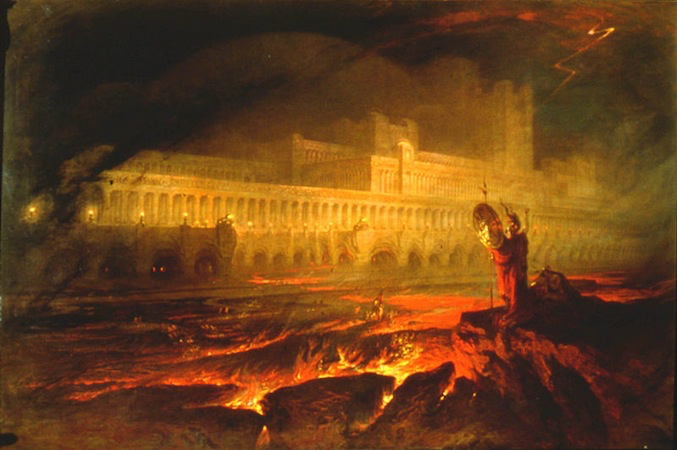
The concept of the “Mark of the Beast” is derived from a gnomic passage in the book of Revelation, the final book of the New Testament:
And he causeth all, both small and great, rich and poor, free and bond, to receive a mark in their right hand, or in their foreheads:
And that no man might buy or sell, save he that had the mark, or the name of the beast, or the number of his name. (13:16-17)
In Revelation, the Mark of the Beast distinguishes the faithful from the faithless; those who reject it, even on pain of death, will be among Christ’s elect. While that idea clearly has a lot of staying power, it’s been a very long time, since around AD 95, when John of Patmos most likely composed his ominous vision of evil dragons, blood-drinking whores, golden girdles, and cryptic numerology. The book has been a point of contention throughout Christian history—it was a late and controversial addition to the biblical canon; Martin Luther used it as a rhetorical weapon against the Vatican, which responded in kind. But despite its long, dramatic past, many American evangelicals have, for generations, considered Revelation to be a deeply contemporary and urgent vision.
The idea that the covid-19 vaccine was the fabled Mark of the Beast exploded with the arrival of widespread vaccine rollouts and mandates. Two TikTok hashtags, #MarkOfTheBeastIsTheCovid19Vaccine and #VaccinelsTheMarkOfTheBeast, reached some seven hundred thousand views in 2021 before being banned by the service. An RNC official in Florida declared that Michigan governor Gretchen Whitmer was acting as a servant of Satan, forcing her constituents to get the mark in the form of the vaccine.
Christian eschatology looms large in the American evangelical mind; according to a Pew Research Center poll from 2010, a full 41 percent of Americans expect Jesus Christ to return by 2050. The historian Randall Balmer called premillenarian dispensationalism a “theology of despair” because once it caught hold at the turn of the nineteenth century, evangelical Christians could look ahead to the Rapture and give up their previously held notion that the faithful should live better lives on an earth that would shortly be crisped to bits in the fire of Apocalypse.
Many scholars, by contrast, view Revelation as a thinly veiled critique of the Roman Empire, with the Mark of the Beast referring to likenesses of the emperor Nero on imperial coins, seals, and stamps. Supporting this thesis is the much touted scriptural companion to the Mark of the Beast—the Number of the Beast, 666, as laid out in Revelation 13:18: “Here is wisdom: Let him that hath understanding count the number of the beast, for it is the number of a man; and his number is Six hundred threescore and six.”
Of course, if you buy that 666 means Nero, that means John of Patmos’s prophecies refer to events of the first-century Roman world. That’s antithetical to the stance of Christian futurists, who are on constant tenterhooks for the Apocalypse. Much of the premillenarian dispensationalist worldview hinges on elaborate extrapolations from individual verses across both testaments, with Daniel and 1 Thessalonians particularly favored, and atextual, multi-millennial gaps inserted at convenient points in prophecy.
It’s an obsession with the End Times that sees Armageddon everywhere, particularly in contemporary politics, which are perpetually teetering on the edge of a time of great persecution for Christians. The fear of persecution as laid out in prophecy and the belief that the faithful must secure Christ’s return through their actions engender both fear and ecstasy in believers. For postmillennialists, this entails securing a kingdom of Christ on Earth; for premillennialists, it means a game of imminentizing the eschaton, drawing the Apocalypse closer and closer to the blissful End of Days.
The most popular vision of premillenarian End Times eschatology was embodied in Tim LaHaye and Jerry B. Jenkins’s Left Behind series, a particular adaptation of Revelation that features rugged, wholesome American Christians (its protagonists are named Buck Williams and Rayford Steele) finding salvation amid the turmoil of Tribulation. Like Frank Peretti’s This Present Darkness, the Left Behind books offered a populist, action-packed view of theology that burned its way into the evangelical mind with far more impact than a dry sermon or a Sunday school lesson ever could. Since its release as a sixteen-book series of novels between 1995 and 2007, the series has sold more than sixty million copies. It’s also been adapted into a best-selling graphic-novel series, a film starring the former “Growing Pains” actor and current Christian Right fanatic Kirk Cameron, and the eschatological proof text of a generation of young Christians.
As apocalyptic visions began to dominate the Christian cultural landscape, former evangelical writers such as Slate’s Joshua Rivera have noted that an evangelical upbringing led them to a constant state of ecstatic tension about the likelihood of the End of Days. “It’s hard to overstate how large the rapture loomed while I was growing up in the evangelical world. As a child, I was taught that I might live to see the end of the world,” Rivera wrote in 2021. “I learned how to see it coming, too: How the nation of Israel was ‘God’s timepiece’ hitting marks on a prophetic timeline, how the machinations of the Catholic Church and the United Nations would soon come to a head and form a one-world government, how God would be driven out of America’s public square as people looked to other things for salvation.”
That was okay, though, because it meant that the end was near and the faithful would have a reward better than eternal life after death. They’d skip death entirely, “caught up… in the clouds“ as 1 Thessalonians 4:17 puts it, before the earth was allowed to rot in Tribulation; the faithful would observe those horrors in comfort, in the bosom of Christ. The mix of terror and seduction Rivera wrote about—and the alluring nature of an apocalyptic vision in which evangelicals’ special status will become undeniable as they are literally evaporated into Heaven—leads some to work tirelessly toward the promised return. Others see the signs of that return scattered everywhere. An obsession with the Rapture also leads to a Christian culture that treasures images of persecution for faith's sake, the torments of the End Times, and the primacy of believers' purity in an unclean world.
Perhaps the most clearly political of these persecution panics boiled over around Franklin D. Roosevelt’s New Deal. Fundamentalist opposition to FDR was widespread, as it was believed that he was intimately allied with the atheistic forces of world communism. His social welfare policies, in the words of the historian Matthew Sutton, were “subverting God’s order and assuming responsibilities that God had assigned to churches and local communities.” FDR was considered by many in evangelical circles to be a forerunner of the Antichrist, if not the figure himself.
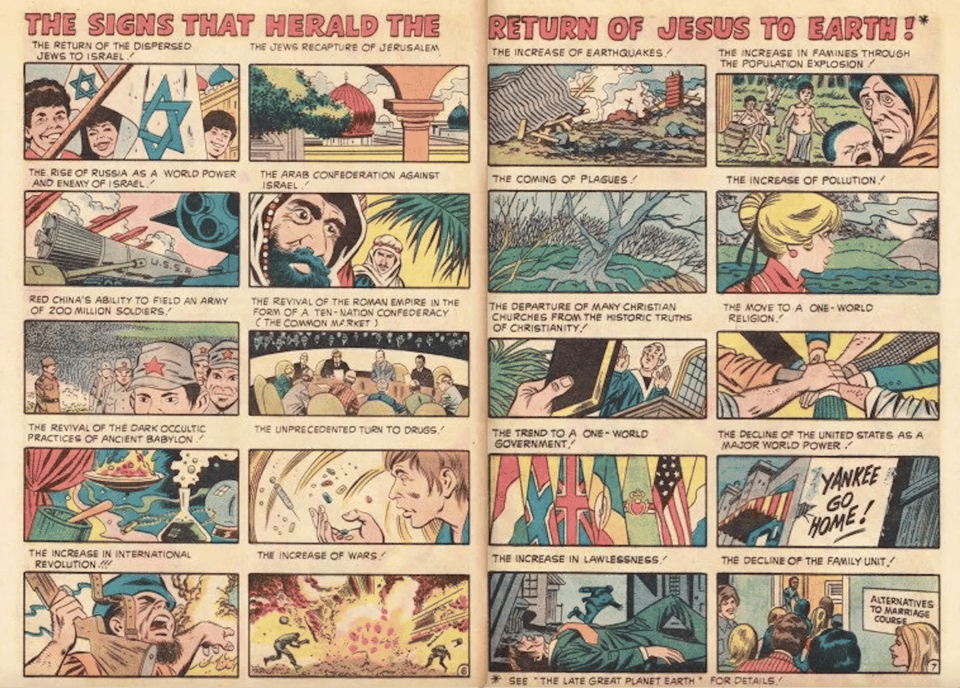
Apocalyptic thinking became a particular Christian cause célèbre in the 1970s, following the wild success of a book by the premillenarian dispensationalist Hal Lindsey called The Late Great Planet Earth. The book was an entreaty for the faithful to look to Christ in the imminent time of Tribulation, heralded by the European Common Market, drug use, “Communist subversion,” the establishment of the State of Israel, and “the alliance of the Arabs and the Russians,” among other signs. It’s difficult to overstate the influence Lindsey had; like many purely Christian phenomena, his influence might not have penetrated the mainstream, but it changed the tenor of fundamentalist Christianity, shifting its focus from the present to a near-term, apocalyptic future beset by omens of doom. Between 1970 and 1999, the book sold an estimated 35 million copies in more than 50 languages, warning direly of the “computerized society” that would enable “everyone who will not swear allegiance to the Dictator to be put to death or to be in a situation where they cannot buy or sell or hold a job.”
Following directly on Lindsey’s apocalyptic vision, emerging commercial technologies became specific focal points for End Times panics. Barcodes for scanning products with greater ease were introduced in the United States in the mid-1970s—and immediately ran into the rising apocalyptic fervor. Protests took place at grocery stores; an urban legend spread that the Number of the Beast, 666, was embedded in the lines of the code. One of the IBM engineers who invented barcodes, also known as Universal Product Codes (UPCs), received an anonymous letter purporting to be from Satan himself, thanking the man for carrying out his wishes so precisely.
Anxieties about the mark and what it heralds—Tribulation, Rapture, the enemies of Christ consigned forever to a flaming abyss—were and are commingled with a certain eager anticipation. “I think we have to recognize it as a hopeful sort of terror,” Anna Merlan, the author of Republic of Lies: American Conspiracy Theorists and Their Surprising Rise to Power, told me in an interview. “If you’re a millenarian or not, the folks who believe in the mark of the beast also want to see it appear, since it marks the beginning of the period of time that ends with the Second Coming. That's why there have been so many false starts. It's a hope that their suffering-for example, being asked to get vaccinated-will be rewarded.”
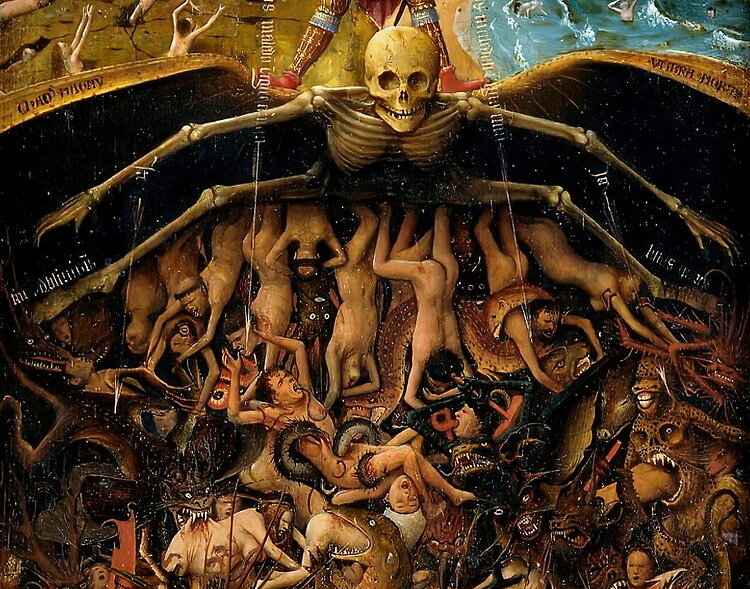
If you are a self-determined member of the elect, schooled to await the Apocalypse from your earliest days, the end of the world coincides with the destruction of your perceived enemies and your elevation to the ranks of the angels. The exultant reaction to the Israel-Hamas war, coupled with demonstrations of public support for Israel, typifies this duality of agony and ecstasy. In the early, bloody days of the war in November 2023, a group of Missouri-based, cowboy-hatted “farmhands” affiliated with the Christian Zionist organization HaYovel (“The Jubilee” in English) landed at Ben Gurion Airport in order to volunteer in the West Bank—during a period in which violence by Jewish settlers against Palestinians had been rising to epidemic proportions. “The time has come for Bible believers to stand,” read a post on HaYovel’s website on November 1, 2023. “Stand with Israel. Stand with Zion. Stand with the Jewish people. Stand with God’s Kingdom.”
In 2 Peter 3:11-13, the apostle declares that Christians should act “in holy conduct and godliness, looking for and hastening the coming of the day of God, because of which the heavens will be dissolved, being on fire, and the elements will melt with fervent heat” (NIv). The act of “hastening the coming” is interpreted in many ways by different Christians: some extremists seek to establish a holy kingdom in the United States, others to usher in a bloody struggle that will explode into the End of Days.
Whether this entails theocracy at home or militancy abroad, Christian eschatology is an underrated factor in US government policy—one that has a direct impact on the lives of millions of people in the here and now.
Many former evangelicals have written about the terror that the Rapture instilled in them as children—the expectation that any day, they or their parents would vanish into the arms of Jesus, never to return. That fear was intimate and present, a catch in the throat upon opening the door and wondering if your loved ones would be there or gone forever. The notion of martyrdom can be thrilling—thrilling enough to dramatize and act out on TikTok over and over again—but it also means that you have to die. Too many people, led by the fickle forces of prophecy and belief, have done just that, whether through the protracted glass-lung death of unvaccinated covid-19, via the religiously inspired skepticism of mainstream health care treatments, or in wars and conflicts eagerly cheered on—and funded-by American Christians.
In seeking to hasten the end of the world, evangelicals often make it worse for others who do not anticipate being snatched up into the clouds to sit by Christ’s side as the seas boil and Satan takes possession of the earth. For those who are not perennially looking out for signs of Armageddon and awaiting it as a child waits for a father to return, the drama of Apocalypse looks merely like a collection of people who, in waiting for the world to end, are actively worsening life in the present.

-
Excellent overview of pre-millinarian-dispensationalism and its hold on Far Right Evangelicals. As you may know, one the main "drivers of this is Dallas Seminary.
-
I found this both illuminating and terrifying to read. It did answer a lot of the questions I had about American zionism and their obvious thirst for bloodshed. I might have to buy the book. Excellent work as always, Tal 🫶
Add a comment: