
The Submarine of Czechia: Or, The Life of a Spy at Mar-a-Lago
A version of this short story was originally published in Flaming Hydra, an art collective I'm proud to be a part of. This is most definitely a work of fiction.
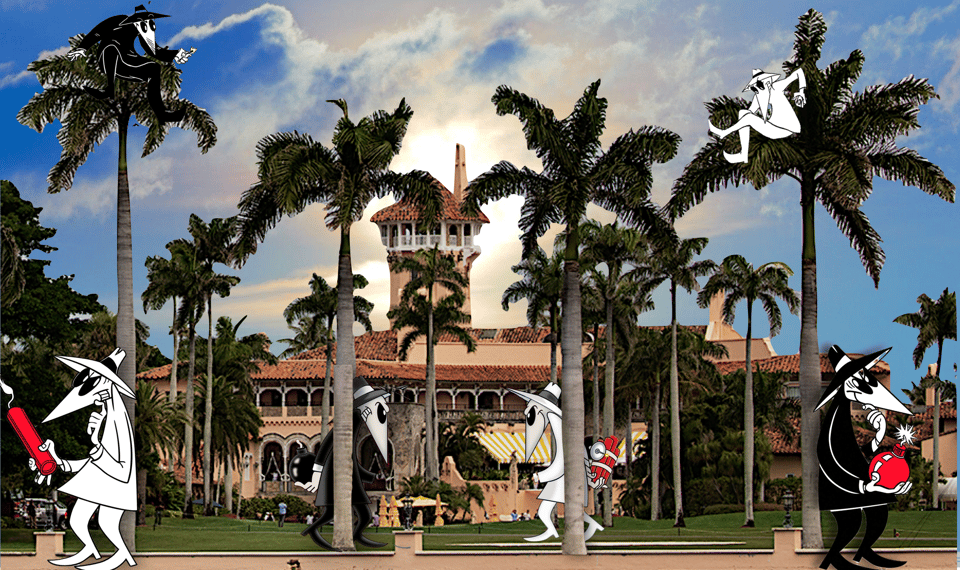
Adéla adjusts her gown just a little bit lower so that the peaks of her nipples—artificially enhanced, along with the rest of her bosom, neck, legs, hairline and buccal fat—tease at the gauzy fabric. The dress is a carefully-judged shade of silver, adorned with spangles. In her area of assignment, one way to fade into the background is to conceal herself as just one more shiny object, designed to catch the attention only for a moment. Mar-a-Lago—the Florida mansion where the American president makes wars, and deals, and spends leisure time with his court—has rooms that are very shiny. Its denizens are as shiny as inbred koi, and so for her own purposes is she, though her purposes are not really her own at all.
Her jewels glitter too, a long pendant with a teardrop emerald that dangles between aforesaid augmented breasts, a platinum bracelet in the form of a snake with emerald eyes that clasps the whole of one forearm, a thick silver cuff on the other. Only the pendant, which contains a microcamera, and her earrings, which house miniature microphones and are dreadfully uncomfortable, are concrete pieces of her tradecraft. Hardware, straight from Czechia, like Adéla herself, handed over along with the rest of the couture wardrobe attached to this identity (and to several others), with great solemnity, in a little grey backroom of BIS headquarters on Nárožní Street on a rainy gray day in Prague. The little technician Ivo had showed her the microphones in the faked-up gems with a craftsman’s pride; Jaromir, her handler of several years, had been nearly in tears, so moved was he by the importance of the assignment, by the gravity of her duties, by the opportunities the operation represented for Czechia, for her, and of course, by extension, for himself and his service.
The woman she was then, a year ago, had been proud of speaking seven languages; as an undergraduate studying theatre, she had read through Kundera and Nesvadba, Dyk and Holub and Topol. Though Adéla was not a product of the Cold War itself but the first generation beyond the shadow of the Curtain, the memory of those times was vivid in her, absorbed through the words of playwrights and the memories of her parents and grandparents, of her country as the small and hapless chew-toy of reckless imperial hounds. A BIS recruiter had approached her after her college-drama turn as Maria in Vaclav Havel’s black comedy The Memorandum; she’d played a bureaucrat who fell victim to spycraft, and, in turn, had been recruited to be a real-life spy.
She’d appreciated the irony of it, and was also rather thrilled to engage in this subtler sort of theater, with its far higher stakes and no audience, or an audience of gulls or fools or outright enemies. She had spent the scant few years of her adult life thus far in the service, helping in a small way to flush the FSB out of Prague by means, for example, of a few dates with a cash-flashing ass named Gleb eager to woo the shy, delicate shopgirl she’d played. She had a keen talent for mimicry, and had easily taken on seven or eight new identities in a year. A secretary in Brno, a student in Ostrava; once she had been three different girls in Prague in three months. Jaromir said she was the best agent he’d ever worked with, and he’d been around since Czechia was still Czechoslovakia, an old man who refused to stop smoking inside the building, or to retire.
The Sword and the Sandwich is a newsletter about deadly serious extremism and serious sandwiches. Please consider supporting this work with a paid subscription:
Now she’d been selected for deep cover, an assignment in a different category entirely. She’d balked at first at the number of cosmetic surgeries, the nose job and the lip filler and the mountainous breasts, in particular, that had so suddenly and painfully replaced her own unassuming bosom. The spray-tan made her pale arms unrecognizable; the mouse-brown hair that had rendered her invisible in Prague or Plzeň turned blonde balayage. “I can’t come back from this, Jaromir,” she’d said, before the first surgery at the anonymous little clinic in Moldova whose bill the service was footing. “I will look different for all my life. And I can’t fade into Czechia like this. Nobody looks like this at home! And who would want to! What are you doing to me?”
“This is the big one,” he’d said, solemnly, pinching out his cigarette between his lumpy thumb and forefinger. “You don’t come back from this into street duty; if you’re burned, you get back however you can and we’ll secure you deep in headquarters. But this—this is maybe bigger even than our Washington agent. You’ll learn who’s influencing the Americans, who’s guiding them into what war, before the bombs drop on our heads. We’re no longer the shuttlecock of empires, no longer spending our days spying on our own brothers and sisters. We’re launching you out like a submarine, my darling. Consider this new cladding for rougher seas.”
This was spycraft: you sacrificed your body. Slicking on a layer of lip gloss, she wished it had been as simple as a bullet to the heart. The plasticized alien she was now, with a face she’d had to learn anew after the swelling went down, spoke the placeless unaccented English she had learned through hours upon hours of watching sitcoms made after 1996, HBO dramas, One Tree Hill, and, her personal favorite, The O.C. From a steel-haired Cold War hand named Marika she had learned about what was euphemistically described as “strategic intercourse.” It was in her interest, Marika explained, to be as unobtrusive as possible in the process of being seduced. “They are already inclined to view you as furniture,” she said. “A person is careless and shameless in front of a chair, a sofa. Aid them in their own tendency to find you harmless, untroubling, unworthy of notice.”
The women she’d seen in photographs of gatherings in the compound nearly all had the same new face she’d been given. It would have made her freakish in her hometown of Ptice, but here, in the hard savage plastic heart of things, it made her unremarkable as a lamp.
The limp little life story of her cover identity—Sasha Hart, the Tampa-born widow of a wealthy car dealership owner had been drilled so deeply into her mind that sometimes it was Adéla who felt like a dream. The forgers had created beautifully meticulous documents, their nimble hands deftly reproducing the latest holography. Sasha Hart had never read a play in her life; she was looking for the simplest possible story: a second, richer husband. But in the end, Adéla had thought as she disembarked from the plane at Palm Beach International, tossing her Czech papers, folded between the leaves of several airline magazines, in an anonymous public dumpster, the sacrifice would be worth it.
She pulled Sasha’s documentation from a carefully sewn compartment in the lining of her skirt. She was the submarine of Czechia: she would learn just how far Russian influence went among the President’s cadre, how deeply Riyadh and Shanghai and Istanbul and the rest had influenced their ranks and by what means. At this shadow White House, where the sun was always blinding and everything was gilt, she would detect, with impeccable radar, every subtle movement of the shadow world.
In the end, it had been insultingly easy.
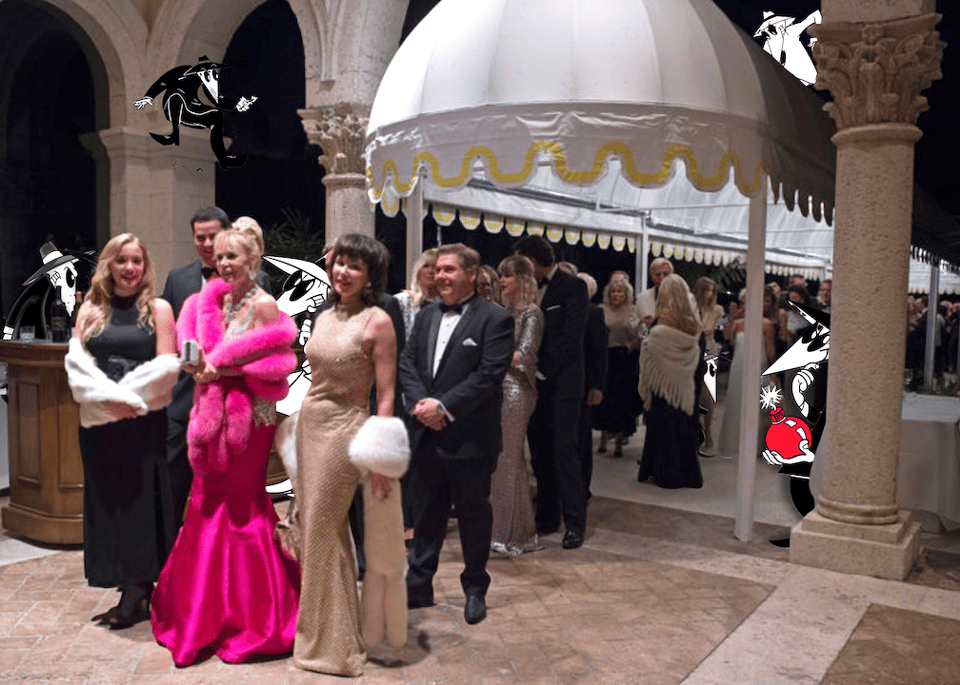
All you really had to do to get these guys talking was to listen, wide-eyed. Sasha Hart was good at not talking, at breathy “mmhmms,” at heavy-lidded gazes and attentive nods. The first Secret Service agent she’d taken to bed had been too drunk to get it up, diky Kristu, and had nearly wept onto her Pilates-sculpted thighs about how much he loathed the man he guarded, how often he talked about various dictators in the most adoring terms, and had he really trained for so long just for this? She felt some sympathy—but not enough to refrain from slipping a little Valium into his whiskey and rifling through his pockets after he fell asleep.
Her first FBI agent was still more disappointing. Even though he was among the new class that had come in with Kash Patel, Adéla had watched all of The X-Files and Mindhunter and had expected rather more from him than snorting a line of crushed Xanax off her plastic breasts and falling asleep with his cock out and his briefcase at the foot of the bed. She’d photographed every file and dead-dropped it in a gardenia plant outside the CVS, where a recipient of the Order of Tomáš Masaryk for services to the Czech state had a daughter who worked in the 24-hour pharmacy.
She didn’t even have to take them to bed, most of the time. The breathy pause, a big-eyed encouragement to boasting, was enough; the promise was enough. All she had to do was echo a few of their more promising words, and otherwise maintain a heavy-lidded silence. Light conversation, heavy booze, a steady progression of long warm nights: a yacht salesman with a brother in the DoD who turned out to be acquainted with some very senior UAE officials; a very young, gimlet-eyed man from the Executive Office of the President showed her his Rhodesian flag tattoo and asked if she liked to be choked. She became a human mirror for their own self-admiration: an admiral, a senior bureaucrat at the Department of Energy, a senatorial aide. It was so easy, and the resort’s membership committee had swallowed her cover so readily; she was almost lulled. And yet the secrets they kept could kill people and were killing people. Sometimes, no doubt, people like herself.
Almost immediately, with the third eye developed by clandestine operations in the field, she saw just how many other spies there were in the resort and its surroundings. It started with noticing who was just a bit too curious about biographical details; who pretended to be drunker than they really were; who kept an eye on the trash cans for papers, who scooped up other people’s bags and briefcases left next to a chair or on a big round banquet table. And once she’d started playing spot the spy, she couldn’t stop.
By the time she’d been living in Palm Beach for six months, she’d begun wondering whether there were any actual Floridians on staff at all, and just how much they were making from clandestine payments to be cutouts or sources. Probably enough to retire, perhaps to Monaco. (Monaco’s agent, a dry little man with a sour mouth, worked on the banqueting staff, alongside Rome’s man, and Madrid’s; they all hated each other and expressed it by feuding over placecard fonts and floral arrangements.)
There was a German in valet parking. A Belgian and a Swiss at odds over vol-au-vents in the kitchen. A small contingent of African spies (Senegal, Cote d’Ivoire, Gabon) on the janitorial staff, relatively careless about Francophone eavesdroppers. She spotted a very young and nervous Turkmen agent shoving a dead-drop spike into the eye of a gaudy reindeer statue at Christmastime, and duly stole it, learning his real name (Kasymguly) and workname (Kevin) in the process. The waitstaff had a Russian agent named Vladimir and a Ukrainian agent named Volodymyr and they’d nearly killed each other in the west parking lot one night. The Polish agent Włodzimierz, who was considerably older and world-weary, smoked a cigarette, watched them brawl, and predicted they’d both be fired for coming to work with visible bruises. He was right, which was a pity; Volodymyr had been very handsome indeed. They were replaced, in due time, by Dmitri and Dmytro, at which point she began to wonder if Kyiv and Moscow were being deliberate about all this for their own inscrutable reasons.
Slovakia had sent a drop-dead gorgeous agent whose tradecraft was immaculate; she wasn’t speaking to Adéla at the moment. (They had a standing cocktail date once a month, though, which each of their respective handlers knew about; the SIS and the BIS had a tight information-sharing agreement, and Jaromir knew Gizela’s handler Bohumil from their Soviet days anyway.) They mostly bonded over mutual hatred for Slovenia’s agent, a simpering waif who’d ingratiated herself with the first lady’s family by means of homemade nut rolls. The bitch.
Australia’s man did the flowerbeds. New Zealand had sent a chappie to labor in the gardens too. Their American accents were vaguely southern, and they tended to avoid officials from below the Mason-Dixon line. Aussie Jack was a lady-killer, though, and was sleeping his way through every Republican wife who still had a beating heart under her twinset and pearls, and skimming quite a bit of information on the side. He called himself a “martyr to his duty.” He and New Zealand Craig were drowning their sorrows by working steadily through all of Florida’s craft beers, one microbrewery at a time. Their relationship was significantly more harmonious than that of the clandestine representatives of Argentina and the Mossad, who had inadvertently dated for several weeks before mutually discovering one another’s identities, and now existed (as bartender and assistant golf green superintendent respectively) in mutually icy disdain, lending further stress to cocktail hour. She’d heard Brazil’s guy in an unwisely loud Portuguese phone call describing the fiasco as “Eichmann, on the rocks.”
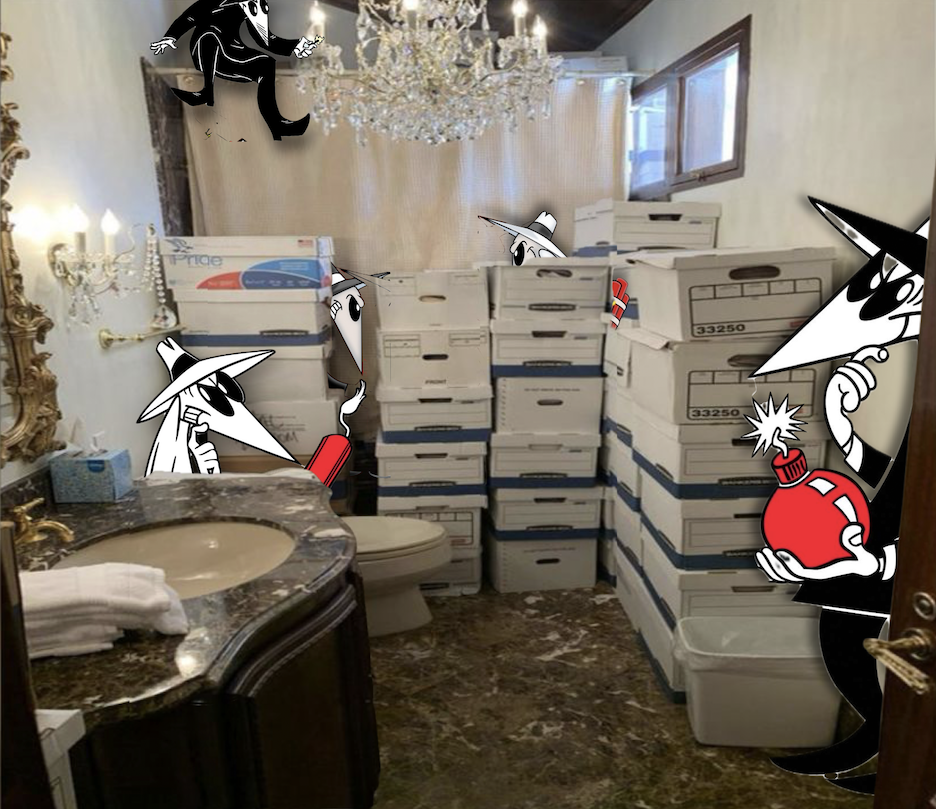
Everyone was jealous of Croatia’s man, a slim, dapper blonde gent who had somehow finagled the task of delivering Diet Cokes to the war room. He wouldn’t tell a soul how he’d gotten it, but the waiter who’d had the assignment beforehand had quit and, rumor had it, had opened a quite successful seafood restaurant on the shore in Hvar. The day she’d found that out, Adéla had, in a fit of pique, stolen the laptop of one of Marco Rubio’s younger aides and discovered he was on the take from Istanbul, Tangier, several crypto companies, and oddly enough Tuvalu, and was engaged in fairly serious cybersex with Alexander Lukashenko’s undeniably hot twenty-one-year-old illegitimate son (although the account was run from Moscow, not Minsk; he was being catfished). She photographed the entire chat history with “Kolya” and was somewhat mollified.
There was enough microphotography and poison in Mar-a-Lago to murder everyone in a ten-mile radius and document every stage of them dying. There was so much bribery going on in front of her eyes each night she wasn’t even surprised when a Saudi agent bumped into her with a suitcase so heavy with gold her leg got seriously bruised. Everyone was as careless in front of the world’s spies as they were in front of the world. They acted as if it didn’t matter, and she was beginning to wonder, as she finished dressing for tonight’s wedding of a beer-magnate Trump donor to a woman sixty years his junior, if it really did matter to anyone but her. But of course it did. She was, in her way, a child of the Velvet Revolution; where you stood mattered. These careless angry men were killing people, they were kidnapping people, there were people in the heart of this tangled net, here where cash and carelessness and cruelty met and commingled in the humid, cologne-scented air.
Two months ago she’d found out that her technician at the tanning salon, the one geographically closest to Mar-a-Lago, was a representative of the DGSE, out of Paris; in Czechia they’d called them the Graveyard Boys, for the proximity of their HQ to Pére Lachaise. She’d caught him out three-quarters of the way down her legs: an inflection in the accent, a quirk in his movements, the nic-fit he couldn’t quite arrest. Now she and Jean (workname: Todd) were cautious friends; he was gay and wouldn’t grope her, which was a fucking relief, and she was equally relieved to be able to talk to someone about how stupid everything was. Up to a point, of course, avoiding operational specifics. They were colleagues in one sense, enemies in another, and friends in a third. He was very good company.
Embarrassingly, they’d gotten drunk together once and she’d quoted Vaclav Havel to him, The Memorandum, the very play that had started it all: “If we take from him his human language, created by the centuries-old tradition of national culture, we shall have prevented him from becoming fully human and plunge him straight into the jaws of self-alienation…" She quoted to him, in French, mournfully, over her fourth Bacardi shot in his flat. “These beasts have taken my human language from me. Once I gathered bilberries on the banks of the Loděnice river, and Jean, nowhere is greener in the whole world; and now I gather poison, and perhaps I will never be able to return…”
In response, Jean had quoted Sartre–Being and Nothingness: “The words of the inner language are like the outlines of the ‘self’ of suffering,” he said, “and you have suffered, ma cherie,” and raised a daiquiri. Standing on his balcony, they’d watched the moon rise over perfect, horrible Florida, where the warmongers made their empty love, and pulled the world down around them, and left with full bank accounts, and the great sea lapped and lapped at the gilded shore, but never managed to pull it under.

-
Excellent! I enjoyed this very much.
-
Great fun, this!
-
Captivating! I need this in an unending series of spy novels, which I will purchase on preorder and await each release with great anticipation.
-
This is wonderful as fiction and terrifying as reality. It recalls the "vast carelessness" from Great Gatsby, except that we're taking about the rulers of empire, and their body count is legion.
-
I want to sit on my couch eating peanut M&Ms while I watch 13 episodes of Adela's adventures, produced by the people who made The Residence
-
↳ In reply to Paprika Pink
Yes, I would love that too, and the people who made The Residence are exactly the ones to make it!
-
Great story, and would make a ripping movie or mini-series.
-
This is terrific, and now I want more, dammit
-
I immediately sent this to several people. This is a masterclass of spy writing and manages to feel real without losing the comedy of it. Incredible work!!
-
Nice. And I think I get a slight whiff of Hunter Thompson...
Add a comment: