
Notable Sandwiches #141: Smörgåstårta

Welcome back to Notable Sandwiches, the feature where my editor David Swanson and I slip messily through Wikipedia’s List of Notable Sandwiches. This week, mayonnaise-slathered Scandinavian specialty: smörgåstårta.
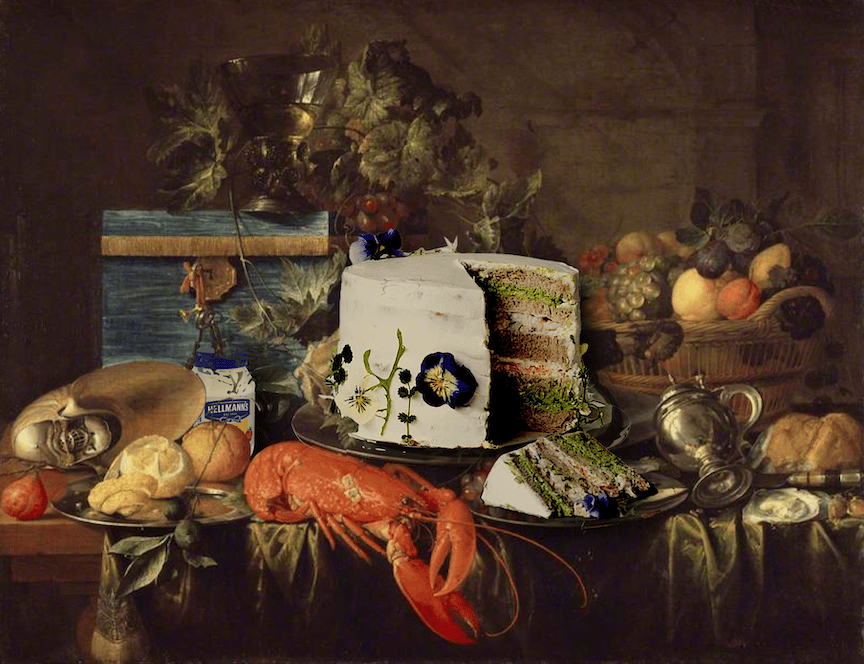
Let us contemplate, for a moment, the crucial binding agent in the glorious loaf that is the smörgåstårta: mayonnaise.
And how it intersected with my own private madness, so that, for a time, I became insane about it. Mad about mayo. That little feral part of me that won’t stop digging hit dead end after dead end, trying to find the facts, trying to untangle the bright thread of credible truth from the endless murk of half-truth and slop and myth and lie. It felt a little like being buried alive. Mayomento mori.
Of all the things to go a little insane over, writing about mayonnaise, in an essay about a Swedish sandwich cake, seems impossibly frivolous. I’ve written about child abuse, I’ve written about neo-Nazis, I’ve gotten death threats credible enough for the FBI to show up at my door; I’ve written about bloody apocalyptic prophecy, read mass-shooter manifestos and analyzed them, written about killings again and again. Sure, maybe there was a process of shattering, pieces breaking off me every time I sat down to write. Maybe it was a decade in coming, the long slow breaking that made me internally collapse about mayonnaise, like a bad emulsion. Maybe it was precisely the jagged dissonance between the essential frivolity of the topic and the impossibility of reaching any truthful answer about it that slid in sharp as a spreading knife.
I thought a book about sandwiches would be easy. All along, I’ve considered these essays an escape—from politics, from the heavier things I’ve written about for most of my career. But inner struggle, or darkness, can’t be descanted with a change of topic. The times I struggled to keep my eyes open and just wanted to sleep for the rest of my life—they aren’t new, and maybe they’re never going away. The times my laptop lid felt like the heaviest thing in the world to lift, and my fingers were numb. It doesn’t matter where you go, what you write about: you carry yourself with you onto the page.
That’s what I learned, in the end, more than any definitive answers about mayo. So many half-truths gathered like silt, and the elusive unknowable thing, the perfect knowledge I was groping after, perpetually out of my reach—it was like chasing a sunspot, a little coin of light spinning away from me, and knowing I was down in the dark, in the river-mud, trying to climb my way out while the tide rose and lapped rancid at my ankles. I was writing from the bottom of a well, and the well was my mind, and you can’t write without using your mind. I could have stood there forever and let the waters rise. But I didn’t. You use the tools you have, and somehow the bad tide ebbed, and my mind was working again. For awhile: maybe it’ll only ever be for awhile, and the best times of my life will be those unpredictable whiles. But light is never so pure as after a long time in darkness. It blinds you as it frees you, and tears gather in your eyes.
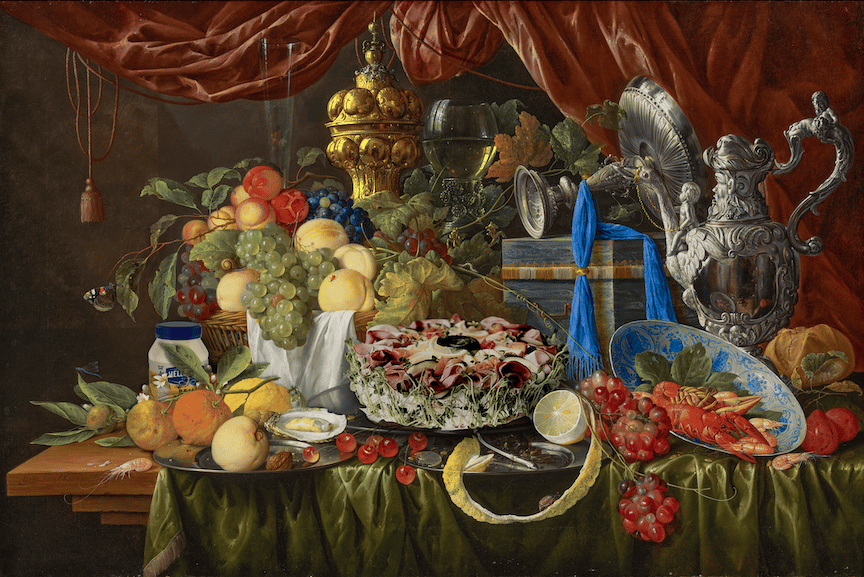
But this is a story about mayonnaise, via a Swedish sandwich cake. Or a fanned-out deck of half-truths: pick a card, any card, and choose what’s real. Or near enough. Sometimes, that’s all you can do.
These essays have addressed bread, and meat of different kinds, at great length, from the history of pig domestication to the agricultural beginnings of wheat cultivation. But leaving out this crucial condiment—near universal in the world of the sandwich, a basic emollient rather than an addendum—is an unaccountable editorial oversight. Where better to begin contemplating it than in the smörgåstårta, that highlight of the Scandinavian festal table?
It’s served at weddings, funerals and celebrations; it is an elaborate cold confection of bread and mayonnaise-based fillings, designed, as per the literal translation of its name, to be a “sandwich cake.” Horizontally sliced loaves, specially prepared for smörgåstårta, can be bought at Swedish supermarkets, defying our expectations of bread in service of revelry. Rye bread, smoked fish, elaborately cut vegetable decorations, lunch meats and pickled herring appear, but the crucial intermediary that binds the thing together—sometimes with the addition of crème fraîche or cream cheese—is mayonnaise.
Whence, then, comes mayonnaise? Its spelling suggests France, which has claimed it and guarded it for two hundred years. It appears in both of the definitional texts of modern French cuisine, Marie-Antoine Carême’s Le pâtissier royal parisien (1815), which codified the French mother sauces and included mayonnaise among them, and Auguste Escoffier’s Le Guide Culinaire (1903), which put French cuisine on the map as the dernier mot in the aristocratic luxury of the table. Yet French scholars have a vigorous internecine debate about its origins, and indeed its original spelling: was it magnonnaise (either after Magnon, France, or the old French verb manier, to manipulate) or bayonnaise (after the French city of Bayonne) before its standardization? Larousse Gastronomique, the legendary 1500-page encyclopedic guide to French cuisine authored by Prosper Montagné in 1938, offers a further theory: that the old French word for egg yolk, moyeu, was corrupted from moyeunnaise into mayonnaise.
All of these theses are essentially just vibes and conjecture. The bayonnaise theorem, postulated by Alexandre-Balthazar-Laurent Grimod de La Reynière in 1808, is particularly ludicrous; his reason for saying the sauce must be named after the southwestern city of Bayonne is that Bayonne is “a town that contains many inventive gourmands, and which, in addition, gives birth each year to the best hams in Europe.” Which … may very well be true? Jambon de Bayonne is still fairly renowned, for its slightly sweet flavor profile and mineral-rich salts from the area. Back-reasoning that into the name of a legendary mother sauce, though, is just an odd form of snobbery. At least moyeu and magnier as corrupted root-words have a sort of internal logic. Everyone’s just food-fighting in the dark.
The Sword and the Sandwich is a newsletter about serious extremism and equally serious sandwiches. Please consider supporting this work with a paid subscription:
Another theory gives the credit for this sauce to Charles de Lorraine, Duc du Mayenne, a rather dark and violent figure during France’s brutal Wars of Religion, in which Catholics and Protestants went at it like rats in a bag for decades in the latter half of the 1500s. Supposedly, the Duc refused to give up on his habit of eating cold chicken in creamy sauce before the great Battle of Arques; after his collation, he led his Catholic League forces into a rousing defeat against the troops of King Henry IV of France. Because the aristocracy can only fail upward, this defiant epicureanism allegedly gave the sauce its moniker.
No documentary evidence exists to support this thesis. I looked. I read all about the French Wars of Religion. I read contemporary memoirs, from Queen Marguerite and the Duc de Mayenne himself. The Duc’s book is more of a collection of military sayings, and the closest he comes to anything mayonnaise related is this rather hackneyed observation: “But as the best of Food turns to ill Humours when it lights upon a vicious and a disaffected Stomack: So the military Profession may be misused; and as skill and Weapons in the Hands of Robbers are hurtful and destructive.”
The most often-cited French legend is that a different duke, the Duc de Richelieu, took possession of (or invented) mayonnaise as part of the spoils of the Seven Years’ War in 1756. The myth is somewhat muddled, perhaps appropriately for an emulsion, but the tale goes that after taking possession of the Port of Mahon, on Minorca (a feat attested in his memoirs as an unlikely military triumph over the British), the Duc, or possibly his chef, finding himself short of cream sauce for a victory feast in the war-torn town, invented mayonnaise out of the simple admixture of oil and egg yolk.
Alternatively, he (or his chef) stole the recipe from the occupied Spaniards of Minorca, and named it mahonnaise in tribute to a battle won. It’s not mentioned in his memoirs, because the story is almost certainly bullshit, but at least it’s ducal bullshit. (The Duc de Richelieu was very real, and a famous gourmand who does have a sauce named after him, but sauce Richelieu is very complex and fiddly, bears no resemblance to mayonnaise, and is certainly not one of the Seven Mother Sauces.) Either way, despite its modern centrality and ubiquity in French cuisine, the name mayonnaise didn’t appear in print in French until 1806—half a century after the Duc’s conquest of Mahon.
(NOTA BENE: The other great cold-olive-oil emulsion, aioli, goes back quite a bit farther. Although many modern iterations incorporate egg yolk, producing, more or less, garlicky mayonnaise, the true aioli—variously aïoli, alhóli, allioli, alioli etc. depending on where you are in the Mediterranean—consists purely of a foam of beaten garlic and olive oil, a bit of culinary wizardry quite a bit more challenging to create than mayonnaise. In Volume 19 of his magisterial Historia Naturalis, Pliny the Elder notes both that “garlic… gives an offensive smell to the breath” and that Cyprian garlic—a milder but similar-looking allium called elephant garlic today—“when beaten up in oil and vinegar… swells up in foam to a surprising size." [Pliny’s contemporary Columella, in his De Re Rustica, recommends “garlic and oil beaten up in a mortar,” but only as a remedy for the swollen-tongued, to be administered via the nostrils.] Throughout the Mediterranean, and particularly in Provence—that region of Southern France whose cuisine has always taken its own parallel track, soaked with sea and sun—aioli has persevered for centuries as an accompaniment to fishes, meats, and other bounties. It predates and anticipates mayonnaise, not its adjunct but its ancestor, perhaps even its superior. But in the world of the sandwich, mayonnaise is king, offering unctuousness without the assertive flavor of garlic: a textural component and an addition of pure fattiness, smooth and mild, binding the disparate layers together.)
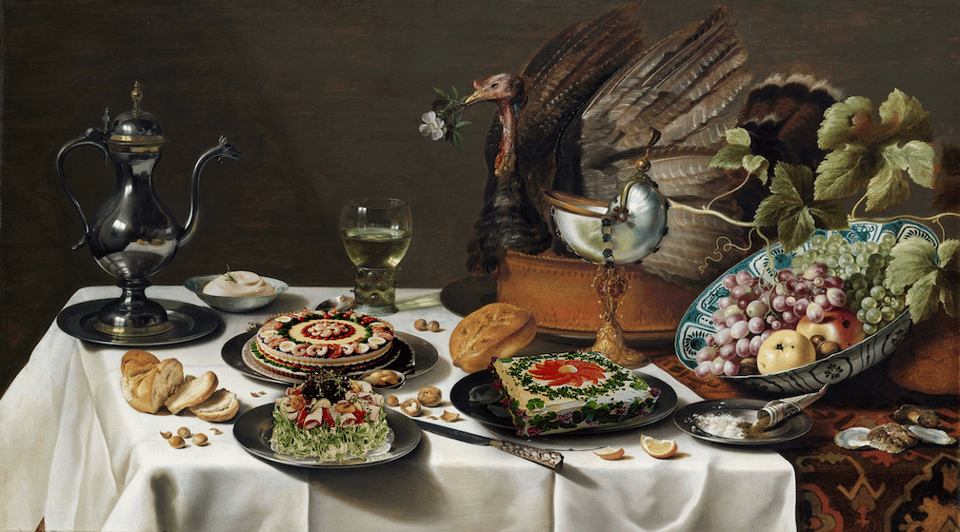
It should be said that the Spanish-speaking world has long held that the French stole mayonnaise—either literally, via the conquest of Mahon, or figuratively, through stolen mayo valor. Mayonnaise, to this day, is salsa mahonesa in Spain. This would make mayo the only one of the seven mother sauces not definitively French in origin, and put paid to decades of etymological apologia. While ordinarily I’d be keen to dismiss this as the usual nationalistic squabbling over any great dish, recent archaeological evidence seems to accrue in the Spaniards’ favor.
A researcher named Pep Pelfort, the highly self-promoting founder of the Menorcan Center for Gastronomic studies, claims to have found an overlooked primary source that definitively proves the Spanish-origin theorem of mayonnaise. His proof? A book of recipes known as the “Caules Manuscript”—which detailed the correct way to prepare everything from steak to shrimp in the Minorcan manner—hidden away in a Ballearic manse since the eighteenth century. The author is unknown, and the dating a bit shaky (Pelfort conveniently traces the book to 1756—the very year the French occupied Minorca). Nonetheless, the “salsa de peix crua” (raw fish sauce) in the manuscript—published as Receptari Caules. Cuina menorquina del segle XVIII in 2024 by Barcino Publishing, with the cooperation of the historical 7 Portes Restaurant in Barcelona—is the very one that the Duc de Richelieu brought back to France, after sampling it in a memorable meal with a mistress. The recipe for “raw fish sauce” in Receptari Caules is indisputably mayo-ish, although low on oil:
You will take egg yolks, in proportion to what you want to make, in a large bowl and beat them very well with a large spoon, often adding a little bit of good oil and a pinch of onion cut very small, a very small chopped onion, a garlic cut also very small, a pinch of good pepper and a little vinegar, always stirring it quickly so that it does not curdle.
The connection to the Duc de Richelieu is less solid, but the only piece of documentary evidence I’ve found points sharply to the salsa mahonesa → mayonnaise theory. Therefore the chief sauce of France was actually taken from Spain—whether as the spoils of love and war or simply as a matter of international commerce is less straightforward. Of course, the more romantic the tale, the more likely it is to win out. There is truth here, somewhere under the murk, under the self-promotion and romanticization, under the false trails of self-aggrandizing etymologies. Pep Pelfort, emphasizing the byzantine nature of his mayo-history adventures, wrote a piece called The Name of the Mayonnaise, in imitation of Umberto Eco’s The Name of the Rose, a murder mystery rooted in semiotic obscurity. “The tangled skein passes through cooking, medical and even veterinary texts, until reaching the definitive end of history,” Pelfort writes.
“Oh no,” I cry out as the barque of my straightforward intentions is yanked sharply into the mists of mostly inaccurate culinary legend. “Not again. I just wanted to find out who invented mayonnaise.” The tangled skein of fog—facts and half-facts, myth and untruth, obscure my journey. Yet I scull forward through the turbid mayonnaise sea of culinary history, seeking out submerged bits of treasure—a primary source here, a document there—and getting myself thoroughly greasy in the process.
Mayonnaise went on to be wholeheartedly adopted in France, and then around the world. As Marx said of history, everything occurs first as tragedy, then as farce; in the case of mayonnaise, its first iteration was haute cuisine—touted at Delmonico’s in the 1830s, white prince of the Savoy and the Ritz—and it recurs in ubiquity. The commercialization—and subsequent worldwide domination—of mayo happened in the early twentieth century, by way of a Prussian immigrant to New York, Richard Hellmann, and his competition, Eugenia Duke, an Ohio-born suffragette, who found ways to shelf-stabilize and mass market the volatile emulsion.
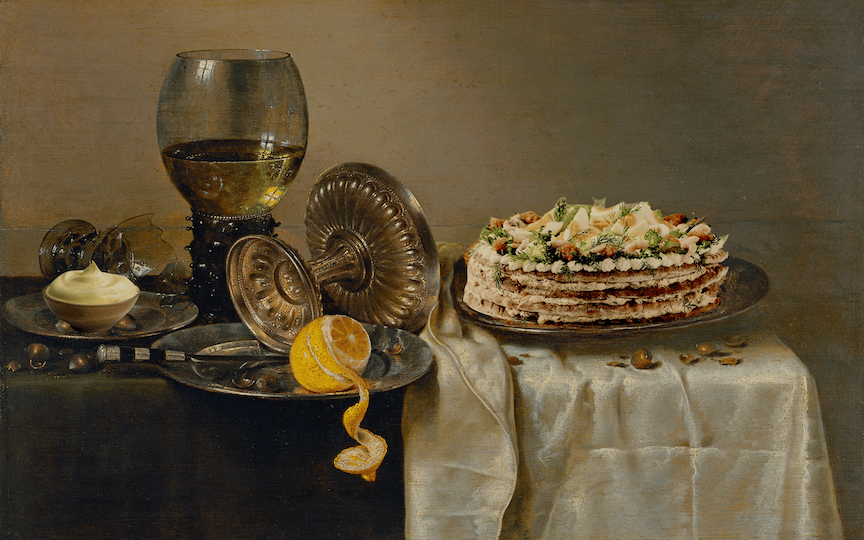
By the time shelf-stable mayo made its way to Sweden, the smörgåstårta was born—sometime in the latter half of the twentieth century. (The inventor of the smörgåstårta, and whether or not the sandwich cake itself was an iterative process of evolution, is, of course, also contested, but the chief claimant to its invention is a Swedish pastry chef named Gunnar Sjödahl, ca. 1965.) There, it blossomed into the centerpiece of countless Scandinavian celebratory tables, reaching the height of its popularity in the mayo-soaked ‘70s and ‘80s.
You can’t make a smörgåstårta without breaking a few (dozen) eggs, given the quantities of mayonnaise involved—a recipe from The Scandinavian Year, by Bronte Aurell, calls for a half cup plus two heaping tablespoons (not to mention cream cheese and crême fraiche). It’s a festal dish, not for casual creation. It’s heavy, and unapologetically intense, and prawn-covered, and rather beautiful. And somehow, in the process of writing about it, digging through so many lies and myths and unknowns, and writing about its key ingredient, something in me broke like eggshell, pooled out and bled yolk onto the blank bowl of the page.
But the thesis of this book—a thesis of my life, even—is that no matter how bad the break, something can be made of it. Whatever fragment of truth can be found is worth the finding. No matter how turbid the murk, there is a way out. So out of that slick of innards spilled from me I have whipped up an essay, one that delves greedily and deep into this contested history. Enough elbow work, leavened with a bit of acid tartness, and something can be made even of a breaking. Even of mayonnaise; even of me.

-
This may be my favorite yet. Thank you.
-
Such an enjoyable, hilarious and beautiful read!
-
Fascinating and weird! :)
Talia, is there any way to view/adjust our subscriptions via Buttondown? I got a renewal warning but can't find any way to do anything about it.
-
Imagine my crushing disappointment at finding an entry dedicated to Smörgåstårta only to find it is, more or less, about mayonnaise. So it goes. It makes sense. But it doesn't make me less sad. (A nice seafood-based smörgåstårta would perk me up, though.)
I'll add that the lengthwise-sliced loaf is called "landgångsbröd" (gangplank-bread) and that you can find them pre-sliced at better grocery stores, though typically only frozen: the throughput isn't that high.
Today, smörgåstårta tradition is alive and well but tinged with anachronism. They used to be a staple at high school graduation celebrations, but these days I mainly find myself digging into one at retirement ceremonies and funerals. Still, every grocery store with a catering department will be happy to make you one. And you can make it yourself. And find out it's actually kind of difficult.
... now I want some smörgåstårta.
Add a comment: