
Notable Sandwiches #140: Sloppy Joe

Welcome back to Notable Sandwiches, the feature where my editor David Swanson and I slip messily through Wikipedia’s List of Notable Sandwiches. This week, a muddy culinary mystery: the sloppy joe.
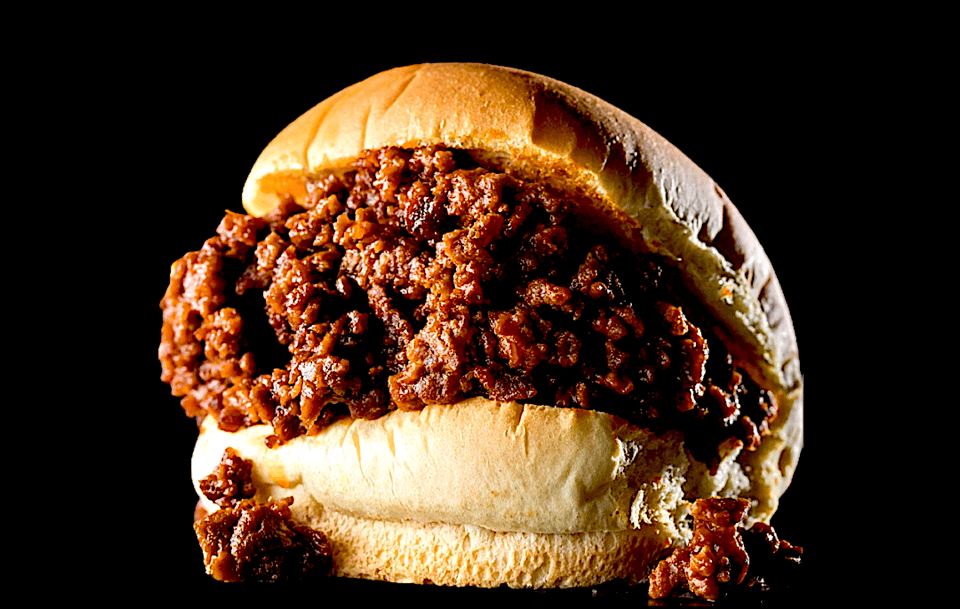
In 1855, the French dramatist Emile Augier coined a phrase that would live on independent of his work. This is, perhaps, all for the best: the play in which it appears, The Marriage of Olympe, is a nasty, soul-shrivelled bit of theater whose central argument is that the vice inherent to a fallen woman’s character cannot be redeemed. Olympe’s fate is sealed from the very first scene, as three male characters foreclose the possibility that any promiscuous woman can reform herself:
BAUDEL. Is it not possible that she should like to give up her former life and want to lead a quiet and pure existence ——?
MARQUIS. Put a duck on a lake among swans, and you will observe that the duck regrets its mire, and will end by returning there.
MONTRICHARD. Nostalgia for the mud!
In Anglophone contexts, nostalgie de la boue, ”nostalgia for the mud”, is less about the inherent unchangeability of character—the way a duck, among swans, stays a duck—than it is about attraction to the low and the degraded, regardless of one’s origins. The phrase is most often used to depict a desire for decay and depravity—Jonathan Ames called it being “drawn to the gutter”; Aleister Crowley, in his Diary of a Drug Fiend, described it as “a morbid wish to be an impossible monster of cruelty and wickedness.” In his article “Radical Chic”, Tom Wolfe uses the term to skewer the hypocrisy of the upper classes, who burnish their own mythos by indulging in “the gauche thrill of taking on certain styles of the lower orders.” (On the other hand, the poet Phillip Appleman took the phrase rather beautifully literally, writing a poem by that title in praise of the infinite varieties of springtime muck in his native Indiana.)
Across the language barrier, the essential meaning is altered. In Augier’s original play, the phrase is used to describe an essential immutability in the human character: a duck cannot become a swan, and a commoner cannot become a noblewoman. It is impossible to overcome a degraded nature. But in Anglophone literature and social commentary, nostalgie de la boue is about willful and sometimes performative debasement, an attraction to filth, vice, and lowness, regardless of one’s origins or essential character. Peter Quennell, an English literary historian, expresses the latter sentiment in his 1929 essay collection about Baudelaire and the Symbolists: “the fascination exercised over minds, otherwise delicate and finely balanced, by a life of extreme squalor, la nostalgie de la boue, in the propinquity of danger and suffering.” Both ideas are essentially reactionary about human nature. It’s about being drawn to mud: the characteristic may be inborn, or acquired, but either way filth is both disgusting and irresistible.
For some reason, I keep thinking about this as I set about writing about sloppy joes.
My own relationship to the sandwich is a powerful attraction to one of the grosser things I can remember eating as a child: I might call it nostalgie de la bouche, if I were precisely the type of pretentious asshole that I am. I remember sloppy joe school and summer camp lunches as over-sauced yet dry, essentially tasteless, an Applemanish “clay/that mooshed into guck.” It always came on a mass-produced hamburger bun, whatever initial fluffiness the puck of bread once had long since sucked out of it. The wet beef rubble sprawls over that porous and soggy bun, sweet and a little tinny. It leaves its mark on you, too: it stains fingers and lips and chins with its orange slick of sauce and grease. Fundamentally, the sloppy joe is like most other sandwiches—bread and meat—but somehow, also, it has a quintessence of mud to it. I would still down one like a shot, though, just on the strength of that faint remembered sweetness.
It’s pure nostalgie de la boue: I am attracted to that which I find disgusting; and to Augier’s credit, this trait is seemingly innate in me, bred through too much contact with sloppy joes in childhood. Nostalgia can play tricks on us, and transmute, through sentiment or familiarity, that which ought to provoke pure repulsion into something known and desired. The beef dry and granular as mortar in the temple of a forgotten god; the sauce at once totally opaque and yet watery; the bread reverting to its medieval function as a trencher to sop up this collusion of juices. Despite knowing the essential hideousness of the object, I’m nonetheless drawn to it in the raw red confines of my heart. The thought of one makes my mouth water even now.
I think for most of us who have this sort of relationship with the sloppy joe—some with less theatrical disgust, some with less attraction in the present—view it as an object of nostalgia, a piece of quintessential Americana that slots into childhood beside the PB&J. Fundamentally, it’s a food you serve at the lunch counter because it’s easy to make and simple to assemble, and so you might think its origins are comparably simple. It might be of some interest, therefore, to examine the two divergent stories that proclaim its genesis. They are mutually exclusive.
This clash of myths is not unique to the sloppy joe. Culinary history is often a tissue of legend with nary a solid fact to be found, and success, in the form of a household-name sandwich, has many fathers. In this case, they are geographically divided between Sioux City and Havana, with an improbable celebrity cameo by Ernest Hemingway, and a profound lack of documentary evidence for either. I spent an astounding amount of time trying to comb through archives from the USDA to Good Housekeeping to various newspapers to cookbooks trying to pin down its origin, butting perpetually up against various apocrypha, and discovering initially-promising ultimate dead-ends; I swear this sandwich, and more particularly its name, is responsible for at least one of my new grey hairs.

Still, the hard facts of this loose sandwich elude me. The name eludes me in particular. I despise not being able to nail down a fact, and the migration of the phrase “sloppy joe” into the everyday American lexicon arrives bereft of a specific entry point or even destination. I learned that there was an entire women’s fashion movement in the late 1930s and early 1940s centered around loose, hip-length sweaters called “Sloppy Joes”; it inspired sour-faced matrons and horny college boys who missed tight-girdled silhouettes to call the teenaged girls who dressed that way “Sloppy Sues.” One particularly overheated advice column from mid-World War II, in 1943, warned mothers that if their teenage daughters go around “wearing sloppy joe sweaters and dirty shoes" the next step is “drinking cocktails with pickups in saloons.” Every time I try to pin down the semiotics of this thing, it springs away from me like a handful of greased beef.
Nonetheless, in the popular consciousness, there are two theories about the sloppy joe's origin which are bruited about with the carelessness of so much of culinary history. I parrot them here with acrid commentary, and with the addition of the tenuous idea that each maps onto a form of nostalgie de la boue.
1. The Loosemeat Theory: Or, A Duck is Always Drawn To Its Mire
The first theory is more or less what you might expect. Out of the great corn-and-slaughterhouse trough of the Midwest arose a tradition of sandwiches that basically involved shoveling ground beef slop directly onto bread. The loosemeat (or loose meat, or tavern) sandwich is a burger without the bother of creating a patty. A number of restaurants in Iowa claim to have originated the loosemeat sandwich in the mid-1920s, including Floyd Angell’s Cafe, and Ye Olde Tavern in Sioux City, and the Maid-Rite franchise in Muscatine. Urban Iowa was comparatively prosperous in the 1920s, while rural families faced both monotony and a steady, grinding descent into poverty. But the loosemeat sandwich was the product of an industrializing state, which became part of the Midwest’s meatpacking dominance by the fin-de-siecle.
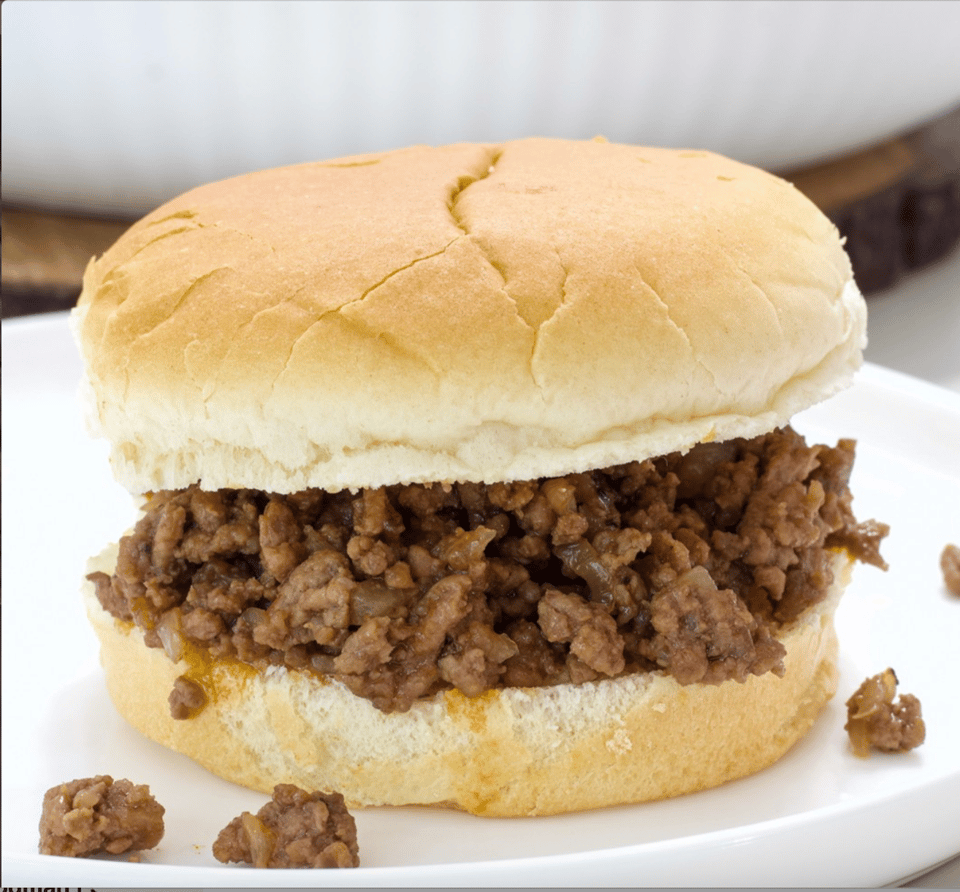
Structurally, the loosemeat and the sloppy joe are similar; in the way of food apocrypha and self-aggrandizement, several of the contender restaurants have hypothesized the existence of a cook named “Joe” who decided to add tomato sauce to the whole business and launch his sloppiness into a world ready to receive it.
Many Iowans wax lyrical about the loosemeat sandwiches of their childhoods, but others are more jaundiced about it. As the writer Liz Cook described the administration of loosemeat sandwiches to hungry schoolchildren, “You’re going to be steaming 10 pounds of gray meat in a roasting pan, and doling out the little nubbins with an ice cream scoop.” Even hardcore loosemeat boosters, such as Jon Yates, who lays out his love of the sandwich in the most glowing terms, describes it as follows: “the sandwiches consist of small pebbles of lightly seasoned hamburger meat spilling out from a standard white bun… The bun soaks up the grease, making even the bread a bit gloppy.” The Maid-Rite corporation reminds its customers that “A little mess never hurt anyone.” This is nostalgie de la boue in the pure Francophone form: knowing its nature, the messiness of the thing, it is nonetheless loved; passed on; touted as a rich substrate of nutrients, as a diving duck scours the mire of the pond-bottom for the creatures and weeds that make its silty feed.
As to loosemeat theory as the definitive genesis of the sloppy joe, I maintain significant doubts. Chief among them is that the loosemeat/loose meat/tavern/Maid-Rite sandwich continues to exist unchanged and un-sauced in its original haunts. The second and more serious issue is the gap between loosemeat sandwiches and the sloppy joe—we can more or less dismiss the apocryphal “Joe,” seeing as no living soul or descendant has come to claim the mantle. Moreover the rise of the sandwich from Iowan curiosity to national fame is itself a bit messy. What the loosemeat theory more or less posits is that a sandwich exists, invented in the 1920s in Iowa, that bears a significant structural similarity to the sloppy joe, albeit without the signature sauce. Its name is a mystery thinly papered over with myths placed in the mouths of the dead.
But the truth is that the name sloppy joe was extremely famous in America long before the advent of the sandwich. To explain why, we must now turn our eyes away from the cornfields and down across the sea, to…
2. Havana: Or, The Bourgeoisie Love Slumming It
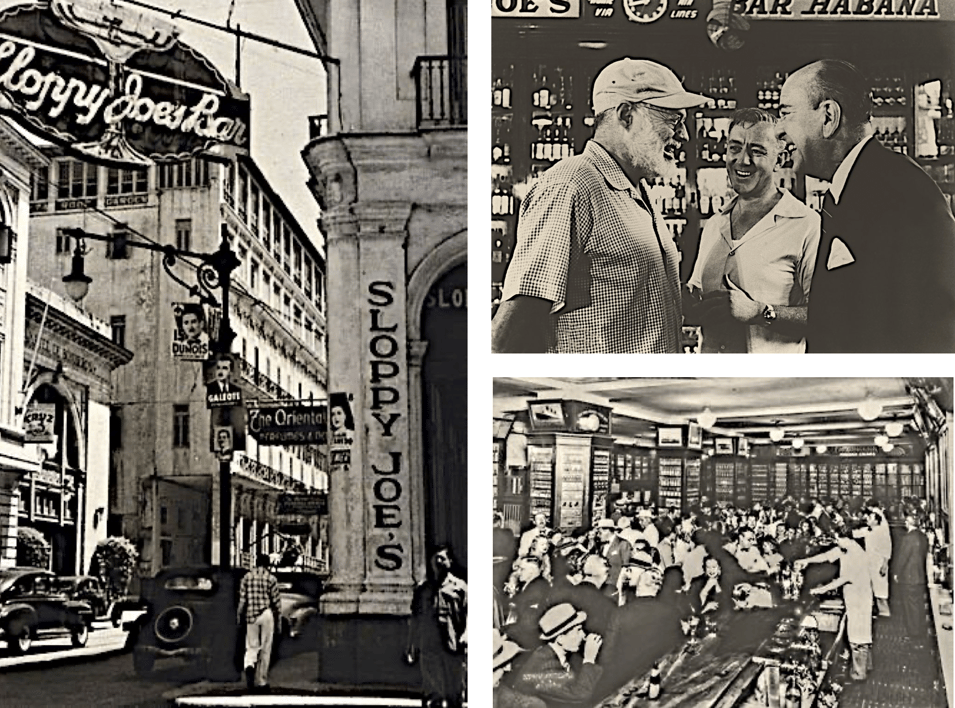
One fact, in all this, is indisputable: there was a bar in Havana, founded in 1919 by Spanish emigré José Abeal y Otero, that came to be known as Sloppy Joe’s. According to the 1939 edition of “Sloppy Joe’s Cocktail Manual,” the sobriquet came about as follows:
“While operating this small grocery store, he was visited by several of his old friends from the States… one of them said: Why, Joe, this place is certainly sloppy, look at the filthy water running from under the counter. From here on, the name Sloppy Joe stuck to José Abeal as part of his own life and was destined to make him and his business famous and internationally known.”
Here’s the thing about Sloppy Joe’s: it was extremely famous. 1919 was a fortuitous time to launch a bar in Cuba: with the advent of Prohibition the following year, Cuba became a haven both for rum-runners and American tourists seeking a legal drink. Sloppy Joe’s, eventually housed in less-filthy and quite classy environs, was a regular American hangout, and eventually became so famous that stops at this bar were advertised as part of cruise itineraries alongside other Havana landmarks like La Merced Cathedral and the National Capital. A 1922 article from the San Francisco Chronicle entitled “Night Life In Havana Just A Cocktail Trail” enticed its thirsty readers with a picture of “Dark Wickedness” on the isle: “And then there's Sloppy Joe's and the McAlpine cabaret and, of course, the Jockey Club and—well don't let anybody bunk you. It's all there—beautiful Sin in all her gold, ivory and diamonds. Go to it, my dear fellow, and watch your step." By 1933, Vanity Fair was already mocking the vulgarity of American tourists who could never know the “ancient and imperishable taint of the lotus” that marked the mysteries of Havana. Instead, “they spend half an hour at the Casino, where they lose their shirt (say, $25) playing roulette and begin to feel like Arnold Rothstein, and they go to Sloppy Joe's and shout and scream and shake their hips and try all the different drinks they can order until they get very sick.”
Enter that personification of nostalgie de la boue—the literary icon, bareknuckle brawler, heavy drinker et al, Ernest Hemingway. Undisputed fact number 2: He hung out in Havana throughout the ‘20s and ‘30s, and did a lot of boating and fishing between Cuba and Key West.
Undisputed fact 3: He also spent a lot of time in a bar in Key West run by his drinking-and-fishing companion Joe Russell. At some point in the mid-30s that bar changed its name from the Blind Pig to Sloppy Joe’s, in honor and imitation of its glamorous Havana counterpart. Hemingway had a legitimate love of the place; he brought around fellow literati like John Dos Passos, and used it as the basis for Freddy’s Bar in his novel To Have and Have Not. Perhaps more to the point, in the ‘60s, after his death, an enormous amount of Hemingway paraphernalia was found in the back room of Sloppy Joe’s, alongside not a few rat skeletons. They’re now in the custody of the JFK Presidential Library in Boston, for some reason, and remain shamefully un-digitized.
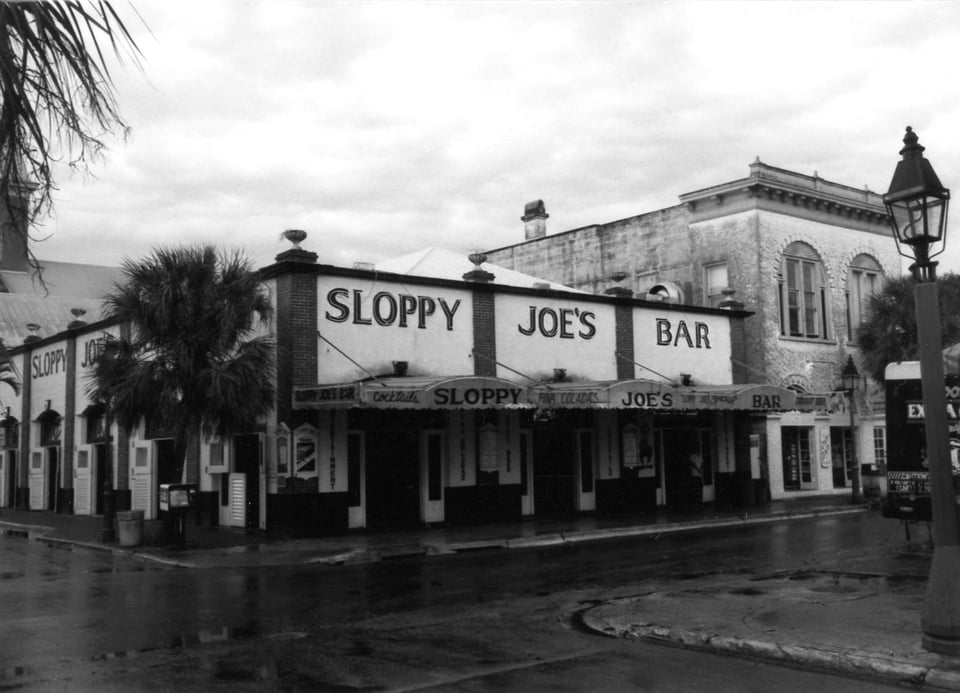
This is a fantastic example of nostalgie de la boue in the pattern of Baudelaire, Leonard Bernstein, and debutante-turned-crust-punks: here you have the cream of literary society hanging with rum runners and Communists and the flotsam of the Florida Keys, the down-at-heel fishermen and boozers that make up the have-nots of To Have And Have Not. Everyone is very drunk all the time. Here’s a sample of dialogue from Hemingway’s 1937 Key West phase:
“Give me a gun.”
“Oh, shut up. You’re drunk. Every time you’re drunk you want to kill somebody.”
“Have a drink,” said Harry, looking out across the gray swell of the gulf stream where the round red sun was just touching the water.
Sandwiches were not the highlight of the book.
There’s a little half-hearted gesturing from food writers at the notion that Sloppy Joe’s in Havana was the origin point of the sandwich. This comes mostly in the form of people pointing out the similarities between a bun-less sloppy joe and various Cuban dishes, from the shredded-beef-in-tomato ropa vieja to the picadillo, a Cuban ground-beef stew with sofrito, olives and raisins. The hypothesis is that Sloppy Joe’s served a sandwich with one of these dishes on it and Hemingway and his fishing-and-drinking buddies imported it to the U.S., bastardizing it along the way for American palates. Sloppy Joe’s in Key West, which still exists, serves what it halfheartedly claims is the “original” sloppy joe.
A few points of contention readily present themselves, despite the compelling romance of the theory. First: Hemingway never claimed to have made this radical contribution to American cuisine (one can perhaps understand his reticence, but he was a prolix enough man it might have come up). Second: Most contemporary articles about Sloppy Joe’s in Havana focus, understandably, on the drinking; no mentions are made of a famous sandwich, despite the bar being open until 1958, well after the sloppy joe began making regular appearances on school lunch menus and guides for thrifty housewives. The 1939 Sloppy Joe’s Cocktail Manual does feature a lunch menu, with an enigmatic sandwich known only as the “Sloppy Special,” which may have been the elusive source point. But it’s all conjecture. There is a profound absence of evidence that is all the more striking given the fact that this origin story is absolutely crawling with professional writers. John Dos Passos’s “Letter from Key West” makes much of his adventures with “Hem” on the island, but the only sustenance mentioned is rum and conch chowder.
The Sword and the Sandwich is a newsletter about serious extremism and equally serious sandwiches. Please consider supporting this work with a paid subscription:
The other point of departure is that Sloppy Joe’s in Key West was by no means the only—or even the first—bar of that name in America. I must reiterate again that Havana’s Sloppy Joe’s was very famous, so synonymous with every breed of sin and debauchery that in 1939, puritanical Boston city officials refused to grant a business license to a restaurant that wanted to open under the name Sloppy Joe’s. Newspaper ads reveal numerous bars that did succeed at opening under that name, seeking to borrow a little of the Havana glamour. Any one of these could have been the launch point of the sandwich. Yet none of them have emerged from the murk of history to claim it.
The final act of Sloppy Joe’s bar in Havana was appearing in the Alec Guinness picture Our Man in Havana, a satire of British spycraft. As to Joe Russell, who ran the Key West establishment, his 1941 obituary ran: “‘Sloppy Joe,’ of Key West, Dies.”
What makes this story endure is, I think, the frisson generated by the inherent nostalgie de la boue of it all: an internationally famous literary icon— winner of the Nobel prize, slumming with rum-runners—generates a sandwich that is purely proletarian. It’s the bare-knuckle whiskey-drinker in Hemingway that renders any of it remotely plausible. The bard of masculinity generates the most prosaic sandwich imaginable; it’s that risibility that gives the hypothesis its endurance. And I appreciate that. I do! But I don’t buy it, either.
What’s left is a dangling coda. There are a few tantalizing, isolated references to “sloppy joe” as a vernacular way of referring someone who was just generally dirty and unhygienic: a newspaper cartoon from 1919 about a guy who doesn’t bathe, a manual on the instruction of “backward children” from 1909 that has a case study of a Passaic child named Charles who was nonetheless called “sloppy Joe” due to his lack of personal hygiene. Dismissing the two main extant hypotheses leaves us in want of a third, definitive one, and I don’t have it. Were the sweaters named after the Havana bar? How did a loosemeat sandwich acquire a sauce and a new moniker and national prominence without leaving much of a trace on its way out of Iowa? Did all of them get named after a little-known piece of American vernacular specifically referring to unhygienic dudes, a filth-coated inversion of the “average Joe”? John Mariani, in 2014’s Encyclopedia of American Food and Drink, came to more or less that conclusion, though he credited the phrase to the sandwich itself: “There is probably no Joe after whom it is named—but its rather messy appearance and tendency to drip off the plate or roll makes "sloppy" an adequate description, and ‘Joe’ is an American name of proletarian character and unassailable genuineness."
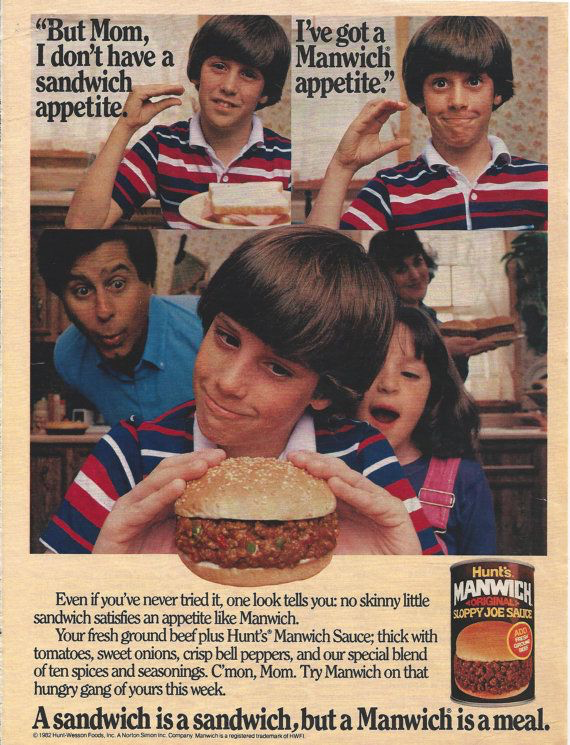
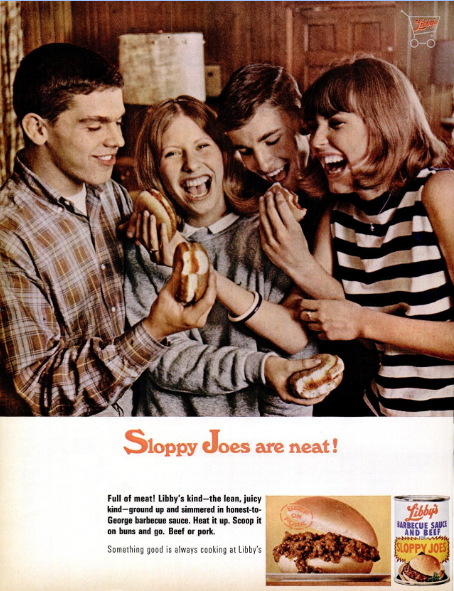
The only incontrovertible fact I could find is that by 1946, the USDA was recommending sloppy joes, more or less in their modern form, as part of school lunch menus; its subsequent sustained popularity has to do both with the ease and convenience of the dish, the way nostalgic foods are passed on from parent to child, and the ingenious marketing of Hunt’s canned Manwich sauce (add ground beef for instant sloppy joe) in the late 1960s.
So why the persistence of these myths? And why is the truth so elusive? Nostalgia makes liars of us all. And nostalgie de la boue—which made me make my own Manwich during the writing of this column, eat it, and then unhappily watch the rest of the beef congealing into orange fat-wax in the pan—is the most powerful of all those drawing forces. As a duck is drawn to its mire, so we are drawn, perennially, back to the sloppy joes of our past.

-
Married to a Puerto Rican woman I met and married in Iowa after law school, with a Puerto Rican mother-in-law who lives with us and cooks for us, I appreciate the references to picadillo (called by them Picadillo Cubano, and definitely no raisins) as somewhat similar. I still pick out the olives in it. I guess I'm still very Iowan. Thanks for yet another enjoyable read.
-
Gorgeously composed!
-
Wait . . .
No mention of the Real Sloppy Joe sandwich (which is cold) from the Town Hall Deli in South Orange, NJ? It's a triple-decker deli cold sandwich, made with thin rye bread, Russian dressing, coleslaw, Swiss cheese, and two types of deli meat (usually turkey and roast beef), cut into squares and served with a pickle.
-
Fantastic read!
When my wife and I first moved in together in a tiny one-bedroom apartment, I used to make her “Sophisto-Joes” from a recipe from Gourmet magazine I Xeroxed at the library. We loved it for the same nostalgic reasons most people do. I still make them twenty years later, and get nostalgia for two different times in my life.
-
Great article! I would recommend trying my favorite sloppy joe variant if you can: the Rhode Island Dynamite. It's spicy and delicious, and the Cook's Illustrated version has a solution to the pebbly ground beef issue.
-
It's been years since I had one, but I think of sloppy joes as an open faced, fork and knife dish. If eaten as shown in the Manwich ad photo, it's only a matter of time until the bottom half of the bun dissolved and the whole thing collapses...
Add a comment: