
Notable Sandwiches #138: Reuben

Welcome back to Notable Sandwiches, the feature where my editor David Swanson and I trip merrily through Wikipedia’s List of Notable Sandwiches. This week, a legend of biblical proportions: the Reuben.
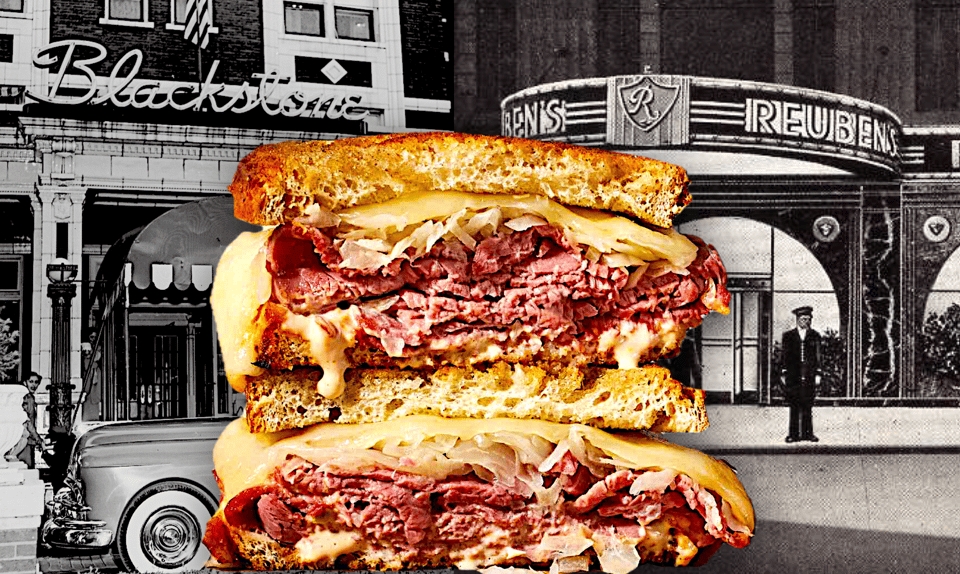
The story of any legendary sandwich—and the Reuben is definitely wreathed in legend—begins with its name.
In this case, I didn’t have to look very far for the etymology. Just back to my childhood, which was as inescapably full of Torah as a swamp is full of moisture. The first words I learned in Hebrew were the language of Genesis: camel, tent, well, woman. And the name of the Reuben comes from that world, the goat-smelling, God-sodden stories of the patriarchs.
The substance of the sandwich should be addressed first, perhaps. In its classic form, it’s corned beef with Russian dressing, sauerkraut, and Swiss cheese on rye. Its genesis is hotly contested, a feud between two Reubens, one from Nebraska, the other from New York. Over the years, the dispute has been as messy as an over-sauced sandwich, attracted both descendants and historians, and devolved into a food fight between two states. Nonetheless, despite the sandwich's backstory bearing hints of internecine Jewish warfare, it doesn't have a patch on the messy life of its Biblical namesake, the minor patriarch and major failson who was Reuben, son of Jacob.
Another matter: Reuben, first mentioned in Genesis 29, is such a good name. In English it sounds strong, doughty, a suitable name for a yeoman or a son of the soil. In Hebrew, from which it originates, the name tells an entire story in a single word, a story about family dysfunction. Re’u, ben! is a sentence, and it translates as: “Behold, a son!” Which means that everyone you’ve ever met with that moniker is more or less named “Look, That’s a Guy” Smith (or Stoddard). Demonstrative. And, at two and a half syllables, rather economical. It’s a name I strongly considered adopting for myself after coming out as a trans man, with its not so subtly encoded gender marker, but just because I was becoming a man didn't mean I was ready to embrace patriarchy so literally.
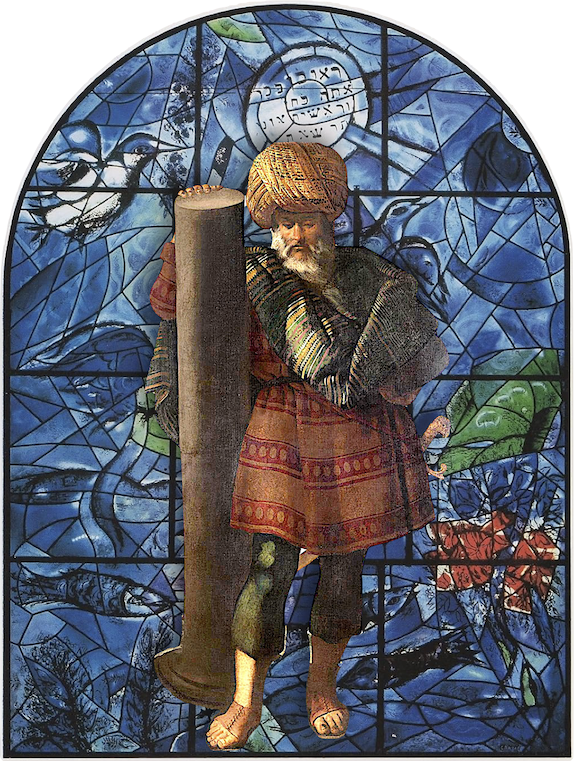
This is an essay about a sandwich, not a condemnation of primogeniture on rye, but naming your boy Look, it’s a boy is a pretty pointed gesture, and I want to pause to admire both the audacity and the sheer persistence of that statement across literally thousands of years. Reuben has been not only the name of a Biblical patriarch, but also a tribe, thousands of men (including football players, a president of Nauru, pornographers, artists and so on), and, not least, an iconic sandwich. This despite the context for the name, helpfully elaborated upon in Genesis:
31 And the LORD saw that Leah was hated, and he opened her womb; but Rachel was barren.
32 And Leah conceived, and bore a son, and she called his name Reuben; for she said: ‘Because the LORD hath looked upon my affliction; for now my husband will love me.’
Inspiring. That’s a healthy marriage right there.
A little Biblical context, for those who may not be fully read up on the absolute trainwreck that is this family tree. The Biblical patriarch Jacob labored seven years for his cunning uncle Laban and, in the bargain, fell deeply for Rachel, the daughter whose hand was meant to be his wages. Laban saw an opportunity to get rid of another unwelcome offspring, and substituted his elder daughter, Leah, at the wedding. All we really know about these women is that Rachel was “beautiful to look upon” whereas Leah had “weak eyes” (maybe a squint or something?) and that Jacob was extremely pissed off in the morning. He agreed to spend a week in Leah’s bed though, and keep her as his wife, and furthermore served Laban for seven more years, in order to finally secure the hand of Rachel.*
*Incidentally, this whole sister-swapping situation gave rise to a rather lovely tradition at Jewish weddings, the badeken, in which the groom, escorted into the room where the bride is receiving her guests, ceremonially lifts the bride’s veil. It’s a beautiful and intense moment, that touch-without-touch, a hushed public intimacy with the whole festive crowd looking on. Still, it’s fundamentally about checking to make sure you’re not about to wed the ugly sister. Such a precaution certainly would have saved Jacob’s assorted women some grief.
Given the whole “the Lord hath looked upon my affliction and now my husband will love me because I gave him a son called LOOK I GAVE YOU A BOY” deal, it’s perhaps not surprising that the life of Reuben, the firstborn of Jacob’s eventual twelve sons, is overall uninspiring. He’s most infamous for losing his birthright by having sex with his father’s concubine*, Bilhah, mother of his half-brothers Dan and Naphtali.
The Sword and the Sandwich is a newsletter about serious extremism and equally serious sandwiches. Please consider supporting this work with a paid subscription:
*While a father’s concubine is not quite the same as one’s stepmother, it’s arguably at least adjacent. What I’m saying is, if we’re looking at the frankly astounding prevalence of stepmothers as figures of erotic fixation in pornography, we might look back to the life of Reuben as evidence that quasi-maternal figures have been the subject of desire since the Bronze Age or so.
Bilhah was Rachel’s slave/”handmaid,” given to Jacob as a gift by the barren and beautiful sister, so that, explicitly, Rachel could take credit for any children Bilhah added to her sister Leah’s damnably fertile output.
Jacob, that wise patriarch whose greatest joy in life involved wrestling angels and making his wives and sons absolutely miserable, gave Reuben’s birthright to Joseph, Rachel’s firstborn son. Later, the rest of the brothers teamed up against Joseph to avenge their father’s blatant favoritism through murder, but Reuben intervened, persuading them to simply throw the lad into an empty cistern. Then, in a show of pretty poor judgement, Reuben peaced out for a while, leaving Joseph in extremely bad company, and also peril. Joseph was sold by his more enterprising brothers to a passing slave caravan before Reuben was able to return, thus proving that the path to your annoying younger brother becoming the vizier of Egypt is paved with good intentions.
Reuben’s descendants became one of the twelve tribes of Israel, but not an especially distinguished one, like the tribes of Issachar, Zebulun and Judah. Jacob, definitely not over the whole concubine-affair situation, dealt Reuben a pretty devastating final blow from his deathbed:
“Reuben, thou art my firstborn, my might, and the beginning of my strength, the excellency of dignity, and the excellency of power:
Unstable as water, thou shalt not excel; because thou wentest up to thy father’s bed; then defiledst thou it: he went up to my couch.”
The world and the Bible are full of mediocre men, and Reuben is very much among them. But that mediocrity didn’t necessarily descend to those who were named after him. After all, being named “Look it’s a son!” doesn’t mean being a son is the only thing you’ll accomplish in life. And his canonical lack of excellence certainly doesn’t extend to the dish named for him, a hot, sweet-sour, totally satisfying blend of flavors that has deservedly earned a place in America’s sandwich pantheon, not to mention diner and deli menus from coast to coast.
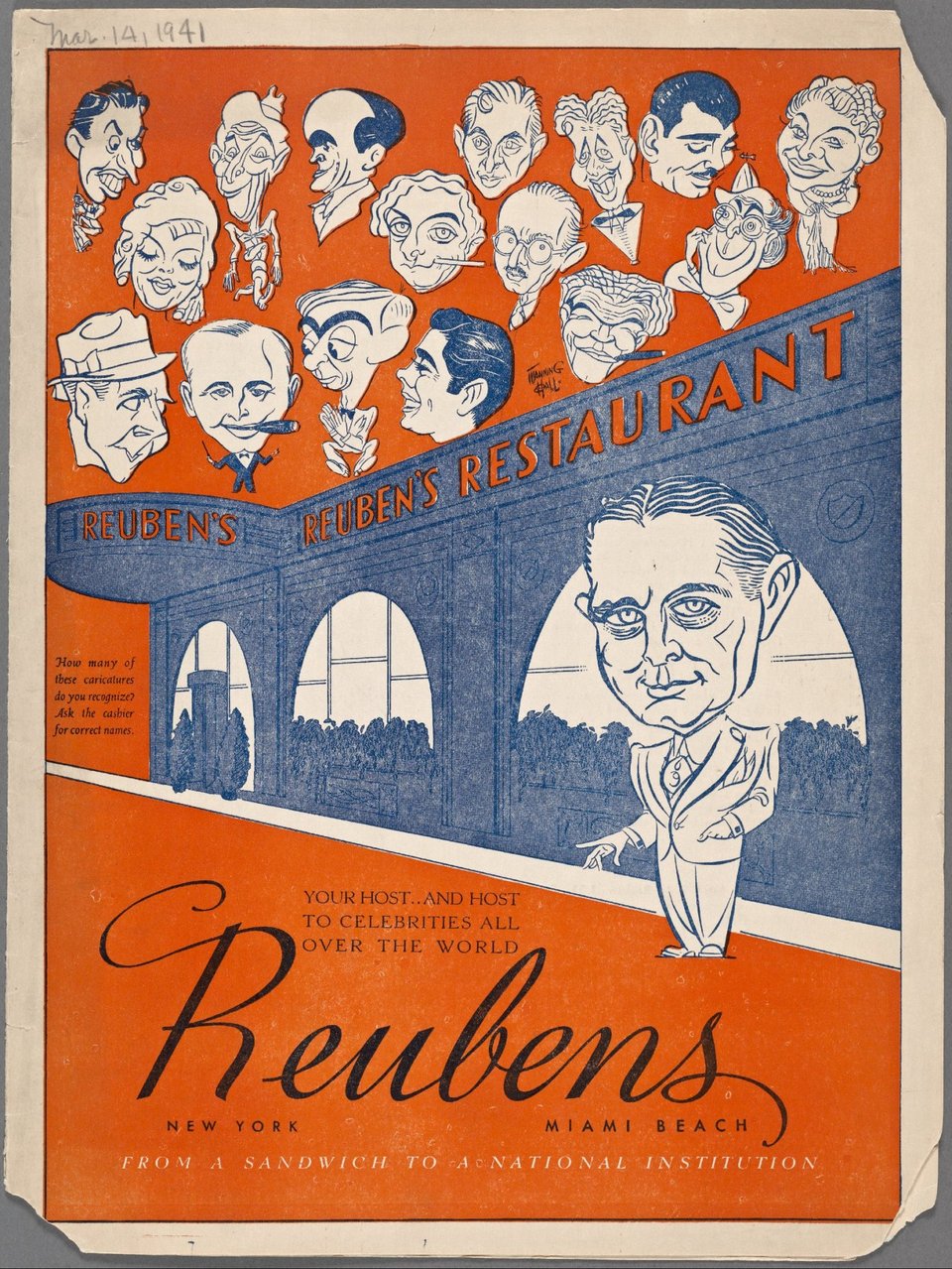
I’ve taken a pretty gimlet-eyed look at the evidence, which divvies up the glory of the sandwich between two claimants. One: Arnold Reuben, the owner of a Reuben’s Delicatessen in Manhattan—which survived on the mean streets just north of Times Square for nearly a century—claimed to have invented it in 1914 in honor of Annette Seelos, a vamp of an actress who’d acted in Charlie Chaplin films. That version Reuben, though, bears little resemblance to the modern iteration; it was, according to Reuben’s daughter, “ham, cheese, turkey, coleslaw, and dressing.”
The food historian Tim Smith located a New-York-published cookbook that, in 1941, gave the Reuben sandwich in its contemporary form: “Rye Bread, Switzerland Cheese, Sliced Corn Beef, Sauerkraut, Dressing.” Thus far, the pickle points to New York, although I raised a skeptical eyebrow when learning that a) Arnold Reuben was a known associate of Arnold Rothstein and other gangsters (his deli may have been the site of the White Sox World Series fixing scam,) and b) he also claims to have invented the New York-style cheesecake in 1928.
What’s more, Nebraskans and their descendants are fierce in their defense of the Omaha Reuben. Enter, a few hundred miles to the west, another tribe of Jews, eager to claim this non-kosher sandwich as their own. (The Biblical Reuben could have eaten it just fine, by the way: kashrut wasn’t invented until Exodus anyhow.) The Schimmel family, of Viennese origin, ran a chain of hotels on the rail route southwest of Chicago. Writes Elizabeth Weil, journalist and granddaughter of the purported reuben inventor: “In the 1920s, my great-grandfather's friends in Omaha, Nebraska, began gathering to play poker at the Blackstone Hotel. Inevitably the men grew hungry and called down to my grandfather, who oversaw the hotel's kitchen, for snacks. For Reuben Kulakofsky, one of the players, my grandfather [Charles Schimmel, trained as a fine-dining chef in Switzerland] created a sandwich: corned beef, Swiss cheese, sauerkraut, and Russian dressing, pressed hot on rye bread. Reuben loved it! Everyone loved it! … God Bless America!” Kulakofsky was a Lithuanian, incidentally, and one thing you learn as an exilic Jew is it doesn’t do to bet against a Litvak.
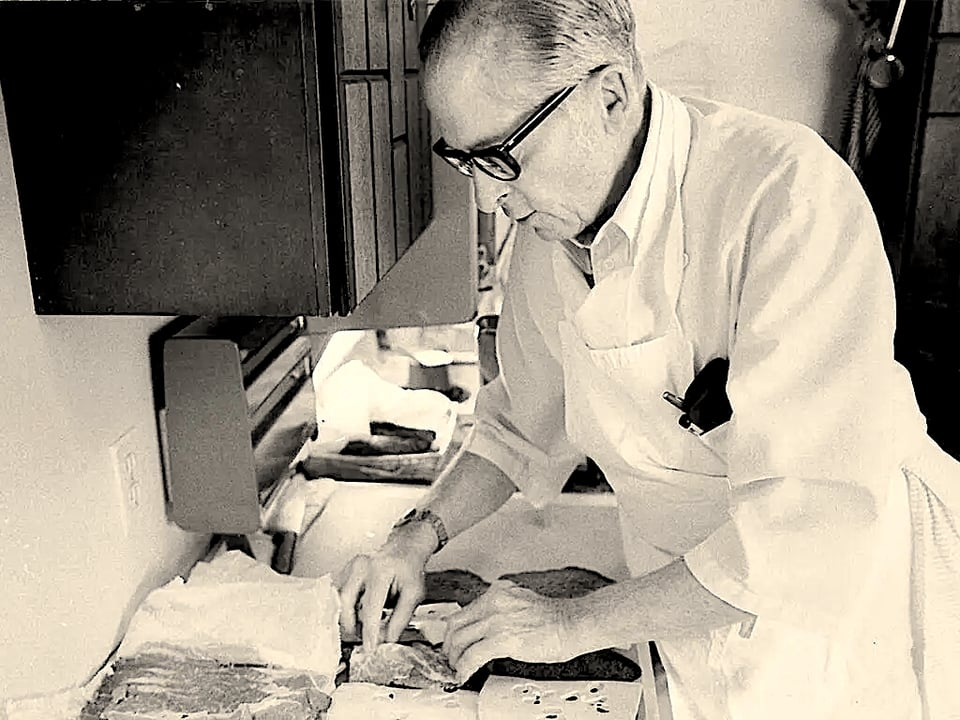
As documented in a lively piece at Saveur, Smith, Weil, Weil’s husband, and the Nebraska State Historical Society traded facts, barbs, ultimatums, and trivialities for a period known within Weil’s family as “Reubensanity.” Smith finally told Weil that if the Nebraskans could find a pre-1941 reference to the Reuben sandwich, prior to the publication of his trump-card cookbook, he would concede the battle. It took an ultimate regional appeal to dig up the goods: would New York, that great maw eating up all accomplishments and gathering endless fame unto itself, consume even this pinnacle of Nebraskan sandwich achievement?
It worked: Blackstone Hotel menus in the hidden archival depths from 1934 and 1937 held fully dressed Reuben sandwiches for 35 cents. Triumph of Schimmel and his Viennese associates, and by association the great state of Nebraska; the boast of the New Yorker revealed to be empty; the provenance of New York-style cheesecake cast into severe doubt.
But when there is strife in a tribe, as when there is strife between two sisters and their shitty husband and also handmaid-concubines, does anyone really win? Reuben the patriarch never claims his birthright; his children are cast into obscurity, and, ultimately, into exile across the world and time. In exile they are reduced to fighting over the provenance of a sandwich, and the boasts and the feud sully what should be straightforward glory. Truly, this is a sandwich that should be venerated, but whose origin has been made murky by territorialism, machismo, and overweening desires to demarcate regional borders. Perhaps, then, the sandwich matches its etymology more closely than at first glance. Frankly, the whole thing smacks of the worst traits of toxic masculinity. From the ancient Near East to 1920s Nebraska… look. It’s a boy.
And in a final gesture of indignity, a deeply inferior variant of the reuben whose origins are entirely indistinct, but which subs in turkey and coleslaw for the corned beef and sauerkraut, is called the Rachel. I mean, read your Bible, people. Didn’t that woman suffer enough?

-
great stuff. I cannot tell you how much Ive enjoyed this sandwhich series and look forward to more.
-
Poor, poor Rachel.
-
I love all of your posts, but this one was exceptionally delightful and educational. As a Nebraskan, the Reuben is very dear to me, but as someone with little religious knowledge, I was not aware of the Reuben-Rachel connection!
-
This may have been my favorite sandwich post. Despite the fact that I shun cheeseburgers, I can't resist a Reuben. Is corned beef truly meat? Is Swiss cheese really dairy? But, to have a story about one of my favorite sandwiches mixed with such a brilliant parsha - well, not to be too corny - chef's kiss
Add a comment: