
My Own Inner Elba
Let me start by saying that the news is incredibly awful. I’m very aware of this, in the way you’re aware of, say, a ninety-seven degree day with one hundred percent humidity, the way it saturates your skin and makes it feel two sizes too small, the way it’s hard to breathe in air gone fetid with heat and rancid with all the rot it stirs up. At home and in the international theater, America is so caught up in the imperial boomerang you can feel its reverberations in the air: the way police and ICE agents shadow anyone who speaks out against them, and are willing to use fatal violence at a moment’s notice. The ferocious and terrible absurdity of a head of state kidnapped at gunpoint being on trial in my city; the way the conversation about Greenland, that pristine isle of ice, have turned into op-eds rationalizing, rationalizing, rationalizing the rhetoric of invasion.
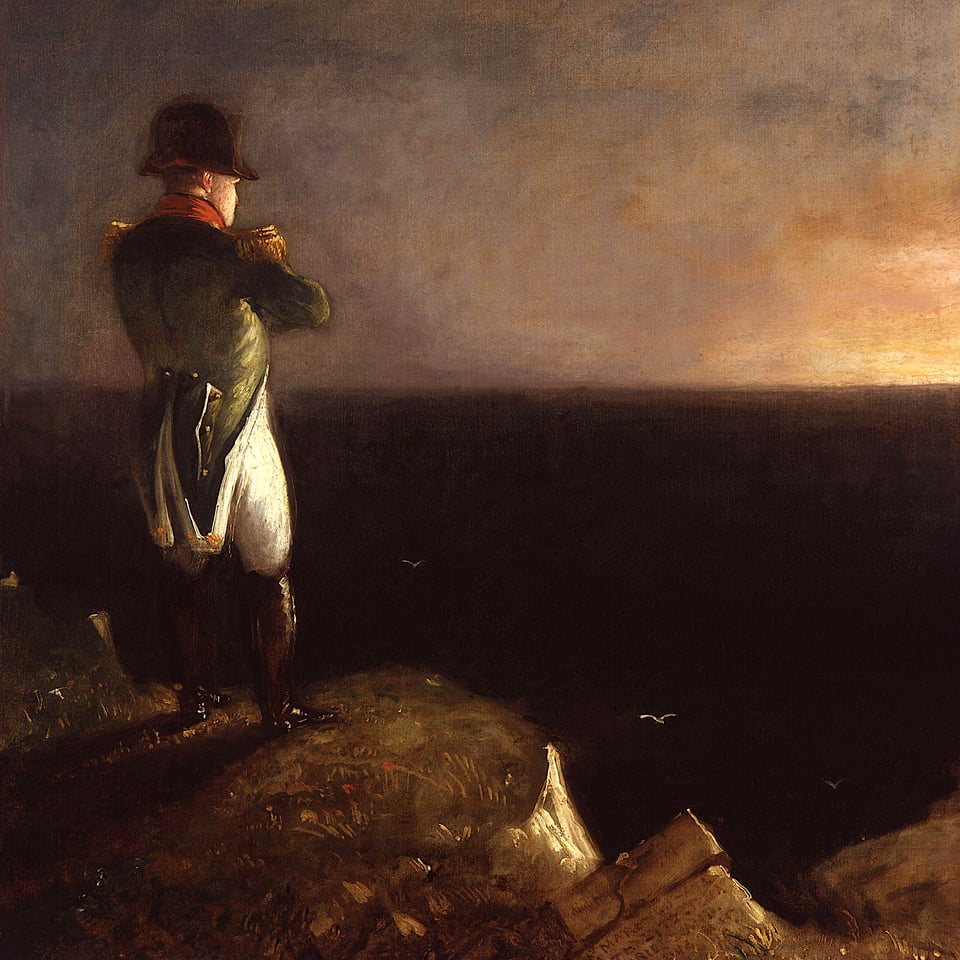
In the face of all this I have been feeling all kinds of inadequate. And as this fashed-up, roided-out machinery has clicked into place—the stuff I’ve been warning about for the last decade, an increasingly panic-laden Cassandra about it, dragging myself through my and other people’s trauma to write big warning books about what was coming, and then watching it come—I’ve engaged in a kind of battlefield exit, a furtive slouching away from Bethlehem. I’ve bundled myself away in exile, into my own inner Elba, kept everything at bay via a screaming sea of denial and fear and discouragement. It’s a retreat inside myself, disgusted at my own inability to step up now that the warnings have failed, now that the Nazis I wrote about and the religious zealots I wrote about have teamed up to wreak havoc on my country and the world it bestrides.
In a life of being a smart weird kid and a smart weird adult and then a very mentally ill adult, I’ve learned a lot about escaping inside yourself, and the tools you use to do it. My vice of choice has always been books. It sounds a little coy, a little self-aggrandizing to talk about reading as a vice—particularly when most people view reading as a chore or an act of virtue. But any activity is changed by the way you do it, and reading can be as much of a compulsion as anything else. When you use it to blot out the world. When you use it to blot out yourself.
Traditionally, the way I deal with emotions is by reading a lot. This is also the way I deal with fixations, interests, concerns, things I want to avoid, things I am trying to look at dead-on but failing, crushes, breakups, and, in this case, the total dissolution of my career, the way every time I sat down to write something serious about the state of my country or the world—set out to create a continuation of the work I’ve been doing since 2013, when I first started writing about politics—I dissolved, and my hands started shaking. Even writing about sandwiches felt like too much, or perhaps too little: how can I write about bread when there’s blood on the streets?
And the more emotions I have, the more I read. This usually results in an outgrowth into prose, and I did succeed in delivering a half-draft to my book editor (for “The Book of Notable Sandwiches”), but in this case, the degree of prose devoured did not translate into anything close to a return on investment. The worse things got the more I inscribed a whorl of paranoia in my head, this tight little spiral of despair about not having the words. And the more I despaired at the lack of my own words the more I read of others’. And the particular cadence was so very different than any vector of reading I’ve done before. I wasn’t reading Great Literature and I wasn’t reading Smart Nonfiction; I wasn’t reading anything I could tell my parents about. By the thick of it, I was reading one to three romance novels every single day.
This is not something I’ve ever done before, in my whole life. Then again: I haven’t gone this long without writing regularly for the last fourteen years, so this is the least productive period of my adult life, and therefore a canvas for the unprecedented.
Before last year I’d probably read all of four or five romance novels in my whole life.
Looking back over the blur of four hundred or so books I devoured during this period of complex but intensely dour emotional lability, there’s one consistency. Two people (or demons, or werewolves, whatever) find each other, and they fall in love, and work out how to make a life together. And they’ve all been queer, mostly gay, mostly about men in love with men.
I didn’t want to read about women because I was tired of reading about bodies like mine whose rights were being eroded. I didn’t want to escape a world, country, and culture so deeply and increasingly laced with open misogyny only to encounter it on the page. Fundamentally I wanted to escape the panopticon prison of heterosexuality—in which you are watching others watching you trying to fit badly and miserably into prescribed gender roles—and jettison it entirely in my imagination. I was also tired of reading about non-queer things because I’m queer and I’ve always been queer and I wanted to read queer worlds and queer fantasies, from the outlandish (gaslight, wizards, selkies, vampires, werewolves) to the banal (people come out to their parents and their parents accept them; people grow by knowing one another; you meet a guy and think he’s annoying and then you kiss him and find out he’s not that annoying after all).
The Sword and the Sandwich is a newsletter about serious extremism and equally serious sandwiches. Please consider supporting this work with a paid subscription:
At any rate, it’s been a full-on, fairly uncontrollable compulsion, and so most of what I’ve been doing in this long, fallow period of self-castigation and shallow introspection and losing all my energy and having twelve to fifteen panic attacks a day is just reading the shit out of a new genre and losing my mind about how much I like it.
Because… romance is stupid, right? Because it’s about emotions? Because women like it? Women write it and read it, so it must be worthless.
It isn’t, as it turns out. Internalized misogyny once again keeping me from a lot of good stuff. It turns out that when the focus of books is emotion, emotion gets explored pretty thoroughly; when the focus of books is love, you read all kinds of ideas about what love is and what it can be. Outside the prism of heterosexuality, those ideas get even more unconventional, and sometimes more pure and pristine, and sometimes stranger, and sometimes more beautiful.
I started out with historical romances, progressed (begrudgingly) to contemporaries, even moved on to sports romances, with a particular focus on the large and burgeoning hockey subgenre. (And yes, I watched Heated Rivalry, and also read the books, and I will not be taking questions about how many times I’ve watched it.) I’ve never even watched an NHL game and I’ve read at least twenty books about gay hockey players. I now know what a Gordie Howe hat trick is, I know what a sloppy turnover means, I know what goaltender interference is, I’ve read three separate highly erotic novels by different authors each entitled “Power Play.” (And also, I know what a power play is, on the ice.) The only rule I have yet to break is I refuse to read about billionaires in love, because that’s just repulsive, way more than, say, sexually deranged seven-foot gargoyles or alpha-wolf mating rituals. This is my confession: I have been spending all this time—all this time that you’ve been busy unsubscribing from the newsletter as I sent them with less and less frequency—reading books about love, realizing how fucking gay I am, and reading more gay books about love, and realizing that once again misogyny had kept me from something I could have been loving my whole life.
I also regained a return to full, flushed, ecstatic and pure joy in reading. Furtive, sure; ashamed, sure, because internalized misogyny doesn’t disappear overnight. But what a gift to gain back, at such a grim time. I even started writing fiction again, a little and a little. (Gay fiction.)
Somehow over the course of this process my inner Elba gained a bit of a shore and sea room; I stopped feeling like I would dissolve into the sea if I wrote any words down. Nothing outside my head (and Kindle/Kobo/bookshelf) has gotten any better; the world is worse; the world is worse than I can comprehend, and getting worse every day. But people are still loving one another and people are still gay and people are always going to write stories. And there is no world in which stories aren’t worthwhile, even stories about the ephemera of love.
I have learned a lot about Quebecois cursing, I have learned about Bazalgette’s renovations of the sewers of London after the Great Stink of 1858, I have learned about baseball’s minor leagues, the major tricks of spiritualism, post-concussion syndrome, the British naval code of conduct, matelotage (aka pirate gay marriage), the Norse concepts of nithing and curse poles, the rhetorical excesses of Gothic fiction, the Czech legion’s epic retreat through Siberia, and all sorts of other incidental knowledge picked up by way of well-researched and well-written fiction. (And also badly researched and badly written fiction that caused me to look stuff up.) I got excited about knowing things again; the force of my own reluctance to write caromed me back into reading so hard I learned more about craft in the last six months than I had in the prior five years, just by sheer volume of prose crammed into my face. I don’t exactly know what this newsletter is going to look like going forward, but watch this space. I’m going to be writing about sandwiches here, and probably queer things, and probably books I like, and quite probably as little politics as I can get away with, if I’m totally honest with you. Maybe irregularly, but I’ll be here, reading til it spills over into writing.
What I can admit now, though, is that things I scorned for so long—because the world hates women, and things women love are not respectable—have been so good for me. They gave me a place to land, these stories about love. And maybe I’m tired, beyond tired, so tired I broke apart, of caring about being respectable and smart and reputable as a public intellectual; maybe all that drained the joy from my life a long time ago. And the world is too bad for that; the world is too bad to admit that badness inside. Guilt and pleasure should only go together when your pleasure hurts others, which reading romance novels doesn’t. It never hurt anyone to read a story about love. (Or four hundred.) I’m going to keep doing it. It’s going to be super gay. And when I emerge from this fug of love: who knows. A better world or a braver self may await me.

A reading list of a few of my recent favorites:
The Penalty Box series by Ari Baran, contemporary hockey romance
— The third book, “Home Ice Advantage,” can be read as a standalone, which I have, seven times, this book is so damn good, it needs to be a bestseller. I love the prose in these books; it’s really, really, really good. I am rooting for these guys so hard.
— Another good hockey romance, prose wise, is “Lucky Bounce” by Cait Nary; it’s just really beautifully written, which I appreciate deeply.
“All of us Murderers” by KJ Charles
— A family is trapped for sinister reasons in a Gothic mansion, but one of them is a sweetheart and his ex-boyfriend works there, and it’s a great subversion of every Gothic trope.
— Anything by KJ Charles is worth reading, I’ve read her entire 35-book backlist about four times, this and “Any Old Diamonds” are just fantastic.
“Brothers of the Wild North Sea” by Harper Fox
— A monk and a Viking absolutely get it on in the year 600, and there’s magical realism too.
“The Carstairs Affairs: Eleventh Hour” by Elin Gregory
— Gay noir spies in the ‘50s; there’s hinky dealings in jazz clubs and reasonably accurately depicted Balkan unrest. Elin Gregory is great and also has a fantastic book about gay pirates called “On A Lee Shore.”
“False Colors” by Alex Beecroft
— This is an absolute delight of an angsty gay adventure in the 1700s British Navy, from the Caribbean to the Arctic; I loved it.
”A Minor Inconvenience” by Sarah Granger
— Romance fiction is obsessed with the Regency, because of Jane Austen and then a writer named Georgette Heyer who sexed up Jane Austen’s comedies of manners; plus it’s super white, premodern in terms of transportation and communication while being semi-recognizable in terms of values etc. Either way, I got really sick of viscounts by the time my historical-romance journey was approaching its zenith. This book has all the trappings of Regency romance (balls, the ton, rides in Hyde Park, scandal) but it’s also super gay and military and has spies in it. I’ve read this book like eight times because it comforts me.
“Powder & Feathers” by Johannes T. Evans
— This book is one thousand pages long.
— It’s about a homicidal transmasc angel and his alcoholic boyfriend.
— Angels are mysterious beings who are also sometimes vigilante murderers, but mostly this book is a thousand pages of hanging out in Ireland with a really weird sprawling found family, making samosas, having orgies with gods and weightlifters, painting in oils, and lots of details the proper method of maintaining wing hygiene. It’s a profoundly odd book, and I love it.

-
OK, whenever I hear about Napoleon on Elba, I remember the palindrome that's been stuck in my head forever - Able was I ere I saw Elba.
That said, I wonder if you know about Gali Carriger's queer fiction? If not, you're in for a treat.
Love your writing as always!
-
You are a wonderful writer, thanks for sharing with us!
-
I've been wanting to coax myself into reading more, and "reading til it spills over into writing" might be the phrase that gets me there. I love that feeling, and I'm glad to have read this. Thanks for your writing, as always!
-
I started reading romance books about seven years ago now because I was in an absolute reading rut (and life rut) and a friend pushed me out of my comfort zone by handing me an ARC of Talia Hibbert's Get A Life, Chloe Brown.
I think my reading last year was about 60% romance titles, which was a bit higher than previous years. Who can say why?
And I'm with you on avoiding billionaire romances, but I'm actually all about the monster f*cker stuff. Not sure what that says about me, but...
Anyway.
Thank you for writing this. The last week/month/year/decade has made it exceptionally difficult... in so many ways. But this post heartened me. And I've got a bunch of great new book recs.
-
I would read anything you’ve written — purely because you gave so much of yourself in the initial political writing I read. From there to now, you are expressing matters of resolute importance to you and they’ve inherently been fascinating. I haven’t picked up a romance novel in ten years, but Nora Roberts absolutely helped me get through the grief of losing my mother at 18. The grief culminated with feeling unloveable in those years. Thank you for writing and then publishing this because it is all deeply relatable in a time when that relatability is precious.
-
Thank you for this and welcome back. I’m always happy to see anything by you land in my inbox. I admire your intelligence, your curiosity, your writing, your sense of humor, and perhaps most of all your courage. You’re always worth waiting for.
-
Hope you can find a way to not be so hard on yourself for the fallow seasons you experience - we live in an era of subscription models and platforms that cultivate expectations of constant new content but even as a paying subscriber I don’t expect you to produce like a machine - and am so thankful you don’t! Your unique voice, however it ebbs and flows, is so refreshing in this era of LLM slop - excited to read about where your interests and development as a creative person take you next
-
I’ve been a voracious reader all my life—fiction, non-fiction, almost anything. . . except romances. About 2 years ago I read one (McQuiston’s RW&RB) and have been binging on gay, mostly M/M romances ever since. I’m a straight, female senior, and, like you, am surprised and delighted to discover such well written, emotionally resonant books. I wish you well, Tal. I’ve been reading your work for quite a while now (and a subscriber to your newsletter) and I think you are remarkable.
-
thank you for this! I have been reading a lot of fluff too, and despite being a bi transmasc person for some reason reading masc on masc gay romance fluff somehow had not occurred to me? Probably because most of my favorite writers I follow for book recommendations are sapphic sorts. Excited to dig into these. I'm glad your creativity feels like it's starting to flow back to you. <3
-
Waiiiiit did you read The Great Stink?? In the late 00s I had a phase of reading British historical fiction (set in 19th century) and that came through. What a wild, creepy, intense read! I hope you liked it too
-
This is great.
-
Fellow recent convert to reading romance here, and this all really resonates. And I am so glad you are preaching the gospel of Home Ice Advantage; it’s such an excellent book!
Add a comment: