|
Partners Group will cut the fees of its €6.6 billion gated evergreen fund by 25 to 75 basis points, Bloomberg reported on Tuesday. Its shareholders vote on splitting the fund in the week of 9 November. Meanwhile, a study of 2,983 secondary trades in buyout funds found no reliable sign that evergreen buyers pushed prices up. In addition, Verdane filed on Tuesday for a second continuation vehicle, five months after six houses' evergreens bought into its first.
The tape
- FUND Sweetwater, the secondaries buyer that hired from K1 and Blackstone, raised $23.4 million from nine investors for a sister vehicle of its fourth fund.
- FUND ICG's second LP secondaries fund gained an iCapital feeder for IEQ Capital's clients on Monday, after the first closed at $1 billion in 2024.
- LP Wisconsin's pension starts its 2026 pacing plan from "a lower post-secondary sale starting allocation", its board book says, with private markets down to 27.8%.
- LP Milwaukee's pension will make no new private equity commitments in 2027 on Callan's advice, Markets Group reported on 13 October, with no sale required.
- LP New York City's pension chief Monte Tarbox told the FT that retail private equity funds' liquidity mismatch risks a crisis, Private Equity Wire says.
-
Partners Group pays its investors to stay
Partners Group is cutting the fees of its gated evergreen fund to keep investors in it before they vote on splitting it in two, an investor presentation shows. Bloomberg read that presentation and reported on Tuesday that investors who stay in the distributing fund, which holds the older stakes, will pay at least 25 basis points less for three years. Investors in the compounding fund, which takes the newer holdings and the new money, will pay up to 75 basis points less until 1 January 2030. Both the compounding fund and the distributing fund are due to operate from 30 November, after the vote in the week of 9 November.
Partners Group proposed the split because its investors queued to leave. Its fund, Global Value SICAV, is a €6.6 billion evergreen with a 19-year record. Its payouts were capped in June at 5% of net assets a quarter, after investors asked back 9.8% in the second quarter. Requests in the third quarter hit the cap again, Bloomberg reported through Swissinfo on 7 October. Then the firm proposed the split on 2 October. Since the proposal, UK notices have shown the fund's stakes in four buyout funds of 2016 to 2018 moving into a new vehicle, as read here on Monday.
Partners Group went from a 5% payout cap to a fee cut in under five months, with the vote three weeks away Global Value SICAV, the dated steps from June to November 2026 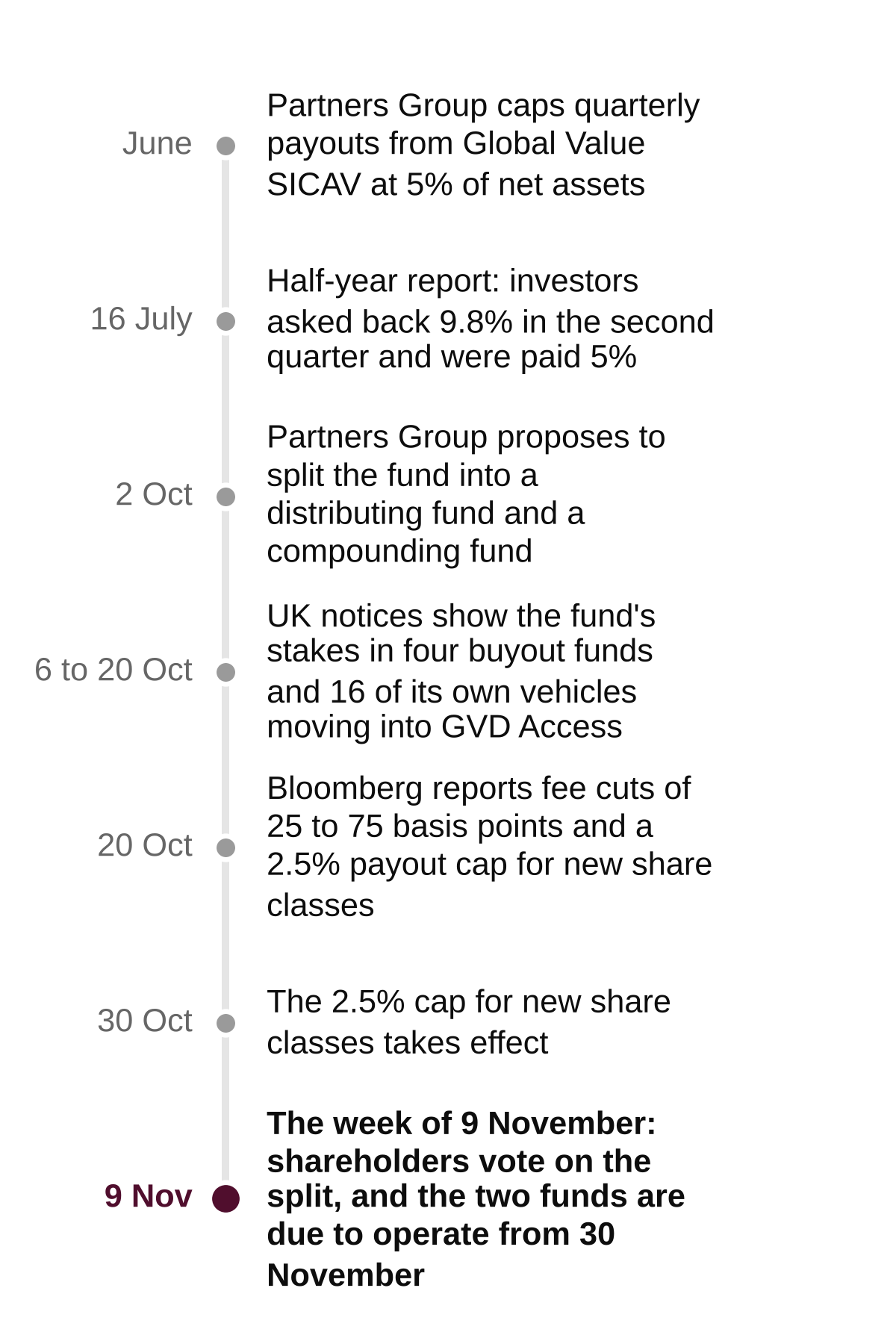 Source: Partners Group, half-year report of 16 July 2026 and release of 2 October 2026; The Gazette, notices of 6 to 20 October 2026; Bloomberg, 7 and 20 October 2026, read through Swissinfo and Wealth Management. |
The cut costs Partners Group little against what a failed vote would cost it. Its management income was 905 million Swiss francs in the first half, up 6%, Bloomberg says. For instance, take €1 billion left in the distributing fund: a 25 basis point cut is €2.5 million a year for three years. The same €1 billion in the compounding fund at 75 basis points off is €7.5 million a year until 2030. The €2.5 million and the €7.5 million are examples, not the fund's figures. The fund's management fees and other costs are 3.2% a year, Morningstar's Mara Dobrescu says. She reads the timing plainly: "The decision to cut fees now may suggest that initial investor response to the fund split was less enthusiastic than the firm hoped."
The presentation also tightens the exit for new money. Its new share classes will be able to take out 2.5% of net assets a quarter from 30 October, half the current limit. The 2.5% is expected to go back to 5% in the compounding fund once the split is done, Bloomberg says. Partners Group told Bloomberg by e-mail that it has "received positive feedback from our distribution partners".
A yes in the week of 9 November creates a distributing fund that sells older stakes to pay those who want out. Its first stakes are already known, because the four buyout funds that moved in October were raised in 2016 to 2018. Buyers price such stakes below their value, at 91% of net asset value in the first half by Jefferies' count. A no, however, leaves one fund with a 5% cap and a queue that has filled it for two quarters.
Evergreen buyers did not bid up LP-led prices
Evergreen funds have not pushed up the price of buyout fund stakes, a study of ten years of trades finds. The same study puts prices since 2023 about two points above what the market's own history predicts. Its authors are Greg Brown of UNC Kenan-Flagler and William Volckmann of the Institute for Private Capital. Their paper of 5 October was reported on Tuesday by SecondaryLink, which supplied the data with EvergreenLink. They examined 2,983 prices for buyout fund interests from September 2015 to the end of 2025. Among them were 783 purchases by an evergreen fund, "more than a quarter of our sample". Across the sample, the average trade priced at 91.8% of net asset value, 89.5% for North American funds and 94.2% for Western European ones.
Evergreens matter to the price because their money arrives every month and must be invested. Their trades priced about 5.7 points lower than the rest in the authors' main model, a result the authors call unreliable. In their time-series model, prices in 2023 to 2025 ran about 1.9 points above the path that pre-2023 fundamentals imply. The 1.9 points are statistically significant but "modest", about 2% of the average price. So the evidence is "mixed", and the paper finds no reliable sign that evergreens paid more.
Prices since 2023 sit about two points above what pre-2023 fundamentals predict Quarterly mean price of buyout fund stakes, % of NAV, 2015 to 2025, against the model's fitted price
Source: Brown and Volckmann, Institute for Private Capital, "Private Equity Secondary Pricing: Understanding the Current Market", Figure 5, p.18, 5 October 2026.
The discount moves with public markets because it is the cost of selling early. Public equity returns move the sample's prices, while a fund's reported value lags those returns by a quarter or two. So a buyer in a falling market pays less than the last reported value, and a buyer in a rising one can pay more. Hence the authors' conclusion, which a seller will not like: "NAV is not a reasonable floor for negotiating secondary pricing."
The paper also says what it cannot see. Its models explain about 24% of the variation in prices from fund and market characteristics. The rest of a price comes from the negotiation and the deal. Its data name an evergreen buyer but never an evergreen seller, so a gated fund selling stakes is counted on the other side. Those data come from SecondaryLink, whose October print puts its market price for buyout funds at about 87% of net asset value. By contrast, the study's own quarterly averages for 2025 sit at about 88% to 90%.
Verdane files a second CV five months on
Verdane has filed for a second continuation vehicle five months after closing its first, and the first already sits in six houses' evergreen funds. Three Swedish companies named Verdane Lif Continuation II filed Form Ds on Tuesday from the Stockholm office of Verdane Fund Manager AB. Each is of indefinite size, has no placement agent and has raised nothing yet.
Verdane is the Nordic growth investor whose latest flagship, Freya XII, filed in March 2025. Its first continuation vehicle filed the same way, through three companies named Verdane Lif Continuation I, on 16 April. Four weeks later Verdane announced a €635 million multi-asset vehicle for Arrive Group, Talentech and Pet Media Group. The vehicle's sole lead was Coller EQT, then still Coller Capital, which this month co-led EMK's VDK vehicle. Its co-underwriter was StepStone, and Simpson Thacher advised Verdane.
The buyers' own books show who funded the first vehicle. Those books, the quarterly holdings reports of six houses' registered evergreens, carried $86.9 million of Verdane Lif Continuation I at 30 June.
Source: the funds' quarterly holdings reports (N-PORT) to 30 June 2026, filed 27 to 31 August 2026, linked on each fund. Values are the funds' own at 30 June, not the cost paid.
Verdane has most probably set up a new multi-asset vehicle for other companies, built the same way and sold to the same buyers. It could instead be a top-up vehicle for the first three companies, since Pet Media Group's plan includes acquisitions. Nothing about either vehicle has been announced officially yet. The next sign is a filing that shows money raised, or a release naming the companies and the lead.
| SEC · Form D | Filed 20 Oct 2026 |
| | Verdane Lif Continuation II (D1) AB, with (D2) and (E) | | Raised | nothing yet | | Size | Open-ended | | Sponsor | Verdane Fund Manager AB, Stockholm | | Earlier | Verdane Lif Continuation I, filed 16 Apr 2026, closed at €635m in May with Coller EQT as sole lead | | Read the filing |
|
On the radar
- Thursday 22 October, 9am, New York, and London. Blackstone holds its third-quarter call, the first since it shelved Project Eclipse, its $3 billion fund-backed obligation, on 24 September. The same day HarbourVest Global Private Equity publishes its half-year results, and up to 1.3 billion SpaceX shares become sellable under its prospectus.
- Friday 23 October, 1pm, London. Baillie Gifford US Growth Trust holds its annual meeting, where Saba Capital asks for three board seats. The same day Cox Capital's offer for Blue Owl Credit Income shares opens at $7.31, 20% below the 31 August value.
- Wednesday 28 October, 8am, New York. Evercore reports its third quarter, its first call since it made Nigel Dawn, who built its secondaries advisory unit, co-president.
- Tuesday 17 and Wednesday 18 November, New York. SuperReturn Secondaries North America meets at Convene on Madison Avenue, with Coller, HarbourVest, Adams Street, Kline Hill and New York State Common on stage. The Secondary Brief has negotiated 15% off for its readers: book with the discount link, or use the VIP code FKR3675SECBRIEF.
-
|

