Charity and Sylvia: the extraordinary claims of Rachel Hope Cleves
In early July, a dispute began between two writers; Rachel Hope Cleves, author of Charity and Sylvia; A Same-Sex Marriage in Early America, (2014), and Tillie Walden, author of the graphic novel Charity and Sylvia (2026). Both books are about Charity Bryant and Sylvia Drake, two women who lived as a couple in Vermont in the early 19th century. Cleves posted an open letter to Bluesky in which she accused Walden of not sufficiently acknowledging Cleves's earlier book, and claimed that Walden's book is an unauthorised adaptation of hers. Walden, via her publisher, has denied that her book is an adaptation of Cleves’s book.
Cleves has repeated her claims several times, and many people have spoken up online to support her. Few, if any of these supporters had read Walden’s book. From the start, I noticed that the smaller number of people who cast doubt Cleves’s claims (including cartoonists Cuyler Keating and Barry Deutsch) mostly had read Walden’s book. So I resolved to read both, and make up my own mind.
I began with a fairly open mind and a determination to look for the textual basis of Cleves’s claim that Walden adapted her book. If it was an adaptation, it would be possible to look at the text and clearly see all the places where Walden had taken a part of Cleves’s work and adapted it.
I read both books, then counted all of Walden’s sources myself, and read & listened to several of Walden’s promo interviews. I do not think Cleves’s claims are supported by evidence; in fact, her claims are much more convoluted & implausible than I realised from my initial reading of her callout posts. There is a troubling disconnect between some of Cleves’s statements and the reality of Walden’s book and interviews.
I’m disappointed that so many people chose to join a social media pile-on against a queer book that they had not read, based on evidence that they had not seen. You would think this would be a known hazard by now.
charity & sylvia vs charity & sylvia
I'll begin with a brief overview of each book, to set the shape of things.
Rachel Hope Cleves's book is a popular history book written by an academic. It's a very accessible read, presenting the known historical evidence about Charity and Sylvia and detailing the sources of that evidence, which consists of diaries, letters, poems and other records. Many, though not all, of these records are archived at the Henry Sheldon Museum in Vermont. The purpose of Cleves's book is to prove that Charity Bryant and Sylvia Drake lived together as a married couple; the book goes into detail about many aspects of their lives that show this, such as their shared business and their extended family life. Cleves argues that the evidence she has uncovered shows that Charity and Sylvia's relationship was sexual and romantic, and that their families and communities treated them as a couple. Like most popular nonfiction books, each chapter has extensive endnotes that tell us what sources the chapter is based on.
Tillie Walden's book is a historical graphic novel; it’s primarily based on history but includes some scenes that Walden imagined based on the historical record. The book is in 5 parts, which are mostly comprised of vignettes of one or two pages, told in 3x4 panel grids. Most of Walden's dialogue is (to use her term) fabricated, but many pages include text from historical documents such as diaries, poems or books (including the Bible). The book's endnotes consist of only 4 pages, but point readers to a more extensive online bibliography.
A couple of weeks after Walden's book was released, Cleves put out an open letter accusing Walden of taking the story from her book without credit.
the letter
It's quite long and I would encourage you to read it in full here. I’ll share this helpful summary by ComicsBeat:
In her letter, Cleves writes, “Charity and Sylvia’s story has been so deeply meaningful to so many people—their story has, without exaggeration, saved lives—that I’ve tried to be happy that Walden’s book is making their story more widely known, even if she chose to take my title and my cover design as well as my narrative and my research with only a single sentence of acknowledgement at the end of her book in her notes section. Walden’s illustrations and storytelling are wonderful, as I told her when she reached out to me during the writing process. It would take nothing away from her hard work to be honest about how it is built on my hard work.”
She goes onto say that Walden has repeatedly said in interviews that she based her graphic novel on extensive archival research “without acknowledging that her book is, in fact, based on my book. … She has adapted my book without credit or compensation, and claimed my research for her own. I don’t doubt that Walden spent time looking at letters at the Henry Sheldon Museum, but the story that Walden tells is not to be found there. It is a story that I pieced together from years of visits to at least twenty different archives and locations across the United States, not only in Vermont but in Massachusetts, New York, Illinois, and Washington State, as well.”
Cleves cites several stories presented in Walden’s graphic novel that she narrativized from “countless fragments” and says, “It saddens me that Walden’s media blitz will make my book harder for readers to find, not easier, and diminish its continuing power to have the enormously positive impact it has had to this point, which is why I feel the need to correct the record.”
My first reaction to this was sadness, as I'm fond of Walden's other work and I'd been meaning to pick up her book at some point. Walden is not a professional historian, and the choice to give her book the same name as the previous main text on this topic felt inexplicable. If Cleves said that Walden's cover design and story were also taken from her book, I had no immediate reason to disbelieve her.
So I looked at the first part of Cleves's claim that I could verify; the cover design that Cleves said that Walden had taken from her.
the covers
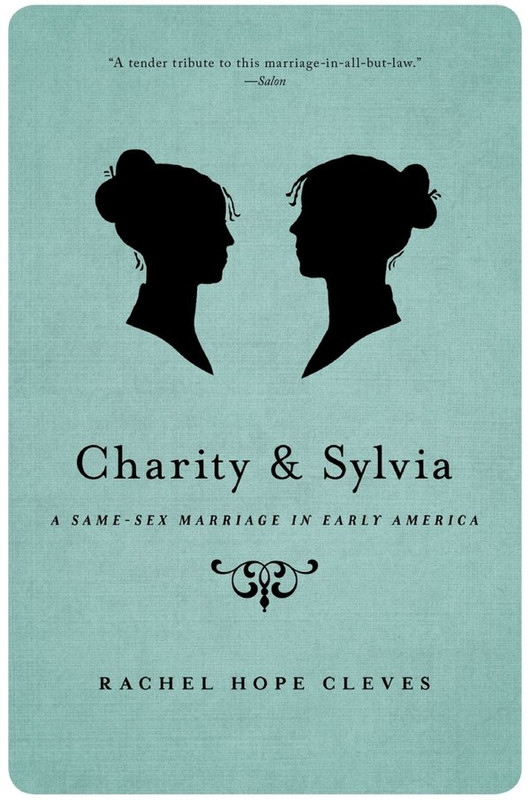
Here's the cover of Cleves's Charity and Sylvia, by designer Connie Gabbert:
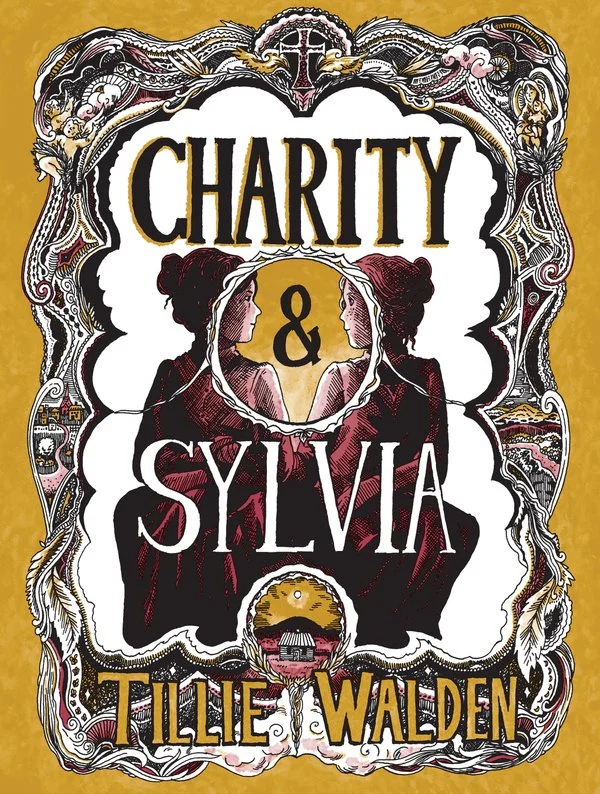
Here's the cover of Walden's Charity and Sylvia, drawn by Tillie Walden:
this gives me pause; I un-RT
...because these two covers do not look anything like each other; not in layout, or style, or colour, or composition.
As I learned later, both are based on the only existing image of Charity Bryant and Sylvia Drake, a silhouette:
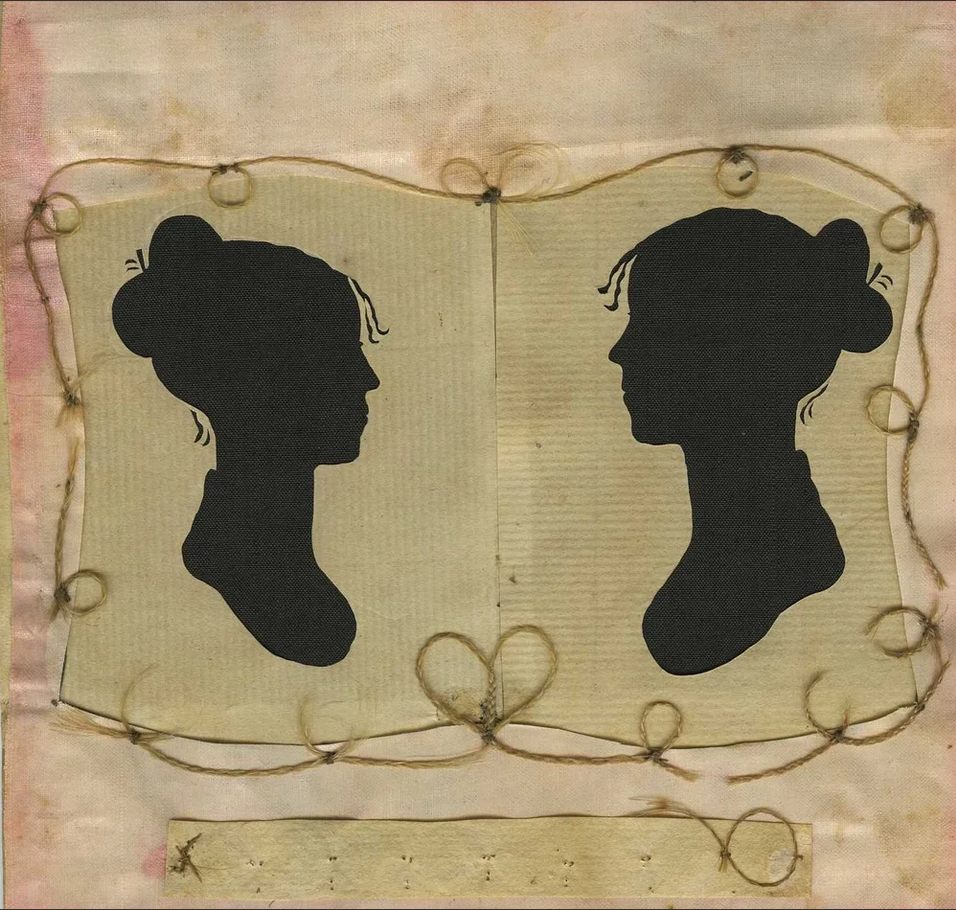
Both Cleves and Walden, in the course of their research at the Henry Sheldon Museum, handled this original silhouette image. Cleves' cover removes the original hair-braid setting and changes the background colour to a bright teal, whereas Walden keeps the hair-braids and the pale background behind the women’s heads, changes the hair silhouettes slightly, and then vastly expands the image into a larger tableau.
It would not be possible to mistake one cover for the other, and Walden's cover incorporates some elements of the original image that Cleves's version omits.
There is also a clear difference in how each writer interpreted the original image. It is not known which silhouette depicts Charity Bryant and which is Sylvia Drake. From reading the very first pages of each of the books, I learned that Cleves and Walden had used opposite interpretations; Cleves' book states in its opening pages that 'it seems likely' that Charity is on the right, and Sylvia is on the left. Walden depicts Charity on the left and Sylvia on the right.*
A couple of minutes of due diligence on the book covers left me unable to take Cleves's claims at face value any more. Cleves said that Walden took her book cover, but it’s quite clear that what really happened is that Walden looked at the same artefact that Cleves had seen, and decided to utilize different aspects of it in her work and expand on them substantially, thus she ended up with a very different depiction from the one on Cleves's book cover.
*Walden said in a promo video that she agrees that Cleves's interpretation of the image is more likely, but crucially, she did not use Cleves's interpretation in her book. Maybe this was to align the figures on the cover with a reader's instinctive left-to-right inclination from the title, "Charity and Sylvia". I wonder how much pain could have been avoided if Walden had simply called her book "Sylvia and Charity" instead.
stick a pin in this metaphor
…because these covers are a microcosm of the entire conflict; Walden's book is mostly built on writing and other objects left by Sylvia Drake, Charity Bryant, and others. Her work includes many elements from these records that Cleves does not refer to in her book, and many of her interpretations of those records are different from Cleves's interpretations, often intentionally so. In addition to her historical basis, Walden's book includes fictional dialogue and story elements that are original to her work, some of which are inspired by Walden's own life.
I learned this by reading both books, but even if you haven’t read the books, it’s demonstrable from the same online sources that Cleves says support her allegations. She has never linked to any of these sources in her letters or posts, or shared any clips or screenshots, just as she never posted the book cover that she claimed Walden took from her. Her followers were left to take Cleves’s descriptions of these documents on faith.
I searched out all the evidence for myself, and found that this faith in Cleves’s statements was, in many cases, misplaced. It is however understandable that she was initially hostile to Walden’s media promo.
the source of ire
I don’t want to overlook the Walden interview that angered Cleves in the first place, because it’s an important part of this story.
Per ComicsBeat, https://www.comicsbeat.com/professor-rachel-hope-cleves-wants-waldens-charity-sylvia-licensed-as-an-adaptation/ "Cleves says her initial inclination was “to be at peace,” but then she heard from a colleague about Walden’s interview on the CBC podcast Q with Tom Power, during which Walden says that during her archival research at the Henry Sheldon Museum, "What I found was journals, poetry, and about 900 letters, but most were written to them and their responses are lost to time. So I read a lot of partial conversations. But their journals and their poetry is what showed me who they are, and no one has actually ever sat down and completely read all of it. I think I’ve gotten closer than anyone. I didn’t get through all 900 letters, but I think I made it to like the six hundreds."
"Cleves says Walden’s claim that she has read more of these documents than anyone else is untrue. “I absolutely read every single word of every scrap of evidence not only in the Bryant-Drake papers at the Henry Sheldon Museum but in many additional archival finds at that collection.”
(You can listen to the CBC Walden interview here). The comment about reading the letters is immediately preceded by praise of Cleves's 'seminal' book, so the insult wasn't intended, but it's completely reasonable that Cleves took offense to the implicit statement that she hadn't read the whole collection. Perhaps it would have cleared up a lot of mess if Walden had apologised for this right away.
However, Cleves’s open letter went further in dismissing Walden’s work in the HSM archives: “I don’t doubt that Walden spent time looking at letters at the Henry Sheldon Museum, but the story that Walden tells is not to be found there.”
She’s saying, simultaneously, that she read more of the original letters than Walden and also that it doesn’t matter how many original documents Walden read, because Cleves’s book is Walden’s real source, so Walden should have cited the book rather than the letters. There is one immediate problem with this claim: Walden did cite Cleves’s book extensively, along with all her other sources.
the bibliography
Not long after Cleves first posted her claim, cartoonist Cuyler Keating quoted Cleves’s post to say that Walden did in fact credit Cleves.
Sticking my nose into this to say that having heard Tillie speak publicly about the book multiple times, she openly acknowledges that Cleves' biography was a foundational text, and has dedicated an entire website www.charityandsylvia.com to a bibliography citing hers and Cleves' research.
— Cuyler Keating (@cuylerkeating.bsky.social) June 30, 2026
"Having heard Tillie speak publicly about the book multiple times, she openly acknowledges that Cleves' biography was a foundational text, and has dedicated an entire website to a bibliography citing hers and Cleves' research. I understand the frustration regarding how upfront and central Cleves' research should be in the book itself, but its worth assessing her claim that Tillie is attempting to pass the research off as her own and the story as her "discovery." She is not. The book is also not essentially a graphic adaptation of Cleves' "C&S," as some are claiming. Tillie read her own primary sources, did her own research, and the book is sewn together with many invented scenes and dialogue to aid in narrative creation and emotional resonance."
The bibliography is at the centre of this conflict. It is not a traditional bibliography or endnotes section. Walden calls it 'atypical'. I am a regular nonfiction reader, I always read endnotes and acknowledgements, and I have never seen anything like the Walden bibliography before. The bibliography provides source notes on each of Walden’s hundred or so vignettes, including the historical documents, visual/material sources, and her thought process behind each page. There are dozens and dozens of full colour photographs. (Walden's book is drawn in a sepia-toned black and white).
In the bibliography, she cites Cleves frequently, including exhorting her readers to read Cleves's book to find information on topics that didn’t make it into Walden's book; for example, in her note to the vignette on pages 162-163, she says “Cleves writes about the many apprentices [Charity and Sylvia] employed... I was sad to not be able to include this more in the book. Should you want to know more about their apprentices, look towards our Holy Mother of knowledge Rachel Hope Cleves."
It is difficult to square the content of Walden's bibliography with Cleves's claim that Walden has not credited her, or has driven readers away from her book. Walden does, in fact, make many efforts to drive readers toward Cleves's book.
It became apparent that Cleves didn't see the bibliography website until after she made the above post accusing Walden of taking her story without credit. I don’t quite understand how this could have happened. The bibliography URL, https://www.charityandsylvia.com/ , is printed in the same endnotes that Cleves said gave her 'only a single sentence of acknowledgement.' If Cleves read that acknowledgement in the endnotes, it's very strange that she did not know about the bibliography.
I’ll come back to the bibliography later, but I also want to note that it’s striking that Cleves didn’t post the wording of Walden’s inadequate acknowledgement of her, or its context within her endnotes. Cleves said it was ‘a single sentence’ then did not tell us what that sentence was. Even without visiting the bibliography, I think Walden's endnotes, and the details of the acknowledgement therein, seriously complicate Cleves' claim that Walden's book is adapted from hers.
the endnotes
In her four pages of endnotes, Walden lays out the basics of her research and writing process for the book, shares some photographs she took at the HSM, and gives several acknowledgements. On the first page she directs us to the longer bibliography, where she says we can learn “Not just about what is true, and how I came to know it, but about my thinking behind the fabrications, behind the art, behind the dialogue”. (She also explains the cost and labour reasons why it was not included in the printed book). Walden then introduces us more specifically to the archive contents: "To give you a brief sense now of what is true: nearly every poem, letter, or journal entry [that appears in Walden’s book] is verbatim from the archive of Charity and Sylvia's papers at the Henry Sheldon Museum... From Sylvia's journals, I took short recollections and turned them into scenes." She includes a brief selection of the diary entries that she used.
It's after this selection of diary entries that she acknowledges Cleves. Here is what Walden said, emphasis mine:
"I was able to weave these short remembrances into a story with the added context of over 900 letters (nearly all sent to them) and the formidable, endlessly informative history on their lives written by Rachel Hope Cleves titled 'Charity and Sylvia' and published in 2014. Without these different angles from which to see them, my job would have been much harder. Their own papers rarely mentioned their childhoods, but because of the work of historian Hope Cleves and her research into that, I was able to describe their youth with a satisfying amount of detail."
(That’s three sentences).
So, firstly, Walden is identifying Cleves's book as not her main source but as part of the context for a story that she built from the archive, and particularly from Sylvia Drake’s diary. Cleves’ book was not the main focus of her project, but was an additional resource that made her project easier.
Secondly, she identifies a specific topic for which Cleves served as her primary resource; Charity and Sylvia's youth. This is a significant difference between Cleves’s book and Walden’s.
Roughly half of Cleves's book focuses on the two women's lives before they met — the first 9 of her 19 chapters. 7 are about Charity, and 2 are about Sylvia (who was younger than Charity and had a less well documented childhood). Walden, by contrast, only depicts their childhoods in Part 3 of her book, which is a brief retrospective section of 22 pages (much shorter than Walden's other 4 parts, which average a little over 50 pages each). So that’s under 10% of Walden’s book, corresponding with almost 50% of Cleves’s book. The first 12 pages of Walden’s Part 3 take us on a rapid dash through Cleves's 7 chapters on Charity's origins; for Sylvia, having less to work from, Walden's 10 pages include several fictional incidents alongside the events that Cleves told us.
If Walden's entire book had been written this way, I would completely support Cleves's claim that Walden's book is an adaptation of hers, in spite of Walden inventing a few events to flesh Sylvia out. Absolutely, no question. It would be completely fair to describe this 22-page section as adapted. However, it's less than 10% of Walden's book. The other 90% of Walden's book does not have nearly such a tight relationship to Cleves's work.
This is a pattern in Walden’s citations of Cleves. For the most part, Walden only turned to Cleves as a source when the other archive materials at her disposal came up empty. Whenever she could, she focused on material from the archives instead, including material that Cleves never used in her book.
and back to you
At the point where Keating brought up the bibliography, I thought the conflict was primarily a question of how Walden should best have cited Cleves's book. The bibliography established that Walden cited Cleves extensively, and Cleves's claim that she hadn't done so was due to the online bibliography citations not being prominent enough. Another commenter who had looked at the bibliography replied to Keating with the following, "In this case, Walden does cite Cleves’s work. The question is how much is fair. I suspect we’re seeing a clash of two publishing cultures, scholarly and indie comics. Different expectations, misunderstandings of the work each involves."
This would be a great discussion to have. It is not, however, the discussion that Rachel Hope Cleves wanted us to have. Instead, she moved on to an even more extraordinary claim; that Tillie Walden ought to pay her money.
escalation: the second letter
"D&Q packaged and marketed Walden’s book as an independent work with no acknowledgment that it was an adaptation of my book. There is exactly one sentence in the notes at the back that acknowledges the existence of my book. Walden has repeatedly presented the work as based on her research, even going so far as to claim on CBC that she’s the only person who’s read all the letters, and saying in a video she made for the Henry Sheldon Museum that she worked exclusively from the diaries and letters. Readers of reviews, people who’ve listened to her CBC interview, and readers of the book have no way to know that she adapted my work. Many people who bought Walden’s book have commented exactly that on social media. Additionally, D&Q took my title, and cover image. I’ve heard from readers that when they tried to buy my book, bookstore owners have pointed them towards Walden’s graphic novel. In the future when people search for “Charity and Sylvia” on the internet the algorithm will point them to Walden, who has a far bigger platform as a cartoonist than I will ever have as an academic. In short, Walden and D&Q are profiting off eight years of my labor and pretending otherwise. It pains me to have to correct the record this way. Walden was initially given a grant to work exclusively from the papers at the Sheldon. Instead, as her website makes clear, she read my book twice closely and outlined and drafted, then went to look at documents to supplement the story I had written. My book is based on research at over 20 archives and historical sites. I am the author of the story. Walden took that story and illustrated it beautifully, but she and D&Q should have acknowledged the adaptation and they should compensate me.
Rachel Hope Cleves"
The goalposts have moved. Now she is aware of Walden's bibliography website, Cleves shifts gears, from asking Walden for more credit to claiming that the website itself, where Cleves is thoroughly credited, demonstrates that she deserves financial compensation.
At this point, the allegations against Walden have become tautological; Walden ought to stop saying her book is based on her own research in the archives, because really she just adapted Cleves’s book, and while Walden cruelly denies this in interviews, her website ‘makes clear’ that it is true. You'd think that Walden, sneaky adapter that she is, would have hidden her tracks better on her own website, which is the one space that she 100% controls. Very careless of her to lie in interviews about doing research but reveal the bald truth on her own website. Does Cleves provide a link to this revelatory website, or explain how it shows that Walden adapted her book? No, she does not. Once again, many people took her description of what the website said on faith.
the denial
Following on from a briefer statement that appears at the end of the ComicsBeat piece, Tillie's publisher posted a lengthy statement in 8 text images to Bluesky, with the header 'In Defense of Tillie and Comics'. Here are some highlights:
1. Tillie did not “illustrate” Cleves’s 2014 book, Charity and Sylvia: A Same-Sex Marriage in Early America.
2. Comics are not a “derivative” form.
3. Nonfiction graphic novels are not “illustrated adaptations” of source materials.
4. Cartoonists do research of a scholarly nature.
5. Nonfiction cartoonists are protected by the same copyright provisions as academics and nonfiction writers, provisions that account for facts and the expression of facts.
6. Tillie was in touch with Cleves in April 2025 as she sent her a manuscript a year before publication stating the Museum had already made edits, to which Cleves replied with a single edit/comment as well as words of praise: “I’m already blown away by the historicity of it, and by the fullness of the characterization, and by the art, of course.”
7. Please see the Henry Sheldon Museum of Vermont History statement on Tillie’s book and research on their website.
[...]
Tillie’s book is told in the language of comics, which, as cartoonists and readers know, is a form markedly different from non-fiction prose. ... Tillie has created a meaningful, beautifully drawn treatise of love and synthesis of her own research and the archives, where the power of comics uses carefully drafted dialogue and extended silent sequences to viscerally show the claustrophobia and beauty of life in a rural community in 1800s Vermont.
... Tillie is a contract-to-contract worker in central Vermont who pays out of pocket every month for her family’s healthcare and survives with no benefits or job security. She and her wife live in Trump’s America, which is currently rolling back protections for the LGBTQ+ community as well as for artists, specifically federal funding for artists via the NEA and via federal support for fine arts masters programs, such as the Center for Cartoon Studies where Tillie studied and where she teaches on a contract basis.
...
It seems that very few people making accusations, if any, have read Tillie’s Charity and Sylvia from beginning to end to understand what Tillie has created. We suggest that if you care, read Tillie’s Charity and Sylvia, and also read Cleves’s Charity and Sylvia: A Same-Sex Marriage in Early America."
Nobody liked this. This was in large part because the claim that Walden's book was an adaptation of Cleves's book had taken on its own gravity. Every denial was more evidence of Walden's perfidiousness. Every reference to Walden's archival research was a lie. Until Walden admitted that she had adapted Cleves's book, no citation or gesture of respect or peace to Cleves could be sufficient.
It is also not a good statement on the merits. D&Q's attempt to frame the denial as 'in defence of comics' was not nearly so well received as Cleves's statement that she was calling Walden out 'for the sake of all the hard-working historians out there whose work has been similarly taken without credit.' Per the commentariat, the dispute might be about all historians, but it is not about all comics, only one, very specific comic. And it seemed rich for a book's publisher to complain that the writer is overworked and has no job security. As for Walden's queer identity, many readers pushed back by saying that Cleves is a queer writer too.
One line, however, was not in dispute at all. "It seems that very few people making accusations, if any, have read Tillie’s Charity and Sylvia from beginning to end." Not a single angry commenter challenged this assertion. They hadn’t read Tillie Walden's book, but they were more convinced than ever that it was a rotten, stolen book.
hold up; what makes an adaptation?
Cleves said, “I am the author of the story. Walden took that story.” The story is a true, historical one. Cleves wrote it based on the historical documents at the HSM and also her other research. She insists that Walden, who also studied the historical documents at the HSM, did not base her story on the archives, but instead based it on Cleves's book.
It is, of course, very common and normal for historians (even those who are not tenured professors like Cleves) to look at the same documents that other historians have examined previously and write new books and articles based on those same records. That’s why you can go to the library and read a dozen different biographies of Napoleon, or Anne Lister.
It is not clear to me if Cleves is saying it would be impossible for another person to make their own story based on the documents at the HSM, or merely that Walden did not do so. She does not offer any reasoning or evidence for either possibility. The former would be a very extraordinary claim indeed; the latter would require explaining what it is about Walden and her book that shows that Walden didn’t do this.
Barry Deutsch was the first person I saw questioning what this story is that Walden took from Cleves:
"I’ve asked over and over what Walden specifically took from Cleves that belongs to Cleves. No one seems willing to answer. Instead, people act as if Charity and Sylvia’s story is Cleves’ property, and can’t ethically be told without Cleves’ permission. That’s wrong both legally and ethically."
In answer to this, I would quote Rachel Hope Cleves, in the afterword to her book. "Charity and Sylvia's story has been told before, in snippets and bits, if never at length. In the century and a half that followed their deaths, the two women were never entirely forgotten."
Here in her own book, Cleves tells us that Charity and Sylvia’s story was a living, known one before she came along. These are real historical events that she learned of from documents that other people can also read. (Walden reproduces the longest ‘snippet’, by William Cullen Bryant, in full at the end of her book. She is well aware of the ‘snippets and bits’).
Barry Deutsch has, like me, read Walden's book. He posted several examples of scenes in Walden's book that are based on real events that Cleves did not include in her book, here, and also here. I encourage you to look at these. (He is not cherrypicking. There are many other examples, though these are two of the more significant ones). Deutsch does not think that Walden's book is an adaptation, and as it so happens, this opinion on this dispute is informed by his professional experience:
"Part of what I do for a living is co-write comic book adaptations of a series of best-selling prose novels. When I do that, fidelity is my number one goal. I can't do the prose novel word for word, but I work hard to create a script that's true to the book's themes and story. It is very obvious that Walden isn't doing anything like that kind of adaptation. She freely makes things up. Cleves may be Walden's largest source, but Walden uses other sources. The book couldn't exist as it is without Cleves - but it also couldn't exist as it is without Sylvia's diaries. ... I read both books, and really liked both of them. But the books are extremely different experiences. One of the main concerns of Cleves' book - proving that the relationship was a sexual one - never comes up in Walden's book. Walden gives the characters a happy ending that only fiction can provide."
There's probably some theoretical cases in which a historical fiction book with an imaginary happy ending could be an adaptation of a history book, but I personally think that's beside the point. Everything in Walden’s book is the point. All of Walden's research, the diary entries she used as the building blocks of much of the book, the other texts she incorporated, the personal experiences she drew upon, the letters in the archives; you could point to one of these things and maybe say 'yeah she put that in as well, but it's still an adaptation'. But all of them? Walden’s book is a complex collage, of which Cleves's book is only one fragment. Walden has said many times that Cleves' book is significant to hers! But Walden sets down layers and layers in her book, in words and art. At what point does calling this book an 'adaptation' become like calling a sandwich 'a slice of cheese'? What gives Cleves the right to call this an ‘adaptation’ if Walden says that she did not adapt Cleves’s book?
the story
I honestly feel kind of bad writing this post, because I'm having to look at two beautiful, very different books, and then pull them up by their roots and cut them into pieces to show you what is different about them. If you don't take anything else away from this post, please take this; you have to read queer books. You especially have to read books before you wade into ill-conceived online conflicts about them. Go put a library hold on a queer book right the fuck now.
Cleves's book is a triumph of queer history; Walden's moved me to tears. If there is a core Walden theme, it's the fragile peace within the vast silence of space (or Texas, or an empty ice rink); in Charity & Sylvia, she brings that to earth, to the 19th century, to Vermont. She reels us through history; she illustrates visions of hell and the emptiness of death, then leads us out again. I'm literally crying at my desk again just thinking about what Walden did in the book's fifth and final chapter. The ending is imagined; but throughout the book, Walden's central purpose is to take those real events and documents, particularly those left by Sylvia Drake, and bring us into how this feels, what these people were like as people. It's not doing what Cleves's book did, which was to present a thorough historical argument that these two women shared their lives as a married couple in all aspects. Instead, Walden is inviting us to feel their greatest pains and their greatest fulfillment.
As Deutsch indicated, Cleves's purpose of proving that Charity and Sylvia were in a marital relationship was simply not relevant to Walden's book. The gift that Walden took from Cleves wasn't her story, but freedom from having to prove anything at all.
the claims: the lack of extraordinary evidence
I think that if you have got this far and you still think that Walden adapted Cleves's book, you have to admit that it was kind of a convoluted scheme. You have to believe that Walden decided to adapt Cleves's book, but then sneakily concealed this fact by reading Sylvia's entire diary and hundreds of letters. She then wrote a lying endnote about how she had built most of the book out of scenes from Sylvia's diary, but also added an acknowledgement to Cleves, further down the same page where she shared a selection of Sylvia's diary entries. Then she put an entire fake bibliography online, citing dozens of diary entries and letters that weren't really the material she used to build her story, because really she'd secretly adapted it from Cleves's book - but oh no! Cleves finds out that Walden adapted her book, and for proof of her claim she points us to this very same bibliography website! 'As [Walden's] website makes clear, she read my book twice closely and outlined and drafted, then went to look at documents to supplement the story I had written.'
(rule of internet: if someone says "This thing proves that xyz!!!" but does not link to the source that they say proves xyz, then it probably does not really prove that).
As Cleves so unfortunately forgot to share a link to the webpage in question, I will do so for her. She's referring to Walden's Charity & Sylvia 'About' page. This page outlines Walden's process. Walden breaks this into phases (these overlap, but there's a few notes where Walden is more exact about the timing, so I’ll refer to those). Walden spent over a year on the research and reference sketching phase of her book, and she did indeed start with Cleves's book. "The first phase of research was simple: Read the only historical book on the subject of Charity Bryant and Sylvia Drake. It is not possible for me to overstate how important Rachel Hope Cleves’ book on the subject was to this project. She researched extensively into their whole lives and pulled it all together into a narrative."
However, Cleves claimed that (emphasis mine) Walden ‘outlined and drafted, then went to look at documents to supplement the story I had written.’ This is not what the website says. It says that after reading Cleves’s book, Walden spent a year doing research in the archives before beginning the draft of her own book. "After getting everything I could from Cleves, I moved on to the wonderful and arduous process of driving an hour and a half over two mountains to get to Middlebury, Vermont where the Henry Sheldon Museum is, and where the majority of C&S’s papers are." That's where she spent the next year, working in the archives. She shares many of her early notes and sketches, including a couple of different plans for structuring the book. Now I've read both books, it jumps out to me that in the earlier notes shared here, Walden was initially thinking of a structure that was not exactly like Cleves's but was closer to Cleves's than to the book she ended up writing. Some of her initial notes start in the late 18th century, like Cleves's book; the 'Initial thoughts on structure' note page puts their childhoods in two separate sections close to the start. Then in the later part of Walden's process description, those early notes get abandoned because they had caused a mental roadblock (emphasis in original); "Finally, I cracked the draft on the fourth try. After making the whole outline I realized that part of what was agonizing me was by trying to connect the story to my research while I wrote. But I had been in the midst of all of this history for over a year at this point and I came to the conclusion that I needed to trust that I knew their story. I put away the outline, put away the notes, put away the sketches and took yet another blank piece of paper and started the story." Walden’s book begins in 1807, a time period that falls in the middle of Cleves's book.
So to recap, Walden read Cleves's book, twice, then spent over a year reading the archive and exploring other material (including physical exhibits at the HSM, other visual references, and many more books from or about the early 19th century). When she cracked her draft of the book, she began at a completely different point in time to Cleves. Contrast this process with Cleves’s claim; “She read my book twice closely and outlined and drafted, then went to look at documents to supplement the story I had written.”
Does this strike you as a fair and reasonable description of the process Walden walked us through?
Cleves dismisses Walden's year-long work in archives as "supplemental" and "claim[ing] my research for her own." For an entire year? What does she think Walden was doing for that year? She wants us to believe that Walden somehow read over ten years of diary entries and six hundred letters, and meticulously recorded which of these served as inspiration for each of her vignettes, but really she didn’t do any research and none of her story came from that stuff, it all just came from Cleves's book. You’d think a researcher would know this, but the first book you read for a project isn’t necessarily going to be the most influential.
I would suggest that the reason Walden's interviews devote more airtime to discussing Sylvia's diary and the other items from the archives rather than just talking about Cleves's book is straightforwardly that Walden spent much more time with those materials than she spent with Cleves's book, and they ultimately played a greater role in her project than Cleves's book did.
If you really, truly believe Cleves’s claim that Walden didn’t do any research of her own and was totally dependent on Cleves’s research instead, you still have to explain how it is that Walden's book — the sneaky adaptation for which all the archival work was a mere 'supplement' — refers to so many events, themes and texts that do not appear in Cleves's book.
I counted it. All of it.
Walden’s bibliography provides a source note for every one of her hundred-odd vignettes. Each note explains whether the vignette is based on an archival document, or inspired by Cleves, or (for about 23% of pages) either fictional or drawn from Walden's personal experiences of her queer life in Vermont. Many vignettes have multiple sources, or one main source plus some other documents that Walden used to flesh out the context.
I counted, page by page. I made a spreadsheet. Thus I can say confidently that Walden has more pages that cite Sylvia Drake's diary as their main inspiration than any other document. This is as expected, given how central the diary entries are in all of Walden's explanations of her process. In one bibliography entry (to p185) she says that Sylvia's diary is "arguably my main source of information" for the book. In her HSM video, she said "The whole reason we know what their lives were like was Sylvia's journal... This is the only time in their lives I was able to get a lot of detail... This is the story. Sylvia wrote down everything that they did. ... I was very happy to be able to take a lot of words directly from what Sylvia said and put it in the graphic novel, because it felt important to be true to how she actually spoke."
In addition to the diary, many vignettes are based directly on letters and poems by Charity Bryant, and letters and documents written by other 'characters' in the story, such as Eli Moody — who is a much more prominent figure in Walden's book than in Cleves’s, inspired by his many letters in the HSM archive, some of which Walden reproduces in her book. (Cleves also quotes from some of the Moody letters, but not as many as Walden). The poet William Cullen Bryant (a relative of Charity's) is also much more prominent in Walden's book than Cleves's, and his writing is used at several key points in Walden’s book. He’s quite peripheral in Cleves’s story.
For my spreadsheet, I tallied citations for each page, omitting 18 blank pages; there is some overlap, hence why these add to over 100%. Walden names original documents by the characters (diaries, letters, and poems) as the main inspiration for 47% of her pages; Sylvia’s diary is the largest of these, but there are many others. A further 15% of pages are based on other texts, such as the Bible, or a 19th century book or map, or other nonfiction books she had read. 13% fell into my 'Visual/Material' box; this includes both Walden's own visual designs (including title/intro pages, for which she cites her design inspirations), and pages inspired primarily by material objects and artworks, including objects at the HSM and other museums in Vermont. (I regret mixing these two categories together. I wanted a box to tick for pages of the comic that were inspired by things that were not text. These pages mostly have either no words, or words laid out in an unusual way). 20% of pages are primarily what Walden describes as 'fabricated'; events and conversations that she made up to serve the story, or where she intentionally changed an event from history to make the story flow better. A further 3% are directly based on Walden's personal experiences.
24% of pages give Cleves as the main source; however, as I previously mentioned, that includes the entire 22-page run of part 3 (I tagged all of these as Cleves, even though several key events in Part 3 were invented by Walden). If we remove this chapter from the total count, only 16% of the book would have been primarily Cleves-inspired. There are also a further 10% of pages where Walden mentions Cleves as a secondary source, or for providing some background context that helped her work; all of these overlap with one of the categories I listed above.
So in total, she references Cleves in some way for about a third of pages, but these do not all have equal weight, and they are very unevenly distributed. I would have a much, much different opinion of Walden's book if all of it was as reliant on Cleves as Part 3. But it's not. Outside of Part 3, most of the Cleves citations are in Parts 1 and 2, where Walden points us to Cleves's work to help set up the context. The deeper Walden gets into her story, the further she departs from Cleves. Walden does not turn to Cleves for her story, but gradually turns away from her.
There are, as previously mentioned, several themes and events that Walden included in her book, but which Cleves did not mention. Most are topics from Sylvia’s diaries that shape the story and art throughout Walden’s book; often mundane, sometimes less so (such as the story of Sylvia and Charity almost dying in a storm). Several historical events that Cleves didn’t mention pass through Walden’s story briefly, such as the Year Without Summer in 1816. One of Walden’s most significant departures from Cleves is her attentiveness to Charity and Sylvia's contact with indigenous and black people, and with the abolitionist movement in New England. Walden’s research shines through here, as she cites relevant diary entries and other texts. She makes several vignettes focused solely on these themes, plus mentions it incidentally on many other pages, in fictional conversations between the characters, and in her chapter title pages that give newssheet-style summaries of moments in American history. Walden makes a vignette out of an abolitionist text that Sylvia mentioned favourably, and she retells an event from Sylvia's diary in which Sylvia was inhospitable to a black visitor. This event becomes woven into the emotional climax at the end of Part 4 of Walden's book, laying guilt and duty over Sylvia's longing for recognition of her life.
Cleves does not mention these topics in her book even once.
assorted examples:
Here on p105, Walden illustrates a poem by Charity Bryant.
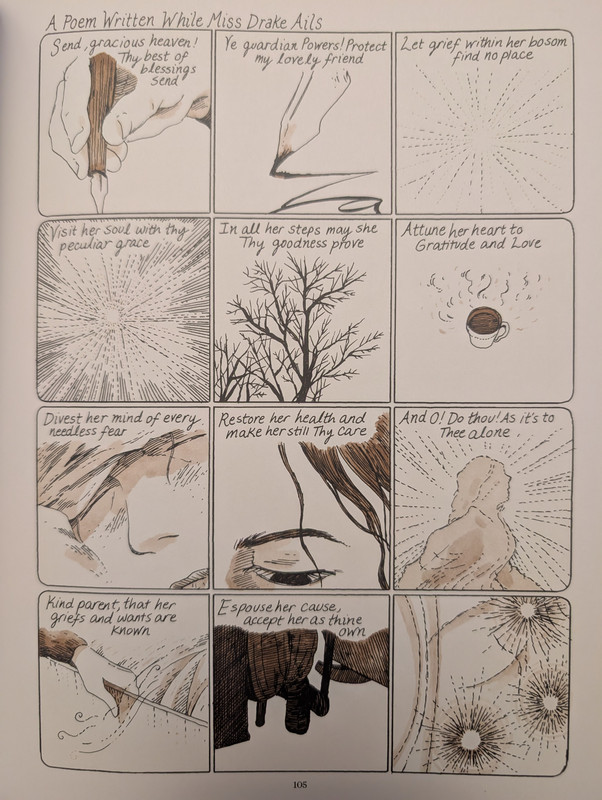
Her bibliography note explains how she composed this page.
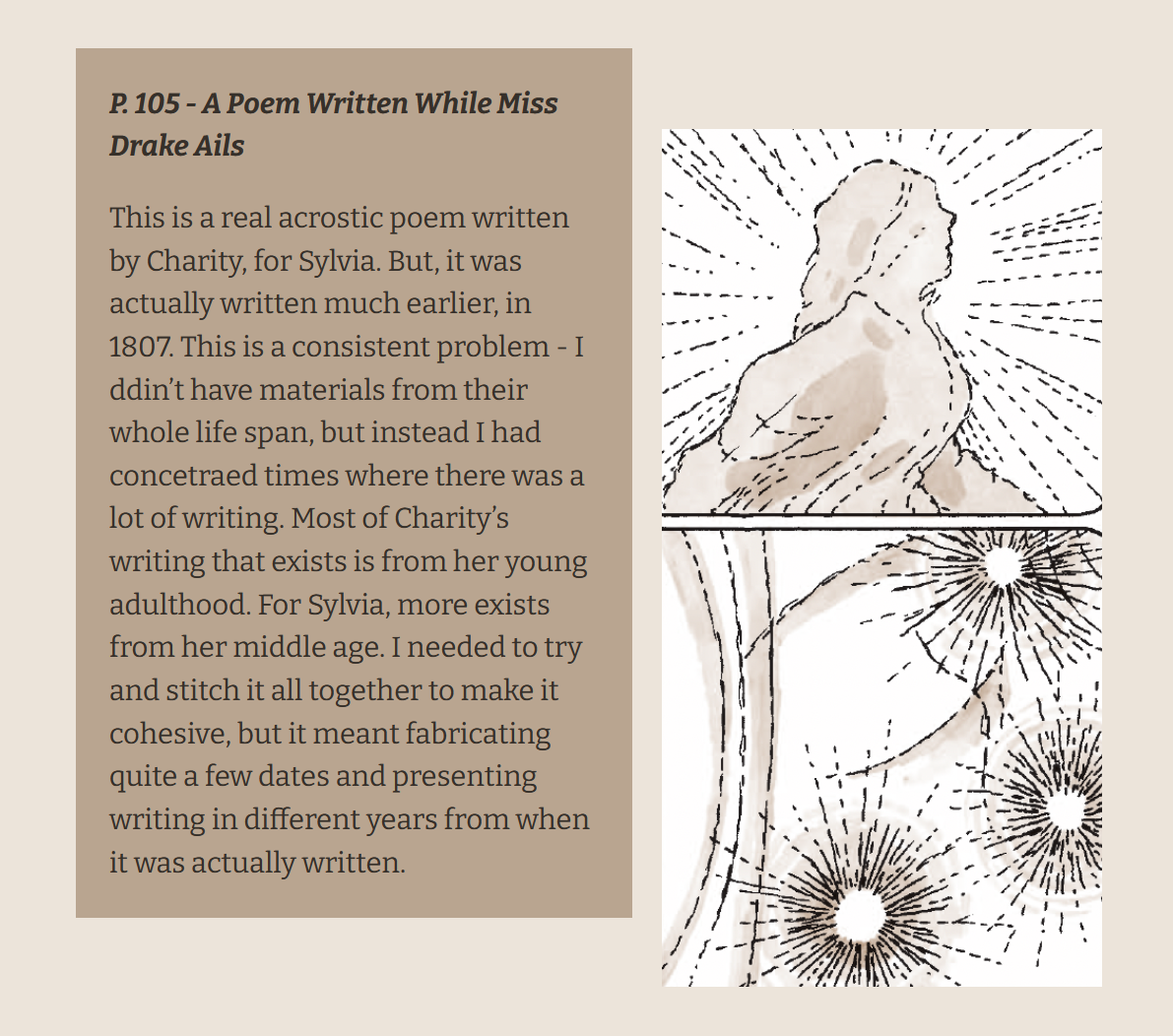
Cleves's book also mentions this poem. Cleves excerpts a few lines from it, and she describes the circumstances in which it was really written. Walden, unlike Cleves, reproduces the entire poem, and she intentionally reinterprets its creation, moving it to a different time in the women's lives. Her note here demonstrates her focus on using Sylvia and Charity's own writing as a source wherever possible. In this time period where there weren’t any surviving writings by Sylvia or Charity to draw upon, it would have been very easy for Walden to simply adapt Cleves's account of Charity and Sylvia's lives...but Walden does not do that. Instead, she moves the archival material around to paper over the gaps in the story.
Here’s an example where Walden cites Cleves as a source of information, but not her main source for the story content:
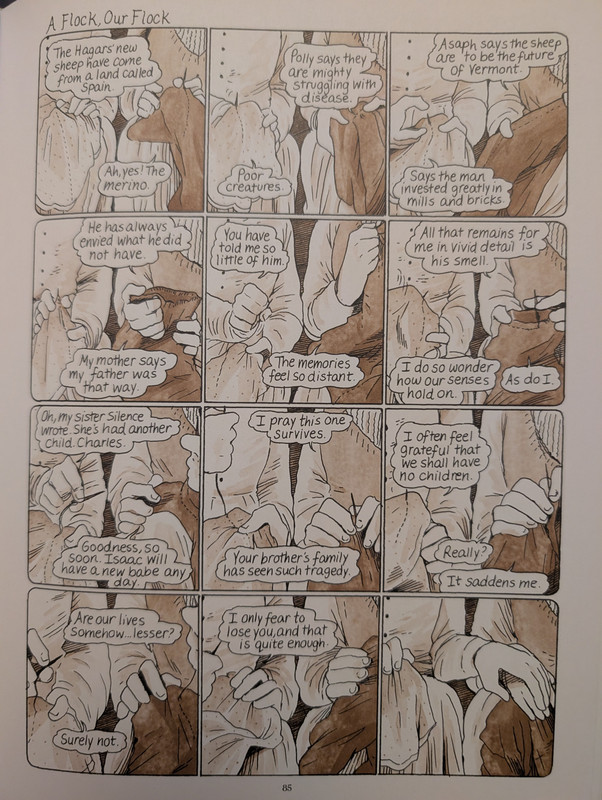
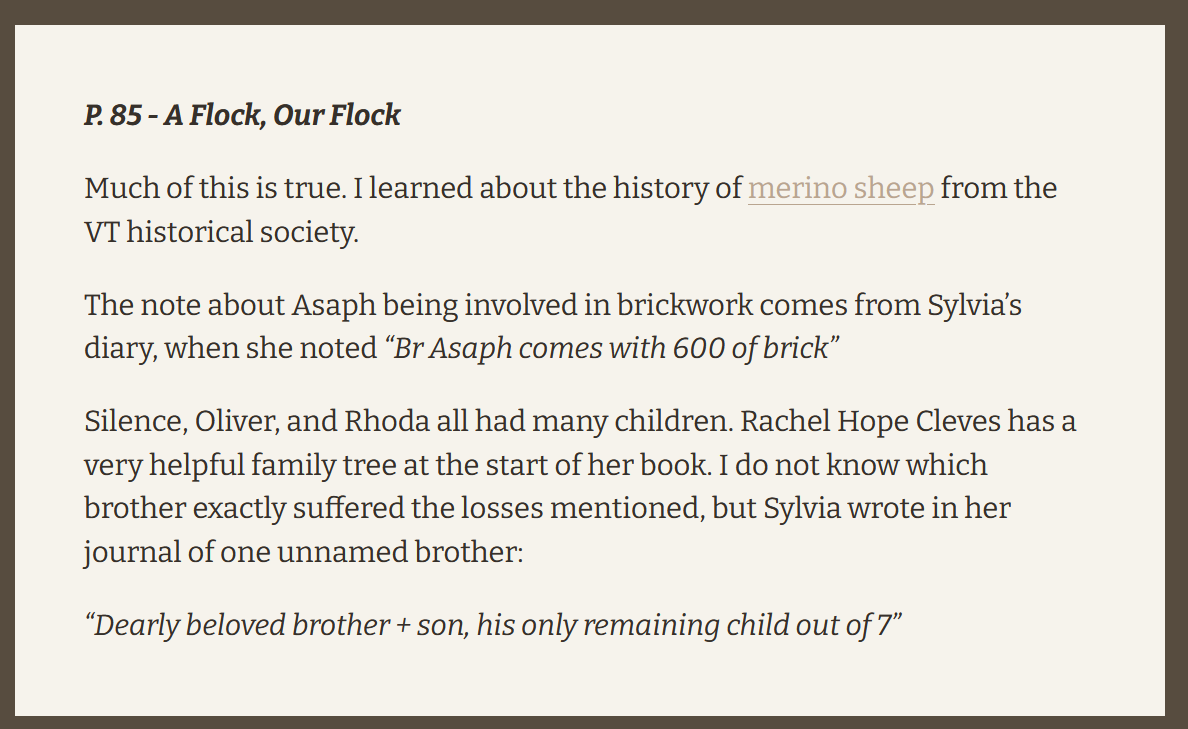
The dialogue and emotional content here are pure Walden, but she cites Sylvia’s diary and the Vermont Historical Society as her main sources, along with Cleves for background info. I therefore ticked my boxes for ‘Sylvia's Diary’ and for ‘Other Text’, plus ‘Cleves - Contextual’, but Walden's storytelling here doesn't really come from any of those things; she's built a frame out of them, and inside it she digs into Sylvia's feelings on being fatherless and childless. There is no sense in which this vignette could be described as 'adapted' from Cleves, and her citation of Cleves here in no way implies that it is.
This the most baffling element of the whole conflict to me. Walden scrupulously recorded every tiny background detail she learned from Cleves, as she did for all her other sources. In return for this, Cleves has lambasted her for not giving her enough credit, and accused her of lying about her use of those other sources. Cleves requires us to believe that Walden has lied not just in a couple of interviews, but a hundred times over in these vignette notes.
Here's another page with a complex mix of sources:
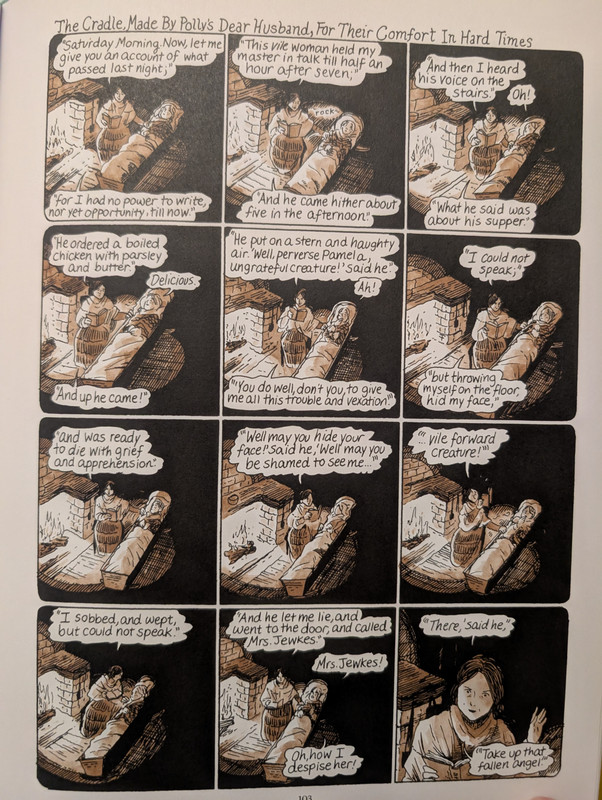
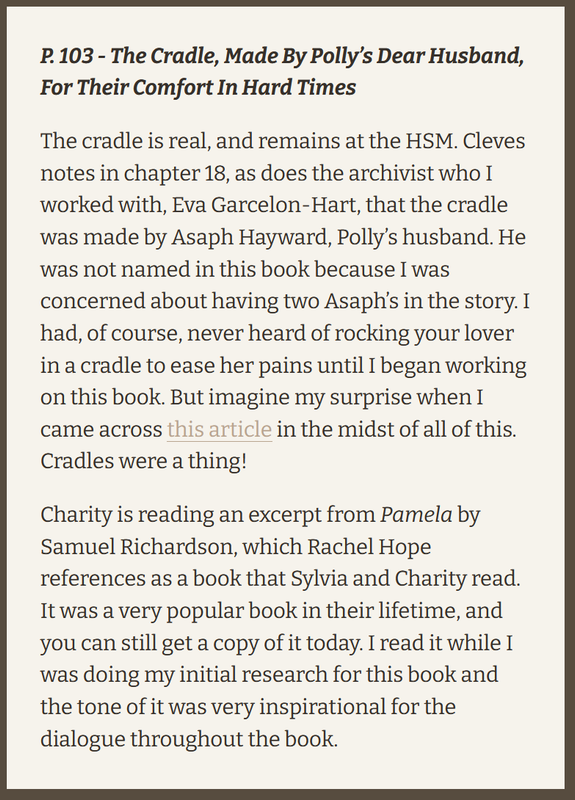
The page is primarily based on a real object that Charity and Sylvia owned. Walden credits Cleves and Eva Garcelon-Hart equally with providing her information on the object. She also references an article on Shaker adult cradles. Almost all the text that appears on the page is taken from Samuel Richardson's Pamela.
Though Walden credits Cleves for mentioning the cradle in her book, I do not think it makes sense to say that this page 'adapts' Cleves. It's a real object, which Walden has seen and touched. Cleves said nothing about the women reading to each other in the cradle; Walden made that up. Walden credits both Cleves and Eva Garcelon-Hart for providing information on the cradle; I find this notable, because I’ve so rarely seen a nonfiction writer credit a curator in specific endnotes before, rather than in general acknowledgements. I’m therefore less than thrilled that Cleves, a tenured professor, is demanding we award her all of the credit for this page, brushing aside Walden's equal acknowledgement of Garcelon-Hart, as if Walden learned nothing from the museum staff who she worked alongside for a year. (Walden, in this reading, cannot be trusted to tell us what she learned from Garcelon-Hart and what she learned from Cleves).
But I'd also note that this page demonstrates how Walden uses Cleves's book. It’s not a text source for Walden to adapt. Rather, it's a map of other material to go explore. Cleves points Walden to Richardson, so Walden dives into Richardson and fills a page with text from his book.
Furthermore, she credits Richardson for her dialogue tone throughout the book! Walden didn't need to credit anyone in particular for her dialogue tone, but she did; she's pointing us to every single person whose work influenced her book even in the smallest detail.
For a completely different case: p110, where Walden cites Cleves and only Cleves.
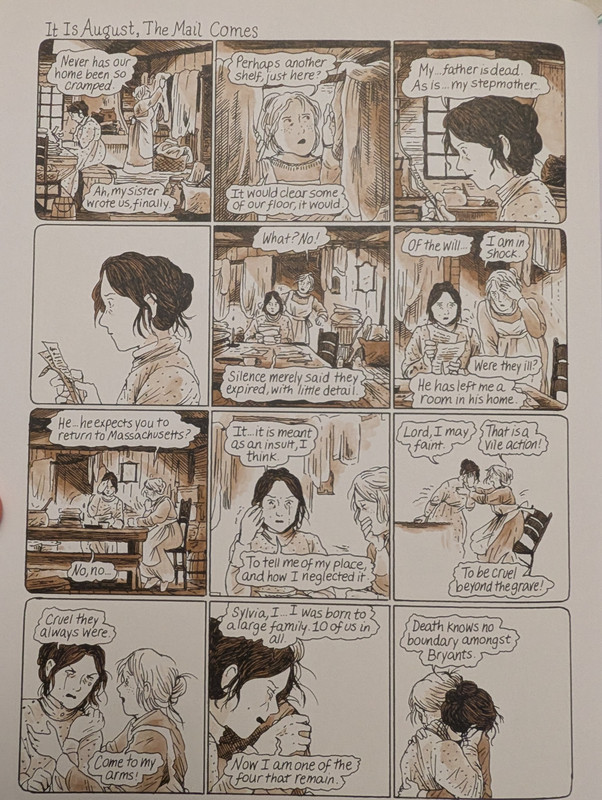
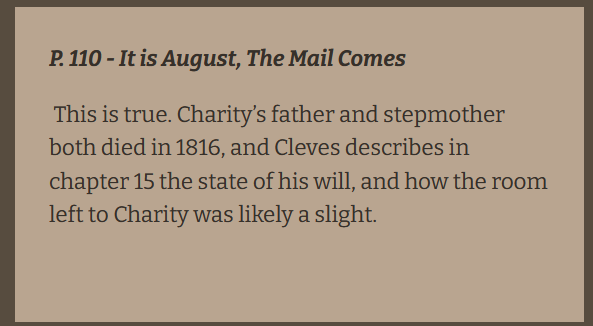
It's very clear-cut; this isn't just based on facts uncovered by Cleves, but also makes use of Cleves's opinion that the bequest was an insult to Charity. From Cleves’s book: “Up to his death in 1816, Philip sought to punish his youngest daughter for her nonconformity, even leaving her less in his will than many in the family thought she deserved. Rather than leave her valuable property, his main bequest was title to a chamber in his house, a slap in the face to Charity, who for almost a decade had made her own home in Vermont with Sylvia.”
Walden has absolutely no hesitation in telling us when Cleves is her main source for a vignette. If every page of Walden’s book was like this, or even most pages, I would have no problem calling it an adaptation. But this was one of few clear-cut-Cleves vignettes I saw outside of part 3. There's others where Walden primarily cites Cleves, but most are adorned with additions from Walden's imagination or additional citations to other sources. I had to flip over 100+ pages to find a clear one to show to you.
To believe that Walden's whole book is adapted from Cleves's book, you have to either believe that Walden is lying every time she cites a source other than Cleves (while also telling the truth when she does cite Cleves), or alternatively, that the rest of the book doesn't matter and the only relevant parts of the story are the smaller proportion of vignettes where she primarily credits Cleves.
assorted untruths
I want to revisit some more of Cleves's specific accusations. In her first open letter, she lists some story elements that she claims Walden took from her:
"The story about Charity learning to sew from her spinster aunt Charity Howard comes from a textile fragment that I tracked down in the Henry Art Gallery in Seattle, Washington." That's some commendable research work by Cleves. But it is not true that Walden took it and put it in her book. It is not in Walden's book at all. This is one of the places where Walden does a "fabrication"; Charity Howard is mentioned in Walden's book only to note that Charity Bryant was her namesake*; Charity Bryant learns tailoring in a different way instead. (Per her note to p105 above, Walden made an effort to trim out characters that shared a name with another major character; it’s likely this is why she chose to make up something different instead of using Charity Howard).
[*ETA: This post originally said that Walden didn’t mention Charity Howard at all, but an eagle-eyed reader showed me that she is mentioned once as the person Charity Bryant is named after, but never as the person who taught Charity to sew. I apologise for the error.]
Also in Cleves's first letter, she said that Walden “[said] in a video she made for the Henry Sheldon Museum that she worked exclusively from the diaries and letters.” Cleves did not link the video, so I shall do so for her. This is the only video on the HSM YouTube account that features Walden. I have listened to it 4 times because I was so confused about this: Nowhere in it does Walden say she worked exclusively from the diaries and letters. I don’t understand how Cleves could have heard something that simply was not said, anywhere. Cleves then repeated this fake quote in her second letter, again without providing a link to the HSM video. (To add to the mess, ComicsBeat also repeated this false claim without fact checking it).
From watching the video myself, I get the impression that Cleves hasn’t grappled with what Walden actually said in it, which was that she is "trying to understand Sylvia's whole life story from only the relatively limited documents remaining." As an artist and storyteller, Walden is thinking of how to characterize and represent Sylvia, and how Sylvia would act in the scenes of her own life. She's focusing on Sylvia's own writing to tell her how to do that, rather than relying on Cleves’s book. No exclusivity contract made her do this; it is her own choice as a writer and artist.
Cleves has claimed that Walden has made her book harder to find. A helpful commenter with Nielsen Bookscan access told her that sales of her book had doubled in the most recent couple of weeks (ie. since Walden's book was released, but before the call-out post). Cleves did not respond, and has not rescinded that incorrect claim, or acknowledged that the sales bump complicates her claim that Walden has harmed her sales. Okay, you might say, Cleves was wrong about the outcome, but how was she to know that the release of Walden's book would boost sales of her own? Well I don’t know, maybe because this always happens with popular nonfiction? It's not like one academic textbook obsoleting an older academic textbook. I buy nonfiction books due to endnotes and citations all the time — that's my main source of new books to read on my fave niche topics. Every serious nonfiction reader does this. That Cleves was so confidently wrong about this isn’t of vast import, but when added to the other issues, it does not reassure me of Cleves's reliability.
I also want to note that Cleves's characterization of Walden's process as a lazy act of theft is completely counter to Walden’s descriptions of her process in the same CBC interview that initially spurred Cleves’s callout post. We know Cleves has listened to this interview, because it is where Walden made the incorrect claim that she had read more of the archived letters than Cleves, which angered her. Toward the end of the interview, Walden says that her artistic process was so driven by the book's ethos that she could not even use a computer to copy the book's grid template; instead, she drew every single 3x4 grid by hand. As she explained, "This is a book about two women who never had a single shortcut presented to them, ever. And I think that their labour in life was one of the most crucial parts of understanding who they were, and so I felt like to understand their labour, I had to sit right in it with them."
It is, I will say again, extraordinary that Cleves would listen to that statement and then claim that Walden had copied her book. It is an extraordinary attack on Walden's integrity and labour, and a reading of both books and Walden’s website does not provide the extraordinary evidence required to support it.
i wasn't expecting this to get so weird
What happened here? Putting all the above together, something has gone inexplicably wrong. Cleves is an academic historian. She makes a living from doing research and understanding texts. Cleves didn't read Walden's book when Walden sent it to her a year before publication, which is understandable if a little odd, but it’s deeply weird that she didn't air any concerns about the title back then, when there was still plenty of time to change it. I can get not having time to read the book, but if you felt deeply maligned by the title, surely you’d mention that in your brief email?
It's weird that Cleves claimed that Walden stole her book cover, when the covers look so unalike. It's weird that Cleves said she felt so slighted by the acknowledgement in Walden's endnotes, but also hadn’t seen the direction there in the same endnotes to the online bibliography. It's very, very weird that Cleves claimed that Walden said something that Walden did not really say — twice, if you consider her claims regarding Walden’s About page.
When I set out to read both books to compare them, I thought this was going to be a serious book dispute, over questions like how best to handle such long footnotes in a comic book printing, and what exactly 'adaptation' means. I was expecting to contribute to a reasoned discussion of these issues. But instead, having looked at the evidence, Cleves's claims come across as careless in the extreme. She’s never shown us any textual comparisons to support her claim that Walden’s book was adapted from her book. She’s never talked about the text of Walden’s book at all. Instead, her claims come across as flailing with little regard for the facts, and less than no regard for Walden as a writer or as a person.
It's hard to even fit in my mind that the perpetrator of these allegations against Tillie Walden is the same writer who so diligently set out her case for Charity Bryant's marriage to Sylvia Drake.
It’s a sad irony that, in reference to rumours generated by Charity Bryant’s youthful lesbian flirtations, Rachel Hope Cleves wrote “The belief that “gossip should never be written” ruled the honor culture of the 1790s, which regarded a person’s good name as their most valuable and fragile commodity.”
a final oddity
I want to take one last look back at that terrible, much-maligned statement from D&Q, and its poorly received invocation of Tillie's identity as LGBTQ+ and as “a contract-to-contract worker in central Vermont who pays out of pocket every month for her family’s healthcare and survives with no benefits or job security.”
Several commenters were annoyed by the focus on Walden's personal life, and pushed back to say that, well, wasn’t Cleves a queer person too? D&Q weren't directly arguing that Walden, a married lesbian in Vermont, had a particular identity-based right to tell this story that wasn't shared by the tenured Canadian, but they also weren't not arguing that. (ETA: I did not like this take myself; I’m bisexual, and most arguments about who deserves to tell queer stories wind up shafting bi people, along with all artists who can’t safely disclose their queer identity for one reason or another).
It wasn't until I’d read both books cover-to-cover that I got a hunch as to why D&Q tossed out all these personal identity comments. Walden's book is suffused with elements drawn from her own life in Vermont with her family. She dedicates her book to her wife, Emma. In the afterword, she calls Emma "the Charity to my Sylvia."
Cleves, at the end of her book, gives a crowning acknowledgement to her husband, Timothy Cleves. She says "His excellence as a husband is a great argument for why marriage should be an equal right for all people."
I'm nosy, so I found his LinkedIn. There's a 'Timothy Cleves' profile with a location in the same town where Cleves works as an academic. He is the VP of Business Development at a communications tech company. Perhaps this is why D&Q leaned into both Walden's lesbian identity and her status as a family breadwinner living on a marginal and unpredictable income. (ETA: I don’t think it’s an issue that Cleves isn’t a lesbian, but I do think that her supporters had a misleading idea about her depending on her academic career & income to survive).
When I mentioned this to a friend, they reminded me that Cleves had tagged her original callout post with #pride.
Let’s finish this long and winding post with a skeet that Cleves reposted, and her reply. If you’ve noticed the level of appetite for queer storytelling in Hollywood right now, or if you know that the comic creators behind those blockbuster movies rarely own rights to their work, you may weep. But who even cares about facts or evidence when you’ve got a good grievance fantasy to ride? Just join the pile-on. It’s a lot easier than reading books.
I agree that you definitely need a good copyright lawyer. With the current graphic-novel to block-buster movie pipeline and its associated big money potential; I can't see them giving an inch.
— Audrey Gale 🏳️⚧️ (@daughterofkrypton.com) July 02, 2026
these are the stakes for D&Q and Walden pretending the work is not an adaptation
— Rachel Hope Cleves (@rachelcleves.bsky.social) July 02, 2026