
No. 132 Upcoming AMA + Humility in writing, how revolutions work, and more
"Newsletter's going free and an upcoming AMA on everything writing and publishing."

No. 132 • 7/14/2026
Dear readers,
First, I'm moving all my newsletter writing back to free, which means this space, "FREE BOB!," will now revert back to "COMPOSITION." To quote the great Dave Pell (of Next Draft fame, not the other one), I write for reads. I want as many people as possible within my audience to read what I have to say. And, while I've loved writing behind a paywall for a subset of a subset over the past nine months, I found myself wishing I could share what I shared there, here. So, that's what I'm doing.
But, I'm also doing something else....
For those invested in a writing practice, who want to be more invested, who've got questions, bottlenecks, and experiences you need answered and contextualized, I'm offering a new, more intimate, more problem-solving way to get that intel:
A monthly, 1–2 hour Q&A on writing, note-taking, self-publishing, and research.
What is it?
- A once-a-month, group Zoom call where I answer, to the best of my ability, any question you have on the nuts and bolts of writing (e.g., long-form, short-form, using beta readers, using AI, not using AI, gathering intel from your audience, etc etc etc).
- An opportunity to workshop different aspects of the writing / publishing / research process with someone who's been doing it for over thirty years.
- A monthly check-in / accountability forum on what you've been working on.
- A place to connect with and gain insight from writers going through the same stuff as you.
The first meeting is happening on Thursday, August 30 at 12pm New York City time.
For now, this monthly hang will be $10 a session. The price is guaranteed to go up. So, if you want to subscribe to the initial rate, click here.
Why I'm doing this
I've always wanted to offer something that's considerably hard to get from working artists: time and attention. Time and attention allows me to speak to the nitty gritty of what's actually coming up for you in the writing process. No more making assumptions on my part. If you have questions, I'll provide the best answers I can. If you have experiences, I'll contextualize them in my own experience and in the experiences of the many writers I've known. I'll also try and bring in guest writers from time-to-time. I want this to be fun, dynamic, and directly applicable to your creative life.
If you're interested in this more focused, more actionable, more applicable offering, send payment here.
If you'd rather subscribe so you can be automatically signed up for every session, click here.
- Date: Thursday, August 30
- Time: 12pm NYC time
- Link: sent upon receipt of payment
In the meantime, here's some of what I've been pondering this week.
"No one is self-made"
Christine Abigail L Tan’s "No one is self-made" reframes Confucian meritocracy through Zhuangzi’s skeptical lens, arguing that virtue, power, and rank are socially determined rather than inherent. By showing how luck shapes outcomes, the piece undermines the myth of the self-made individual, and urges humility about our achievements.
Admittedly, I've not yet processed (aka "worked") the piece in its entirety, but it's replete with wonderful quotes I just had to share.
Regarding the normie Confucian take:
"[A]ll human beings share the same basic moral capacity. Everyone possesses the potential for goodness. Since everyone has the same equality of opportunity, unequal outcomes and differences in social position follow differences in effort, discipline and development."
This is the boomer playbook: If my father could do it, and he had nothing, and if I could do it, and I had less than you, then you can do it. AKA survivorship bias. What boomer analysis misses are the conditions, which shift dramatically over time. To put it another way, the rules of the game change, because people have learned to game the rules.
Zhuangzi has a different take:
"[M]oral distinctions arise within concrete situations."
For anyone paying attention, this is Marx. 👆🏽
"What looks like an act of compassion toward one person can simultaneously harm others; what counts as righteousness in one context can become cruelty in another."
This is what makes me a contextualist. Not what is a thing in its nature, but how is a thing functioning in this context.
"What might look like individual agency is always co-produced. Zhuangzi’s concept for this is ziran (自然). It is often translated as ‘naturalness’, but better understood as the ‘so-of-itself’. Events and actions arise from the situation, and not from a sovereign self who imposes their will on the world."
I mean, does it get any better?
Signal your range
Many people have many Strong Opinions™️ about Andrew Huberman. As far as I'm concerned, Huberman is really just two things:
- An expert-level interviewer (interviewees are given a huge amount of time to speak for themselves)
- An expert-level contextualizer (he situates his understanding in explicit contexts).
Listen to Huberman speak on any topic, and you'll hear him situate his knowledge within a range, saying things like, "At least within the context of this conversation," or "As far as the science tells us up til now," or "For the purposes of this conversation," etc. Huberman regularly defines the scope of what he's talking about, making clear his explanation covers a specific range, context, or set of cases. The effect is that he comes across as:
- Generous and honest: signaling to the audience that there's more to the topic than what’s being covered right now shows his knowledge may be incomplete or evolving
- Trust-worthy: acknowledging limits rather than pretending to have all the answers humanizes his communication while increasing his credibility
- Confident: being open about uncertainty shows he's secure in his position, and that he's smart enough to know the limits of his intellect
That last one is key. Knowing what you may not know is a big smarty pants tell, in my book.
Tactics vs Strategies
Danish privacy activist, Lars Kragh Andersen, was arrested recently, ostensibly for posting "his two favorite numbers," AKA the social security number of Denmark’s Prime Minister Mette Frederiksen, along with her phone number.
"Andersen, a self-described anarcho-capitalist who opposes efforts to ban encryption in Denmark, says that in publishing the numbers, he didn’t explicitly say they were the Prime Minister’s phone and civil registration numbers (basically a social security number). Masked men, who identified themselves verbally as police but were dressed in civilian clothes, can be seen busting down the door as Andersen stands there naked with his hands raised." (Gixmodo)
The 400+ comments on Hacker News regarding this case may be of interest to some of you.
My primary interest in this case has to do with ongoing thoughts about tactics vs strategies as defined by the late Jesuit priest and postmodern philosopher (cuz he's French, and French dudes can easily be both priests and rhizome lovers), Michel de Certeau. Some quotes from Father de Certeau:
A tactic "must play on and with a terrain imposed on it and organized by the law of a foreign power."
Tactics are "always on the watch for opportunities that must be seized 'on the wing'." "Whatever it wins it does not keep." "It must constantly manipulate events in order to turn them into 'opportunities'."
And, with regards to tactics and reading:
"The reader invents in texts something different from what they 'intended.' He detaches them from their (lost or accessory) origin. He combines their fragments and creates something un-known in the space organized by their capacity for allowing an indefinite plurality of meanings. Is this 'reading' activity reserved for the literary critic...or can it be extended to all cultural consumers?"
The bi-hemispheric zettelkasten
More and more I find myself thinking of the zettelkasten as comorised of two hemispheres.
One hemisphere is distributed, rhizomatic, bottom-up, and cross-topical. This is the "main compartment" containing single-idea notes (1) used for cross-topical interactions between information, at times leading to experiences of serendipity, and the building of different trains of thought (established through the linking of said single-idea notes).
The other hemisphere is centralized, arborescent, top-down, and topically-situated. This hemisphere is comprised of what I call "drafts," which include structure notes, project notes, and writing drafts. These docs are used to further develop interactions between single-idea notes, and capture any questions, comments, further thinking, etc you have on the topic they speak to.
These two hemispheres correspond to two different modes of work / ways of thinking. The first embraces false starts, meandering trajectories, and not quite understood relationships (as well as their opposite). The second is more discerning, topically focused, and determined to sew up loose ends.
Of course, I can see someone arguing for only the distributed aspect, as well as only the discerning one. If I had to choose between one of these and not my own, I'd go with the former.
(1) I'm using the term "single-idea notes" for convenience. Really what I mean are notes containing information regarding a single concern.
What does it mean to "work a book?"
Sascha of zettelkasten.de, recently asked in his forum whether or not the phrase "work a book" sounded too "unenglish" (Sascha speaks English as a second language). To be expected, the conversation quickly veered into whether English readers would understand the phrase (of course they would), whether it was proper (who cares), etc. Most of this misses the point.
Thankfully, forum member, ZettelDistraction, got to the crux of the matter:
"One works through a book when reading or studying it systematically; the phrase suggests sustained effort."
Spot on. Later backed up by Amontillado:
"To me and my street punk English, working a book would suggest a book of problems which our protagonist was solving. I think it would be a rhetorical trope chosen for effect. 'I worked that accounting book until I not only couldn't tell debit from credit, I no longer cared'."
For me, to "work a book," implies a somewhat heroic approach to reading, suggesting "more than," and a "not average" skillset. It also implies a bit of hubris. But, in the right hands, I'm more than happy with the phrase.
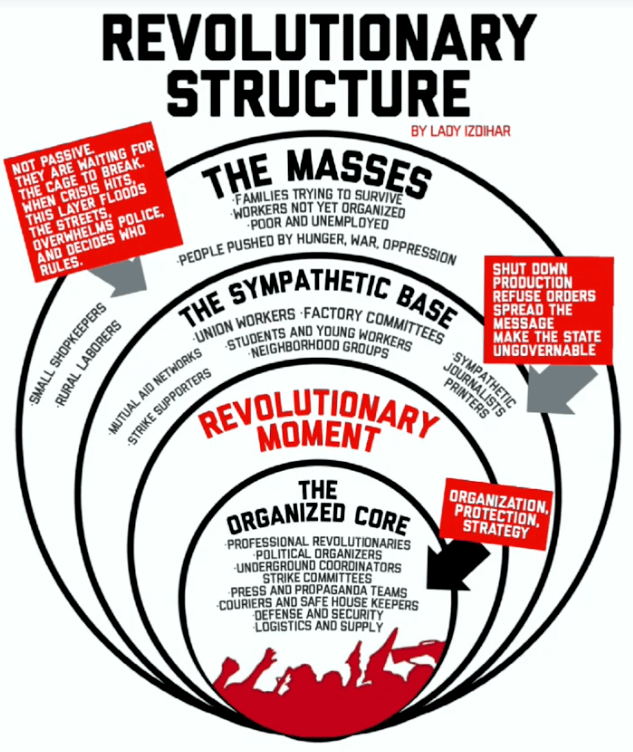
How do revolutions actually work (according to Lenin)
Communist, Muslim, clown, IG grammer, Lady Izdihar, does a splendid job of breaking down the basics in how revolutions happen from a Leninist perspective. Say what you will about communists, they really love a framework.
tl;dr:
And, that's that!
Help me extend my reach by telling folks far and wide to sign up for this newsletter.
Get my book
Pick up my latest book, A System for Writing, [here].
What people are saying about my newsletters:
"It's one of my favorite things to see in my Inbox." —JS
"I love everything you speak on!" —MA
"I'm fine with it." —MG
Got a question or something you'd like me to write about? Send me what you're thinking!