|
The Daily Reconcile.
All the cloud native news that’s fit to reconcile
| Sunday, October 25, 2026 |
Two pages |
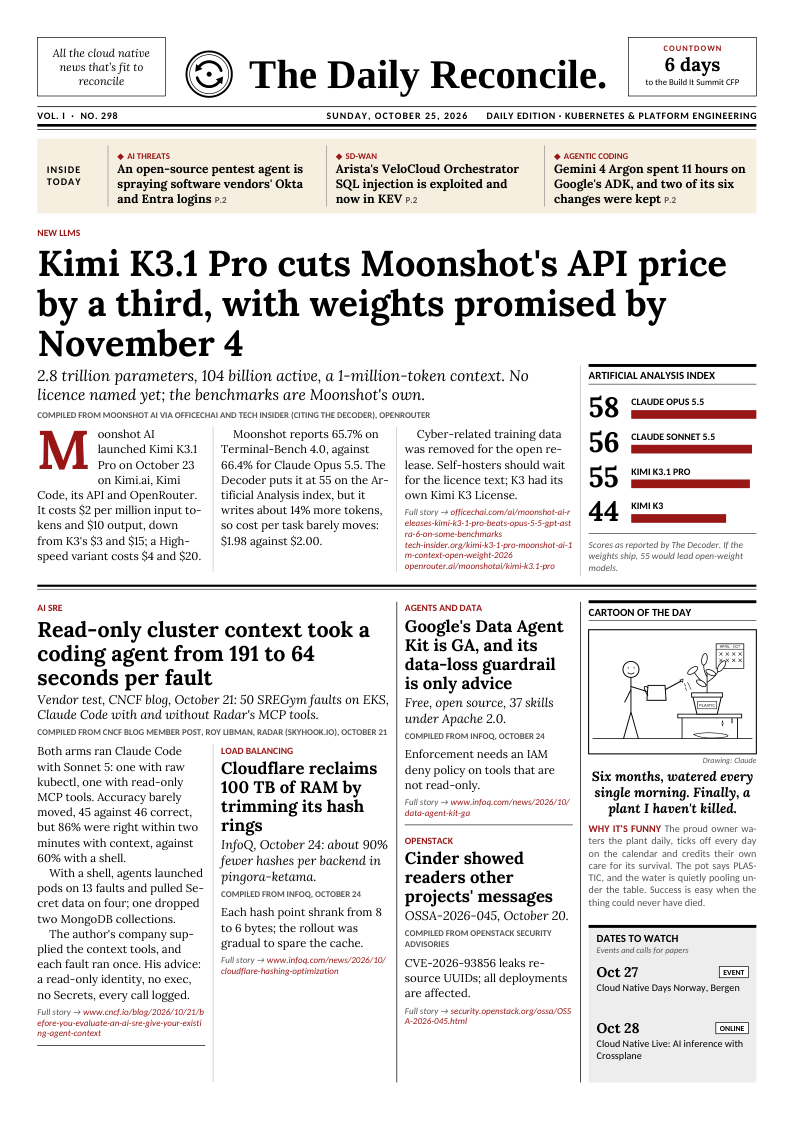
Front page · tap to read the PDF
New LLMs
Moonshot AI launched Kimi K3.1 Pro on October 23: 2.8 trillion parameters with 104 billion active, a 1-million-token context, and API prices of $2 per million input tokens and $10 output, a third below K3. Open weights are promised by November 4, but no licence has been named, and the benchmarks are Moonshot's own (65.7% on Terminal-Bench 4.0). It writes about 14% more tokens, so cost per task barely moves.
Artificial Analysis index | Claude Opus 5.5 | | 58 | | Claude Sonnet 5.5 | | 56 | | Kimi K3.1 Pro | | 55 | | Kimi K3 | | 44 |
Bars to one scale, highest value 58 |
Also in today’s two pages
| → | A vendor test on the CNCF blog: read-only cluster context cut a coding agent's mean time per fault from 191 to 64 seconds across 50 SREGym faults. | | → | Cloudflare reclaimed 100 TB of RAM with about 90% fewer hashes per backend in pingora-ketama. | | → | Google's Data Agent Kit is GA; its data-loss guardrail is advisory, and enforcement needs an IAM deny policy. | | → | OpenStack Cinder (OSSA-2026-045): readers could see other projects' messages and resource UUIDs. | | → | Krateo PlatformOps: core-provider 2.13.28 freezes each composition's origin version so a version bump can't uninstall it. |
| | kubectl tip kubectl auth can-i '*' '*' checks whether you can do everything in the current namespace. |
|
Want it on paper?
The PDF is laid out for exactly this: A4, two pages, printed on one sheet. It is how this paper is read every morning.
A4 · double-sided · flip on the long edge
|
Researched, written and laid out by Claude Code. Every item links to its source; always check the original.
Made by Diego Braga, who decides what it covers.
Sources today: Moonshot AI, OfficeChai, Tech Insider, CNCF, InfoQ, OpenStack, Daily CyberSecurity, GitHub
You get this because you asked for it, and for nothing else. We keep your address and your paper preference, and no other data.
Privacy ·
Source on GitHub
|