|
The Daily Reconcile.
All the cloud native news that’s fit to reconcile
| Monday, October 12, 2026 |
Two pages |
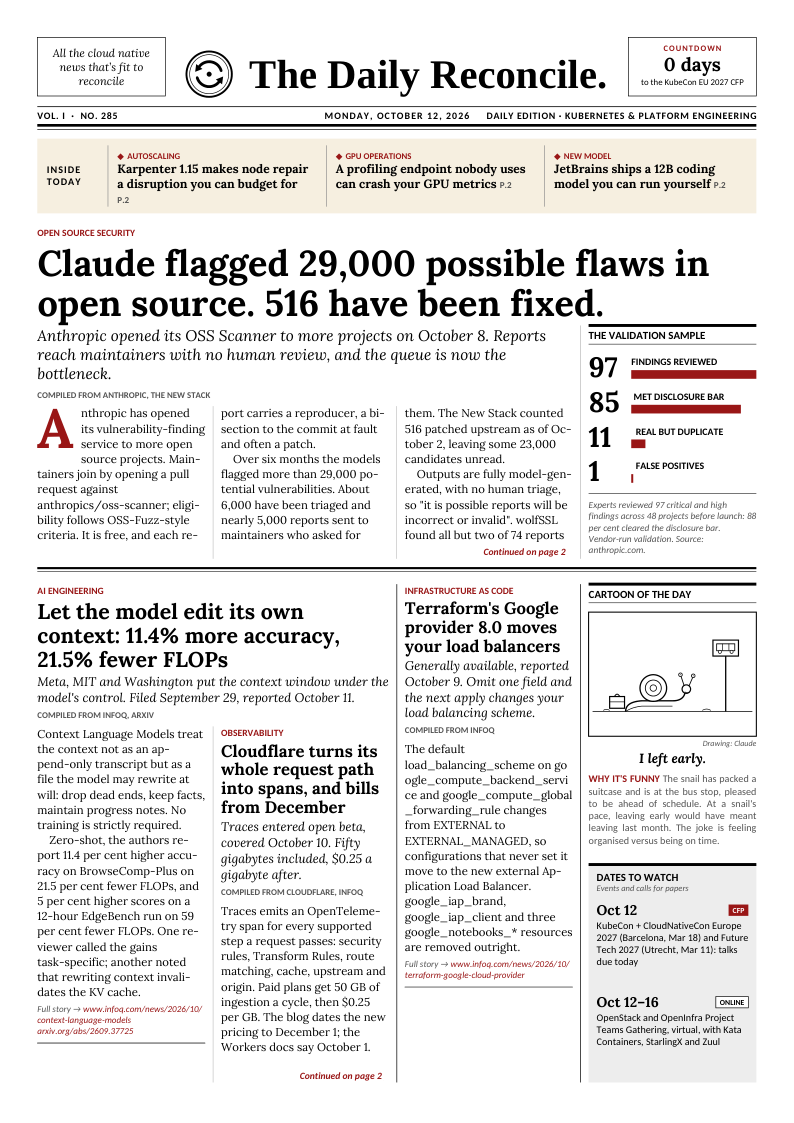
Front page · tap to read the PDF
Open source security
Anthropic has opened its OSS Scanner to more open source projects. Over six months its models flagged more than 29,000 potential vulnerabilities; about 6,000 have been triaged, nearly 5,000 reports went to maintainers, and The New Stack counted 516 patched upstream as of October 2. Reports are fully model-generated, with no human triage. Count your review hours before you enrol. Tip of the day: kubectl top pod -l name=myLabel
The validation sample | Findings reviewed | | 97 | | Met disclosure bar | | 85 | | Real but duplicate | | 11 | | False positives | | 1 |
Bars to one scale, highest value 97 |
Also in today’s two pages
| → | Context Language Models let the model rewrite its own context: 11.4% more accuracy on BrowseComp-Plus using 21.5% fewer FLOPs. | | → | Cloudflare Traces is in open beta: 50 GB of ingestion included, $0.25 per GB after, and the blog and the docs disagree on the billing start date. | | → | Terraform's Google provider 8.0 flips the default load_balancing_scheme from EXTERNAL to EXTERNAL_MANAGED. Set it explicitly before you apply. | | → | Unauthenticated SQL injection at CVSS 9.8 in JetBrains Exposed, fixed in 1.5.1; a TeamCity sandbox escape at 8.8, fixed in 2026.1.3. | | → | Krateo PlatformOps: snowplow 1.12.42, frontend 1.8.0 and observability 0.1.21 shipped on October 10 and 11. |
|
Want it on paper?
The PDF is laid out for exactly this: A4, two pages, printed on one sheet. It is how this paper is read every morning.
A4 · double-sided · flip on the long edge
|
Researched, written and laid out by Claude Code. Every item links to its source; always check the original.
Made by Diego Braga, who decides what it covers.
Sources today: Anthropic, The New Stack, InfoQ, arXiv, Cloudflare, securityonline.info, Karpenter, Trivy and GitHub
You get this because you asked for it, and for nothing else. We keep your address and your paper preference, and no other data.
Privacy ·
Source on GitHub
|