The Crime Lady: Remembering Lauren

Dear TCL Readers:
I’ve been struggling with what to say since I learned last week that Lauren Milne Henderson died. What are the right words for someone who was a formative influence on your life, whom you’d known in person since your early twenties (and online for longer) but whom you hadn’t spoken to in years, and whom almost all of your mutual friends had gone similarly no-contact? Lauren, dead too young just shy of sixty, was a brilliant woman, a loyal friend, a wickedly incisive writer, and her own worst enemy.
I don’t quite remember how I first learned of Lauren — rec.arts.mystery, if I had to guess, all the way back in the late 1990s, when I was in college — but by 1999 and 2000 I was spending an inordinate amount of time on the website Tart City, which she co-founded with Stella Duffy, Katy Munger, and Sparkle Hayter, all of whom were crime writers I loved featuring protagonists who were tough, messy, complicated, confident (sometimes) women — they seemed real and aspirational to me, still figuring herself out and ready to shed past selves, literally and metaphorically, before my first move to New York City for graduate school in the fall of 2001.
Tart City had an active message board and I posted a lot there; those threads are all gone now, but the site’s still available through the Wayback Machine and Lauren’s writing — whether praising or reviling — was marvelously astringent (even if very, very rooted in that time.) That same voice, combined with absolute fidelity to fair-play crime-plotting, figured in her seven-book Sam Jones series, which I loved, particularly Black Rubber Dress (1997) and The Strawberry Tattoo (1999).
After the series ended, Lauren honed that voice away from crime fiction, too, in the romantic comedies My Lurid Past (2003), Don’t Even Think About It (2004), and Exes Anonymous (2005), her delightful 2005 nonfiction book Jane Austen’s Guide To Dating (2005), six young adult novels, and for a time, great success with her Rebecca Chance books, all of them sexy and funny and glamorous and stiletto-sharp.
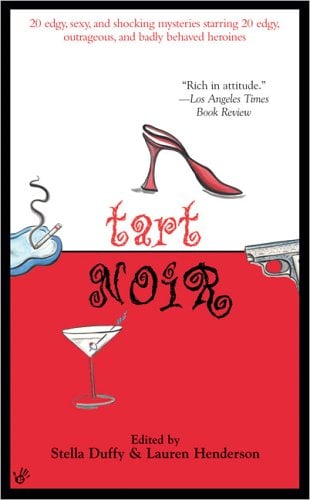
But the pivotal year was 2002, when the Tart Noir anthology came out — I’d never read an anthology like this, and the quantity of stellar women crime writers contained within its pages anticipated the later domestic thriller boom and also was keenly rooted in their crime-writing ancestors. Would Troubled Daughters, Twisted Wives and the Women Crime Writers anthology exist if not for Tart Noir? I doubt it.
That year, though, I was still toiling in grad school, still working one day a week at the Greenwich Village mystery bookshop Partners & Crime, still learning my way around the book industry and going to my first Bouchercons and Edgar Awards and whatever parties and after-hangs after author events at the various mystery bookshops. I remember visiting Lauren’s fifth-floor walkup SoHo apartment on Thompson Street, the energy of the gathering (and nearly tripping on the step-down toilet) imprinted forever. Yes, she was fun to be around, a great host, a championship-level gossip, but also, once you were her friend, utterly loyal — though as I would learn later, such loyalty came with hidden costs.
First, more good memories. The 2013 Albany Bouchercon, a weird time for me personally in the strangest of venues but people still talk about that Real Housewives panel she was on. Getting the behind-the-scenes intel on her travels (with Laura Lippman) on the Orient Express, which became this 2014 magazine piece. Visiting her flat in London in the summer of 2016, while her cats purred and her then-husband served drinks, talking about our favorite crime books (and the not-so-favorite ones) and being incredibly kind in the face of my then-brand-new cancer diagnosis. Karaoke in New York City with other crime writer friends a couple of years later, a riotous occasion. Possibly the last good one.
Change happens incrementally and then suddenly. I always sensed that Lauren wasn’t one to cross, but our dynamic was different than with most of her other crime writer friends because I was so much younger, for a long time (but blessedly no longer) the youngest in the room. Pinpointing the beginning of the end is difficult: Was it a dinner where Lauren spent the entire time haranguing a now-former friend? Was it getting upset that I wouldn’t constantly acknowledge that she had come up with the subtitle for my first book? Was it her descent into transphobia, a slide that resembled a slow-motion car wreck? Was it the ways in which she started being openly cruel to our shared friend group?
Pulling back was the least resistant path. To stop answering emails, or to answer in curt, one-line missives. I knew Lauren’s life had run into trouble: dropped contracts, the end of her marriage, health problems. Compassion has constraints, and by 2024, most everyone she’d been close to had exceeded their own bandwidth.
But like Greg Herren, whose tribute you should all read, said, “I wish things hadn’t gone sour between us, always figured one day we’d work past it…and it makes me a bit sad to know it’ll never be worked out.” Acknowledging what ultimately happened doesn’t negate the good, not at all. (See also these wonderful tributes from Ayo Onatade and Lisa Jewell.)
Lauren was a trailblazer, whose work was unique regardless of category or genre even as it was deeply rooted within the crime fiction tradition. She loved Peter O’Donnell’s Modesty Blaise and could quote chapter and verse from just about every Agatha Christie novel. She put herself on the line, always, but we didn’t know until it was too late how membrane-thin that line was. I hope she, and her family, has peace now.
**
I’ve been subsumed in work all month, and this newsletter was intended as a catch-up on pieces I’ve published and books I’ve read. But I’ll save that for next time, hopefully later this week.
Until then, I remain,
The Crime Lady

