The Crime Lady: Beth, or Betty
Dear TCL Readers:
Somehow, this is my first newsletter of 2026. January was — well, I don’t have to tell you. We’re in the midst of it, upheaval and resistance and murders of ordinary citizens by the federal government and the demolishing of whatever was “normal” before, because there’s no going back. Hope, community, and the belief in the profundity of art? That’s all still there, more than ever.
Somehow, I’m keeping my wits, but I won’t deny that escapism beckons, and I’ve spent more psychic time in decades (and centuries) past of late. Some of that owed to spending the last few months, off-and-on, working on an essay that appears today in The Atlantic, on a woman who deserved attention for the life she lived, and less so for the way she died.
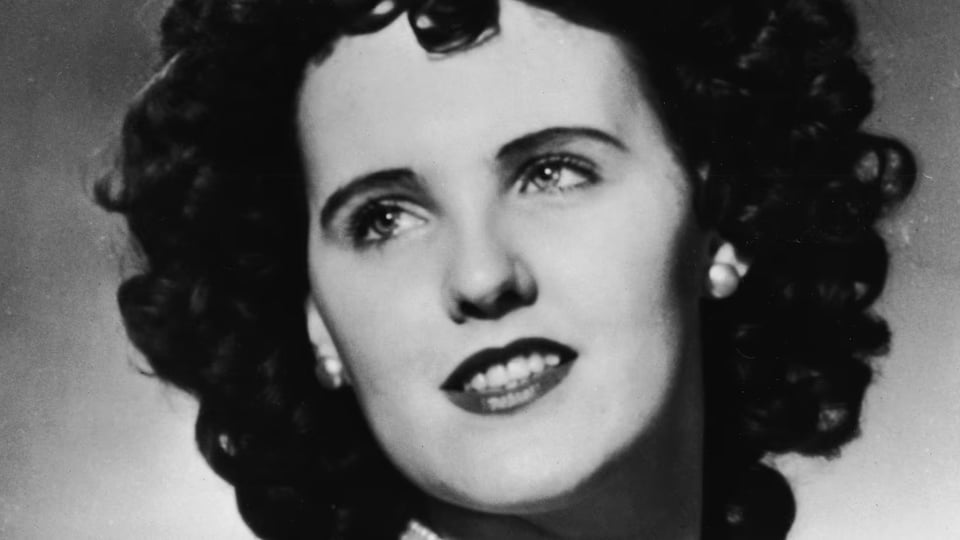
Yes, it’s an essay on Elizabeth Short — Beth or Betty to family and friends, only Elizabeth legally and posthumously — and the ways in which the True Crime Industrial Complex failed her over and over again in the nearly 80 years since her murder in January 1947. William J. Mann’s new book Black Dahlia, the latest of so many books about the case, does make a valiant attempt to humanize Short. But it’s undone by his need (or perhaps his publisher’s) to zero in on a suspect. His choice of Marvin Margolis, by coincidence, is also the subject of one of the most egregious and irresponsible podcasts I’ve ever listened to.
Elon Green wrote far more about this travesty for Defector, and I urge you all to read his piece. (He and I worked on our stories concurrently so needless to say, we were each other’s sounding boards.) I’m sorry to report how badly the piece reflects upon Michael Connelly, a writer and person I’ve admired for my entire adult life, but Killer in the Code is a disaster of a project built upon a premise that is nowhere near credible. Marvin Margolis isn’t Elizabeth Short’s killer and he most definitely, absolutely, isn’t the Zodiac. I can’t believe I even have to write this sentence.
I found this to be the most illustrative point of Green’s investigation:
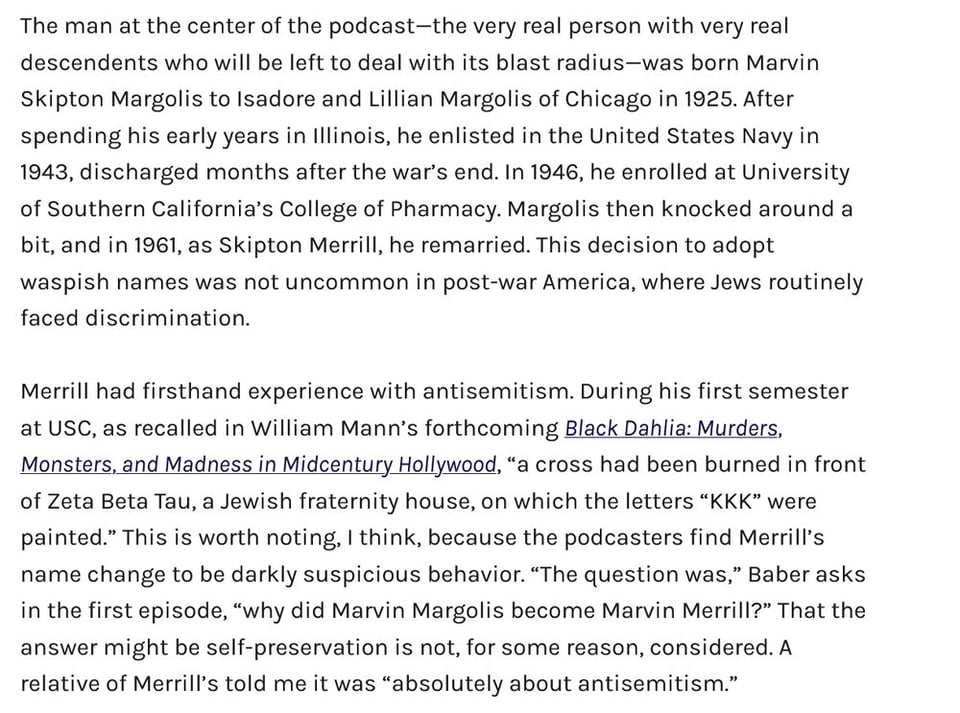
Let me repeat that last line: “It was absolutely about antisemitism.” Somehow, this explanation eludes the podcast as well as Mann, yet it was screamingly obvious to me, a Jewish woman whose own father who lost out on jobs in the 1950s and 1960s, well aware of how many other Jews felt compelled to alter their names — and still do — to head off discrimination and survive in a world that would prefer them not to exist.
Marvin Merrill clearly made a ton of mistakes in his life, personally and professionally. But the need to designate him a suspect in not one, but two notorious cases is one of the clearest examples of what I think of as narrative injury, where the imperative for some kind of tidy story arc, turning reality into a clever game, causes moral harm to actual human beings. All of the tools that Alex Baber allegedly used, and that Connelly and his ex-LAPD friends enthusiastically endorsed, to pin these murders on Merrill have ripple effects. Merrill’s family won’t be able to run away from this. The dead can’t be libeled but the living are stuck in a loop of reputation damage.
(Also, Eugene O’Neill House should seriously reconsider this February 21 event. $125 a ticket for this? Seriously?)
The hell of it is, the life and death of Marvin (Margolis) Merrill would make a great, morally complex narrative. Maybe someday, once the hubbub dies down and the bullshit recedes, that story can be properly told. I also live in hope that Elizabeth Short’s life will matter to the public far more than the way she died: I do feel confident that if the LAPD ever lands on a credible suspect in her murder, it will defy any sense of a tidy narrative and raise more confusing questions.
Deepest thanks to Boris Kachka, my editor at The Atlantic, once again a true pleasure to work with, and to the entire books & culture team — ace fact-checker Valerie Trapp, culture editor Jane Yong Kim, and copyeditors Francesca Billington & Janice Wolly.
**
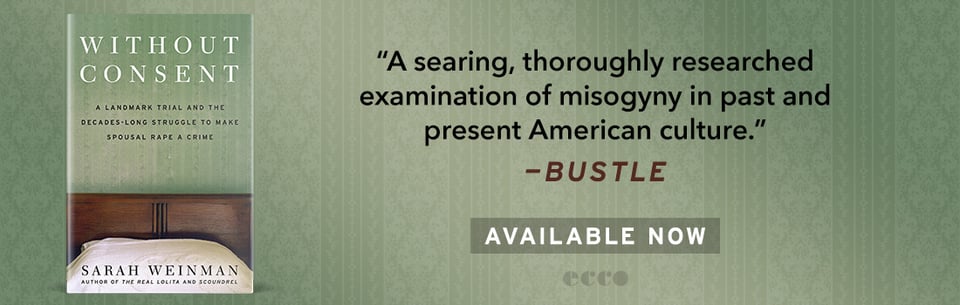
It’s been so long since I’ve sent a dispatch that I have been remiss in linking to recent coverage of Without Consent. I’m beyond grateful that the book sparked this larger consideration of consent by S.C. Cornell in the New Yorker, an essay that left me much to think about — particularly about the relationship between consent and architecture, something I’d never given much thought to before. The Wall Street Journal also gave the book a favorable writeup, as did the Winnipeg Free Press and Zoomer in Canada.
Two months out from publication, I’m truly heartened by the response from readers. Thank you so much. Without Consent is indeed a book that needed to exist, and I look forward to talking about it as events come up. But I’m also glad to be immersing myself in new projects, and to say more about those at the appropriate time.
In the meantime, stay warm, stay vigilant, and find ways of helping out.
Until next time, I remain,
The Crime Lady