The Crime Lady: A Few Questions for Emma Garman
Dear TCL Readers:
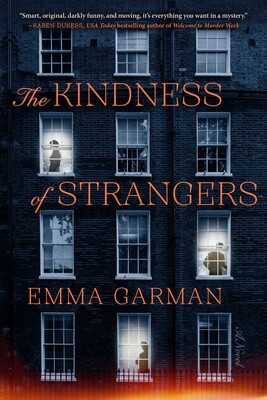
When Emma Garman and I sat down earlier this week in a Lincoln Center-area coffee shop to talk about her debut novel The Kindness of Strangers, which published this week in the United States (and last month in the UK) we realized we had first met almost twenty-five years ago, when the IRL and online worlds felt vastly different (put it this way: we had blogs and met in person at a blogger meetup held at an East Village bar.)
Fast forward to 2026 and our lives and careers, in middle age, somehow resemble the dreams we had in our twenties of the literary life: Garman, a longtime freelance writer now living in Brighton, England, “always wrote fiction on the side” which finally coalesced into this marvelous mid-century mystery.
The Kindness of Strangers is set in one London building in the early 1950s, where an assortment of people (many previously unknown to one another) have found refuge, forging real friendships and community — until an interloper arrives and upsets the entire balance, leading to murder. Garman’s book truly delighted me in a deep way, and the critical reception so far can be summed up by Laura Wilson’s review in The Guardian: “not only an excellent mystery, but an evocative portrayal of a group of people displaced socially and geographically by war and its aftermath, with the moral and topographical landscape of 1950s London superbly rendered.”
Here, edited and condensed for clarity, is our conversation about The Kindness of Strangers, our mutual love of Kate Atkinson, questions of identity and performance, the murders at 10 Rillington Place, and so much more.
The Crime Lady: First off, I was curious about the year you chose to set The Kindness of Strangers. Why 1953? That’s such a specific year to choose, but it seems like a very rich year in London in particular.
Emma Garman: That’s exactly right. To me, 1953 is one of those pivotal years in British history. I think always in retrospect, we look back on history and we're like that year was really, you know, so much happened that led on to momentous aspects of history. Even though World War II had been over for some years,t here were so many consequences of the war still lingering — not to mention there was still food rationing. It was the year that Elizabeth the Second became Queen. It was the time when events happened that actually led to the abolishment capital punishment. Also, it was the sort of beginnings of the legal changes that led to homosexuality no longer being a crime, same with abortion. These seeds were being planted in this particular year, which, yeah, it just makes me think some years just have something about them.
TCL: Right? I mean, here in United States, I feel like 1968 has that “something.” I think we're going to look back at 2016 in the same way. I mean, there are jokes like we were still living in 2016 And I don't think that's totally wrong!
So, you have this minefield of cultural milestones to play with, but you set it in this one building, 46 Tregunter Place. That was clearly by design, but I wondered about what cloistering all your main characters in this one house allowed you to do novelistically?
EG: Yeah. If, as a novelist, you can hit a setting where a diverse array of people are naturally together, that's just very fruitful. But for plot, for drama, there are probably more potential settings like that in the past than there are now. The country house setting is a little more artificial now [for present-day narratives.]
TCL: Now those narratives are compared to The White Lotus.
EG: That’s such a good example, it’s true — because even though The White Lotus is believable, I know a lot of people who were watching would think, "they would at least sometimes leave the resort, right?” They never leave the resort. They eat at the same restaurants every day. It’s so funny.
TCL: How did you decide on the specific characters who would populate the house? Honor Wilson, the landlady, is very different from Saul Reznikov, the refugee poet, who is very different from Mina, the teenage clotheshorse would-be sleuth, who is very different from George Mountford-Owen, the debutante, and from Robbie Trafford, the literary editor. And then, of course, there is the interloper, the man whom we first know as Jimmy Sullivan.
EG: One of my aims with writing the book was to have distinct personalities, because I designed that as a very interesting exercise to get into the heads and personalities with people who don't necessarily have much that one with each other, or with me. I really hope that when people read it, they will think, Oh, these characters aren’t the author’s voice.
TCL: But obviously, as the author, you are in every character to some degree.
EG: I mean it's something I've thought about a lot. I think it's one of those questions that, as an author, you can't answer objectively. Obviously, how can you not lend some of your attitudes and thoughts and behavior to the characters you have, because really, yourself is the only person who you really know.
TCL: I think the common thread between all of the people who live at Tregunter Place is that they are seeking to reinvent themselves. Some of them do so overtly. They change their names, they change their backstories, you know, they really bury their secret schemes. But there there is Saul, who I have to admit I related to the most — not just because he’s Jewish but because of being a refugee and the trauma of the Holocaust. I thought the way you dealt with that, specifically set in 1953 at a time when we think no one is really talking about it, quite well.
EG: It’s interesting about Saul. It actually crossed my mind that Saul is the only character whose given name is his name. It’s not really a spoiler to say that Honor, for example, is not her real name. Mina is really Wilhelmina, Robbie is really Robert, George is really Georgina. The extent to which they have changed their name correlates to the extent they were trying to get away from their origins.
TCL: Also, there’s a sense of fluidity with the names, too. Again, without spoiling, there’s a pivotal scene that depends on a misunderstanding about George’s name.
EG: Having these play on names happened somewhat organically in the book. What happens with George’s name did become useful plot-wise.
TCL: Especially because you know that any mystery-loving person knows the most famous female George is the one in the Nancy Drew books.
EG: Oh, that’s so interesting! Because I thought you were going to say the most famous fictional female George was the one in the Famous Five books by Enid Blyton.
TCL: Now I’m wondering if Blyton and the Carolyn Keene syndicate made their Georges concordant. But we’re getting off track, though it might be a good way to ask what your experience of reading mystery fiction was like and how it informed the writing of The Kindness of Strangers.

EG: I’ve always really liked plots. Obviously, I read a lot of literary fiction, but there's something about a mystery plot where I find the nuts and bolts of it so satisfying. It’s almost when you're when you're experiencing plot like that as a reader, it’s a slightly different reading experience. Same as with writing a plot — the sort of construction of it is almost like it's craft, like you're kind of like imagining as if it was like a piece of woodwork. I'm like, this piece goes here and this piece goes there.
One of the writers who plotting I admire probably the most is Kate Atkinson. I think the first few Jackson Brodie books are outstanding.
TCL: It made me so sad to have to write negatively about the most recent Brodie novel. But Atkinson’s historical fiction has also been pretty great. There’s no question that Case Histories really leveled up the field in UK crime fiction, as did Tana French a few years later with In the Woods. And they in particular set things up for your book.
EG: I think you’re right about what Kate Atkinson has done. Correct me if I’m wrong, but I’m not sure how many other British mystery writers who create stories where you’re coming at it from multiple directions, with multiple characters, and at first it might be quite different but they they all converge together. I think that’s something Atkinson does so well.
TCL: Her brain operates at a level that even when it doesn’t quite work, the fences she’s swung for are those most wouldn’t even attempt to swing at.
EG: It does make me think about how I had to balance the tone between literary writing and character and straightforward mystery plotting.
TCL: Did you ever feel like you went too far afield in one direction or another?
EG: When my agent first read the draft, her notes made it clear the book should tilt ever so slightly more in a commercial direction. And she was absolutely right. think when I first wrote it, I was, I was a little more focused on the characters and it was a little little more, I want to say, realistic but it evolved into something a little suspenseful, a little more playful.
TCL: Speaking of writing, literary magazines figure quite prominently in The Kindness of Strangers. I'm going to paraphrase, but there was one section where Robbie talks about writing novels and his own snobbery, getting to the 30,000 word mark and then failing, and then reading something that makes him mad, and then one time he read some dreadful novel, and he got to the 40,000 word mark and then pulled back. I don’t want to make a correlation here…
EG: But am I describing myself? Not exactly, but you would be absolutely right to say there’s a little bit of me in there. But I’m so bloody-minded that I do not stop at the 30,000-word mark in a manuscript! Though I have been guilty of thinking, well if they can write that, I can do better.
TCL: At the same time, and perhaps you have this too, where you read a book by someone you know and think, “my god, this is so good, I have to up my game here.”
EG: Or in low moments, thinking, “Oh my god, what is the point of even trying?” If I’ve learned anything, it’s that with a novel you have to push through your own self-doubt, and your fear that if you have to spend too long or try too hard then somehow, it doesn’t have the same value as if it came easy.
TCL: This book has some serious high stakes storytelling. You have abortion, you have homosexuality, you have blackmail, you have, you know, lost families from the Holocaust. You have people reinventing themselves after traumatic events. I mean, you threw a lot of it in where and yet, the output is so elegantly constructed. So I don't envy you that task of having to essentially wrestle this manuscript into being.
EG: Well, thank you for saying that. You’ve probably heard that Agatha Christie once said she never knew who the killer was while working on a book —
TCL: Well, that wasn’t entirely true…
EG: Exactly. What she actually said was that she might not decide until later in a draft, but once she did so she would go back and plant the various clues and seeds. Like she was reverse-engineering it. I find doing that on a first draft to be a calm, normal exercise. Because you can decide how an outcome or an element might play out and then go back and see how the early drafts can be changed.
TCL: Another way in which setting the book in 1953 is important led to one of my favorite scenes in the book, where everyone is sitting around the breakfast table discussing the morning headlines about 10 Rillington Place.
EG: Exactly. That was another miscarriage of justice. Once the bodies were found in John Christie’s basement people realized, maybe we’ve made a mistake [about Timothy Evans]. And yeah, maybe you did.
TCL: Did you read Kate Summerscale’s recent book?
EG: No, not yet. I think her book came out as I was working on mine, and it felt like there was some degree of synchronicity. I’m sure it was great, because she’s great.
TCL: I actually buy the theory she came up with about Evans and the murder of his wife and child. It's so interesting how that crime keeps getting revisited and almost reinterpreted for contemporary times.
EG: Yeah.
TCL: So of course, you had to call attention to [the Rillington Place murders] in a way that wouldn't have been over the top. Of course this group would have been sitting around the breakfast table talking about it.
EG: It really was so geographically close to where they were. And literally everybody read newspapers.
TCL: So we’re close to wrapping up. And my last question for you is about your next book. You close The Kindness of Strangers with an epilogue that catches the characters up to the present day, more or less, which I loved because it created this bigger scope. But it also meant you weren’t going to write a sequel. I gather you’re now working on something set in the 1960s. What can you tell us about that?
EG: So it’s set in 1967, which is one of those years in the UK that is also pivotal.
TCL: The “Sergeant Pepper” year…
EG: Right. The Sexual Revolution. Society is rapidly changing, it's the kernel of a theme for the new book. It's set in a finishing school, and it’s also a murder mystery. But in 1967, the idea of a finishing school is so old fashioned. Young women don’t care about these things.
TCL: They want to hang out on Carnaby Street.
EG: Exactly. They want to wear mini skirts. And the woman who runs the finishing school has been doing so since the 1930s, and recent events are causing the past to come back for her in a big way.
TCL: Well obviously I’m looking forward to this, and to how people respond to the The Kindness of Strangers. Thank you so much.
**
I’m off to Santa Fe for the International Literary Festival, where I will be in conversation with the civil rights lawyer Kate Ferlic at 10:30 AM on Saturday, May 17 (the event is “at capacity” but there is a waiting list.) It’s my first time visiting New Mexico, and I’m excited to explore part of a state I’ve been eager to visit. More updates upon my return.
Until then, I remain,
The Crime Lady

