The Cosmic Chronicle #7
Back with Cosmic Chronicles: reformatting dilemma, astronomy workshops, and provocative celestial discoveries!
Hi ,
Yes, I know, I took a long hiatus. Unfortunately, I got rather busy. However, I’m back with new issues of the Cosmic Chronicles, featuring a more sustainable schedule and some changes to the format.
What’s Changed
First of all, I’m still trying to figure out how to format the “What’s in the sky this week” section. As you know, the timings and visibilities of each event change based on your location. Some of the events that are visible in America, for example, may not be visible from India. Given that most of my subscribers are from India, it makes sense for me to format the events according to the Indian sky. However, I don’t want the other subscribers to feel left out. The other option is to format it for the US sky, as most websites do. So, you tell me what to do.
How should I format the "What's in the sky this week?"
Of course, in case of a notable event, such as an eclipse, I’ll include it along with the details, like where you can see it from and when.
The other change is the “What’s happening in Astronomy” section. I’ve started to include more varied news covering Astrophysics, Astrobiology, Space Exploration and General Astronomy. Hope you like it.
Astronomy Workshop for Children in Kolkata by Sky Watchers’ Association, Kolkata
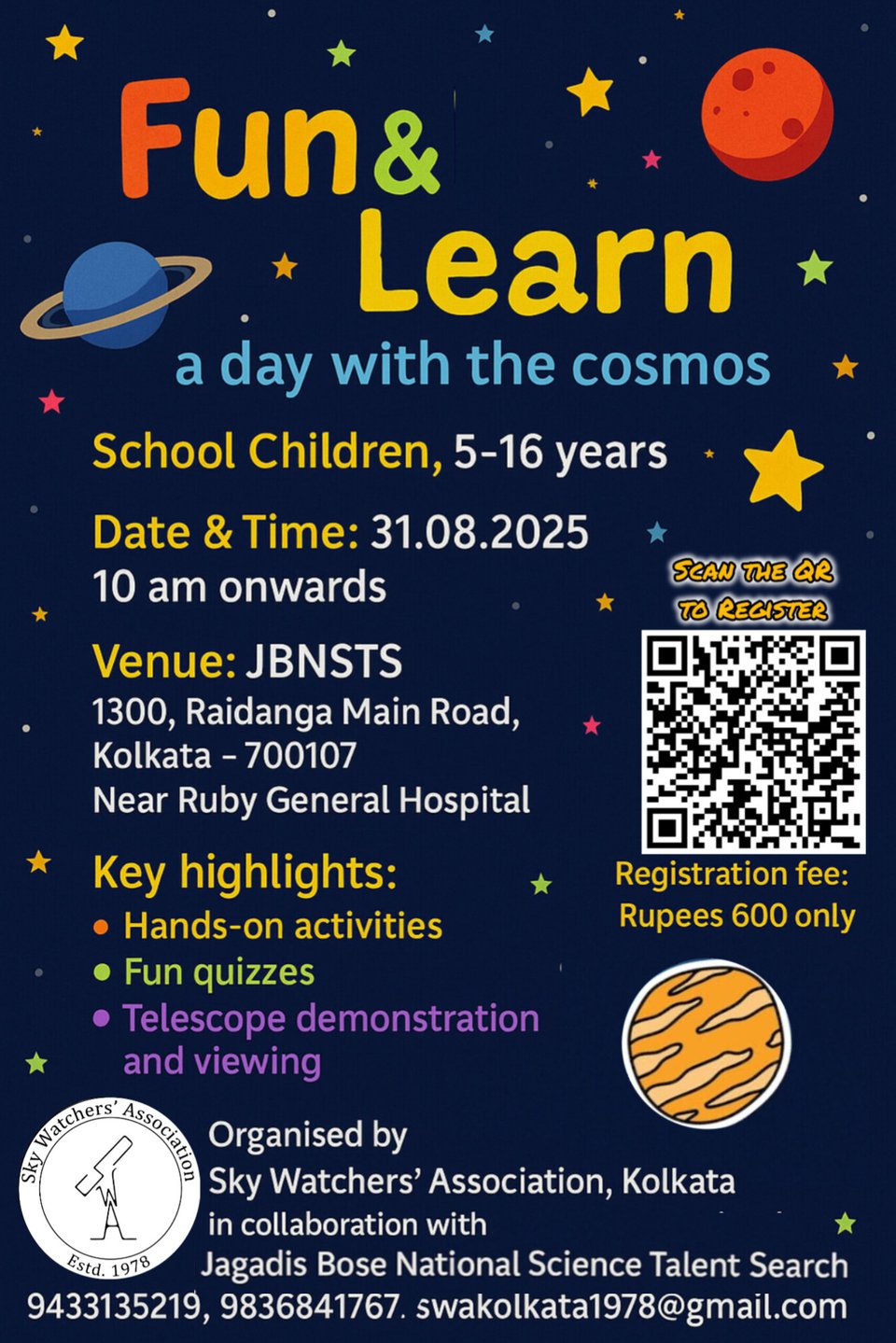
Scan QR or click on the link to register 🌠
✨Hands-on Astronomy Workshop for School Children✨
📝Registration Link:
https://forms.gle/FyQGms2i7LD94DN2A
🗓️Date of Workshop: 31.08.2025
⏰Time:
☄️Session I - 10:00 am - 1:00 pm (for children aged 5 - 10 years)
☄️Session II - 2:30 pm - 5:30 pm (for children aged 11 - 16 years)
🏠Venue: JBNSTS, 1300, Rajdanga Main Road, Kolkata - 700107(Near Ruby Hospital)
💰Registration Fee: ₹ 600 only (payable only after receiving a confirmation email from SWA after 07.08.2025)
🗓️Last Date of Registration: 14.08.2025
📄Certificates will be provided to all the participants following active participation in the workshop.
If you’re an adult, don’t worry! The next one is for you.
Certificate Course in Astronomy by Sky Watchers’ Association, Kolkata
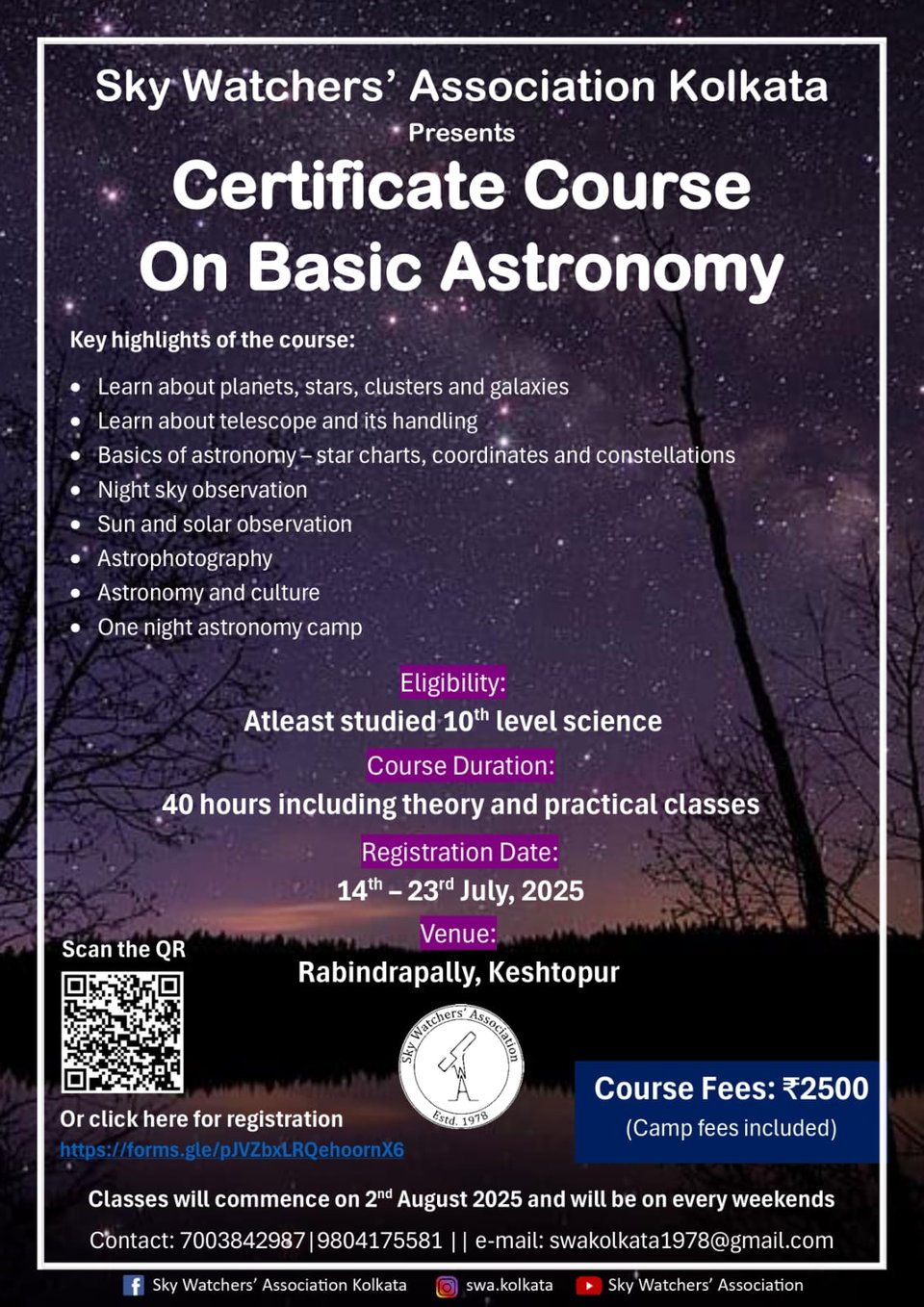
We are back again with our Certificate Course in Astronomy!
Course commences from 02.08.2025
Last date of application: 23.07.2025
Classes will be held only on the weekend afternoon (Saturday and Sunday) at the Keshtopur Office of Sky Watchers' Association, Kolkata
(https://maps.app.goo.gl/FQQ9Q6ooCSHuMuoq7)
Registration Link:
https://forms.gle/pJVZbxLRQehoornX6Interested people must register through the given link or scan the QR code. Selected participants will receive a confirmatory e-mail from us.
The course fee should be paid only after receiving the confirmatory e-mail.
Hurry up and apply! Seats are Limited !!
What’s Happening in Astronomy
Could the latest 'interstellar comet' be an alien probe?
Astronomers have recently identified an interstellar comet named 3I/ATLAS, notable for its high speed of 245,000 kilometers per hour and potential size of up to 20 kilometers. This discovery has sparked discussions, particularly among Harvard astrophysicist Avi Loeb and his colleagues, about whether the object could be of alien origin, citing anomalies in its orbit and close planetary approaches. The challenge of distinguishing between natural celestial bodies and potentially artificial probes, such as identifying signs of maneuvering or emissions, is critical as researchers refine their methods of detection. While current observational capabilities focus on larger objects, smaller probes like 3I/ATLAS remain difficult to detect until they approach the inner solar system. Despite the intriguing prospects surrounding 3I/ATLAS, there is currently no definitive evidence to suggest it is an artificial probe, emphasizing the complexities of classifying interstellar objects.
Mars glaciers found to be over 80% pure ice, study shows
Recent studies of glaciers on Mars have revealed that they are composed of over 80% pure water ice, challenging previous assumptions about their rocky composition. This significant finding has implications for understanding Mars' climate history and suggests these glaciers may serve as valuable resources for future exploration. Using standardized analysis techniques, research indicates that glacial formations across different sites on the planet share similar characteristics, implying a common formation process. The work contributes to advancing scientific knowledge and supports NASA's goals for future manned missions to Mars, while also emphasizing the importance of these features in the context of understanding the planet's water resources.
'Democratizing space' is more than just adding new players
The collection of documents explores the theme of democratizing space, emphasizing the need for inclusivity and equitable access in space exploration as more countries, including those in Africa, establish their space programs. Significant milestones, such as India's moon landing in 2023, represent technological achievements that also carry cultural implications. Despite the growing international participation, disparities remain, particularly with dominant players like the U.S. and China overshadowing newer agencies. Issues related to land use, Indigenous rights, and environmental sustainability highlight the challenges faced in this evolving landscape. The discussion advocates for the inclusion of diverse voices and perspectives to ensure that space exploration is not only expansive but also responsible and beneficial to all communities, focusing on collaboration and sustainable practices for the future.
Unusual plasma waves detected above Jupiter's north pole may finally have explanation
NASA's Juno spacecraft has made significant discoveries about plasma waves at Jupiter's north pole, challenging existing theories of planetary magnetospheres. A recent study explains these unusual phenomena by suggesting the existence of a new class of plasma waves that transition from Alfvén waves to Langmuir waves under specific conditions of high magnetic field strength and low plasma density, potentially facilitated by powerful upward-moving electron beams. Additionally, the document touches on various scientific advancements, including unexpected electron variations linking Jupiter to its moon Io, innovations in gas separation membranes, AI developments for cancer research, and insights into plant cell responses, highlighting the dynamic nature of contemporary scientific research.
Proto-sub-Neptune detected with metal-poor atmosphere and a hot interior
Astronomers have recently identified a young exoplanet, V1298 Tau b, classified as a proto-sub-Neptune, using the James Webb Space Telescope. At approximately 20 million years old, the planet exhibits a clear, metal-poor atmosphere with strong signals of water vapor, methane, and sulfur dioxide, indicating active photochemical processes and high internal temperatures. Notably, its atmospheric metal content is about 100 times lower than that of older sub-Neptune planets, presenting significant challenges to current models of planetary formation and evolution. This discovery prompts further investigation into the atmospheric characteristics of young exoplanets and their evolutionary trajectories.
Science in REAL time: CubeSat poised to explore Earth's radiation belts
NASA's Relativistic Electron Atmospheric Loss (REAL) CubeSat mission, launched on July 23, 2025, from Vandenberg Space Force Base, aims to study Earth's radiation belts by measuring the quantity, energy, and angle of particles entering the atmosphere. Developed by the Johns Hopkins Applied Physics Laboratory in collaboration with Dartmouth and Montana State University, REAL will operate for six months to collect data that might elucidate the forces behind high-energy electron behavior, which impacts satellites and atmospheric conditions. This mission is part of broader advancements in scientific research, including studies on animal behavior and new technologies like AI tools for mRNA treatments and nanoscale carving methods.


Add a comment: