Victorian Fashion: The Oppression of Women and the Fight for Feminism
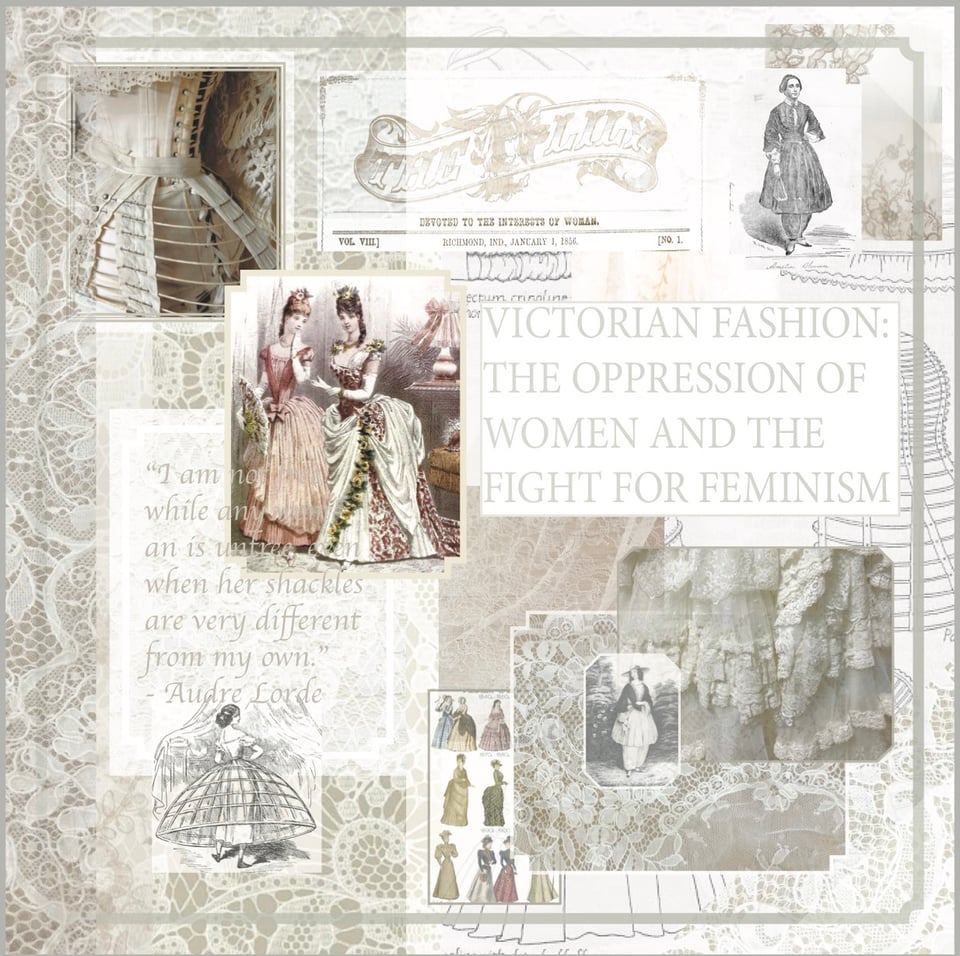
Fashion wear during the Victorian Era was not only fashion, it was restriction, oppression, and resistance. She would withstand the pressure of society and at the same time be a perfect woman. Garments suppressed movements, and clothing caused either adoration or scandal. This applied to every woman of every class. In terms of fashion, one could easily distinguish amongst the classes: upper-class women wore elaborately decorated dresses, many times including multiple layers of petticoats to bring volume, bustles (also known as ‘bum-rolls’) to prevent sagging and to emphasise her hips, and as well as corsets that brought artificial-like shapes to a woman’s figure. Middle-class ladies wore less extravagant dresses compared to wealthier ones, as they used more affordable materials, but their structures were nonetheless the same. The working-class wore practical clothing that allowed for convenience as they worked. However, for all social classes during the Victorian Era, her community and men had major influence over a woman’s clothing and a woman herself.
The corset, also known as a stay, was widely used throughout the Victorian Era. One of the purposes of this garment was to give the appearance of a tiny waist and a lifted bust; this strived to create the illusion of an hourglass-like body shape. Another would be to maintain the shape of the outer dress and to prevent the fabric from wrinkling. Women of all ages and classes were to wear one or she would be considered indecent and even scandalous. For the ladies, corsets were a symbol of status; the tighter the corset and the smaller the waist, the more respectable she would be. Commonly, she would practice ‘tight-lacing,’ which would sometimes cause a few to faint from breathlessness. Amongst that, limited movements were often associated with status as well. Since a wealthy lady had less hard labour to perform, she would not be required to move much. Hence, she would be able to wear heavier skirts that restricted movement but in return required assistance when walking. Due to these expectations, women were depicted as helpless and fragile, which was what encouraged the romanticisation of the trope ‘damsel in distress.’
Additionally, women were also expected to dress themselves modestly. Depending on the situation or the time of the day, a lady would be required to wear a dress with a high neckline, long sleeves, and skirts that often covered her feet. She must also never appear in public without gloves. Strict rules such as when and where she must wear a certain dress or whether hats and bonnets were needed must be followed. Moreover, the popularisation of the white wedding gown by Queen Victoria in 1840 symbolised purity and innocence, which was another standard for women. Without adhering to some of these fashion etiquettes, she could be declared scandalous, lose respect from society, and even be deemed ‘undesirable.’
These rules were designed to keep women subject to the pressure of society and men; the idea of an ‘ideal woman’ was so common that it would be possible for a lady to fail to find a spouse if she did not fit into their standards. Since she was considered to be weak and helpless, women were expected to remain home as their husbands worked. This is known as the ‘Angels of the House,’ where women were to stay at home and tend to their children, the house, and to chat with neighbours. She would be denied education, as that was a man’s privilege. Instead, she needed skills such as cooking, sewing, cooking, and tidying. To society, women were not human, but a perfect trophy to keep at home and protect.
The Dress Reform Movement was what changed corsetry and skirts. These fashionable instruments were designed to limit movement to the point where it was uncomfortable for its wearers. This pushed women to drive towards less restrictive clothing. It started in America when Elizabeth Smith Miller’s invention of the ‘bloomer’ was popularised by Amelia Bloomer, a feminist activist and the founder of the women-orientated newspaper ‘The Lily.’ Miller’s bloomer was described to be a combination of pants and a skirt that reached just below the knees. This garment quickly grew popular amongst women who sought comfort. Furthermore, as mentioned above, tight-lacing corsets cause concerns about its effects on the human body. Health experts claimed the results of tight-lacing, especially if worn for a long period of time and during adolescence, were to be collapsed lungs, bruised or fractured ribs, damage of internal organs, and more. Amelia Bloomer also advocated that the corset was an oppressive instrument used against women. This movement inspired women to promote education, employment, and even birth control. Eventually, women moved on from the restrictive corset and found comfort in different garments.
In the Victorian Era, a lady must not make mistakes. She must follow proper etiquette or she would end up spouseless. Garments like the corset and the layering of petticoats forced restriction upon women so she would remain home like a doll, victim to the oppression of the people. Her purity and innocence were displayed as modesty for men to admire. Besides all, the Victorian Era served as a stern push for feminism as women found a way to fight for their comfort and advocate for what is right.
However, it is important for us to remember that although these events occurred almost two centuries ago, it does not mean it is not happening now. Feminism does not turn a blind eye to any woman. After all, Audre Lorde quoted: ‘I am not free while any woman is unfree.’
#FreeAfghanWomen