
On Psychosis
I
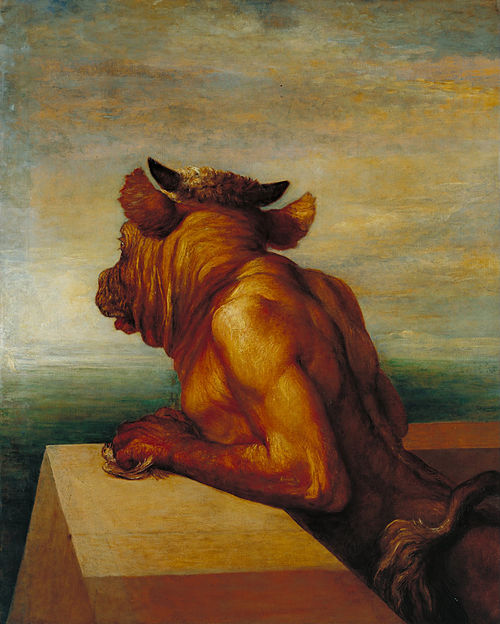
Asterion, half-man, half-bull, was born to Pasiphae, daughter of Helios the living sun, not as a curse to himself or even to her but instead to Minos, king of Crete. This passage of curses, from king-father to queen to child, traces a lineal arc of mental development, the seed and the egg and the subsequent child, born into cursed life. Minos, tasked with sacrificing the finest bull of his herd to Poseidon each year to protect the island, in some myths because of Crete itself being a sea nymph under Poseidon's rule, once bore witness to a snow-white albino bull and, believing it a boon from the gods, refused to sacrifice it to Poseidon. The appearance of the white bull is vexing; Minos, son of Zeus, knew on sight a divine boon marked for the god of the sky and not the sea and was at once set upon by the impossible question of which god to honor and which to spurn. While it is Zeus who is most wrathful of the three divine brothers, Poseidon is not far behind, jealously guarding the sea from the sky and being closest in the myths to ascending to the throne of Olympus before Zeus' ascent. Incensed by this turnabout, Poseidon cast his cruel curse not to Minos but to Pasiphae herself, that she might fall in love with the bull rather than the man. Pasiphae in her mad bestial lust hired Daedulus the great architect to construct a wooden cow for her to mount herself within such that the snow-white bull might in turn mount her and deliver to her the fruit of her desire. Having done so, her belly swelled with child and soon, to Minos' horror, the bull-man was born.
His name Asterion is his proper name. It is the name of Minos' father, the previous king of Crete, and is thus his true patrilineal name, given out of love and affirmation of his personhood. You see, Pasiphae loved her son. Broken of the spell of her curse, she viewed the snow-white bull with disgust; it appears no more in the myths after their mating, likely slain. But to Asterion, she was doting and loving, if often overflowing with tears. The weight of his burdensome life laid upon her chest and was a sorrow she never divested herself of. It was Minos who, in disgust, forced Daedulus, upon discovering his part in the bull-mare plot, to construct a labyrinth to contain his son, too ugly and monstrous to rule or even for Minos to be seen. Daedalus, per the myths, shows no enmity toward Asterion; given what we know of him, he likely viewed Asterion with cold curiosity, a sign of the mythic dreamlogic of their time. Still, the labyrinth prison was built, with Asterion needing no chains in that abyssal darkness, as dark as the hellish depths of the sea. In the earliest Grecian tales, there is not a firm differentiation between Poseidon and Hades, a fact we see with the preponderance of rivers within Hades and the way water is the passage to the underworld. This darkness of the labyrinth is the darkness of the sea and the darkness of hell, one Asterion was condemned to by no sin of his and not even a sin of his mother, who was forced by divine compunction to create him, but a sin of the father, a sin still so rebuked that he hid the mark of his shame in a dungeon below. Still, Minos did not order his son to be killed. It differs in sources whether it was by an understanding that Poseidon would rise with curses once more or out of a sense of duty toward both his wife and son, a tragic weight of penitence. Instead, it was a life in hell, albeit still a life.
Daedalus for his part in both acts was condemned to build for himself a prison tower and to likewise be entombed in the sky, oppositional to the containing cursing sea, with his own son, a mirror to Minos' hell. We are told in the telling of this tale that Daedalus' punishment is unjust, that he is suffering for the cruelty of a mad king. But we ignore in this telling Daedalus' complicity, that he knew of Asterion and still chose to build his prison labyrinth, that it was Minos' dream but Daedalus' cold hand that made that prison possible. We ignore as well Minos' conflict, receiving a bull which by its snow-white color was associated more with Zeus than with Poseidon. The jealousy of those two brothers regarding their respective demesne was legendary and fierce, and it is unclear which would be more fruitful to cross given the temerity of each in their extremity. Even Poseidon, petty as he is, is not fully culpable in a divine sense, being far too human in his anxieties of place and honor in witnessing the birth of a bull meant for his brother among a herd dedicated to him. In Hellenistic myth, even the gods are bound by the web of fate, which is spun, measured and cut by the Moirai but not controlled by them; what hand compels their actions is not known, lingering closer to the primordial Kaos that birthed the foaming world that became our own. Will and honor, penitence and sin, are structural rather than personal; everything is wheels within wheels. But what this eventually leads us to is a namelessness and a blamelessness that still emerges as a curse. Minos is deprived a son; Parsiphae is shamed in her lust; Daedalus is entombed in the sky; Icarus is doomed to, and you see now why, death in the water after reaching too high toward the opposing sky. But Asterion most of all is born monstrousness, abandoned to hell, entombed, and fed only the meat of children lured into the labyrinth, only nurtured by his mother and his sister Ariadne, who loved him truly as a brother despite his disability.
Some interpretations of the myth lean toward that image of disability, that the bull-man was in fact simply a physically or perhaps mentally deformed child who was deemed incapable of taking the throne. While we often credit overly-credulously a frankly foolish understanding of the role of the divine in the Hellenistic era, a clearly disabled and infirm prince would nonetheless read as obvious dynastic weakness to political rivals and offer a clear vector to neuter the current kingship in order to position another; it was not uncommon, is still not uncommon, for the powerful, the monarchs, the wealthy, the old money of the world to hide away the shame of their infirm, disabled or deformed children. It is not mere superstition. We have viewed, an ugliness of the human soul, those disabilities as a sign of weakness, deciding that those disabled cannot be strong simply because they would need the assistance of others to be strong. In doing, we ignore that no kingdom or dynastic system has ever been the head alone but always the broader structure, the attendants and advisors and managers and laborers, on and on, of which the head is ultimately a lynchpin but not the engine total. This is not mere Marxist social theory; this is why a larger army can defeat a smaller, why organized forces overwhelm those that are disorganized, why collaborative spaces exceed those of competing, scattering individualism. Regardless, Ariadne, daughter to Minos and Parsiphae, loved Asterion, pitying him in his deprivation. They were not the only children of Minos and Parsiphae; Androgeus, one of Minos' sons, was slain in battle with Athens, the cause of the subsequent sack by Crete, the prayer to Zeus by Minos for aid, and the subsequent bleak gift of youths to be fed to Minos' monstrous son. There were other sons and daughters, including an heir, but none else are mentioned in the myth of Asterion, either because they were not born yet, they were not present or they simply did not care enough about their brother to factor in, intensifying his abandonment regardless of the cause.
Note that I have not referred to Asterion yet by his other name, the Minotaur. That name, literally "bull of Minos", was coined to mock the man, to reduce him to mere animal, mere monster, and to rob him of the humanity and grace that was present in him. Minotaurs are not a type of creature, half-bull and half-man, but a specific man defined in that name by his disability and not his personhood. It is a name-prison as robust and complete as the containing labyrinth he was set in, whose walls are so fierce that few recognize his name on sight. Intensifying the irony is Baldur's Gate III using the name with slightly varied spelling for a character who only bears thematic resemblance to Asterion in terms of personal drama, but gestures to something so little known more people now see the name as a video game reference and not the true name of a mythic monster who was yet still a man. The myths of Asterion offer him little in the way of humanity aside from this name and the love Parsiphae and Ariadne view him with. We are left only to infer that Minos' refusal to slay his monstrous son is done in part to bear the curse well but as much out of love for his child, if a shamed and fractured love. But all three to varying extents still views his life as pitiable, something to make up for, less-than, not due to the psyche motivating his body but due merely to his body itself.
II
In retrospect, my first clear episode of psychosis was in the throes of that first major mental breakdown I had at 21, the one that hurled me out of my life as I knew it and set me on the direction oblique to all paths I have since walked. It, like most of my experiences with psychosis, is impossible to differentiate from the outside as cause or effect, whether the chaos of my life at that time predicated a mental breakdown or if the breakdown gave ground to the subsequent chaos until the psychosis erupted in more obvious manner. Time, it turns out, is less functional the more linear it is, especially when the fluctuations of the psyche can be so varied, sometimes buried processes evolving over long stretches of time with silent but growing influence and other times being spontaneous eruptions of disorder. Even in the throes, I knew what I was experiencing was different than before, substantially worse than my intermittent manic episodes prior had been been. My ability to think beyond obsession was non-existent; explaining this mechanically to people who have not experienced it feels hopeless and has never worked, but a short attempt would be to say it is as if thought becomes one of your senses and is thus just as impossible to turn off. You see a cloud on your eye from a cataract; in obsession, you have a thought you cannot shake, that circles and cycles, that overrides attempts to think elseways, that blots out even the sublimate desire to think about other things. At that point for me, it was the scale of space and time and thus the enormity of the black silence of death. The topic of obsession, however, I have since learned doesn't really matter. Some topics are perhaps more likely to become those fixed points that the mind can use, those of intense and obvious emotional and psychic gravity, but I have had varied enough episodes that I have since learned any thought will do when things get bad enough.
Psychosis, it turns out, is more common than we are told. In its most comical image, it is speaking a lunatic non-language, babbling and saying you are Napoleon reborn, acting the part of the psychedelic fool in full sobriety. This, it turns out, like many of the comical depictions of mental ailments, is the most substantially rare form.
Most episodes of psychosis are quieter, less obvious until you learn what they are. Psychosis rarely invents; instead, it most often takes what is already there and intensifies it to comical degrees. This doesn't just include actions and conscious thoughts we have throughout the day but also the minor impulses that we otherwise keep in check. Morality for many is highly artificial, a construct that implies an inner character to outer action and which judges ultimately that inward character most harshly. In most scenarios, this correlation makes sense. Actions, after all, do not arise ab nihilo but do in some fashion reflect the mind of the agent from which they emerge, either by affirmative consciousness aka deliberacy or negative consciousness aka thoughtlessness. The same act of cruelty done deliberately or accidentally takes on a different internal character, though both are obviously moral failings. The problem that psychosis introduces is the emergence of the subconscious or the liminally conscious into the equation. So many of our impulses, generated by our limbic system and brainstem and certain "lower" (a poor phraseology if thought in terms of quality but useful if imagining a vertical stack where the top is active consciousness and the bottom is the body sans consciousness) functions of the brain. These are filtered out by functors within the middle brain, albeit imperfectly. Those automatic functions are everything from breathing to the pumping of your blood to the peristalsis of your intestines. Within this network too however are certain elements of fight-or-flight, adrenal responses to stressors which cue not only feelings like anxiety but also what we might consider more base emotions of anger and anhedonia, the grey lack of pleasure. Normally, by the time impulses like the sudden desire to strike someone or to scream in public or to reach for the most hurtful words we possess regardless of their consequence or would say about us are caught in these filtering processes so that our conscious mind only sees a small portion of those aberrant thoughts, which we in turn use socialization and therapeutics to teach people to suppress, integrate, but not act directly upon. Psychosis can be understood in brief as the removal of those checks.
Not all psychotic episodes are made equal. Psychosis is best understood as a symptom and not a specific type of event; any failing of the autonomic systems within the brain that are neurochemically driven and govern our mood and subsequent action can fall victim to a psychosis. Minor psychoses, failures of single systems, often are so lackluster in their negative impact that we don't really register them as psychiatrically valuable; people have bad days and those bad days come and go with minor effort. As multiple systems fail, or single systems fail more concretely and long-term, we begin to take notice. These are those long periods of aimless aggression, sorrow from nowhere, a sudden numbness that leaves you incapable of feeling excitement or joy, manic episodes of tittering laughter. Often, these events too fall below the classification of a psychotic event, even though they are functionally the same. Language, as I continuously say, is a anxiety, and the way we use language in regards to health reflects sublimate anxieties as well; dysfunction is codified as anything outside of a baseline function without necessarily concerning itself with whether it is an acceptable dysfunction or not, while disorders are the linguistic tool we use to communicate a dysfunction that is negatively impacting life either on the personal scale or a broader and impersonal social scale. It is the latter form which most often tilts into the problematic, opening itself for cultural definitions that leave it susceptible to capitalist recapture, fascist definition, etc. Those who live with these ailments, myself include, can attest to the use of the personal scale, however. They are hell.
We begin to actively call these episodes psychotic when we see mass systemic failures. The fact that these can come from multiple vectors is validated by the categories we give them: psychotic depression, for example, is a psychosis episode triggered by the raw intensity of depression and is most common for people struggling with C-PTSD, while a plain jane psychotic episode is perhaps better understood as a manic episode turned dark. In the deepest throes, those systems in place to keep your darkest and most impetuous impulses out of your mouth and out of the world fail, whether piecemeal or completely, and you cannot always catch yourself before you do damage to yourself, to your life, to your relationships, to how people perceive you. Psychosis doesn't invent but it does distort, taking things that we otherwise would in good conscience suppress and refrain from indulging and unleashes them out into the world haphazardly. We suddenly become accountable not to our reasoned action and heavily-weighed moral acumen but to impulse that definitionally cannot be checked. We see sometimes people in good faith attempting to defend the insane, myself included, from ableist perceptions that we instantly become evil or active threats, but in doing they often overstep and functionally say that the madness of these conditions doesn't exist and doesn't deeply distort the self, that we remain the same level of accountable for actions emerging from deep illness as from conscious reason. It is a cruel burden to place on the already-burdened, one that deepens the shame associated with the affliction and presses on the raw nerve of worthlessness and helplessness that come from these episodes.
For me, psychosis most often clings to an inborn sense of guilt and shame I carry. There is a running monologue behind my thoughts and actions monitoring people's faces and sudden quiet for signs that I've fucked up, that I've made people uncomfortable, that my natural being somehow hurts or disquiets people. Some of this is autism and the difficulty reading social information that comes along with it. Some is real aberrance that emerges in the wake of my C-PTSD from neglect in childhood and PTSD from direct torturous trauma that causes the flame inside of my heart to flicker and forces me, it feels, to fiercely attempt to establish my being in the world. This results in me being suddenly and shockingly extreme, my words suddenly taking on a ferocious character that I am often otherwise too gentle to affect. It feels for me like I lean back in my chair and suddenly behind me feel the cold wind of the permanent deep of the void and must suddenly lunge forward with all of my might. No one else sees this sudden glimpse of oblivion; I look unwell because I am, because those actions without grounding inside of my head look like me lashing out from nowhere at nothing in particular, This voice inside of my head, placed there by intense emotional trauma, tells me that I am a negative force, that I make life worse and that I don't even always see how until the damage is done, and that the world and its people would be better and safer without me in it. Every act I clock, whether told to me or not, adds to this passive sense that I must exit the world and, on worse days, makes me suspicious even of strangers as having somehow already learned of my evil.
When psychosis comes for me, this latent paranoia unleashes itself in totality. Often, I am able to talk myself down from the ledge, use DBT to interrogate those thoughts within myself and CBT to curb the maladaptive actions I might take in their stead. Those methods, however, require a level of epistemic doubt to function, that you can conceive of the information you are dealing with might be wrong. Psychosis robs this from me; the paranoia feels as pressingly, terrifyingly real as my understanding of gravity, of the forward direction of time's arrow, of the limits of the human body. The only thing I am capable of thinking of is sin and penitence, that I am burdened by unforgivable deeds and I need more than anything else the ability to be forgiven. It drives me to a religious fervor, albeit through my atheism, where the notion of the coldness of human hearts toward forgiveness makes me feel inconsolable, monstrous, and either undeserving of life or unwanting of it. Life within a cold world like that is not worth living; nothing is stable and all permanence is a step away from falling into the icy abysses of hell. My psychosis does not invent these terrors but it exacerbates them to the extreme, robs me of my ability to regulate them, suffuses my limbic system with so much adrenaline and cortisol that I feel like I am on fire, that time has slowed permanently to a crawl and that I cannot focus on anything but a looming invisible threat. My OCD becomes quite literally uncontrollable; my obsessive fixations become in my mind the only rope to guide me out of my madness, and the compulsions toward them are the only thing my brain understands as forward motion, even if it is not true. It is a storm I get caught in, one I must endure until it passes, when I can at last survey the wreckage my addled mind has wrought again.
III
Labyrinths are fittingly as multivarious as their interiors are presumed to be. In English, we differentiate multicursal, or "many-pathed", and unicursal, or "single-pathed", labyrinths with the term "maze" referring to multicursal ones. In other languages, this distinction is not so clear. Etymologically, the word itself is currently presumed to be an old Cretan word for "cave", given its presence in Linear B writings we have since translated somewhat successfully that associate the word with places well-known for their caves. This at least affirms the cloistered sense of labyrinths that the myth of Asterion implies; an open-air brightly-lit labyrinth containing a bull-man is substantially less imposing and would hide the monstrous figure very poorly given the tendency in those times for palaces to be built up vertically to see as much of the territory as possible. Cretan designs, both on walls and on coinage, use both multicursal and unicursal patterns, obscuring the meaning even further.
Labyrinths per their English usage refer to a mathematical structure called a space-filling curve. These structures fascinate me. Being one-dimensional, or a single line, they definitionally have no area or volume. Given that they are curves, they are likewise definitionally required to be embedded in higher dimensional spaces. A curve, for instance, can't exist in one-dimensional space because it already fills its space totally, being a line itself. Space-filling curves are iterative, a self-complicating pattern that, carried out to infinite, goes from intense intricacy but zero area to a solid block of finite area. This transformation only occurs when carried out to infinity. The passage between the first iteration of the curve to that space-filling infinite iteration is a sequence of evolving patterns related to fractals; in fact, you can construct rules for iteration on a space-filling curve that generates dimensionalities between numbers, such as Serpinski's triangle, which has a dimensionality of approximately 1.585, or more precisely log3/log2. Another fascinating aspect of space-filling curves is that their initial state is also their bound state, often marking out what the totality of their territory will be if viewed in those higher dimensions, with further iterations filling in rather than discretely expanding. This is especially fascinating when these lines are embedded in dimensions higher than 2, where the iterative geometry they produce can be vexing swirls of bends and lines that can feel like setting the Eiffel tower on its corner and spinning it. That at all times prior to the infinite space-filling iteration they function as unicursal labyrinths likewise fascinates me, the embedding of this symbolic form in higher and higher dimensions.
Unicursal labyrinths were eventually used in Christian places of worship or monasteries as a meditative path. You would start at the outside, eyes lowered to your shifting path, chanting prayer or muttering psalms to yourself as you chewed over the mysteries of your faith. The process of shifting and turning resembled the unclear and curvaceous path we are set upon through the world in pursuit of God; the center, larger than the path, a place of completion, represented the unity with God experienced after the long journey of the soul. Monks and lay practitioners would walk these paths back and forth, focusing on their meditations or the regimented prayers of the monastic life. They still in this form represented containment, where now the cave was the darkness of mortal life away from God and the brightness of the outside world was the luminous spheres of heaven lit by His radiance. Interestingly, this places God at the center of the cave rather than outside it altogether; perhaps a reference to the tabernacle, the place where God could enter the physical world with His total presence, but perhaps a mystery to ponder. Embedding this walkable meditative form in higher and higher dimensions begins to yield what to me is the beginnings of a rich patterned object. It is the path taken conceptually and chronologically by novels, theory texts and poetry, where the ambiguity of present time, past and future time, and an amorphous commentariat non-time are shot through one another in a pattern that on lower dimensionality looks like a drum solo and on higher dimensionalities reveals itself to be a patiently walked labyrinth. Because a unicursal labyrinth is a single path but not a straight line; it does not seek the shortest possible path but the fullest, having the patience to chart the totality of its allotment.
Multicursal labyrinths are we begin to see the associations of mazes with confusion and bedlam. A unicursal labyrinth is used when in confusion to abate it, sorting one's mind through the patient act of the walk; multicursal labyrinths induce confusion, breaking one path into many among a sea of identical walls and shifting paths. Yet the simple multicursal labyrinth, or the static unicursal labyrinth, is still eminently solvable. There is the age-old algorithm, for example, of placing your left hand on the left wall and walking and turned only where you could maintain contact. This is the algorithm used by the old Windows screensaver which always reached the end of the maze. This is because a randomly generated maze of any finite size has a much higher chance to be solved via that algorithm than without it. If we consider each square of a labyrinth to have 15 possible states (0, N, E, S, W, NE, NS, NW, ES, EW, SW, NES, NEW, EWS, EWN, NEWS), then we have 15^n variations of mazes where n is the number of cells the maze takes up. If we limit this to only square mazes, we get 15^(n^2) where n measures the length of a side of the square.
This number blows up rapidly but likewise a certain amount of those mazes are trivial (all open spaces, for example) or impossible (all closed spaces, for example). When you cut down trivial and impossible mazes, you are left with a still quite large but much more manageable number, of which a similarly large percent will be solvable via the simple algorithm. Interestingly, we do not yet have a formula to give us an exact number of non-trivial valid solvable mazes for any given size. We have determined formulae that work for upper and lower bounds, but narrowing in on a precise number has proved tricky; combinatorics, homology and algebraic geometry have all been tried on this problem and, while they've proven immensely helpful in creating tighter bounds, we still haven't managed to find a precise equation. Further, we don't know whether we even can find a precise formula given the math we currently have developed. Some simple problems prove subtle in their complexity, winding up needing to be mapped on polydimensional vector space of many more dimensions than is immediately intuitive. That problems generate discrete geometries and topologies in their solutions is also something that if you are not familiar with mathematics may feel unintuitive and bizarre.
What of the mazes where you cannot use the simple left-hand path algorithm (already a gnostic- and magic-charged algorithm by name alone)? It turns out even a smaller percentage of complex algorithm-requiring mazes still blows up to enormous numbers when, say, the number of total generatable mazes in a 10x10 grid is 4 with one hundred seventeen decimal places after it before it reaches the ones place. These are mazes that involve loops, where a single-hand algorithm will eventually hit a recursion, or a folding back on itself, prohibiting further forward motion. The loop might be immediate or far downstream; it might be a small, tight loop or a large, winding one, one where you cannot easily tell that it has occurred at all; the correct turn off for the solution might be within the loop itself or it might be far, far back, passed without mind while following a simple algorithm. We have a number of other algorithms that we can employ, however. For instance, the water-fill algorithm counts each square it moves in, including branches, slowly mapping the entire maze in its own space-filling algorithm until it inevitably finds the end. This algorithm winds up as well telling us the shortest possible path through a maze, that being the path that ends on the smallest number that also reaches the exit. There is a variation of this algorithm called the lightning algorithm, which inverts the numbers and always turns as if by a compass to move toward the exit in a straight line wherever possible. It finds exits to any given maze and does so much faster than the space-filling method given it does not need to map the totality of the maze to generate its answer. It is used, fittingly, to model why lightning bolts take the mathematically impressive shapes they do in the sky given we know that electricity flows through the shortest possible path from source to ground.
This only accounts for static mazes, however. The most fiendish of mazes are complex mazes, dynamic mazes, which change their pattern as you move within them. A set shifting pattern would complicate the mathematics a bit but ultimately would still yield a finite and thus solvable pattern of mazes. Once the walls begin shifting at random, with no particular timing or direction, no limit on what can be moved and where, you have the ability for the square space to multiply into infinity, with no guaranteed solution at all. You can imagine each square maze as a tile itself. Every new state the maze configures itself to, just one of its enormous number, is another tile we can imagine laid next to it on a grid. The problem comes with the fact that squares can tesselate the plain; they are space-filling geometry, able to fit snug against each other and fill an infinite area with no gaps. Thus it is possible to have a sequence of maze states that produces no viable path to an exit or center, that keeps you swirling in meta-loops of tiles-of-tiles forever. Worse, there is no provable way when in the midst of such a maze to prove that it cannot be solved. In theory, it could always generate just the right sequence of states that allows you slow but measurable progress toward an inevitable end. But likewise, at any moment it could recapture you back into swirling infinities. It becomes a labyrinth that, once entered, is mathematically indeterminate regarding your fate. You do not even have the luxury of knowing you are doomed, that effort is useless. All you have, like the unicursal labyrinth, is the walk.
IV
The relation of labyrinths to psychosis perhaps already feels intuitive, given the mathematics, but we haven't yet touched on the greatest violences of labyrinths. The first is existential: how can we know what kind of maze we are in once inside? As you move, can you guarantee that the walls do not move? That they move in set patterns? That you could lay your hand and walk and find the end? All of our solving algorithms imply viewing the maze as a totality, from above, not being within the maze ourselves. Our robots which act out the computer science algorithms are freed from the existential burden of awareness and thus free of dukkha, the suffering that comes from awareness of the world. In the throes of a labyrinth, girded with no tools save our eyes and our bodies, we are given no means to find existential security in knowing even what sort of labyrinth we are within. This brings us to the second and greatest violence: labyrinths are walked in the dark, blind.
After all, we are not led to believe that the labyrinth of King Minos was a well-lit and single-pathed traipse. Ariadne would not give a thread to navigate such a maze. Likewise, we imagine the thread being brightly colored, a visual guide, but the descriptions we see in myth are not so; Theseus is guided by the thread by hand, implying in that deep dark of the prison-labyrinth he could not even see well enough to navigate at all. This makes sense, given the role of the labyrinth wasn't for fun or intellectual exercise but to ensnare a bull-man and inevitably lead seven chosen youths to be consumed by this bull-man deprived of all other food. It is from this darkness as well that we get our understanding that perhaps the Minotaur was not a bull at all; perhaps in that dark lay a boy who was disabled, whether mentally or physically or both. In that obscuring dark, any disfavorable youth could have been hurled. With no sight to guide them and only the barbaric badly-chewed bones pulled out after the fact, what else might they believe other than it being the dwelling place of monsters?
Psychosis, as you might have guessed, is a labyrinth. It is one you technically walk into; psychotic episodes rarely dawn spontaneously and often include long, slow build up that can be headed off if noticed and treated right away. However, the shifting walls of this mental state keep it often well-obscured, drawing you by iterative tiles closer toward the maze itself without you or your loved ones realizing at all. At last, you awaken in the dark of the mind, robbed of the totality of reason. It would be less hellish if you were simply fully mad. A mind sans reason whatsoever is functionally sans consciousness, with no way to correlate meaningfully or not any event with any thought or any sensation. Freed of causal bounds, the mind dissolves to experience itself, being by nature without the existential burdens that come along with correlated experience. How can you construct the mental affect of anxiety or dread when you can no longer meaningfully say that events lead to or from doom? These feelings become brute physicalities, states of the limbic system and the body rather than states per se of the mind. The mind instead is reduced to chaotic firing without direction or meaning. The madness of foaming, no bubble connecting to another, and into which the self can be extinguished utterly.
Instead, psychosis is awakening within a labyrinth, dark and cold, unaware of how you arrived there or even if there is an exit. Reason feels fit to guide you: nothing else is there, after all. But this is a labyrinth with shifting walls, where solidities you thought were there are phantoms, where entire structures of thought you construct to erect yourself in the gloom can fall away in an instant without you having done anything at all. There is a foreboding sense in the heart. I cannot stay here; I must flee. But your sense of direction is scattered and there is no way, inside those walls, to know what is progress and what is retreat. People outside can see your thrashing, judge it, but their judgments don't help you there. It is too dark and their calls for directions appeal to a sense you no longer have.
Cold sweat runs down your back. You feel out of breath and unable to retrieve it, as if suffocated. You flee something monstrous there, obscured in tremendous gloom. It takes a long time to realize that you are, in fact, alone. That the monster is you. That the hot breath you fear from flaring bull nostrils is your own and that the rancid scent of steaming unwashed fur is coming from your own body. You may at this point surrender, lay still until the walls shift just so to allow a straight shot out, drained of your will toward motion at all. You may howl in tragic pain, unknowing of how this transformation has taken place. What you do not realize is that this transformation means a second grim fact: those with swords have come to kill you.
The threat of psychosis is two-fold in its self-complexifying space-filling algorithm: first, that your paranoia makes you perceive threats that are not there and act with aggression, terror and panic toward things that are not there to hurt you; second, that on seeing your madness, there are many who do in fact turn against you, who decide your aberrance makes you an active threat, that things otherwise obviously too cruel to do to another are acceptable to do to you because their safety, they insist, is at stake. It is not fully untrue. In the throes of that mad labyrinth, with the terrible strength of a bull, we find ourselves capable of inflicting substantial harm to others in ways our sober mind would never allow. But outwardly, people do not seem to see or sympathize with the terror and confusion, with the great inward vector of intense suffering. Instead, they seem to respond only to their own discomfort, the greatest sin in the world, and allow themselves in its presence full license to inflict any harm that they might conjure.
I have cried out in pain in the depths of my psychosis and received none. I've been told this is because people are not always prepared or capable of giving that kind of help. When I have asked why that is the case, why we do not work to extend ourselves in that way, there is no answer. The truth is we all know what would heal the world of its sorrows. We know that mending fences and tending to wounds, of being sympathetic to the violence inside of a mind and how it guides the cruel abstract logic of the violence of the hand, that feeding and housing those in need and tending to the wounded and fractured psyches of the world would reduce pain overall. We simply do not do it. Every compassionate soul, myself included, has a limit. We attempt to defend this limit, but we don't do so because it is in fact morally soluble; we do it for the simple venal reason of being incapable of looking at our own failure directly. We would rather, at the last moment, say it is the world's fault for being too wounded and not ours for not being strong enough to continue to help. This is a profound and selfish cowardice that, when I notice it in myself, makes me feel disgusted. I am told autism makes it hard for me to see nuance, but in this matter it feels clear to me that nuance is another name for obscurantism when the obvious fact is failing to aid those in need when they call is precisely that: a failure.
One of the brutalities of psychosis is that haunting sense of failure. That your presence in that place is your fault, that others do not find themselves there, that others find their ways out easier than you, find less damage to amend when they escape, are received back into the world more warmly. Every psychotic episode is a test of alienation and how far away from the world you can go and how much it wants you back; often the answer is disheartening. But like all suffering, it teaches lessons, in this case about the reality of failure. Failure invades and pervades us, penetrates our lives and marks the limits of our minds and thoughts. It doesn't erase success; it is simply the boundary where success and achievement end. There is never a state when any living body does not sit with both. Success is an expanding territory charted by the space-filling curve of our lives. Failure is simply the edge of the iteration, the thing not done yet and perhaps never done at all. Relieving this utter terror regarding failure makes it easy to witness where it is. We see so many spend so many agonizing hours disowning not only their own failures but failure itself, seemingly certain that acknowledging it as a reality at all will stain them in a permanent essential way and leave them, as Christianity says, incapable of receiving grace. The ugly truth is that this is true, but only because people let it, only because the same people are the ones withholding grace from others in the same perditious condition. We are all drowning with our hands pressing down on other people's heads.
V
I have always loved mazes. My affinity for math and geometry was apparent from a very young age; with Duplos, I would exclusively make large palatial geometries, always with at least one axis of symmetry, wanting to make the most abstract and potent set of curves and angles that still cohered to a deliberate shape-process as I possibly could. I am red-green colorblind and so the color coordination of these efforts has never interested me, being too vexing for me to easily apply myself to anyway. Instead, even before I had the words for it, I was obsessed with geometric form, symmetries and embedded mathematics, structures that seemed to intuitively generate themselves to the degree that my hand is a vehicle rather than the driver of its creation. This love never translated to Legos proper. Something about those felt more deliberate and specific, like I was violating some unstated ethos if I used them to freely build my many-angled contraptions and places and crystals.
It did, however, carry over to mazes proper. Whether it be the screensaver, which released when I was still in single-digit ages and enamored with computer graphics and the alien worlds they could conjure or mapped onto a page in wild shapes, I became obsessed. I often would buy books exclusively of mazes; the first Renaissance fair I attended, it was the only souvenir I bought, a book of mazes in the shapes of knights and castles and dragons and weapons. Over time, I became interested not just in solving mazes but in mapping them as well. The way a failed jaunt made its jagged geometry on the page fascinated me, charting a shape that was alien to typical forms, represented seemingly nothing but itself. I once mapped a maze on tracing paper so that when I lifted it off of the source, I would be left with a gnarled lightning bolt folded in on itself. This fascination extended to the parallel related mathematical form of knots. Knots can be conceived of as a form of maze, with a clear entrance and exit in the ends of the strand that is knotted. It is unicursal but indicative of how a unicursal labyrinth inverts our expectations, being agonizingly simple to walk within but at times vexing to the extreme to map from the outside. Knots too can extend into higher dimensions, are the basis of rigorous and fascinating mathematics involving topology and algebraic geometry, with closed knots being able to be condensed topologically to a one-dimensional object just like a unicursal labyrinth but likewise able, with great contortion, to be embedded in higher and higher dimensions. And, just like a labyrinth, when viewed one dimension higher than the embedding, the maze becomes trivial.
This fixation on knots would eventually lead me to the Phrygian city of Gordium and its infamous knot. Given what we know of the complexity of knots and their tendency to spontaneously emerge via simple forces (see: the tangle of headphone wires when left in a pocket for a day), we have reason to believe the knotted cabled about the anchor in the square may have been legitimate and real, albeit clearly meant to invoke a symbolic gesture to the august sagacious wisdom of great leaders rather than a pure and tedious mathematical untangling. Still, Alexander's famous solution, to slice straight through, is a valid one; breaking the knot into dozens of smaller strands liberates them from the knot and leaves it undone, that being the sole requirement for the prophecy. This in turn is quite canny. Often we find ourselves vexed by circumstance because we are following rules we believe are implied but have in fact never been stated or established, and an act that appears heterodox is actually allowable but unthought of. The benefit of a rule-based structure is that heterodox actions in violation often cannot occur, leaving us only with gesturing toward the implicit geometries of rules to deny a specific turn or shape. But until they banned putting the football on the ground and bowling it down the field, it was not an illegal play, and the Holy Roller play by Madden's Raiders was able to be carried out, at least for the one game it appeared in.
Knots, like labyrinths, can be embedded in each other. Further, this embedding can be so dense that it is not apparent until solving. A practical example would be disentangling cables from a cable bucket or drawer, unlabelled and uncoiled, set to bind up each other like snakes writhing in a warren. But so too can we think more abstractly, of one shape containing another, a cell of a maze being conceived of again as a tile of a complete smaller maze, downward and downward forever, just as it can go upward and upward forever. Who is to say we ever exit the labyrinth? Who is to say we ever entered from outside in the first place? What is madness but yet another of endless conditions of allowable being, as hellish and alienating as it might be? We can untie one knot and find multiple strands bundled together, shedding mass from the structure bit by bit until the final strand falls limp as if on its own, the knot having simply been a winding together of strands like a roper at their trade.
But inevitably, these roads led me to Borges. Jorges Luis Borges is, in short, the origin of my literary voice; I wrote before him, passionately even, but I had not yet found that spark, the one of displaced identity, where you see yourself not just in the content of another’s thoughts but in their words themselves. The way he approached a sentence intoxicated me: they were as like to be sliced off, clean and precise, as they were to unwind in Faulknerian excess, to build conjunctions and enjambments in grammatical structuralist temples of word and thought. I found the first story of his I ever read, “The Book of Sand”, while flipping aimlessly through my English textbook in the tenth grade while bored and daydreaming. That chance discovery sent me to my computer to find more, where I discovered “The Garden of Forking Paths”, “The Library of Babel” and “The Aleph”.
Those aware of his work will notice that three of these four are labyrinths themselves in other shapes. “The Book of Sand”, about a book with infinite pages of infinite thinness such that you could never find your place again once lost but which seemed to contain in a single tome every possible thought; “The Garden of Forking Paths”, about a novel that is a labyrinth, where every chapter is followed by every possible next chapter, and those too are followed by every possible next chapter, as the single tome self-pluralizes to infinity with no clear or coherent narrative exit; “The Library of Babel”, an infinite labyrinth of identical tiles, hexagonal rooms with two bookshelves with the same number of books on each shelf, the same number of pages per book, the same number of lines per page and the same number of characters per line, all random, such that any text of any length coherent or not could be assembled by sequences of books, if in this infinite tomb-labyrinth you were ever able to find them. These labyrinths collapsed the anxiety of language into the anxiety of the existential, collapsed thought to an object you could hold in your hand, a Lovecraftian forbidden wisdom in a room, a novel, an old tome.
Pursuit of more led me to his collection Labyrinths. It was fortuitous: Never issued in Spanish, Labyrinths was a compilation of assorted short stories from across his career released relatively late in his life in a failed attempt to break open the Anglosphere market to his work. It landed in few hands, but those who held it would become in time major literary voices; he was, per William Gibson’s opening in the edition I bought, the Velvet Underground of prose, discovered by only the lucky few but all of whom found in his work the inspiration to rapidly evolve themselves into capable and noteworthy writers. This was, is, my only dream; I committed myself to studying his labyrinths as though it were the only task in the world. To follow them, I bought books on mathematics, pre-ordered an interesting novel that riffed on his ideas called House of Leaves, read works of alchemy and Gnosticism and Sufism to parse the casual virstuosity of his concept-dense prose. It was unclear where I was falling into his labyrinth or discovering via his words the walls of my own. These texts would become the liminal gateways of my own madness; as my breakdowns would happen and accelerate, it was to those mystic limits of mathematics and spiritualism and the arcane texts of proto-scientists in a yet-mythic age that reached in to my broken brain to poison me. I saw Satan as a burning star guiding me from the pit of hell, a burning brand if I was brave enough to clasp it. Philosophy and theology followed. A universe of thought.
My father suffered with psychosis intermittently for much of his life. PTSD flashbacks can be categorized, depending on their intensity, as psychotic episodes; they are responsive, in turn, to the same medication we use to dull the intensity of those episodes in others. He survived a hellish childhood with a father who was too traumatized from his own hellish youth with my rapist great grandfather, his night flight to the circus as a boy, his shocking homosexual encounter at age 12, all leading to a jaunt in the army among the soon-to-be-dead of the Pacific theater late in World War II, all before the age of 20 when he sired my own father. My father fled that brutal hand to go to his own war, Vietnam, where despite the terrors of a nihilistic and vile jungle war he still re-enlisted just to avoid going home. His return to America was as a heroin addict scattered by psychedelics in the jungle, reliving the helicopter crash he miraculously survived and the two confirmed kills he carried, both of boys his own age born in the wrong country and for which he could never in his life forgive himself. Cocaine and alcohol dulled the agony; as he aged and my brother and I came into the picture, all substances were replaced with alcohol, hastening a nihilistic addiction that would in time take his life. He possessed a liminal sanity, a burning brilliance when sober and coherent that fell away to frightening and often likewise frightened madness in the throes of his own space-filling curve, vodka and orange juice and boxed wine. He was my role model, like it or not. My mind was more in the mold of his than my mother’s and so my fate seemed likewise bound to the same fits of depressive psychosis he endured. I would in time mirror those same struggles with substances, all to silence the same infernal racket from my always-rumbling head. He at last found peace in the grave. I am yet still alive.
It was from Borges that I learned Asterion’s name. I, like all others, knew him only as the Minotaur. It was by Borges’ hand that I saw him not as a bull pretending to be man but as a man mistaken for a monster. In the damaged life of my own autism and C-PTSD leaving me depressive, anxious and intermittently violent, I saw myself in his hairy face. In his heavy breath within those enclosing walls, I saw the terrible enclosure of my own labyrinth. Those who endure psychosis, held accountable to a self that is not their own, a spirit which possesses and then releases the body blamelessly into the blaming gaze of those yet living, are bound together in the same pitch black pit with its shifting walls and the foreboding sense that swords endure in the dark, looking for your heart. Heaven and hell lose their meaning. There is you, your mind, and your body, broken apart like a shattered vase, fumbling to reassemble yourself before the blade comes and all cheer for the death of another monster.