
Lavender Burning: An Ecdysis (Part 1)
I - She Kneels Down To Tell Me Our Name
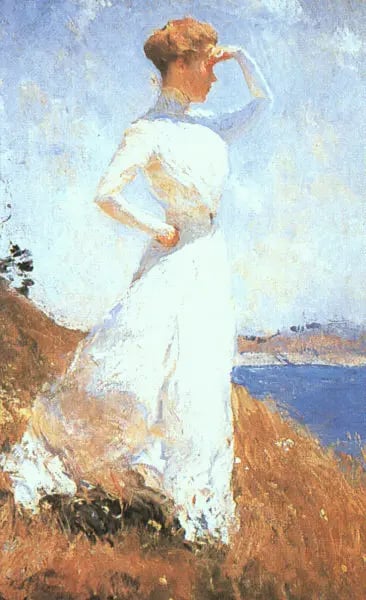
It is the day after my 37th birthday. I have just displaced a lengthy stretch of writing that originally opened this piece, writing that is apparent to me now as too autobiographical and winding to make its point clear, at least now. In the past week, I have purchased dresses for myself because I have decided to name within myself womanhood. This action is new and not new; like many who are not cis, this is a sense that has been burbling, bubbling, boiling within me for decades, one suppressed by social norm, animal fear, the anxiety of self and of knowing self. But the wizard’s task, to crib a notion from the occult and alchemy, is to seek gnosis above all, and you can only encounter this phantasmal white-gowned woman in your own heart before you embrace her in seriousness and give her a home. You are frustratingly able to remain homeless in your own heart and body forever if you so choose. But I lay down my sword now. I embrace something else.
I had a conversation a few months ago with someone I care very deeply about regarding music. I mentioned a love of women singer-songwriters across a span of genres, clearly hedging my position before showing a song that was meaningful to me. This person, a woman, said that it frustrated her how women are culturally expected to connect to the work of men while also maintaining their femininity in order to appeal and be acceptable to men but men are not expected to do the same and in fact are discouraged from doing so. This person knew I am non-binary and wasn’t speaking about me specifically but mentioning a general thought, one which to be clear I think holds true. It made me self-conscious still, the way that words that like gentle outstretched fingers strum the overwound strings of your heart might. I am imperfect but I do my level best not to inflict on others those accidental uncoverings; I lodged it away, an artifact to consider. What I wanted to show to her in that song was beauty.
Beauty, it turns out, is a spear and a door. Beauty is what I seek in art, regardless of form. Ugliness can be beautiful, as can truth, or elaborate lies, or endless sheets of detail, or simple clean images, or the sound of a guitar, or the hum of a voice, or a canvas of just one color, or a tableau of a holy feast. Beauty has no definite form, an act of grace that saves us, arrives on wings and slashes of light to offer us, ah!, those visions of. And that’s the thing, right? Beauty reveals truth, both known and unknown. You see an image or hear a line and remember a grandparent, a lover, a blackberry bramble, your childhood best friend’s bedroom, the color decay of your SNES. These are things you know, beauty calling back beauty and truth already known. But the other purpose of beauty is to call up from within you that which you do not yet know even about yourself. Something in those experiences of beauty runs the rim of the bells of the heart, and you discover inside your chest new resonance chambers and tones you did not know you possessed. Sometimes, they have been there all along, hidden. Other times, a space once dense has become hollowed and resonant without your noticing. Yet others, beauty does its third miracle, giving birth to a new truth within you in the moment of your experience. This is love at first sight and divine revelation. Beauty, one of the few valuable things about being alive, finds itself in your joys and sorrows, memories and hopes, regrets and anxieties. It, a spear, cracks open the otherwise impermeable adamant shell of the heart.
I am listening to Half Waif right now as I write. This is not incidental; the title of the total piece itself is, after all, taken from her work too. There is a magic for me to song. I am autistic. Autism produces within me something that externally looks like hyperlexia, logorrhea, an overabundance of words that can often choke out their own meaning. But this is the external affect of an internal opposite. I feel within devoid of words at my center. Feelings are so intense that I feel them flush through my body; I go ice cold and burn alive across the span of nearly every day. My feelings come in flashes of color, geometry, sensation that I cannot possibly name. Any artifact of command of language I possess comes from the frantic anxiety after the fact. All language is a form of anxiety. A way to desperately hurl to another some thing within or without us that we are afraid might otherwise be lost. Song bypasses this for me. Song speaks in color and shape directly, the timbre and texture of sound and its layering and change-over-time containing a density of meaning and shockingly a specificity of meaning that surpasses the written word. I think in music as I write; any decent cadence of my line or music to my prose is because one begets the other for me, is superior, commands. Song speaks for me; my showing of music to others are windows to the rooms and gallery halls of my heart. Often, in those key moments, when beauty cuts me open, the words of a song don’t feel sung to me but by me, some buried and now-discovered part of me. In keener beauty, it is as though the voice I hear myself is mine, in a timbre I’ve never heard before.
“Lavender Burning”, the opening track off of Half Waif’s album Lavender, spills out in a mix of confessional and imagistic poetry, keen details cut against moments of clarity of emotion. The music is electronic, beats built against a piano and layered synthesizer, like a modern approach to something Carole King might have done. I would play the record over and over, that opener spilling into “Torches”, then the others, this sequence of words. When I would listen, like I listen now, I did not feel like I was experiencing someone else’s work; it felt as though I had unearthed an old journal, with pictures and scribbled lines and jotted notes. And in that journal, I am a woman. A thing I did not expect. But it was not that I did not recognize it in that first blush. Her words were not shared by me but became me, revealed by their beauty that they were me, that the voice I heard was my own voice. It was like a magic spell. I could be outside, a man, slowly losing faith in my manhood, and then inside I could put on headphones and suddenly meet this woman within me.
Hers was not the only music that showed this self to me. The first time I heard Lady Gaga, I was in the throes of my first great depressive breakdown, when the weight was so severe that I finally needed medication, a reality I have not and never will be able to shake. I was driving from northern Virginia to Pittsburgh, a five-hour trip, and one I often made late at night to cut the traffic so I could blaze down the highway in my beaten hand-me-down car. Changing CDs, which I had plenty of, was tricky at speed, so I would flip through the radio as I drove, using the scan feature to drift across stations the way I flew across miles, picking up an R&B station here, a pop station there, some college radio in the mountains. I was so fucking depressed. The world had narrowed for me to a pinprick, no future and no past, and I felt I could rarely breathe and I had no idea why. The reality of my traumatic youth was departing; I was, at last, safe. Decompression sickness, I think. You get away and suddenly from another room all the suppressed pain roars back, the adrenaline protecting you gone. I round a corner on the mountains, see a gleaming town below in the depth of night, and the opening bars of “Just Dance” begin to play from my radio. I was whimpering already. When she got to the chorus, that explosive imperative to dance, I choked; when she said “gonna be okay”, a line too direct to be artful, I broke into open sobs. I wept through the rest of the song. It felt like an angel draping her wings over me.
I look back at those last few paragraphs with the same frustration as the first draft. I am writing this in real time; the sudden enunciation of womanhood within me came, as of writing, perhaps only a week ago. I had made slight murmur to my wife just before Halloween that I wanted a dress, but the urge became insatiable in early December of this year, 2025. I was in the midst of a number of stressors, some self-inflicted and some from health and some being mere banal mental collapse, a fitful erasure of the will to live that is colloquially referred to as "the family curse" by my uncle and I given its provenance in the Hickman line. I had a dream, you see. I was laying down, eyes closed, not quite asleep, listening to Ethel Cain, whose record Willoughby Tucker, I'll Always Love You struck by bell heart with its small golden hammer. Cover art is important to me, as are album names, track titles; these amount to something, a gestalt aesthetic object, and it is within that gestalt that the ravishing blades of beauty lie. I saw behind my eyes an orange room, burnt orange, like the cover of the record. In the room was a woman in a white dress. Depending on how I moved my spectral eye through the scene, it was either a tunic-style almost monastic white dress, defined skirt and blocked matte body, or a semi-lace dual-layer white dress, long sleeves each time and a matte long skirt always. The woman was slow dancing alone, not unhappy. She was me. I could sense it without seeing her face. In dream, this isn't needed for me to recognize myself; my own face barely feels my own, rarely has throughout my whole life, like I'm playing a character that people love and hate. But I was not just the woman. I was also the figure in the doorway watching her dance alone, masculine, suited. And I too was the room.
It did not take much in the way of art history or aesthetic theory to recognize the burnt orange room as my heart. I had found a key, buried somewhere but always there, and opened this locked room and found a woman inside of me peacefully smiling. This didn't frighten me. It was soothing. Affirming doesn't quite capture the feeling; it felt like perhaps closer to I, my own mother, reached my arms around me, like this hidden part of myself had been waiting to console the known. What I struggled with was more complex for me. I had, I have, a certitude that I am not merely the woman. The profundity of this moment that struck me would make no sense if that were the case. The me she/I consoled was still me, a created thing, haphazard and trying, attempting to assemble itself from its own wreckage. (As all of us are.) It felt more like: Don't cry. I'm here now. We can do this together.
I spent the next day crying. I still don't know if it was a cry of release or of sublimated pain, or if there is a meaningful differentiation between those two at all. I had been ruminating on topics I thought were uninvolved in my gender concerns: that my previously insatiable flirtation, wide and often, sudden repulsed me and felt like a way to run away from people I truly loved, that I wanted something else from what I was replacing with romantic and sexual attention, a desire to be loved and to belong and to hold, to be held. Suddenly, in the wracking wreck of tears I had become, the dirt cleared from the floor of my head and a stone was revealed. A topic that occurs in bisexual space, especially before people reckon with their desire, is the tangled question, "Do I want to befriend them, be them, or fuck them?" The truth of that question, which we both socially and culturally often fail to reckon with, is that there isn't any difference between those three. Each is an attempt to entangle, and at heart entanglement is all they are. They leave different scars and pleasured memories, disperse different miasmas and perfumes, but they are the hunger of a heart to know and be known, to see itself through another and in doing let that person see and be seen as well. I had found myself asunder on this same question from the other direction, an untying of sexual desire to reveal a blunt truth. I wanted to be taken in. I wanted to witness and be witnessed, be a loving friend, a presence. But I also wanted to learn who I was. I would see fragments of myself and reach out impulsively, without all of me knowing why.
In the novel Melmoth the Wanderer, many characters are beset by often lengthy and confounding woes oft undeserved. This culminates eventually with the grand reveal of the demon Melmoth, a man cursed with eternity, clad in lightning at the window, dressed in thunder. He offers them a deal: take his eternity as their own and be delivered from their woe, or suffer. Only someone who knowingly takes the curse can relieve Melmoth, let him die and finally rejoin the only woman he ever loved, a woman whose life he ruined and eventually ended without knowing. They never take the deal. Melmoth departs, wounded, angry, bitter, but disempowered. I felt as though I heard the crack of that mighty thunder and, looking up at the cell window of my heart, saw the shape of a woman. In this case, however, it was a woman holding a key. I would not understand these things, I would not understand myself, without her. She wasn't another woman. She was me. It became apparent to me that if I did not buy a dress, seek the dress I saw in my dream as best as I could, that I might miss this stretch of time where the door and key revealed themselves. I might slip into an unanswered dark for who knows how long again. I consulted my friend Laura, a woman who went through a similar albeit full transition under similar circumstances to me, and she told me to wait until my wife came home to go shopping together. The words made inherent sense. So I waited.
The dress shopping went well. I hate to disappoint with all the buildup, but the simplicity of it and the joy of it was so... You know, I am genuinely at a loss for words, and I don't think that putting it to words will actually benefit conveying what it was. A small warm bright light, big enough, the right size. Feeling fabric, talking fashion, explaining what cuts and silhouettes I like and which I don't. I even found a white dress that matched what I saw in my dream. It did not and in a certain way does not feel real. I also found a sweater that bridges the masculine and feminine as well as a dress that, on my body, reads more like a resplendent wizard's robe, which is impossibly fitting. It isn't what I need right now, but it represents a me, one that may return and one that led me here.
I've been so anxious to open this door because I don't know the shape of it and I've never handled not-knowing well. My entire love of philosophy, the urge toward theology that led me into, through, and out of religion again, my obsessive reading and fact-checking, even my own moral OCD, is a manifestation of this overriding anxiety that I must not not-know. Part of this stems from autism. The social danger of not-knowing is profound, where a well-intentioned and even deeply-reasoned action can sometimes have calamitous and real effect that is hard to understand; part of the humility of life is accepting that not anticipating or understanding an effect doesn't mean it's not worthy of my heavy consideration, to seek to understand. But there is also a real internal anxiety that pre-exists the impact. OCD gets typecast often as touching the butter dish three times or flicking the lights on and off, which are real potential manifestations, but it is at root exactly as it says: an obsession that generates a compulsion that generates a, turning into a feedback loop. It produces behavior I am not proud of; it produces cycles of self-torture that help no one.
Part of what I do not know is how much woman I will find that I need. I am not worried about finding that I need much; for whatever reason, the idea of taking estrogen and diving in if that's what is needed doesn't frighten me. I'm not unaware of a shifting and cruel world, but I have a capacity to retain certain aspects about myself and to pursue certain things no matter the cost. One of the great benefits of a suicide attempt and having been in those pits is I feel bone deep that my life is optional, not mandatory, and so I only want to remain on my own conditions. Should things ever worsen or prohibit me, if I cannot overcome those barriers, I can always kill myself and exit stage left. This isn't a scary thing for me to think about. This is, at root, a strength. It means, until and unless I pull that lever, these kinds of choices about my life, my heart and my mind do not get to be dictated by others. The very worst cost is death and if I keep that one in my palm, I'm free to do what I want. It's fairly simple.
What I am anxious about instead is if I find I don't need as much as: and that's where the thought again hits this wall of white light, where I don't know how to articulate it without fear. I'm anxious I won't need as much womanhood as people outside of me would need me to attain to respect it. I am anxious I will be seen as a man trying to avoid accountability by stealing identity from womanhood. I am anxious that I will, as continuously happens, no matter my pronouns, no matter what I say or do, no matter even if people can get it all right on paper, that I will be seen and treated as a man doing this. I don't fear rejection or resistance from fascists or their ilk; as a communist, I not only expect it but anticipate and prepare myself for it as much mentally as anything else, and as someone with an unwaveringly compassionate heart my weapons are as much learning how to speak to find the center of the heart and where it began to grow wrong as, let us say, normal weapons. I am afraid of being rejected by my own. I am afraid of seeking myself and finding abandonment instead. I am not afraid of abandoning myself; I am afraid of not being worthy of love, of forgiveness. My mind does not ease or erase that which I know I need to be forgiven for, and the seriousness of my conviction I have carried since I was a child is what pins that urge forever to the walls of my heart. I carry that with pride, no matter the pain it causes me.
This anxiety comes from the fact that I do not feel "woman" as much as "and woman". I see in myself my father and my mother. It feels, in that psychic space, agonizingly, obviously simple. I did not receive from one or the other and I do not in fact have to choose. That which emerges by the synthesis of their love, my mind, my body, I feel, have always felt, like a translational force between the two of them, both in real life and the versions of them within my head. It isn't a conflict I feel but a coexistence, where I am neither of them but a third thing that comes from the relation of the two. I don't have an absent relationship with manhood and masculinity; forced to live within it as I was, I found parts of it that I love, that I treasure, that have more depth and care and able desire than are sometimes read, and while there are parts that are ugly beyond reason to me and fit to be cast into the fire, there are other parts which are true parts of me.
Likewise, there is a great deal of non-gendered space that I feel quite intensely and have consciously explored for quite a while now, probably around 20 years or so. The me I encounter in the world of philosophy and the agonies and ecstasies, the real breaking tides of passionate emotion I feel in that space, are not those of man or woman. The thing that is me I get to encounter there is as alien to man and woman as cabinets are from apples and pomegranates. The existence of it does not preclude or even effect in any meaningful way he existence of the others; it simple is unrelated, something else entirely. It is this non-ness, for lack of a better word, and the great amount of it I feel through my body and my heart and my mind and the urgings of my spirit, that caused me eventually in rage to take up the pronouns of they/them. It is this alien thing that speaks and acts in the world, and it is being seen as a man and being read as a man that mutilates my intention, my desire, and often makes a selfish and domineering monster of what is, closer to truth, an earnest, often unaware, open but eager thing. I denied, and in that spirit still deny, that I am trans per se; this thing inside me that is me is orthogonal to that, which I often feel utterly unconnected from, as distant from as descriptions from cis people of so much of their manhood and womanhood. I have in truth never experienced dysphoria on this point; I have known who and what I am and I have, despite a great deal that has been done to me and or happened because of my own ignorance and missteps, pursed becoming myself. The genderless Romantic I see lit within myself when I'm reading Byron or Shelley (either of them) or Schilling or Holderlin or Emily Dickinson or the Brontes has always been there, calling to me, and I have always followed. What I want is not to discard any of the aspects of self I have found. I seek now to know the woman that has lived inside of my heart and see how she fits within the alchemy of my selfhood. I seek to be transformed in my understanding of my own actions and desires, to see which sprouted from this fertile femininity within me all along, breaking through only the lattice of other names. Names, after all, are but masks, artifacts of an anxiety called language. What matters yet is the thing itself.
Coheed and Cambria have always held a powerful place in my heart. I went from not understanding them really, lumping them in with the emo-pop boom of the early to mid-aughts that I largely was uninterested in, to gradually witnessing and learning to appreciate their edge, their interpolation of heavy metal and progressive rock, as well as what I eventually found to be shockingly moving lyrics. I am, to be clear, not a lyrics-first listener; maybe it's the autism, but the thing that draws my heart closest to song is the sound itself, the array of sounds, and what colors and shapes and moods those convey. It's not quite synesthesia, at least not in full, but that is the closest way to explain the sense of fullness of color I feel from music in general. As I said earlier: I seek beauty. Whether that emerges from harsh noise or dance pop or Balkan folk music or Indian classical music doesn't matter to me and, in many cases, learning with humility how to witness more beauty is more interesting to me than the opposite. Still, lyrics have often for me been a thing that bubbles up, not a thing I focus on. Nirvana is perhaps the best way to explain this. By and large, while we all sing along to it, we are not consciously thinking of Kurt Cobain's words at all times during the song; they serve a melodic and rhythmic purpose and often have a nursery rhyme simplicity, but they aren't precisely what we are supposed to keep our eye trained on. Then, like a saracen with blade flashing, there comes a line drives itself into our heart like an unseen arrow. "I feel stupid and contagious" is one for me, a line that positively leaps from the song as though the entire piece of music surrounding it exists solely to condition me for receiving that line. "I wish I could eat your cancer when you turn black" is another. Whether I knew as a child, running into those lines when I was about 5 during the radio blitz of their material following his sudden death, what they meant to me or why was immaterial. As I said, beauty reveals you to yourself, sometimes rings a bell that in defiance of time has not yet formed inside of you.
Coheed however have always been odd for me in terms of the resonance of their lyrics with me. In large part, this is because, like the Mars Volta and Yes, two other bands that have struck me blind with wordplay, I do not fucking understand half of the shit that's being said. The fact that it often all ties into a sci-fi narrative isn't really the point of the illegibility; in fact, adding that lattice over top the words seems to only make them more confusing, not less so, introducing a sense of narrative cohesion that also doesn't seem to exist. Yet, fascinatingly, this doesn't effect in any real way the emotional heft of what's being sung, at all. They level me, and often, feeling in that beautiful and perfect way like it is being sung directly to me, that it's production in the world was a mere methodology toward the ultimate aim of delivering itself like an Orphic mystery to my lap. What's even more interesting I find is that this sentiment is broadly shared among the Coheed fandom. None of us really get what Claudio is singing about almost ever and this fact is a common joke and bonding point. It is almost always followed by a list of songs that devastate us or seem to lay ourselves bare to ourselves despite, because, despite that utter lack of understanding.
There is a side point here worth exploring, one tied to gender in a sidereal way. Language is, in one sense of things, a structure we inflict on the world and work haphazardly with each other to refine into a shared method. The breakdowns in friendships and romances, the small betrayals and accreted silent hurts, are testament to this fact of language being ultimately a seemingly infinite series of microlanguages that overlap only haphazardly with one another, sometimes cohering enough to make us believe they require no further work and other times discohering so completely that we know compatibility would require active conscious effort rather than being assisted by happenstance. But language is also an event, an act, a thing that happens within the moment. This is why a song or a painting can in one shattering moment convey some secret inherency within our heart only to close its doors thereafter, no longer calling up from the depths that same fundamental truth we once found. Language is not always inherent to an object; language lives within time and within event, a hazily defined philosophical concept sitting somewhere between the ontological and the phenomenological, the material and the subjective. This in turn is one of the points of nonsense poetry, Dadaism, surrealism, etc; they seek as methods, by bypassing language-as-known, to arrive at a language-of-event. You do not walk in anticipating a thought or a feeling because the grammar and lexicon are utterly alien to you, or just alien enough that it disrobes you mentally. In that fresh and naked state, the earnest mind is capable of receiving thoughts or feelings that otherwise might be impossible to convey. This in turn is what makes the occasional mind-twisting poems like, say, The Waste Land or "Howl" so primally effective; even within their set language, they dash us to pieces, and in our imperfect reassembly of meaning by the line we start seeing shapes, geometries, colors, emotions, and understandings of memory and self that we otherwise would have been bereft of.
So to say that I generally got why the near-nonsense lyrics were able to move me is a pretty comfortable statement. And for years, that's all it wound up being. They would score moments of my life that were tremendously distressing, from the wreck and ruin of my mind in the black hole of suicidality and grief as a means of primal impassioned survival to the scouring intensities of the final year that I drank, where with friends I started to witness in a conclusive way the shattering and falling away of the crude shell of maleness that had thus far encased me. I knew, from my first experience hearing "The Crowing" and "Welcome Home" onward with each successive new album, that they struck something deep within me. The necessity to name or know more deeply that which they struck had not occurred to me; it was enough to feel it and, against the intermittent hardness of spirit, to let the tears out that they effortlessly called up, be it by ballad or heavy progressive ripper. So, in the throes of this most recent fit of gendered discovery, when something within me that is woman felt like it was bursting from my heart to be seen and to be named, coming to me in a shadow of my life to console me, I found myself again listening to them obsessively. In particular, I was listening a great deal to the two most recent Vaxis records, the second half of The Afterman and, as always, Good Apollo.
I realized as I listened to it obsessively, to and from work, in cafes with my headphones in unable to read even a single page, at home at the writing desk or from my sound system, playing from my phone before I went to sleep, why they came back to me in that moment. I will, as a lot of people do, hear a snatch of song in my head sometimes; I take this as a sign to return to a record or an artist, like something within me that can't communicate so easily with my conscious mind (language is also an inward anxiety, that self attempting to understand and communicate with the self, from hunger pangs to the need to sleep or use the bathroom to those emotional desires). The image-metaphor of the enunciation of this woman within me had already nestled itself into my heart. She is not, the I that am she, that I that has been she without my always knowing, the dominant figure of the house of my heart, nor is there one. There is Me, this earnest and genderless child, the way the Fool or the Star are without inherent gender in Tarot. And then there is a Man, some fatherly and loving and strong figure, that I had discovered already by the way society made me remain a Man for far longer than made any sense to me. This woman within me wasn't coming to displace anybody but to join, to wrap her arms around that smaller self of mine and, releasing her, tell me I could lean on her more knowingly, let her be me, hold me. I realized that when I listen to Coheed and Cambria, I am hearing not one but both of those voices, and my own small voice as well.
I cannot precisely articulate why. Is it the range and timbre of Claudio's voice? I am often more responsive to vocals as a textural and melodic element than a way to convey discrete meaning, and his certainly run not an androgynous range but a fully bi-gendered one, leaping from one to the other and tracing the space between. This is in part because so many of his stories he is conveying are about mothers and fathers and their child, these repeating tesselated triads all over their body of work, requiring him to be able to not just take on the voice of each but sometimes take on the voice of them in simultaneity as a kind of Greek chorus. I realized that what I hear is not a part of myself but all of myself, that any part of me is or could be singing to one or all of the others. That's why some songs stoke that undeniable fire at the pit of my psyche, when I depleted of everything, that I will survive even if cursed in my head. That's why some songs feel like they call up that deeply feminine desire not just to belong but to belong among women in a feminine way, a way I don't yet know how to achieve or articulate. It's also why their music conjures so clearly for me that third gestalt me, the one that is neither the man or woman as well as both of them, that does not know how to exist, that comes out when I write, that sleeps in the gentle hollow of my ribcage.
This all would be easier for me if I simply felt a man or a woman, cis or trans, with the desire to take up the fullness of either of those experiences. But so much remains alien to me, incommunicable and remote, and the scattered array of self I continue to find more often leaves me feeling alienated not just from the cishet world but often much of the queer world as well. It's why I find kinship in the kind of madness of artists, as temperamental as that can be. I will not take the shape demanded of me. I will search with the fierceness of my heart for the shape that is me and I will make that real. I will become myself. I want to find her and know her and become closer to knowing who and what I am so that I can be and give for another. Both this women and man within me, this mother and father I feel inside of my psyche in a way distinct from either the DID or psychoanalytical interpretations of that statement, both create and encourage that same earnest yearning within me. I can experience wounds and confusion and bear thorns and fire; I want to heal and to be peace. In sleep, you pull my arm over your body and, without words, there is a profundity of comfort that is not just sleep but true peace, strong enough to break in its moment the uncertainties of past and future and let us know both that I am with you, meant in both directions. That this sense comes from a womanhood within me as well is an inner revelation that upends so much of what I thought I knew about myself. What I believed was my sexual desire has for the past month fully melted away. So much in my head has been about me that I sometimes could not see other people, didn't even know that I wasn't seeing them. I want to see other people. I want to be a peacegiving and loving thing. I do not yet know this thing that I am, but I am looking.