
Still on the Shelf: Metropolis
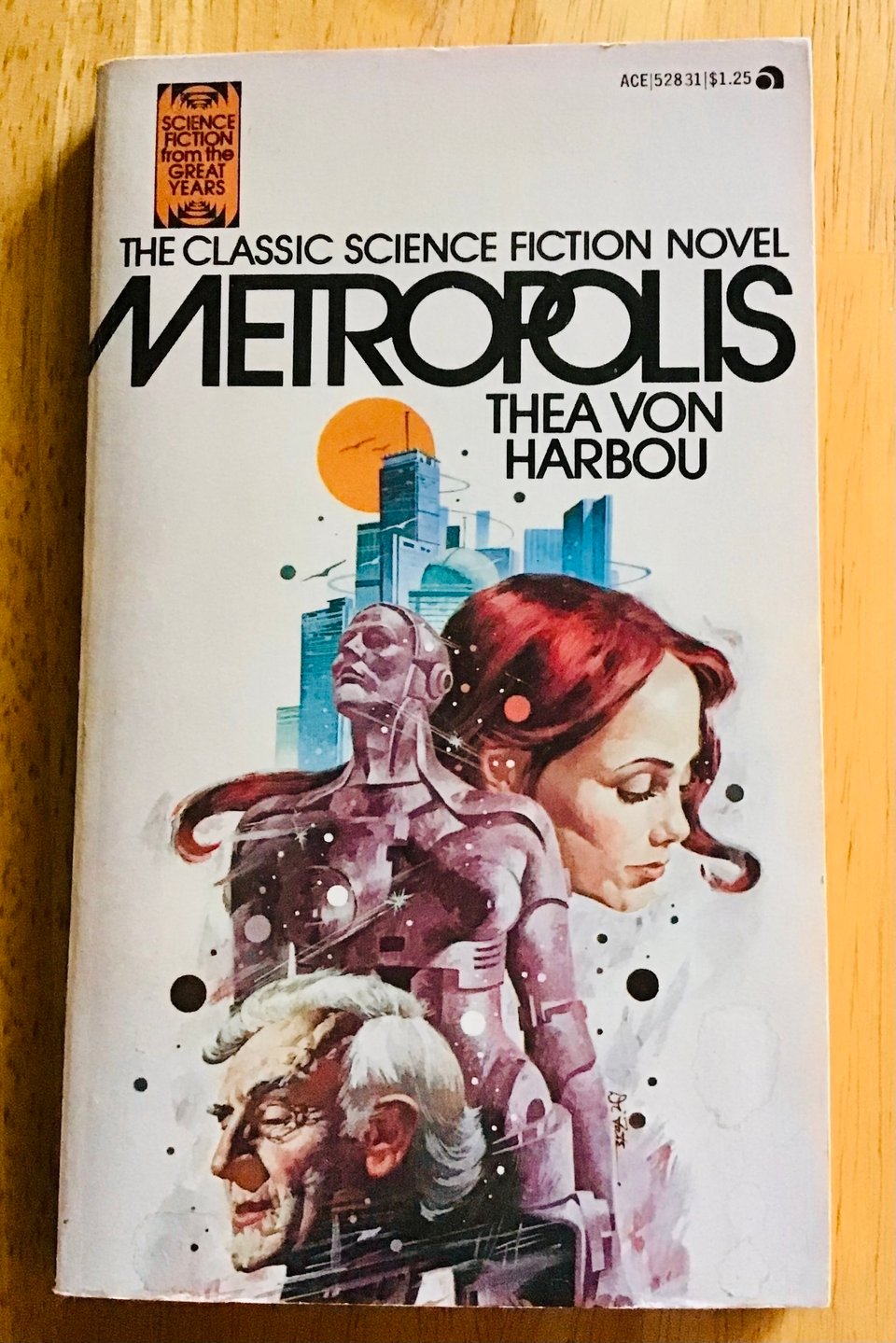
Did my edition of Metropolis come from 1972 ... or 2026?
Media tie-in novels are older than one might think. Sitting on my shelf, Metropolis by Thea von Harbou, who was the wife of director Fritz Lang.
Bought in a used book shop in the late 1980s, but I still don't know when it was published because the book itself does not say. Let's look at the numbers.
From Wikipedia:
Metropolis' screenplay was written by Thea von Harbou, a popular writer in Weimar Germany, jointly with Lang, her then-husband. The film's plot originated from a novel of the same title written by Harbou for the sole purpose of being made into a film. ... The novel featured strongly in the film's marketing campaign, and was serialized in the journal Illustriertes Blatt in the run-up to its release.
Reminds me of seeing the Star Wars novelization (ghost written by Alan Dean Foster) in my local stationary store as a kid before the movie came out. "The novel featured strongly in the film's marketing campaign," indeed; it applies to both movies.
There is no publication date inside my copy of the novel. There are a couple of references on the internet of it being a 1972 edition of the 1963 Ace edition, but I'm not sure and the cover art throws me. It looks late '70s at best. The $1.25 price would also put it at that time, in my opinion. I bought it used around the late 1980s, to the best of my recollection, no help in dating the edition.
As I was typing this and speculating on the cover art, I realized why it felt familiar: it looked like art by Vincent Di Fate. The inside title page, where a cover art credit would go, says: "Title-page design by Jack Gaughan." Well, that's not the cover. There is no cover art credit.
Then I spotted a squiggle along the arm of the robot in the cover art, a clear artist's signature: Di Fate.
Bingo, and one of my favorite science fiction artists. (I was thrilled to see him as a guest of honor at Balticon several years ago.) Would he have done this in 1972 ... or later?
According to Wikipedia, he did cover art for Broke Down Engine (and Other Troubles with Machines) by Ron Goulart in 1969, the year Wikipedia says he broke into illustration for speculative fiction magazines, and was nominated 10 times for the Hugo Award from 1972 to 1985. (Though if Broke Down Engine was the short story collection, it's dated 1971.)
So, yes, very likely he could have done it in 1972 (and quite a good, ahead-of-its-time type of illustration it is, too). But the cover price still bothers me. Is it 1972-ish?
A quick look of Ace paperbacks from 1972 revealed one at 75 cents, two at 95 cents, and one at $1.25 (The Stragglers by E.J. Kahn Jr.). I don't know about The Stragglers but a big-name movie tie-in like Metropolis could merit the higher price.
OK, it could be a 1972 edition, and the lack of such information inside the book could, ironically, also be evidence of such a date.
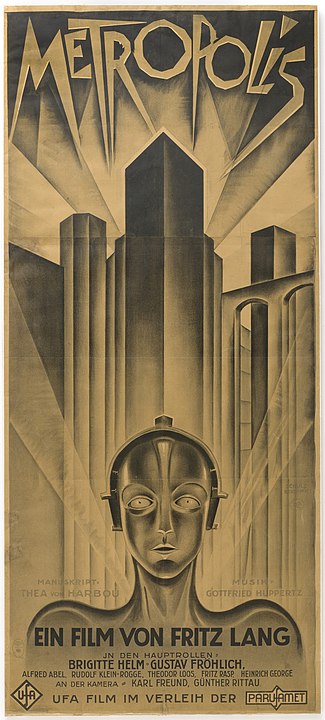
Theatrical release poster by Heinz Schulz-Neudamm, via Wikipedia
Metropolis was released in 1927. Filming began in 1925, the year of publication for the novel. Inside of the title page it says the first English edition of the novel came out in 1927. The first page inside the cover declares in all caps: "THE WORLD OF 2026 A.D."
Forrest J. Ackerman signs his introduction with a date: 24 Novembro 2026. No help in dating my edition or any edition, though perhaps it started in the original Ace edition of 1963. Is he somehow responsible for "The World of" reference?
Because, placed behind the first page and signed T. vH., it says:
This book is not of today or of the future.
It tells of no place.
So the 2026 reference is an addition not connected to the original film or novel. Some clarity from Wikipedia:
The time setting of Metropolis is open to interpretation. The 2010 re-release and reconstruction, which incorporated the original title cards written by Thea von Harbou, do not specify a year. Before the reconstruction, Lotte Eisner and Paul M. Jensen placed the events happening around the year 2000. Giorgio Moroder's re-scored version included a title card placing the film in 2026, while Paramount's original US release said the film takes place in 3000.
A note in one edition of Harbou's novel says that the story does not take place at any particular place or time, in the past or the future. Meanwhile, the 1963 Ace Books edition, which is a reprint of the 1927 English edition, specifies the setting as "The World of 2026 A.D." [citation needed]
I got your citation right here — or, above. At least for the 1972 edition, if it is one.
So we have a 1972 edition of a 1925 novel, a purposeful tie-in or treatment or precursor of a 1927 movie that does not take place in 2026 though that reference is added to the first Ace Books edition of 1963, probably the source of Giorgio Moroder's version's new title card (1986), and has been sitting on my shelf as a prized possession since the late 1980s (or thereabouts).
And the price? Written in pencil on the first page is what must be the price I paid for it in a used book shop: 63 cents.
I need to erase that and put in its real value:
Priceless.
