Navigational Course Adjuments
Friends,
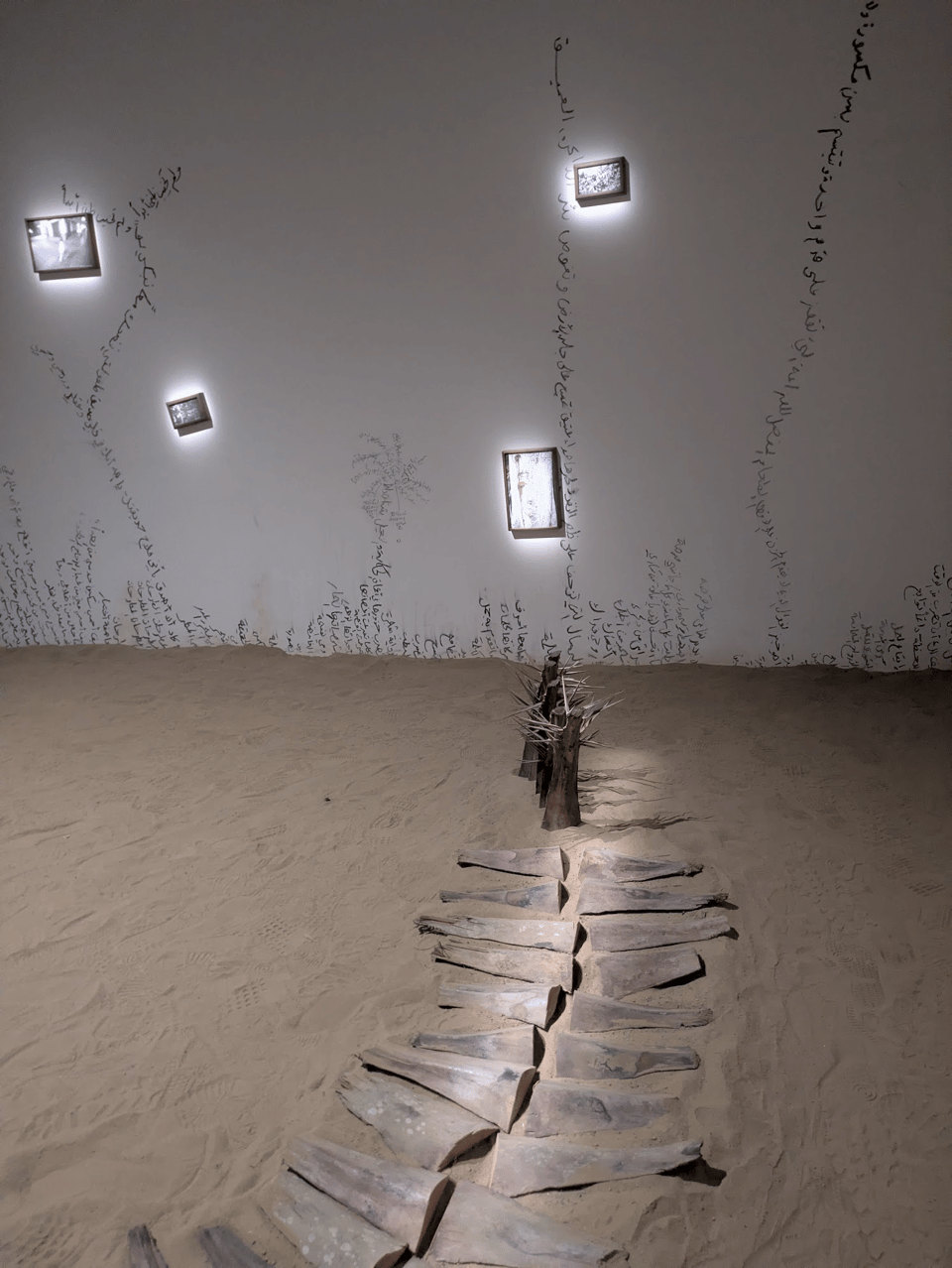
The above photo is from Mohammad Al Faraj’s art installation Like Tea Leaves in Water, which we were lucky enough to see at the Taipei Fine Arts Museum. A photo, of course, does not do the exhibit justice. The room was filled with sand, while wedges of palm wood were arranged in a way that seemed like a path, but also looked vaguely spinal. The walls were covered in Arabic writing shaped like climbing plants, while some of the plants “bloomed” into photographs of village life in Saudi Arabia. It was so engrossing and thorough and evocative.
We had visited TFAM years ago, before we’d even moved to Taiwan, and I’m glad we took the opportunity to revisit it with a friend. Apart from Like Tea Leaves in Water, my favorite exhibit was seeing the winners of the 2025 Taipei Art Awards, especially the work of 王冠蓁/Wang Guan-Jhen. The specific art is here, and her IG page is here. I love the mix of familiarity and uncanny, the surprising amount of chaos in a still frame.
We’re right in the trenches of the mid-semester slog here. I’m teaching two classes at the university: one for doctors who want to improve their English in order to better participate in international research, and one for all students (mostly undergrad) that originally focused on writing for websites/social media but has slowly evolved to be more about professional writing based on what the students respond best to. The second class has the word AI in the title, but each semester I spend more and more time on the negatives and less and less time on the advantages. It’s hard to believe, but this is the fourth time I’ve taught the former and the fifth time I’ve taught the latter, and this semester will finish out my fourth year at the university. It’s a blessing to continue teaching the same class as it means a lot less time on lesson planning and more time for feedback, one-on-one conversations, and adjusting. I’m trying to do more adjusting this semester, both the “constantly try to improve my practice” kind of adjusting and the “have to keep this fun and interesting for me too” kind of adjusting.
I’ve wanted to add more reading to the media/professional writing class for a while, but it’s tricky. We already look at lots of excerpts, to see the writing techniques we discuss in their natural habitat. I also have them read articles of their choosing, but we were missing a shared text they could talk about together. Reading has to have motivation for the students to do it beyond class discussion, and a quiz about reading content wouldn’t fit the class, nor did I want it to be confined into a homework assignment. (Before you go to the instinctive “kids these days!” reaction about not doing homework/reading, I absolutely skipped over a ton of readings if it didn’t seem like they were going to be essential to my grade.) So this semester I went for it, picked out six articles, and threw students into groups to make mini presentations about their group’s article by the end of class. It seemed to work out well! Of course, it needs some tuning, especially around pacing, but there were some great conversations happening. Small groupwork like this takes up a lot of time, but it’s good for getting students who wouldn’t otherwise talk to participate, since there’s both the comfort of a smaller audience while also the guilt of not being the silent one. In my very limited experience, this guilt is even more effective for getting students talking in Taiwan than in the US.
I’m also doing some adjustments in my tutoring work, mostly in the vein of keeping things from being too repetitive. This week I’ll go on my second small field trip, taking students to the Human Rights Museum (previously written about in January’s newsletter), having previously taken a student to a small art museum. I’m fortunate to be trusted enough to do these ventures and not have to justify myself much, as these visits are not really in the scope of my duties as an English tutor, but the students have been learning a little bit about Taiwan’s dictatorial period in their school classes and I don’t think anyone else is going to take them, so it seems important. If I did need to justify myself, I think I’d focus on encouraging intellectual curiosity, which covers just about everything. I was also a little nervous because the history contained within still echoes forward to today, and of course I don’t know the students’ parents’ politics, whether they think a focus on this part of Taiwan’s past is over emphasized or propagandist in nature. Nothing bad yet! Here’s hoping.
Unfortunately, I’m second guessing my decision, because the Human Rights Museum is a series of largely open buildings, and Taiwan is getting its first warmup heat wave this weekend…
Further reading:
I’ve seen enough and am calling it early. Here it is, the best opening hook paragraph of the year.
I’m really excited to check out the book Super Nintendo: The Game-Changing Company that Unlocked the Power of Play by Keza MacDonald, and my excitement is born out of this delightful interview with Anne Helen Petersen.
Start reading Jen A. Miller’s blog entry on regretting going the traditional publishing route for the excellent Alyssa Liu meme, finish reading it for the meditation on wanting a thing for a long time only for it to turn out to not be as great as you thought. Very interesting behind the scenes look at the choices you make as a writer.
Hammer & Hope’s photo essay documenting the ICE invasion of Chicago is an incredible piece of work, the kind you expect(/hope) to be in history books in the future.
Thankful for Dr. Tressie McMillan Cottom for calling attention to the Kentucky Tenant Union, which has gotten a collective lease for members, the “first of its kind in the southern US”. Yay!
Research out of Denmark trying to identify causes of gender-based gaps in education have found that when school is not in session, boys’ reading drops off monumentally, whereas girls kept turning pages. This mirrors behavior I’ve seen in Taiwan (though I’m not sure being in school actually changes things much either). I told my students about getting free Pizza Hut Pizza for taking whatever those computer book quizzes were when I was a kid, and we all decided that’s the obvious solution to this problem.
Clair Obscur: Expedition 33 was an absolutely incredible game. If you’re into RPGs at all, I highly recommend it, especially if you can manage to get started without being exposed to any spoilers. It’s still bouncing around in my head a couple of months later, especially the soundtrack. Check out “Lumiere”.
Next month I’m looking forward to attending the Taiwan International Documentary Festival! A student of mine is volunteering at the festival and made me aware of it, otherwise I probably would’ve missed it as a consequence of my continued stubborn refusal to be present on Taiwan’s main event planning platform, Facebook. I’m considering seeing How Long is the Road, Beyond the Anti-DuPont Movement, Man Mei, Where the Sea Breeze Blows, SPI, and The Blueberry Blues. Only the last isn’t about Taiwan. I had hoped for a couple more food-centric ones, but alas. I’l report back on how it goes.
Watching documentaries is one of those things I rarely think about doing, but when it happens I’m usually satisfied/grateful afterwards. The last time was on the plane, where I watched a string of minidocumentaries about Taiwan. They were great, and surprising, and hard to find online. One focused on food in Tainan, one focused on a hiking area near Nantou, but my favorite was about a school in the town of Zhudong called 親愛愛樂/Chin-Ai Music (roughly “dear lovely music”). It was setup by two teachers, initially just to teach music, but became a real community and family for students from poorer, rural backgrounds, who continue to support each other even after moving on to jobs or university. (On the airplane I think the video had English subtitles, but the YouTube version does not, unfortunately.)
Hope something in your life surprises you with a feeling of satisfaction and gratitude, too.
-g