My Winter Break as a Tourist
Friends,
Winter break has begun, and I’m using the opportunity to a) spend Christmas week with a mild cold that would not shake and b) check out some Taipei-area sites that have been on my list for a long time, but the convenient opportunity/motivation hadn’t popped up.
First was the new National Archives building out in Taipei’s suburb of Linkou. It just opened in November and the building is absolutely gorgeous, inside and out. It has a coffee shop inside and tons of little details throughout that shows they went out of their way to make it engaging and interactive for kids. The exhibition itself uses replicas of documents to show the past ~100 years of Taiwan’s history, mixing together a lot of official government orders with relevant slices of daily life.
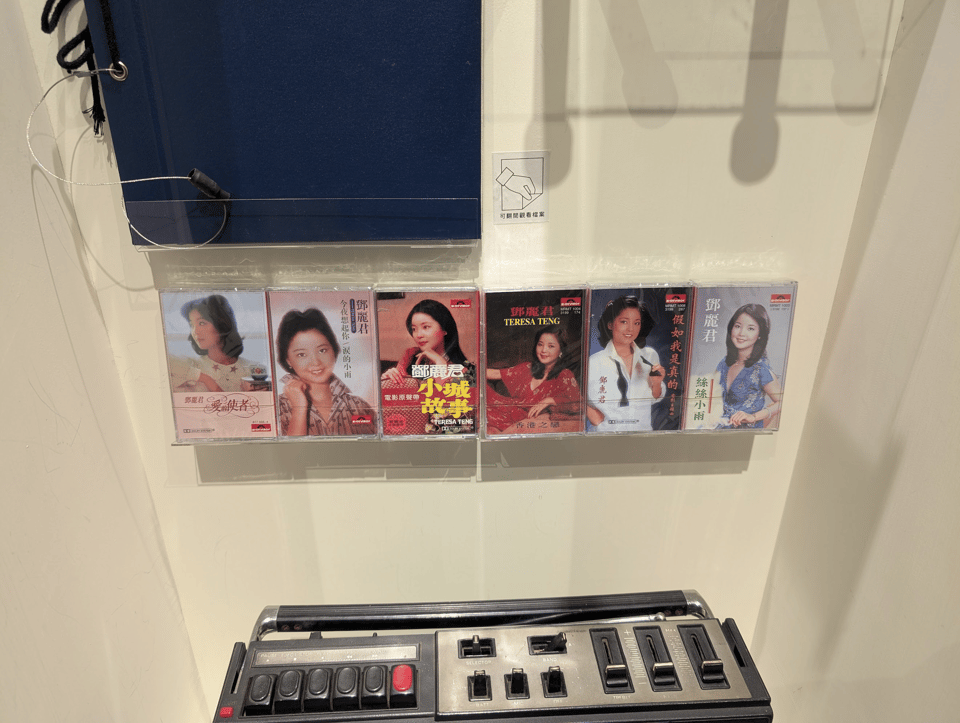
The most important documents were a collection of Teresa Teng/鄧麗君 cassette tapes.
Unfortunately, the context presented with the exhibition often elided some of the truth. Captions tell you that “the central government secretly transported gold to Taiwan, some of which was used for military expenses, while the rest was allocated to various financial needs.” The financial needs, here, included tons of corruption and enrichment of the heads of the KMT. A placard about Taiwan’s transition to democracy says that originally legislators were unelected “due to political factors” instead of plainly stating the totalitarian control of the government. The info about the martial law dictatorship mentioned a few specific people, but almost never said the KMT’s name itself. But these omissions are unsurprising, given the KMT’s continued existence and power in the government.
Otherwise, it’s really well done, but also relatively short, so I wouldn’t recommend a trip to Linkou just to see it. There are tacos nearby, so that’s a plus.
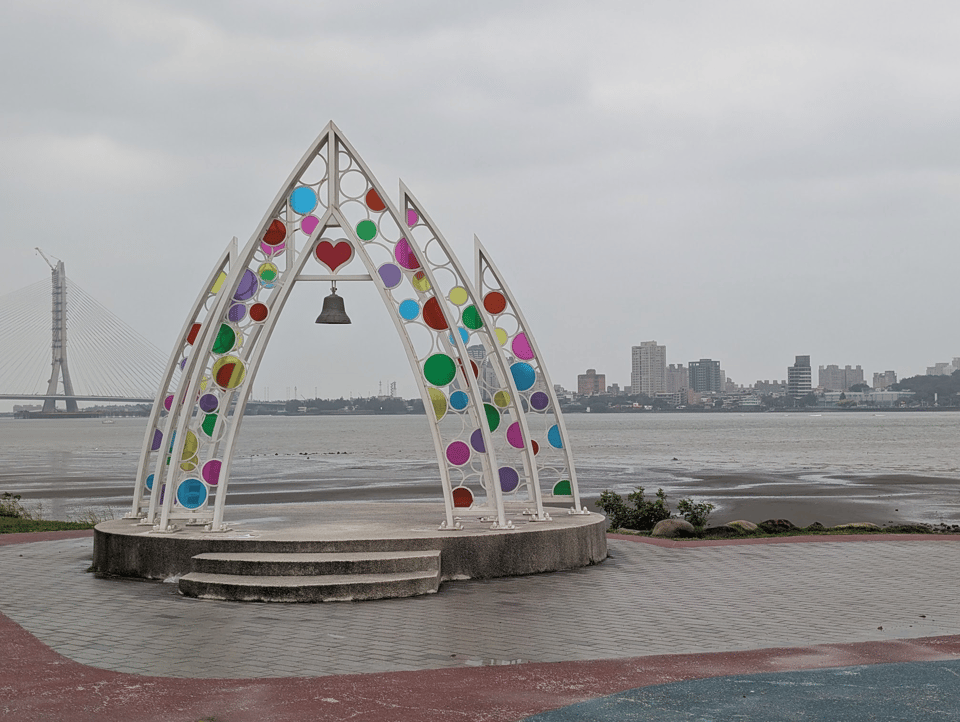
A short drive from Linkou is the coastal port town of Bali. There, you get a nice view of the much larger port of Tamsui/Danshui, which you can see in the background of the opening picture of this email. However, the reason I wanted to go was to visit the temple honoring Liao Tianding, who was introduced to me through a video game several years ago (I wrote about that game, The Legend of Tianding, back in 2022). Liao is frequently compared to Robin Hood, as he stole from the occupying Japanese forces and gave some of it away to locals. He was killed near Bali by Japanese police after being betrayed by an accomplice, hence the temple and nearby statue. Being promoted to a temple-worthy minor deity after death is rare these days, but if Liao Tianding can do it, I suppose I can too.
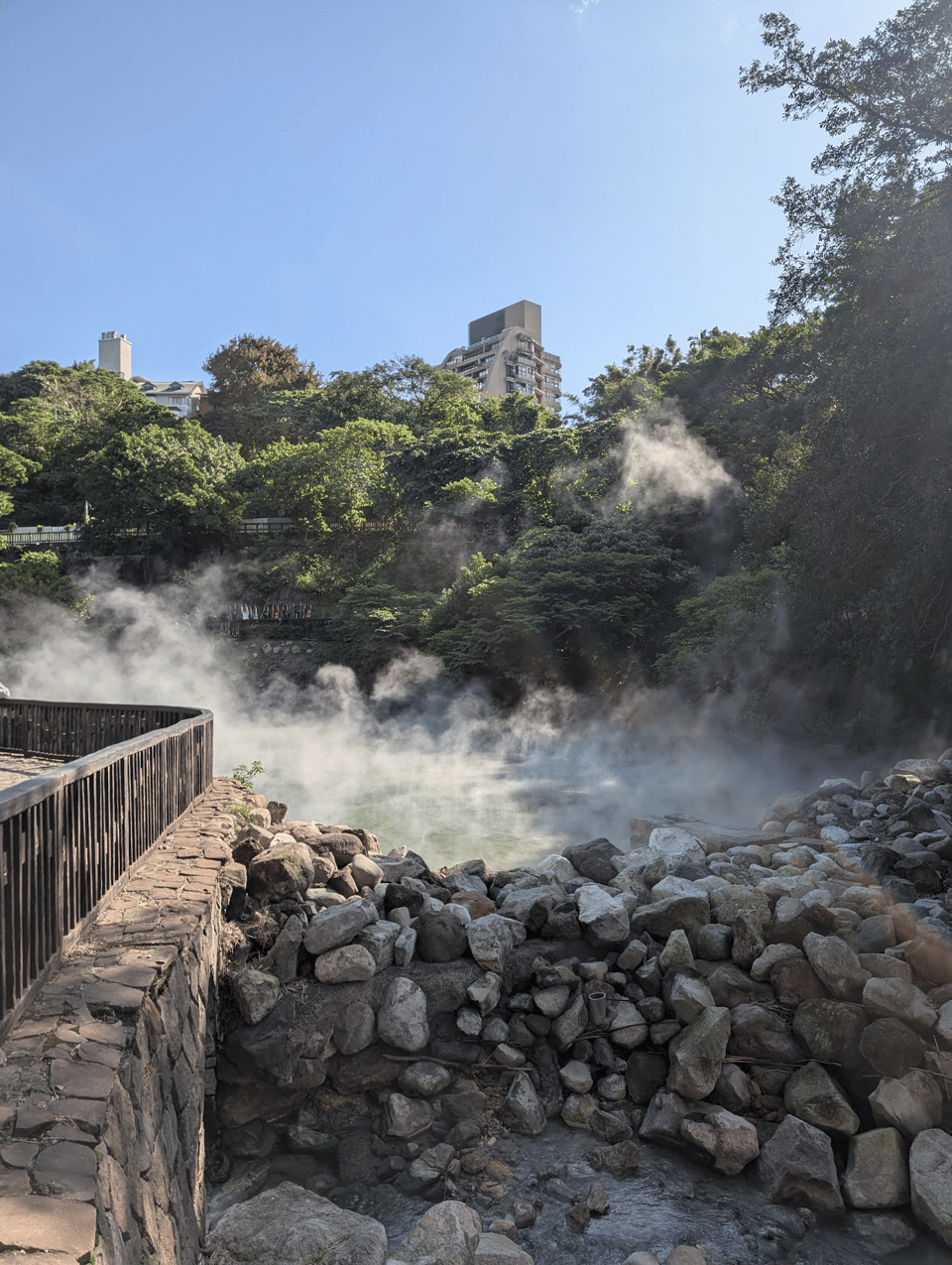
The next day, we took a trip to the north of Taipei to be practice tourists for a friend who has recently completed training to serve as a tour guide. We’d walked past the Hot Springs Museum and Beitou Public Library before, but this time we went inside to check them out, along with walking along the fragrant sulfur hot spring runoffs. The Hot Spring Museum looks quite small from the outside, but it’s deceptive! Inside there’s some general info about the springs, the history of the area, and then there’s a recreation of what the Japanese bath house was like. It’s just neat, and it’s really conveniently located next to the MRT and a park and the library. The library is absolutely gorgeous from the outside: all curves and wood and windows. Not really worth going into and disturbing patrons, but peek through the photos.
We also made the trek up to the Zhongxing Guesthouse, AKA Yangming Shuwu, an elaborate mountainside mansion where the dictator Chiang Kai-Shek spent summers to escape the heat, built using the aforementioned gold allocated to “various financial needs”. It was… something! The mansion’s guide let us know that Chiang’s wife was a night owl who slept until noon, whereas he followed the early-to-bed early-to-rise lifestyle, yet she outlived him by decades, so he suggested that no one yell at their children for sleeping in.
Then, this morning, I was riding a bus to the Jing-Mei White Terror Memorial Park and Human Rights Museum when I began reading about the murder of Renee Good.
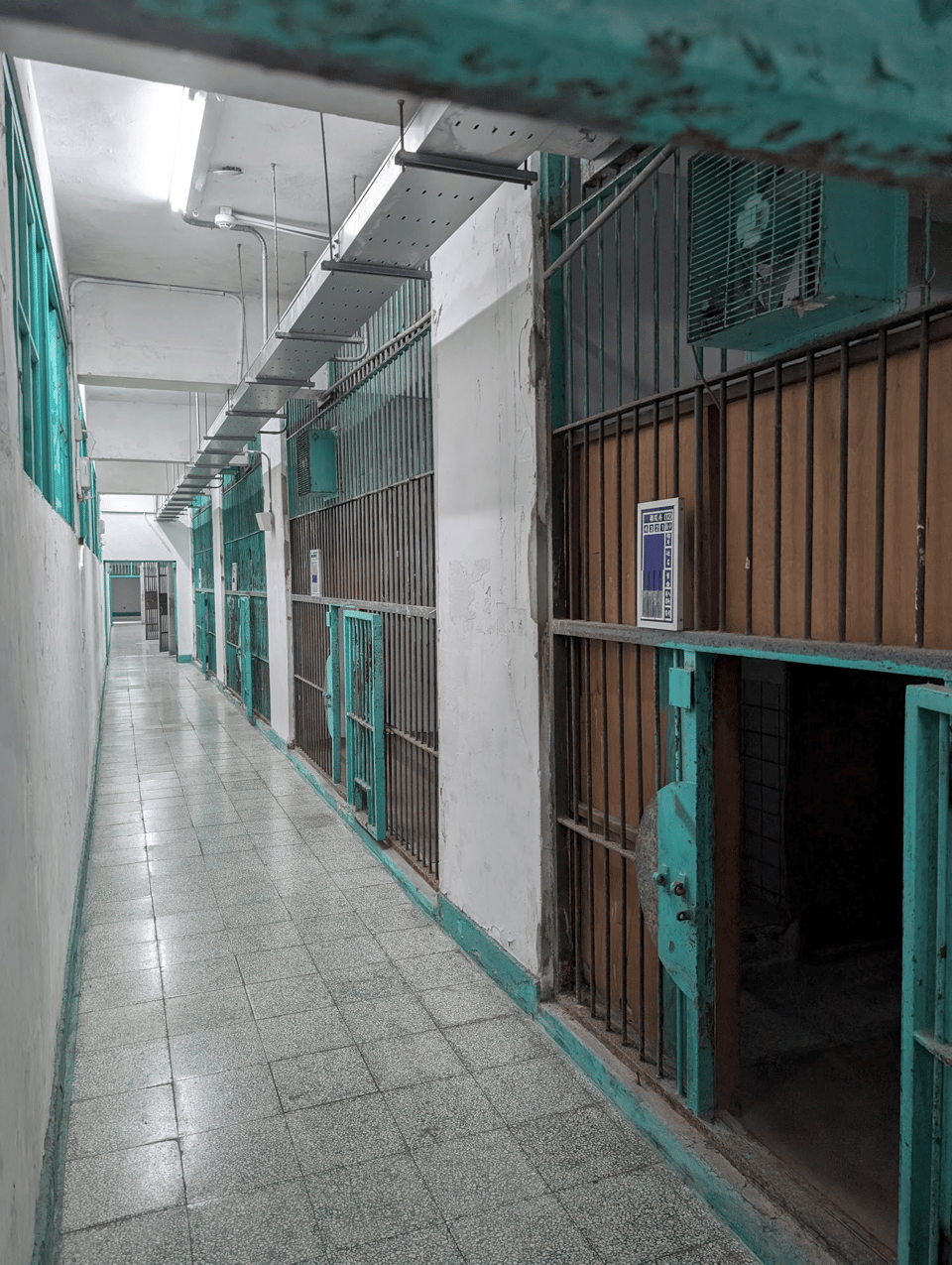
This museum is on the site of a prison and courtroom used for political prisoners during the White Terror martial law dictatorship. Here, some prisoners were sent on to the island prison Green Island, while others were forced to work making clothes and other goods. The humiliation and abuse were physically built into the prison. Doors used by prisoners were just three feet tall. Ten men were crowded into cells the size of our kitchen, which also included a rarely-working toilet. On the rare occasion prisoners were allowed visitors, they could only talk to them through thick glass over a recorded phone, and were only allowed to use Mandarin Chinese, despite that not being the majority of their families’ native language.
I found myself thinking a lot about last month’s stabbings in Taipei. Two people were killed and seven were injured by a man with a knife who used a smoke grenade, who afterwards committed suicide. This event captured the totality of Taiwan’s attention, as this kind of thing is exceedingly rare here - the last mass attack was 11 years earlier when four people died - and a lot of people seeing the video were shocked to see bystanders’ nonreactions. But it’s completely unsurprising. It’d be much more logical to assume it was someone filming something for Instagram or a cosplayer than actual violence.
The response to this year’s stabbing was to cancel some events where mass amounts of people were going to be, doubling security personnel at other place, and adding a ton of security guards who are now equipped with fancy shields in the subway stations. Policy changes have been recommended: restrictions on people buying smoke grenades, more surveillance, more death penalty.
Take this strand of thought and add to it another: Taiwan’s street safety is atrocious relative to its development, and if you look at any English-language discussion of the issue, the main culprit is lax policing. I can sympathize to this response: it’s incredibly frustrating to see a traffic cop directing traffic and a vehicle break the law to squeeze through a light, literally beside the cop, and the cop do nothing. I see that on a regular basis, and it makes me almost as angry as when I walk past the bench in front of Family Mart where there’s a poster that says NO SMOKING, FINE $10,000 and the bench always has someone smoking on it. It’s also frustrating to hear the official response to when the traffic issue pops up in the news is to add new laws instead of enforcing the existing ones. It seems illogical.
But. But when I look back across the Pacific Ocean and think about what happened in Minneapolis yesterday, and when I think about the nearly forty years Taiwan spent under martial law, there’s no way I can think the main answer should be to give more power to the police, to put more emphasis on punishment. That’s a hard road to change directions on the further down it you get, and we’ve already taken some steps that way.
Very thankful to hear Taiwan’s VP, in the days after the stabbing, to emphasize the social safety net, including education and civil service, instead.
Further reading:
Bogotá, Columbia is doing a really enviable and logical experiment: trying to make care work less painful. There’s so many cool details in this story that it’s hard to extract a single summary, but basically they’re building “care blocks” where the people (overwhelmingly women) doing unpaid care work for children/elderly/disabled can get support for everything from classes to laundry to counseling. “‘Cuidar no es ayudar, es corresponsabilidad.’ To care is not to help; it is co-responsibility.” Bonus, the photos are great.
Your obligatory one LLM-related article for the month is Sam Kriss on the grating voice that “AI” has made ubiquitous. “A.I. writing is marked by a whole complex of frankly bizarre rhetorical features that make it immediately distinctive to anyone who has ever encountered it. It’s not smooth or neutral at all — it’s weird.” (Note - I feel obligated to say that this gets way more complicated when we mix in non-native English writers.)
I’m going to be honest, Jenna Tang’s translation of Fang Si-Chi’s First Love Paradise was too difficult for me to make it through - it’s a disturbing, trauma-heavy novel. But in the process of reading about it, I came across Tang’s roundup of Taiwanese literature in translation on Words Without Borders, which gave me a lot of works to add to my “to read” pile.
Charlie Warzel writes about phone addiction among grandparents. It’s complicated because there’s benefits! Combating social isolation, and the myriad uses that can help prevent cognitive decline, etc. But that dopamine hit of short-form videos and confirmation bias is hard to fight against. As an aside, it kind of sucks how the word “slop” has taken over all discourse.
Focus Taiwan ran a piece profiling Emma Cheng, a Taiwanese doctor-turned-artist who does illustrations for The Lancet and elsewhere. Her art is so cool! Whimsical and evocative. Little late for the Christmas season but for the medical-attuned people in your life, a lot of good stuff in her store.
I didn’t know who Betty Reid Soskin was until reading this article, but I’m glad I do now. Thanks Alex Shephard for the link.
The newest entry in the Knives Out Cinematic Universe, Wake Up Dead Man, is a good movie. It’s not as good as the first film, and I’d put it on par with the second (though it has a wildly different tone). Even though it’s not as good as the first, it’s still probably the best films I saw in 2025. Check it out.
Need a new fireplace crackle in your life? Rob Sheridan has a new slow-motion 10 hours of flames that is perfect.
I’ve been feeling pretty down on myself lately over language learning, feeling kind of locked out of a few things I’ve wanted to do as a result of not being fluent. But then every now and then I have a Mandarin conversation that just flows, and god it’s a high. I also try to tell myself, hey, 己 已 巳 or 土 士 are all different characters in this language and maybe no one truly knows how to read it, they’re just messing with me.
Spanish has the famous false cognate of embarazada, but Mandarin has these words where two characters add together to something unrelated. 大 means big and 家 means family, but 大家 means everyone. 高 means tall or high and 鐵 is iron so of course that’s the high-speed railway. 飯 is food and 店 is a shop but together they’re a hotel. 酒 is alcohol and 店 is a shop, but together they’re… also a hotel.
Anyways, I wish I could’ve understood more than 50% of what the Human Rights Museum tour guide this morning said, especially after more than six years of working on it, but I didn’t, and so after I hit send I’m going to go back to working doing better next time.
Hope you’re working on doing better next time, too.
-g