Customary Procedures

Friends,
What do you think is the story behind the above photo? This scooter has been sitting on the side of the road for years, but I believe it’s slowly accumulating more branches. I like to think there is a frequent passer-by who wants to emphasize that this scooter is unused, just in case the city is looking for abandoned vehicles to claim. Maybe every few months they add another limb, and get a little more annoyed. Maybe one day I will pass by and the scooter will be completely housed in a primitive structure. Maybe we can sell tickets, turn it into a tourist attraction. Then, when the owner of the scooter smells an opportunity to cash in: queue the angry revenge music.
I’m squeezing this email in just before the avalanche of end-of-semester responsibilities hits me. The last month has been pretty great. Thanksgiving gathering, a lucky streak of good books and TV and video games, a small hike with students and scholars, a trip up to Maokong for tea and lunch with a mentee. University essays continue! I love it, even as my students oscillate between nervous tremoring and exhausted relief.
For the second time, I had the pleasure of attending a student guzheng/古箏 concert. The guzheng looks like a steel guitar but is more like a horizontal harp. You’ve heard it somewhere, maybe without knowing, in a movie or a commercial. Here’s a nice video from the Austin Guzheng Studio, a place I just learned exists. Our Mandarin teacher told us that her sister teaches guzheng, so she’s had to go to so many concerts that she struggles to stay awake during them, but for me it’s still a novelty. Plus it’s entertaining to see the students outside of our usual interactions. Here are my notes: 1) Guzheng is not very tall lanky kid-friendly. The other kids look like they’re delicately adjusting the strings to produce exactly the sound they want; the tall lanky kid looks like he’s leaning into a car engine to try to find something he’s dropped inside. 2) Public performances like this—in America too, but especially in Taiwan—have a wonderful tension to them. There’s some kind of universal obligation to have corny little dialogues during the downtime between songs (or between presentations, even at big university events) but the students don’t enough incentive to practice that banter, inevitably making it incredibly stilted platitudes. I love it. The music was good too.
A student this week asked if I had kids, then without batting an eye immediately hit me with a “Why not?”, and as always this kind of question made me think about the stereotype of direct vs. indirect communication. I’ve written about this before, that the common knowledge is that Asia is more indirect and the “West” is more direct, but that my experience has been this changes wildly based on the conversation topic. As an example, we have a neighbor across the street beside a little stand where we buy eggs, and we always say hi to her. She has this very, very sour face but always lights up when she notices us. It’s great. Weak ties, I highly recommend them.
Anyways, last week I was buying eggs and made small talk, hi, what about this weather, done with work for the day, etc. etc. Suddenly in the middle of the conversation she points at our apartment building and asks how much our rent is, which she’s actually asked before, but the previous time I pretended like I couldn’t understand her. This time we were in the middle of a more complex conversation, so feigning ignorance was not really an option. I panicked and told her like 20% less than reality. It made me so uncomfortable. Should it?! Tons of people have asked how much we pay. Why does it bother me for them to know? My American instinct is I don't want them to judge how much money we have based on rent, but that's kind of dumb since it doesn't matter - we spend a relatively low percentage of our income on housing and they're not casing us to rob. I also don't want them to think we're chumps for paying so much, which I'm sure they do, and I don't want them to think we're driving prices up in the neighborhood, which we probably are. But these are logical reasons, and I don’t think my reaction is logical. I think overall it's just a deeply America instinctive revulsion to discuss. If I look at it from the outside, doesn't someone who has lived in the neighborhood for presumably decades deserve to know how much newcomers are paying to live beside her? Maybe? I don’t know! Regardless, I got so annoyed in the moment, like I felt ambushed, but of course she was not ambushing me. Where is the line between nosiness and curiosity?
The answer is culturally relative! Someone should do a study.
Further reading:
RIP to Todd Snider. It’s a close toss-up between him and Ani DiFranco as to whom I’ve seen in concert more times, and man it’s a blow that I’ll never have the opportunity again. Every time I saw him, he exuded his appreciation for the situation, that he was lucky to be there on the stage, lucky to be sharing his stories (no coincidence he used the album title Happy to be Here), even when drunk guys would keep yelling for him to play “Beer Run”. And what a storyteller he was! The spaces between songs were as joyous and artistic as the songs themselves, and therefore the live albums are the ones to check out. He taught me who DB Cooper and Dock Ellis were! A few favorite songs: “Money, Compliments, and Publicity (Song Ten)”, “Sunshine”, and his cover of Robert Earl Keen’s “Corpus Christi Bay”.
One of my favorite genres of writing is smart academics taking their theoretical frameworks and applying them to the current zeitgeist in a more relaxed style, before those thoughts ossify into journal article formatting. Minjung Noh’s look at KPop Demon Hunters’ religious connotations is a prime example.
Another great genre is celebrities pulling back the curtain a little bit for us normies to see the weirdness of that lifestyle. Charli XCX’s entry grasps that weirdness, that absurdity: “You get to wear fabulous clothes and shoes and jewelry that sometimes comes with its own security guard who trails you around the party making sure you don’t lose the extortionate earrings sitting on your lobes or let some random person you’ve just met in the bathroom try on the necklace around your neck that is equivalent to the heart of the ocean.”
Most of us are familiar with “learned helplessness”, “emotional labor”, “mental load” and the ways in which these show up in households and businesses, but Anne Helen Petersen’s interview with Professor Allison Daminger is so good for giving more depth and context to what might be common knowledge. Also, if you haven’t read the linked comic, “You Should’ve Asked”, I highly recommend checking that out too.
Yet another ChatGPT article, but this one I’m sharing because it actually talks to the people on the ground, including students. Alex Moore’s deep dive into how ChatGPT is affecting Yale is much more specific, and (as I’m always telling my students) thus more interesting.
One of Zohran Mamdani’s former professors at Bowdoin College wrote a fantastic essay about the pointlessness of talking to the NYT as a professor. It’s a really well-crafted essay (and depressing). Choice quote: “I agreed to an interview. I did this because, in ways you might think I’d have outgrown by now, I’m a fucking idiot.” Additionally, if you haven’t read Mamdani’s acceptance speech transcript, you should. I’m going to be using it as part of my persuasion lesson plans in the future.
Carolina and I greatly enjoyed the Netflix murder mystery-comedy The Residence. As a fan of Knives Out and Clue!, I highly highly recommend my friends with similar (and correct) sensibilities to check this out. The ending is not quite at the same level as the build-up, but it’s still one of my favorite TV experiences in the last few years.
Carolina and I have also had an absolute blast working our way through Blue Prince over the past months. Normally puzzle games like this seem impossible to enjoy. Either the puzzles are too easy and it’s boring, or they’re too hard and it’s frustrating, or they’re just tedious. Blue Prince largely avoided all of that for us, threading the needle in a way I’ve never seen before (Outer Wilds did this too, but is a much different game for me, though I know others would disagree). If I had to describe it, I think the most succinct would be the best escape room you can imagine as a video game, with connections to Myst and the board game Betrayal at the House on the Hill. We aren’t quite smart enough (or maybe patient enough) to get 100% of the secrets, but we’ve seen most of the game and filled up half a notebook in the process. It’s been a blast. Don’t read anything else about it if you’re interested, just get it.
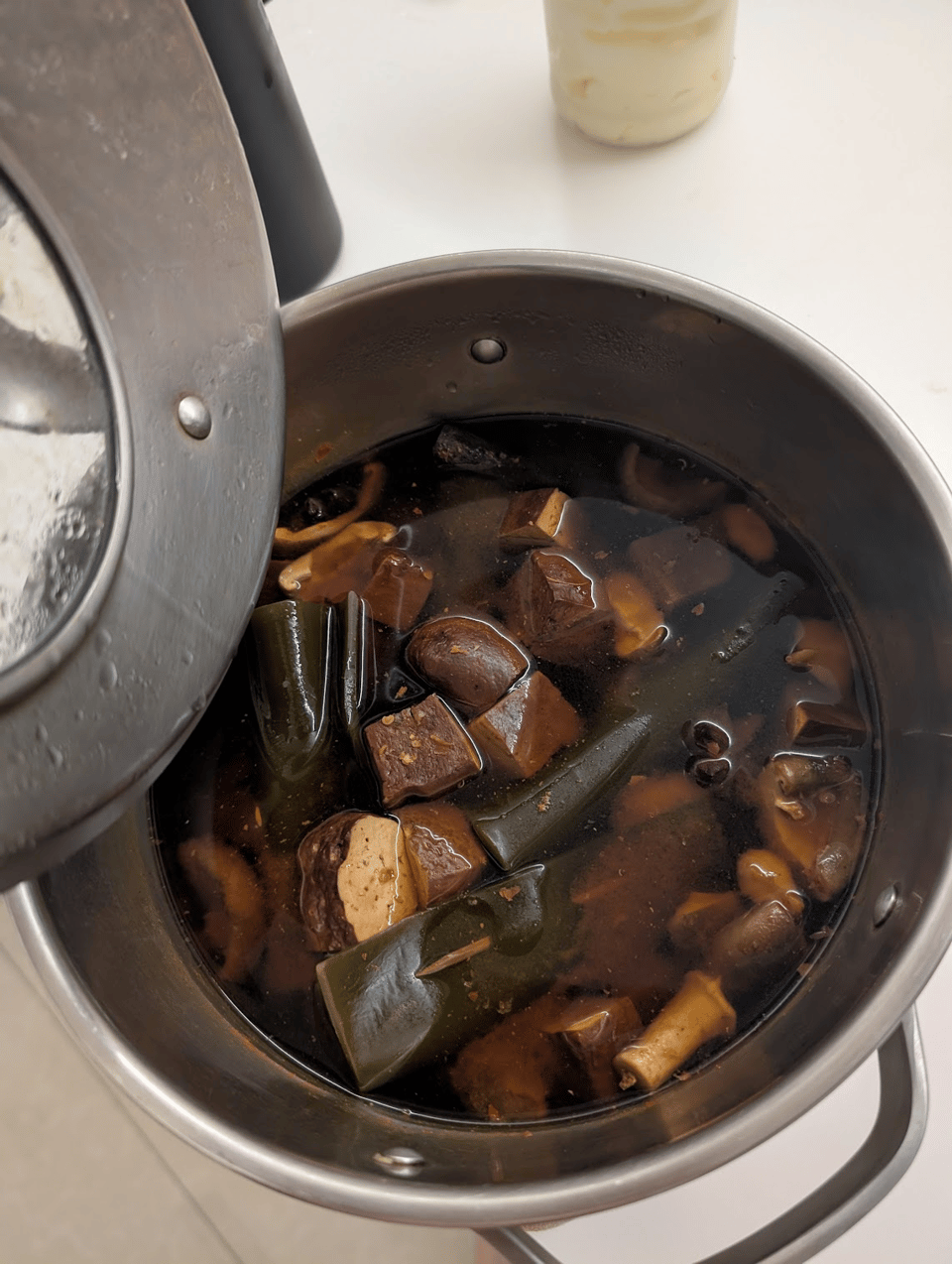
I recently tried my hand at making lu wei/滷味 at home. Lu wei is one of the most common cheap dinner foods here. Often small restaurants will have a giant pot of the flavorful broth (most have pork, but the veg recipe I used is here and uses peppercorns, Sichuan peppercorns, cinnamon, star anise, soy sauce, fermented spicy bean paste, cooking wine, and sugar) and then an array of ingredients you can choose to be cooked in the broth. In my case, shiitake mushrooms, kombu, and extra firm tofu (I refuse to call 豆干 by it’s more typical translation of “dried bean curd”), alongside a small pile of sweet potato greens splashed with the same broth. Here’s a fairly typical meat-centric stand near our house.
The beauty of lu wei lies in the efficiency: the broth could be used for a soup base, to flavor a plate of blanched greens, or to cook almost any ingredient you can think of, allowing a restaurant to have a large variety of dishes with lower cost and higher efficiency. This same advantage makes it not very attractive to cook a small batch of at home, so even though I was happy with how mine came out, I will not be cooking it again. However, it’s a nice to have in my back pocket, to know I could replicate it if needed, when I’m in a situation where cheap lu wei is not available on every block, or as my next party trick.
I hope you have something in your back pocket, too.
-g