One day's practice, one day's progress
Hello friends,
I’ve been to a couple of special workshops lately, and have some observations to share, after some schedule reminders
The Monkey qigong workshop is coming up: this Wednesday evening, July 29th. It will hopefully be outdoors, in míqәn / Beacon Hill Park, though either rain or smoke could send us to the backup indoor site I have booked downtown. Register online to get venue updates, including the exact location in the park.
Workday qigong will hopefully be on tomorrow afternoon, July 27th, and then take a long break, restarting the Monday after Labour Day.
We’ve also firmed up the schedule for Chen taiji in autumn & winter:
Wednesdays at 11am, 100% confirmed.
Thursdays at 6pm, subject to getting enough registrations.
Both will be at the James Bay Community School Centre (indoors or outdoors depending on weather), and both sessions open the week of Labour Day. Full dates and times are up on my classes page now. Registration is due to open mid-August, and I’ll send an update with links once it’s open.
So, back to the workshops. The first was in late June, with Sam Masich. We talked about the eight jìn (勁, usually translated as “energies”) that taijiquan is built on, and did some partner exercises to feel how they relate to each other. A month later I’m still digesting some of this, gradually getting a clearer sense of how these concepts are enacted in the forms and the silk reeling exercises.
I’ve talked about the first two from time to time in classes: peng (掤, “ward” or “ward off”), and lü (履, “roll” or “divert”). In the coming session I’ll introduce the next two—ji (擠, “squeeze”) and an (按, “press”)—and how they relate to each other, which I think Sam’s framework will help me to explain better.
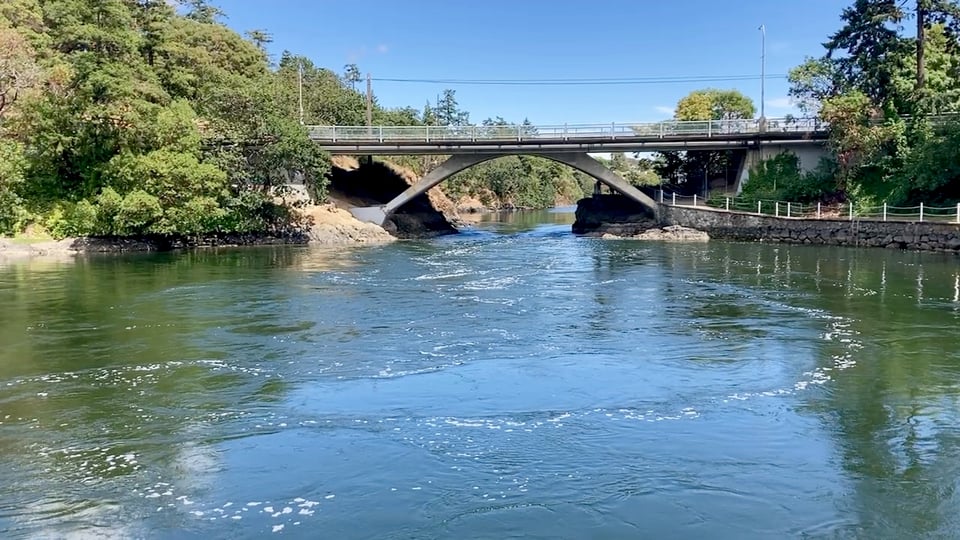
When Sam visits in summer, he teaches at Esquimalt Gorge Park. It offers the best place I know for meditative breaks:
Then in mid-July we went to Seattle for four days of training with Grandmaster Chen Zhenglei and his three children. Grandmaster is gradually handing over the reins as he ages, so most of the teaching is done by his kids these days, and fortunately they are great teachers too.
We had a day on New Frame 1 and its applications, and a day on partner exercises. That second part was frankly humbling. One of the deficiencies in my own training is that I don’t do enough partner work, so I still struggle to put into practice basic concepts that I understand in theory. It’s good to be humbled sometimes, and at the same time the feedback from working with a partner really helps clarify some of the solo work. I want to start bringing a little bit of partner work into our regular classes; please be patient with a bit of your teacher learning with you as we go.
For the second half, the workshop was split into two tracks, and Melinda and I chose different options. Melinda worked on the straight sword form with Grandmaster’s elder daughter, Chen Juan. Here’s a great demonstration of the form:
It’s going to be a while before I try teaching New Frame, and longer until any of the weapons. It’s important to have a very solid grounding in Old Frame first, and jumping ahead will only be confusing. But I think there’s value in seeing the breadth of what this discipline can expand to once the foundation is in place.
Meanwhile I went back to basics and spent two days with Grandmaster’s son, Chen Bin, on Old Frame 1. There were a few places where his details or emphases seemed new to me, and many more where either watching or listening to him helped clarify longstanding mistakes/weaknesses I need to work on. Conveniently the first major change is to the next movement I’ll be introducing returning students to in September, so I have a little more time to integrate his changes so I can demo them well.
But what I really want to talk about are some general themes from all of that training time. Chen Bin often came back to stressing clarity of intention. He demonstrated three ways of performing “Step back, twirl the arms”, with different timing and weight shifts. When questioned about which is correct or preferred, he labelled one as the reference but explained that the others are equally correct, as long as there’s a clear understanding of why we’re doing it a particular way.
That leads into a huge topic: the tension between faithfully reproducing the techniques that the Chens generously share with us, and making them our own. In teaching I place a lot of emphasis on letting each of our bodies find what works for us, because we’re all different. When I watch the siblings or Grandmaster’s cousins demonstrate, their movements are not identical either, because they’ve done the same. At the same time, it’s important that I transmit what the people who are much more experienced than me teach me, so that students can see a somewhat standard baseline for your own exploration. This is partly a matter of doing justice to the tradition, and partly recognising that the people I go out of my way to learn from have a much deeper understanding of the system than I do. So I’m currently trying to follow all of the new variations I saw demonstrated, and will take some time to sort through what works for me.
In turn, this brings me back to the basics. There’s a sort of spiraling process to learning things like taiji. We gradually add things (new steps, new energies, new exercises) as we go, but we never leave the basics behind either. As we advance, it’s natural and important to keep revisiting the most fundamental pieces of stance, stepping, and moving, along with the first few steps that are shared between many forms because they teach these fundamentals. David Gaffney & Davidine Sim expand on this in a recent newsletter. Much of my own work at the moment is going back to those first steps and watching for where my intent loses clarity, or how I could better embody things that one or another of the masters talked about.
I also left the set of workshops feeling that I need to make more time for my own practice, because there’s no substitute for simply doing the thing over and over again. In that spirit, I will close with something Grandmaster said towards the end of the workshop. He summed up some advice to a student as simply:
One day’s practice, one day’s progress