
Wonder and science: A monster-filled exhibition at the Linnean Society
Hallo, friends!
This first of two April newsletters is a little late, so apologies for that. I fell down a rabbit-hole while hand-annotating back issues of the New York Review of Books, and am crawling out for a bit before heading back with better snacks.
In today’s newsletter:
Announcements
A close read of a monster-filled display at the Linnean Society
A paperback, a paperback!
Announcements
I’m now on the books of a speaker bureau, Chartwell Speakers. My keynote lecture topics range from what monsters can tell us about the origins of modern medicine to media revolutions from the invention of writing to AI. If you or someone in your organization would like to learn more, do get in touch! There’s a form for contacting the agency at the bottom of my speaker page, and you can also contact me directly.
The May print issue of the German GEO Magazin includes a feature interview, complete with fancy-monstery author photos from a three-and-a-half-hour photoshoot with photographer Jagoda Lasota. Physical copies are out now. The online version will be live in a few days. Many thanks go to staff writer and editor Gesa Gottschalk for reading Humans so carefully, interviewing me for two-and-a-half hours (!), and alchemizing everything into her thoughtful essay.

Wonder and science: An exhibition at the Linnean Society
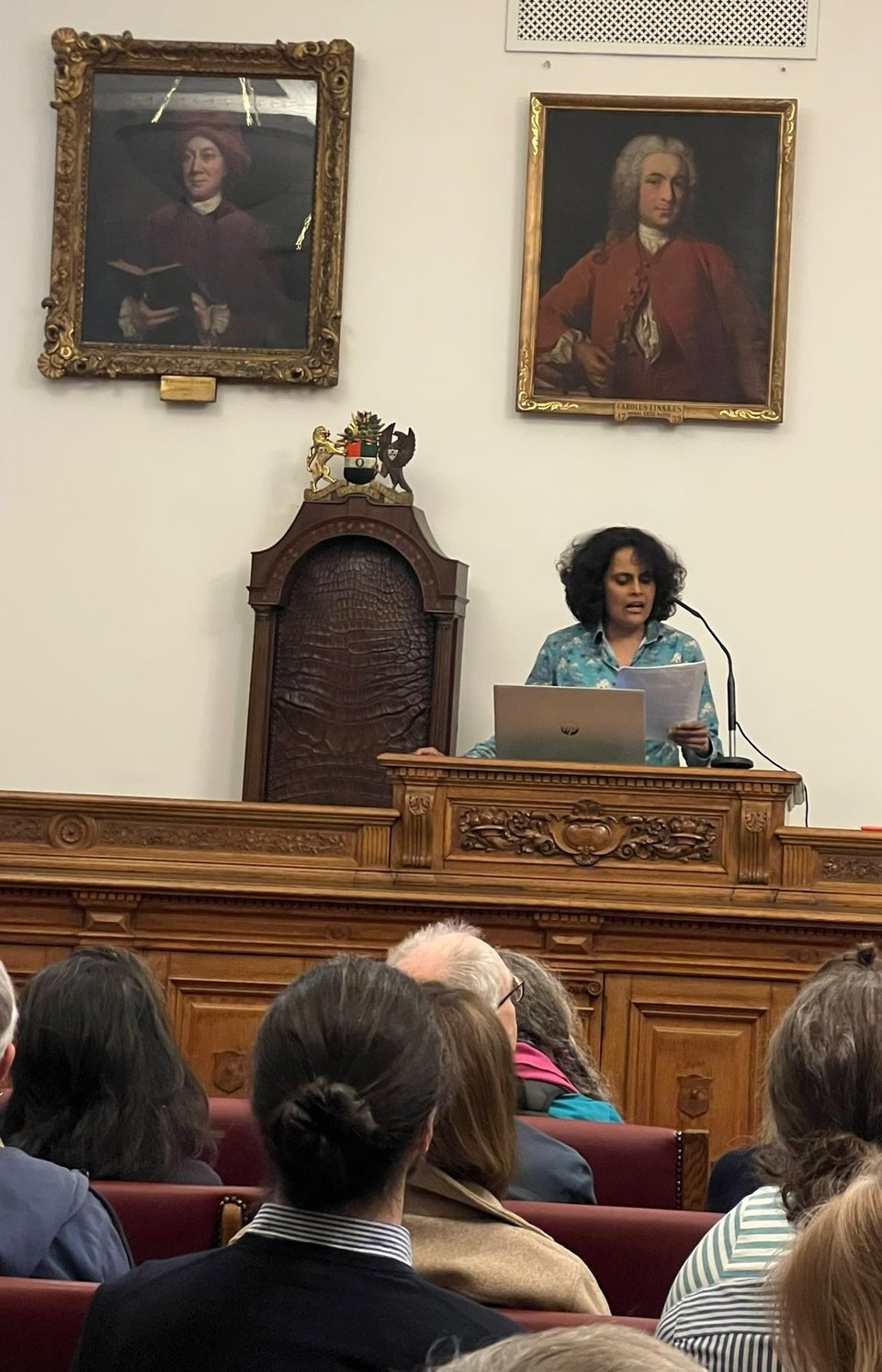
Last month I gave a talk on Humans: A Monstrous History at the Linnean Society. The recording is here. The event took place on the last day of their exhibition on “Wonder.” Here’s a panoramic video of the gorgeous Reading Room where the post-lecture book signing and reception took place.
The exhibition cases offered a snapshot of the mental world of a European practitioner or enthusiast of the natural sciences. Let me take you through one case, crammed with items collected and books/letters written between the mid-sixteenth and late nineteenth centuries:

[Collection date unknown] A Devil’s toenail! This is a fossilized Gryphaea, an extinct genus of oysters. (Rather better photos of Gryphaea appear on the University College, Cork, website.)
A portrait of the Brussels-born physician and anatomist Andreas Vesalius (1514-1564), from his massive anatomy book, De humani corporis fabrica libri septem (1543) (Six Books on the Structure of the Human Body). Vesalius dissected the bodies of executed criminals. (The linked British Library blog post about Vesalius’s life and work is a little grisly in content but not in visuals, so long as you don’t look too closely at the picture of the Fabrica’s title-page.)
A woodcut of two satyrs, from the Monstrorum historia (1642), a gigantic compendium documenting a curiosity cabinet assembled in the sixteenth century by the Bolognese physician Ulisse Aldrovandi.
Aldrovandi and his assistants also compiled volumes of drawings of the natural world. One of the real people who appears in the printed Monstrorum historia also had a watercolour painted of her and included in the collection: Antoinette Gonsalvus, a little girl with a hairy face. In Humans: A Monstrous History I wrote about how artists, collectors, and men of science depicted, collected, and examined Antoinette and other members of her (mostly hairy) family. Part of this section was excerpted on the Folger Shakespeare Library blog.
Three human-animal hybrids with vaguely horse or lion-shaped features from John Jonston’s Historiae naturalis de quadrupedibus libri (1657) (Books on the Natural History of Quadrupeds). Ancient thinkers wrote about monstrous animals and beasts; early modern naturalists had these writings in mind as they tried to make sense of recent accounts about animals in distant places and their own observations of specimens in the study and animals in the field. Considering the number and variety of animals, live, preserved, or mouldering, that travellers were hauling back to Europe, it was not unreasonable for naturalists to wonder whether some of the extraordinary beasts described by ancient geographers might have been real.
A fragment of a mummy wrapping bought in Egypt by the author and traveller Edward Wortley Montagu (1713-1776) as a gift for King George III in the late eighteenth century. Europeans were fascinated by preserved mummies long before the unearthing of Tutankhamun’s tomb in 1923.
A python’s skin found in the hut of anthropologist, explorer, and polymath Alfred Russell Wallace (1823-1913), and depicted in his The Malay Archipelago (1869). Wallace collected well over 100,000 specimens during his sojourn in what’s now Malaysia and Indonesia.
In 1858, while sick in his hut on the island of Ternate, Wallace came up with the notion of the survival of the fittest, independently from but simultaneously with Charles Darwin, to whom he wrote straight away. Both Darwin and Wallace would soon present their findings simultaneously at the Royal Society in London. But it was Darwin who got his ideas into print first: The Origin of Species appeared in 1859.
Besides some history of science nerds (and now all of you!), few remember Wallace’s work today. If that’s not an alarming enough story to frit me into getting a laptop’s-worth of half-thunk thoughts finished and out into the world faster, I don’t know what is.
But, to be fair, Darwin had been processing his thoughts on evolution for many years by the time Wallace had his fever-induced brainwave. (For more Wallace nerdery check out the website of the Natural History Museum in London.)
An unsigned watercolour of a dragon from Linnaeus’s portfolio, eighteenth century (LM/PF/ANO/12, for anyone who wants to examine it). This image supports one of my pet arguments: There are no monsters, but all of them are real.
Almost everything about dragons exists in the natural world. Reptilians. Flight. Teeth. Wings. There may never have been animals capable of breathing fire, but between spitting cobras and electric eels there are certainly animals with unusual weapons built into their bodies — even weapons that kill at a distance.
What are life’s parameters of the possible? Pick up an essay on, say, life in the ocean depths, and those parameters seem limitless. There’s some comfort in knowing that life will find a way, even if the burning that the rich and the powerful are inflicting, knowingly, on the earth brings about the end of the Anthropocene.
A paper presented at a Linnean Society meeting in 1879: “On the Monstrous Form of the Wild Carrot, Daucus Carota” (DA/ENG/2/SP/783). Here’s the thing: weird and wacky varietals of plants — some emerging naturally, others painstakingly bred — give them a genetic diversity that makes them better able to withstand changes to their environment. In the name of scientific “progress” and in the service of profit (perishables that can be stored for longer, for example), many ancient varietals have been lost, with fields re-planted over time with a narrower range of varietals.
A letter from 1892 about the origins of the Shapwick Monster (MS/235/12). In 1702, a fisherman was trundling his catch along a road on the outskirts of the village of Shapwick (in Somerset, England) when something icky fell off his cart and was spotted by one of the villagers. The Thing was armoured - and it scuttled away, sideways! Said villager ran away screaming, convinced he’d seen the Devil. He returned with reinforcements: villagers armed with sticks and (of course) pitchforks. In the meantime the fisherman had noticed his missing catch (a crab, of course), returned, and calmed the panicking villagers.
Which of these collection items makes you feel the greatest sense of wonder, curiosity, or delight? Which blows your mind the most, and why? Feel free to share this in the comments area of this post (scroll to the bottom for the link), and post any questions you may have!
Subscribe now for free to receive a subscriber-only gift essay and an excerpt from HUMANS!Monsters weren’t marginal to the practice of the natural sciences. As I showed in Humans: A Monstrous History, they were foundational. And as far as European science is concerned, that stretch from the late Middle Ages to the eighteenth century, a.k.a. the early modern period, was a turning-point for understanding the relationship between humans, monsters, and geography.
If you’d like to learn more, I talked about early modern monsters last year on the Folger Shakespeare Library podcast and on the Not Just The Tudors podcast.
A paperback, a paperback!

I was delighted to hold the paperback of Humans: A Monstrous History in my hands. It has soft covers, an unreflective mirror (rather than the spooky silver of the hardback), and smaller margins. My thanks go to Michael Berk, Colin Dickey, Ed Finn, and Jan Machielsen for generous reviews of the book, pull-quotes from which appear on the back cover:

The quotes:
“Wide-ranging, weirdly fascinating.” — Michael Berk in The Ink
“A radical and timely plea to renew our focus on the humanities. . . . Humans makes clear how vital it is that we invest in understanding how we are put together culturally.” — Colin Dickey in The Chronicle of Higher Education
“The monsters at the heart of this stimulating new book do not hide under beds or coil around the edges of maps. They do not harass passers-by with riddles. As the mirror on the cover suggests, Surekha Davies’s monsters are us — in her view, perhaps the best of us.” — Jan Machielsen in the Times Literary Supplement
“Davies invites readers to imagine the lives of historical monsters and to empathize with their often-wretched treatment.” — Ed Finn in Science magazine
More info about the various editions, and how to order the book from the University of California Press with 30% off (by entering UCPSAVE30 at check-out from the book’s UC Press webpage), is at this link.


Add a comment: