
Queen, monster, icon: Marie Antoinette at the V&A

Hallo friends, and welcome, new readers! In today’s newsletter:
Publication news
Podcast and video news
Thoughts on the V&A Museum’s Marie Antoinette: Style exhibition
Publication news
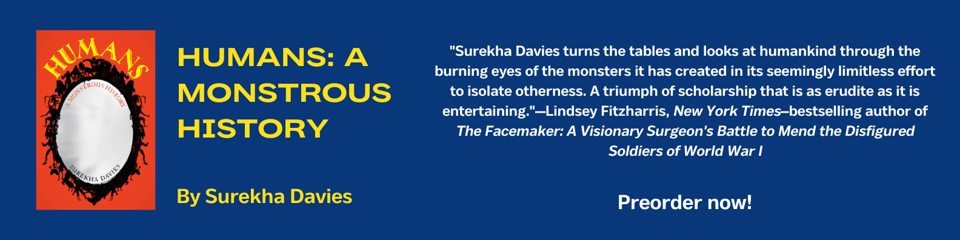
HUMANS: A Monstrous History is out now in paperback! It’s available (or orderable) from wherever books are sold! UK-based folks can currently also order the magnificent hardback from Waterstones for just 10 GBP.
Professor of literary theory Antonio Barros translated an issue of my newsletter from a year ago, “Basement adventures taught my why ChatGPT can only ever be garbage”, into Portuguese! Read it here, or share it with your lusophone friends if you fancy: “Aventuras no Subsolo me Mostraram Por Que o ChatGPT Sempre Será um Lixo.” I’m very grateful to Prof. Barros for his efforts.
Watch and listen
Current affairs junkies and pop culture fans (and Renaissance scholars wondering how centuries past can be put into conversation with the present) may enjoy my latest podcast interview. I appeared on Oh God, What Now? with Zoë Grũnewald and Jonn Elledge — part 2 of the show, starting at the 35-minute mark.
The recording of my book talk at the Linnean Society is available online.
Marie Antoinette at the V&A
An alarming set piece in the Paris Summer Olympics opening ceremony in 2024 featured a bevy of body doubles of Queen Marie Antoinette, wife of the infamous King Louis XVI of France.1
Standing in the windows of La Conciergerie, the prison in which Marie Antoinette had spent her final days, each queenly performer had her bewigged, decapitated head in her hands.
At the V&A in London, Marie Antoinette’s style was the subject of their latest blockbuster exhibition, which I visited during its final days. (If you were in London and missed it, fear not! The exhibition catalogue is fabulous, and every V&A exhibition, free or ticketed, is usually a masterpiece, so just go whenever you can.)
The show traced the doomed queen’s influence on fashion and the decorative arts during her life, how she was characterized as a monster — one might say monstrified2 — during the French Revolution, and how her style and story continued to shape the arts into the present.
Marie Antoinette is perhaps most often remembered as a wanton consumer. A single phrase which she most likely never uttered encapsulates that infamy: “let them eat cake.”3
Yet decades of wars and overspending by several kings had preceded the Austrian archduchess’s arrival at court aged just fourteen. Crowned at eighteen, she was guillotined at thirty-seven. Although Marie Antoinette became the poster royal for France’s financial woes, “Madame Déficit” was not its cause.
The queen consort was expected to support French workmanship by patronizing high-end artisans and workshops. Her commissions for porcelain, furniture, jewellery, and clothing consolidated a pan-European appetite for French goods.
During the revolutionary years, printers devised satirical engravings portraying Marie Antoinette as a human-animal hybrid. Two such prints from 1789 appear in the exhibition. In one, the queen’s head appears on the body of a hyena, her elegant coiffure re-imagined, writhing with Medusa-esque coils.

Another presents her as a harpy, an ancient half-human, half-bird monster.

With her talons she tears up the (barely visible in my photo) Declaration of the Rights of Man, which was also written in 1789.
Blaming a queen consort was a safer way to critique the monarchy than to go after the king directly. Ultimately, however, not even the monarch was left undisturbed on his divinely ordained pedestal. An etching that appeared after the royal couple’s failed attempt to flee France in 1791 depicts them as a two-headed monster, proclaiming that: “Les deux ne font qu’un” (“the two add up to just one”).

The queen’s wig is adorned with feathers and crawls with snakes. The king sports the horns of a ruminant, perhaps a jibe at his penchant for hunting. (In the entry in his hunting journal for 14 July 1789, the date of the storming of the Bastille, Louis famously wrote “Rien” (“nothing”) to mean he didn’t kill anything.)
Ancien régime shoe tales, beautifully told in one of Helena Cox’s essays in the sumptuous catalogue accompanying the exhibition, evoke a world in which, for the 1%, money had no meaning. Marie Antoinette received four pairs of shoes a week, but the king’s brother, the Comte d’Artois, received 365 pairs in 1777 alone. When the royal family fled the Tuileries palace, chased by revolutionaries, Marie Antoinette lost a shoe. One of the palace guards snatched it from the hands of the mob. The shoe was passed down through the family until the guard’s great-nephew donated it to the Musée Carnavalet in Paris in 1914. And even from prison, Marie Antoinette managed to order, and send for repair, her shoes.4
The show’s artefacts include both sumptuous objets d’art and everyday objects. One of the more haunting pieces is Marie Antoinette’s chemise, a simple linen undergarment dating from when she was held at the Temple prison in 1792-3. The queen had fled the Tuileries with little more than the clothes on her back.

During the Terror there emerged a grisly fashion for black clothing (a form of mock mourning), red chokers (ribbons around the neck) and what was known as the porcupine hairstyle: the look of a condemned woman whose head had been shorn.
But by the nineteenth century and the Bourbon Restoration of the monarchy, royalist sympathizers were looking to Marie Antoinette as an icon of respectability. The Empress Eugénie spurred a cult of relics of the doomed queen’s effects and style.
Objects carefully passed down through families continue to appear on the art market. Marie Antoinette had entrusted her personal jewels to her ambassador to Austria. He smuggled them out of the Tuileries palace in 1791, and their whereabouts remained unknown until they appeared in an auction at Sotheby’s in 2018.
In this century it’s hard not to think of the historical Marie Antoinette without the imagery of Sophia Coppola’s 2006 biopic starring Kirstin Dunst (the movie and other modern retellings appear in the exhibition and the catalogue). Marie Antoinette inspires designers like Manolo Blahnik, who designed shoes for the movie, some of which appear in the show.

Blahnik, who sponsored the show, describes in a foreword to the catalogue how, as a child, he became entranced with the story of the young princess and future queen. His mother read him Stefan Zweig’s biography of Marie Antoinette (carefully skipping the guillotine part).
It’s ironic that the queen should have become the emblem of financial profligacy in a country in which she didn’t even count as a full person much less control the kingdom’s purse. Not until September 1791 would the playwright and essayist Olympe de Gouges pen The Declaration of the Rights of Woman and of the Female Citizen. De Gouges (who would also lose her head) drew attention to a gap in how revolutionary men framed their supposedly all-encompassing definition of human beings and citizens.
Then, as now, existing reservoirs of prejudice often get in the way of holding to (in this case horrific) account the real perpetrators of oppression. To be sure, that’s not entirely the case for the French Revolution. Louis XVI lost his head too, as did a hell of a lot of other aristocrats rich on the labour of starving peasants in France and enslaved African-descended people in the colonies. Nevertheless, too often the rich and the powerful set out, intentionally, to monstrify groups of people in order to redirect the blame for their own crimes.
Starts just after the 47-minute mark on this recording. ↩
In his essay in the exhibition catalogue the historian Colin Jones traces this myth to the mid-nineteenth century, fifty years after the queen’s death. The catalogue is Sarah Grant, ed., Marie Antoinette: Style (London: V&A Publishing, 2025). ↩
These examples appear in Helena Cox’s essay in the exhibition catalogue. ↩


Add a comment: