
Defining "America" in the LA Times, and "AI" in education
Thanks for reading my free newsletter! If you’d like to support my work, buying or gifting HUMANS: A MONSTROUS HISTORY would be wonderful. Excellent free ways to support me include: borrowing HUMANS from your library or recommending they buy it; reviewing the book on, say, Amazon, Goodreads, or Storygraph (the links take you to the book’s pages); adding it to your wish list or TBR list; or telling friends, family, colleagues, or students about it.
Hallo friends, and welcome new readers!
Today’s newsletter is about some words out in the world, two impending talks (one online next week), and a February brain-management resolution.
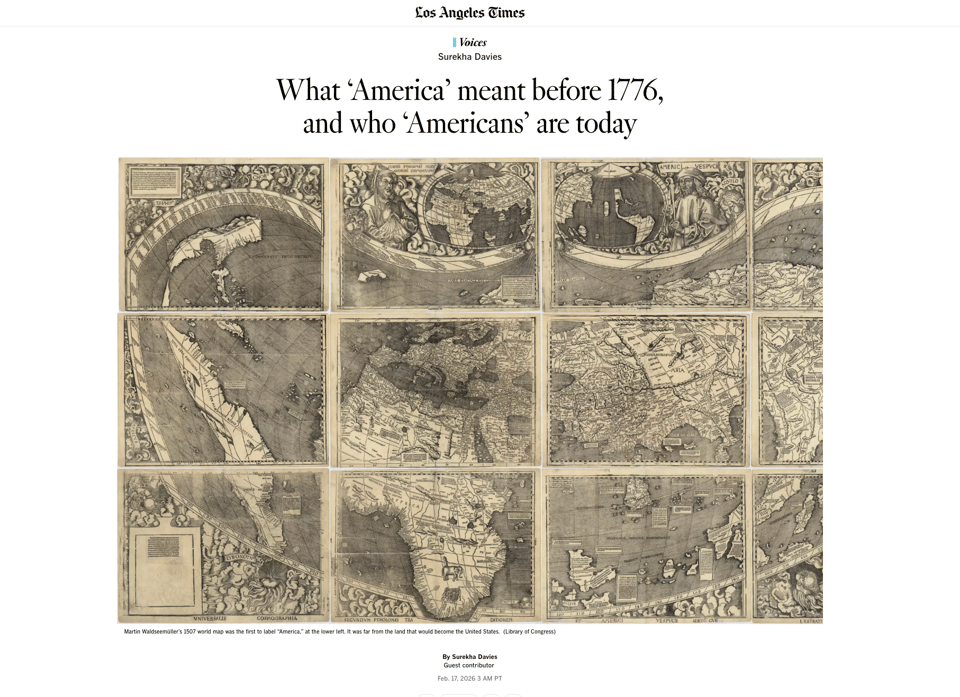
‘[T]he term “America” began life not as a label for the United States (nor “American” for its white Anglo citizens) but as a place name for somewhere else entirely.’
These (fighting) words are from my op-ed in the Los Angeles Times today: “What ‘America’ meant before 1776, and who ‘Americans’ are today.“ In the essay I show how a 500-year-old map I began researching as a grad student has surprising things to tell us about present-day debates.
I’m excited by the bits that are, on the surface, about as far as one could possibly get from Renaissance cartography. No spoilers!
Online talks: Critical perspectives on “AI” in Education
This spring, California State University-San Bernardino is hosting a series of free conversations entitled ‘Critical Perspectives on “AI” in Education.’ The first event is with Adam Becker today (Tuesday 17th Feb, 12 noon Pacific / 3pm EST / 8pm GMT).
I’m the guest next week, on Monday 23 Feb, at 12 noon Pacific / 3pm EST / 8pm GMT. The full list of speakers, dates, and Zoom links are here. Feel free to share this with any students, educators and other interested folks you know who might appreciate it.
Subscribe now for free to receive an exclusive subscriber gift essay and a book excerpt!
February: nasty, brutish, and short?
2026 began with rushing from one unfinished thing to another and back again. Putting down a library book in order to read one that had been recalled. Filing loose papers (moving partially organized piles from one room to another). Speed-reading magazines for which my subscriptions were about to end (I still subscribe to more than I can read, because quality journalism and writing is worth paying for, but my interests are too multifarious to subscribe to everything, everywhere, all the time this side of a windfall).
I would work on a thing for a couple of hours, take a break, work on something else, and finish nothing that day. Even worse, I seemed to be addicted to starting shiny new things while still carrying around all the original open loops.
I was assuming these shiny new things would be short and easy — the work of an hour or so — and that they would give me a quick win while being a fun break from longer tasks.
Wro-ong!!!
My working pattern had become ridiculous.
If something shorter than writing a book (or a book proposal or chapter) is worth doing (essay pitch; promoting a book event; doing a tax return), then it’s worth doing from start to finish without alternating it with eight other work-like activities and finding that each one progresses at the pace of a glacier.
Of course it’s not that simple. In the best hours of the day one wants to be doing creative things, not photographing receipts or typing numbers into benighted Excel spreadsheets. For me, the best hours are the first hours of the day. And some parts of a large project (like writing a book proposal) are fun and relatively easy (like reading comparable titles or reading around in the genre), and others require serious brainpower (like writing the chapter outline).
The problem (a good one?) is that if I start with writing or book-related stuff, I’m reluctant to stop later in the day, and then I get behind on unspeakable mundanities. However I act in those first hours (e.g. deep, analytical/creative stuff) tends to work like an anchor even once I start doing other things.
How I’m thinking now is that everything I call serendipitous/wider reading (novels; comp titles) is lower mental intensity, and that the rest (research; writing; book proposal work; book publicity; essay pitching; household paperwork) is higher mental intensity (sometimes because it’s intellectually challenging; other times ‘cos I haaaate or feaaar it").
The resolution: Unless something unexpected raises its head during the day I’ll work on ONE type of higher-intensity thing per day. Whenever I get fed up I may move to the lower-intensity but essential-in-the-medium-and-long-term work of reading great books, but otherwise I must play, not work.
A week into the realization that task-switching, even after a focused, long (say 90-120 minute) session and a break, is not as effective as sticking with hard things that take a day or three until they are done, I’m noticing that things are actually getting done and off my plate!
My latest LA Times op-ed was the first result. It took 23 hours from the brainwave (while watching a recording of the Super Bowl halftime show) to pressing “send,” including sleeping, exercise, and downtime but no additional work tasks competing for space in my brain.
Did I feel discouraged along the way? At times. Did I wonder whether all that effort might lead to a story that didn’t get picked up. Yep!
But I told myself: If I’m doing it, I’m doing it. I’m not going to wander off and use my brain on something else until I’ve either finished it or decided to abandon it.
Here’s to taking that focus into tomorrow, when I have to do the paperwork that I haaaate and feaaar!
In case you missed it
Next in-person event: London, the Linnean Society, Thursday 5th March, 6-8pm (lecture, reception, book sales, signing).
The backstory to my monster books (online and audio essay): “Can an Archive make a Monster of a Historian?”
More essays and published interviews are on my website.


Add a comment: