
Sundog Bio News | November 2025
Good morning,
We’ve made real progress this month, both on our product and our thinking on how our product should interact with the world. Read on for more on both of these, including exciting visuals in Tom’s update.
Alex Mitchell | CEO Update
There's a question that I keep getting from the scientists I speak to that I didn't expect: "where do you store the images I upload?"
The first time I heard it, from a biologist who leads his own research group, I was surprised to get a question on what seems like a minor detail from a customer point of view. We're building on AWS, so I explained that everything is stored on S3; I followed up by asking if he wanted to integrate our tooling with existing cloud storage. "No," he said, "I want to know who can access to our images. Who are you sharing them with?"
Many of the scientists I speak to automatically assume that we're going to sell the images they put on our platform - or at least, that we retain the right to do so. This is not the case! From day one, our terms and conditions have had written in them that we don’t have the right to sell, or to use for ourselves, the images users put in our platform. There are a few reasons for this.
Philosophically, the idea of selling our customers’ images disgusts us. Sundog is a place to do work. The work that our customers do here - and the images they upload are central to that - belongs to them. The office you rent doesn’t own the work you do in it. Similarly, Sundog has no claim to ownership over the work our customers do here.
More practically, IP protection is paramount in life sciences. Many of the scientific innovations we rely on today moved from academic labs, to biotechs, to big pharma. Universities have tech transfer teams, dedicated to protecting the intellectual property of the teams in their labs. It’s hard to imagine a nice conversation between an IP lawyer and a scientist telling them that, “well, the data is probably already out there in someone else’s training dataset, is that going to be a problem?”
There is exciting work in AI image analysis happening in academic labs across the globe, and many biologists want to be a part of that. The release this June of KRONOS, an open-source foundation model for spatial biology analysis, is a great example. But KRONOS’ license is not permissive - you can’t use it in a commercial tool without prior approval. Our customers may well choose to share their data in the future - but they deserve to know the models they contribute to, and to have a say in how they are used.
Sundog is a sharing platform. The foundation of our product - a sharing product - has to be that you control who can see your work - whether that’s a person, or a computer.
Tom Armitage | CTO Update
A lot of the technical focus in November has been on what we call the Stack Viewer - the tool that lets you interact with and collaborate around imagery. It’s been through a number of names, but we’ve settled on the idea of Stacks: collections of image layers, overlays, data layers, and annotations, that are placed in order on top of one another.
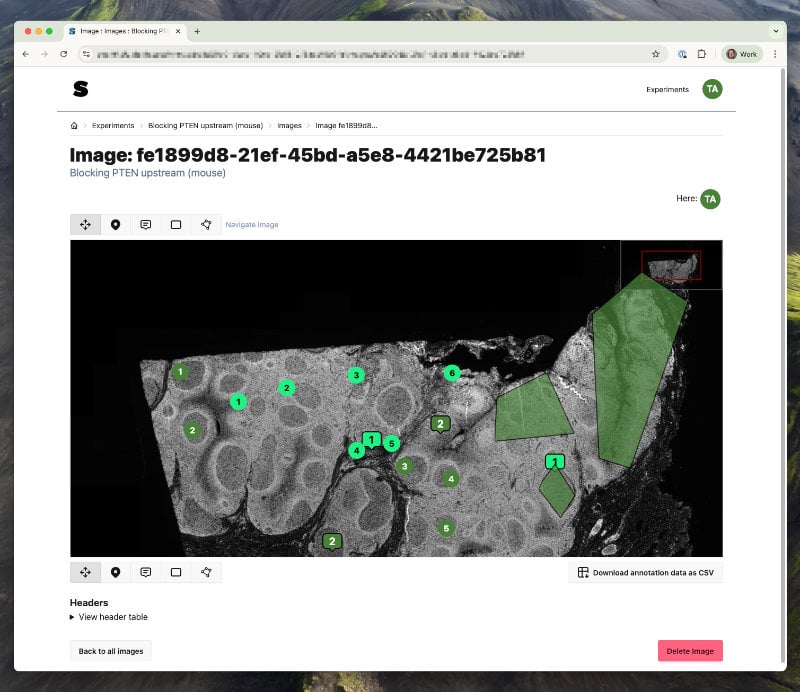
In the summer prototype - which you may remember from the demo video - our image viewer looked like this:
By the end of November, it looks like this:
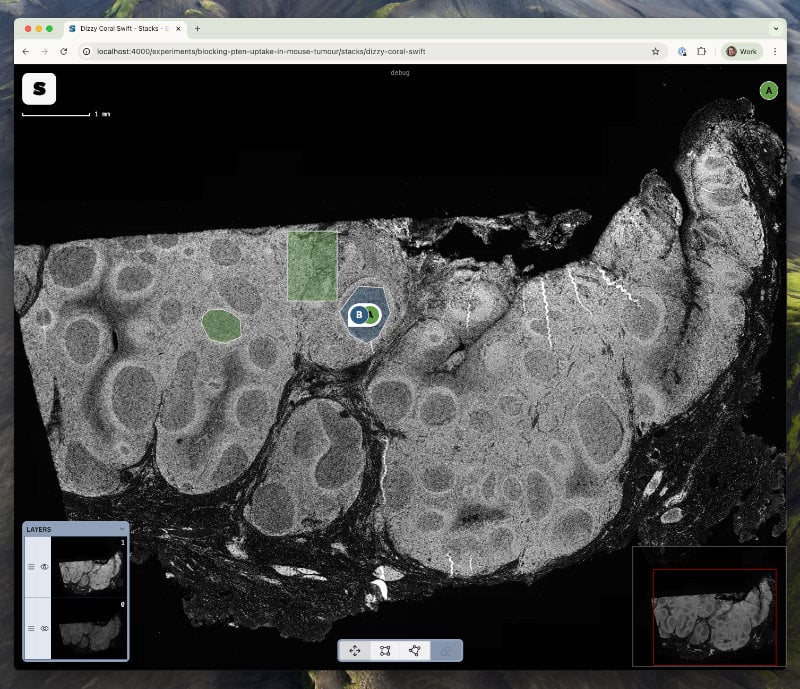
Sundog users are going to spend a lot of time in the Viewer, and we're really pleased with how it's turning out. This window-filling design, with interaction that feels much closer to a desktop app, is definitely a huge leap in the right direction. It’s technically challenging work, but I can’t also deny that it’s just fun to be inside, to manipulate, and that makes the effort woth it.
I’d love to take you on a tour of the new viewer and show it off, through the medium of GIFs. (If, for whatever reason, the GIFs don’t work for you, you can view this newsletter on the web.)
At the top, we have what we call the fat breadcrumbs:

Hierarchical navigation to get you back to the Lab and Experiment your Stack is in, tucked away unless you need it.
Below that, we have our scale:
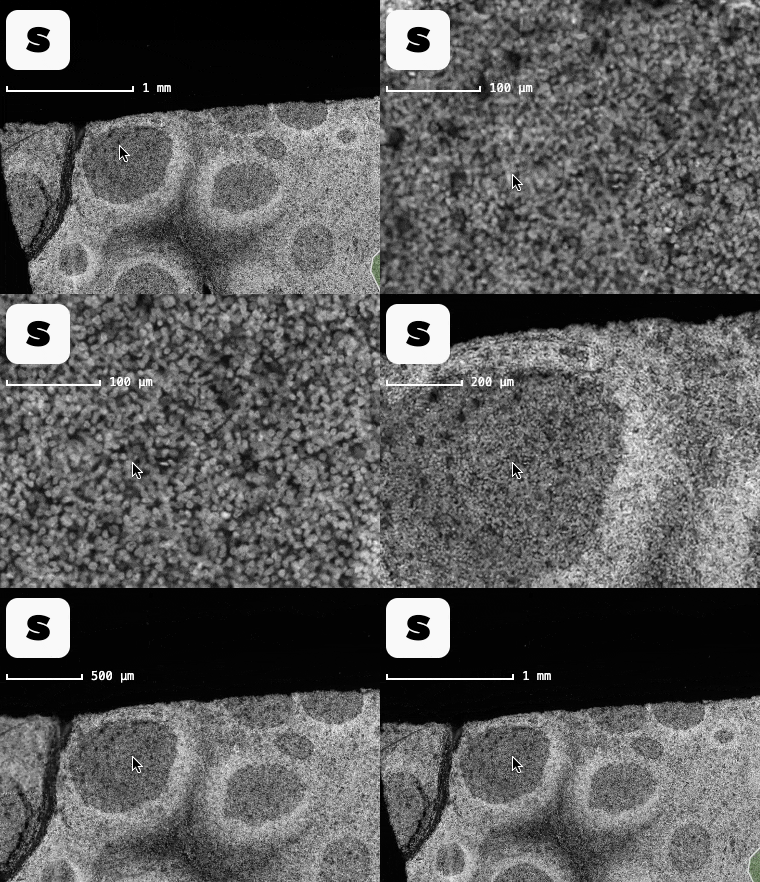
We know how large your image is from its metadata, and that means we can display an accurate scale at all times, rounded to a pleasant number to deal with. (Our sample image here is about 1.3cm wide).
In the bottom left, we have our layers palette:

which shows the various layers in the stack, and lets you manipulate them.
Bottom-centre are our annotation tools:
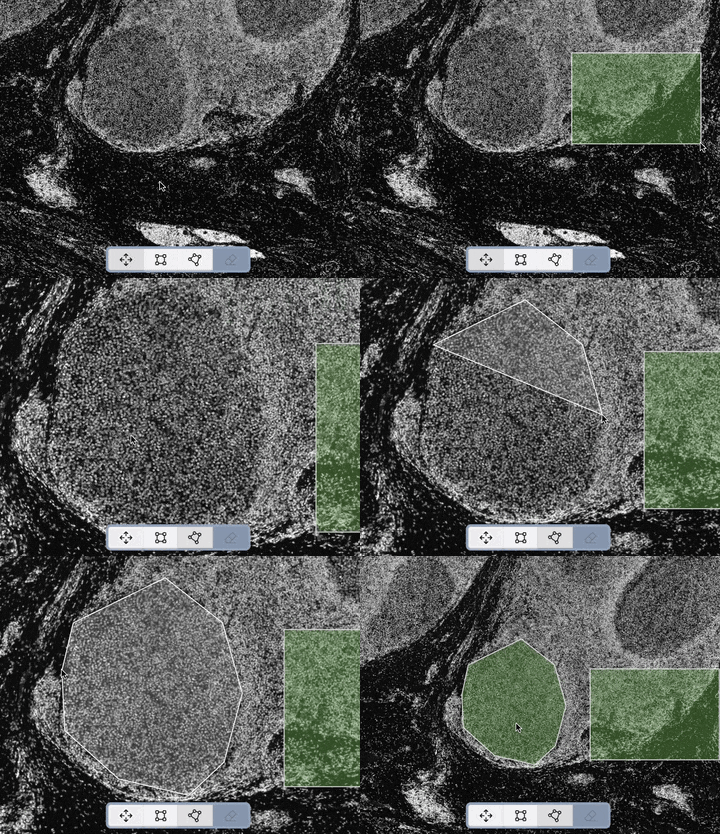
These let you add square or polygonal annotations. Single-clicking a tool returns you to edit mode after you’ve made an annotation; double-clicking it keeps you in that tool mode until you return to the selection mode manually. And we have keyboard shortcuts for all these; the annotation tools are on the number keys across the top of your keyboard (you can even hold shift to enable the ‘permanent’ mode). Tools for power-users are important!
Once you’ve made an annotation, double-clicking on it will add a comment thread:
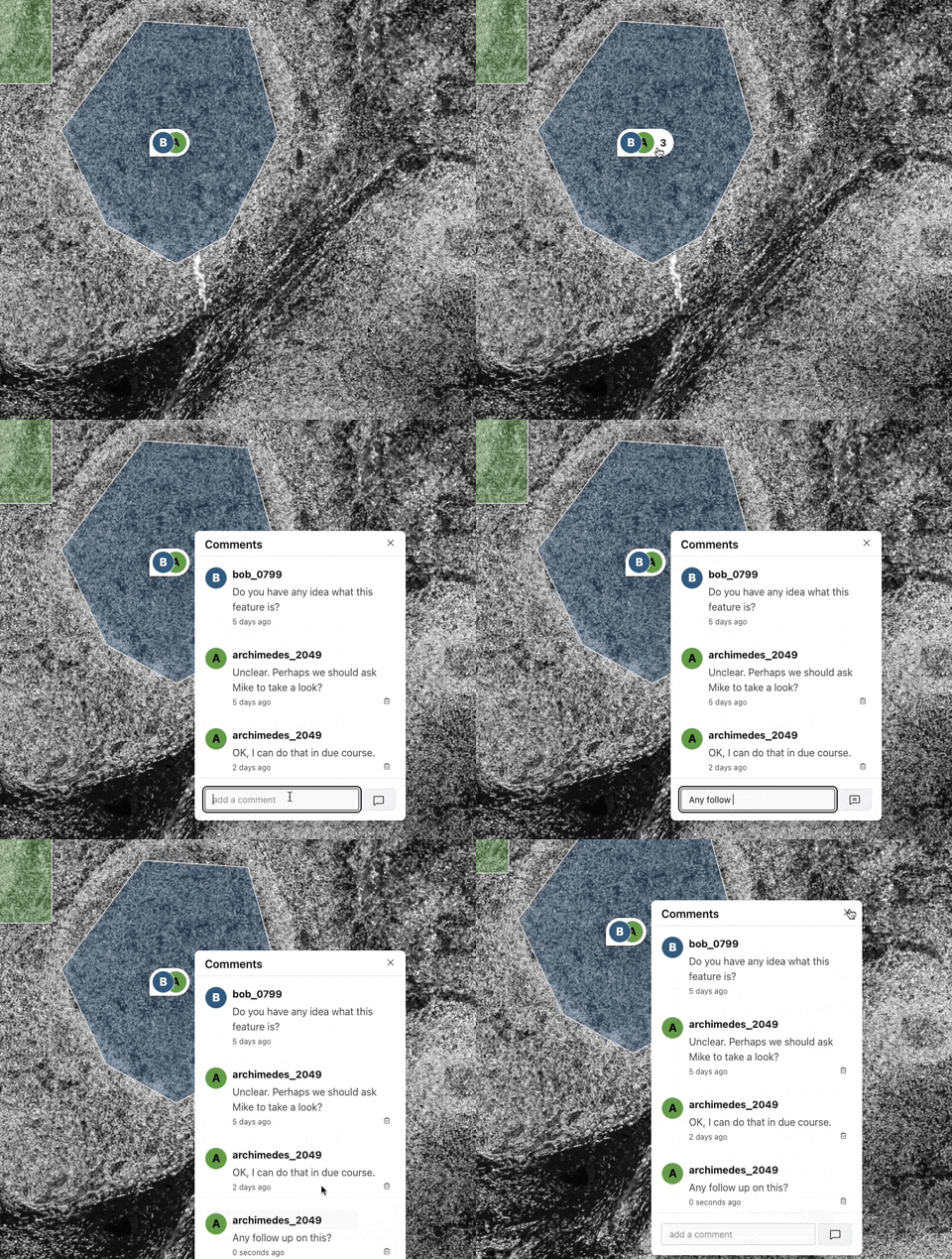
which will be marked with the participants and number of comments. Visiting the URL for a comment will take you to the correct co-ordinates on the page, scaled to whatever the user leaving the annotation saw as they made it, with the comment expanded ready to view.
Collaboration is entirely realtime:

Other users can be seen arriving and departing top right in the screen, and their cursor, annotations, and comments appear in real-time.
I think it’s important to see these features in motion. Not because of the flashy animation, but to help imagine exactly what it will be like to work in Sundog. We hope that Sundog is a place customers are going to spend a lot of time in, and it needs to feel snappy, precise, and fast. As we work on the Viewer tools, we bounce between adding delightful, useful new features, and firming up the many complexities of a graphical interface. Just how should a comments box position itself on screen? What should happen when you delete the comment you’re looking at? And how should it behave for everybody else?
Every time the team shares parts of the Viewer with each other, there’s an excited response: moving images are visceral! But they’re also a great demonstration of how the product is moving towards its customers.
In October, we wrote about the details that matter in building a product like Sundog. This month, those details have come together into a product that feels brand new, yes, but also considered and right. Thank you, as always, for following along with us. We’d love to hear from you - reply to this email or get in touch with alexandra@sundog.bio.