Sui Developer Monthly Newsletter #15
In this issue of the Sui Developer Monthly Newsletter, we are sharing tools to make debugging your dapps a lot easier; previewing some new package management tooling to simplify dependencies; and showcasing highlights from around the community, including chances to contribute to the Sui and Walrus ecosystems by showcasing your projects and competing in global hackathons!
10,908 meters below the surface.
That’s how far filmmaker James Cameron dove—solo—to set a world record.
For context: this was a plunge to the Earth’s deepest point—the Mariana Trench’s Challenger Deep—in a submarine Cameron, the guy who made the Titanic movie, designed himself.
But the most unbelievable part came next.
See, when Cameron, the creator of Avatar, was at his most alone – 10,908 metres (35,787 feet) below the Pacific – his wife called!
Apparently, Suzy Cameron had commandeered the comms to say hello to her husband, the genius behind Avatar 2: The Way of the Water. Even 35,787 feet below sea level isn’t deep enough to get away from the people who care.
That’s what building on Sui is like. However deep in the trenches you go, you’re never building alone: Sui devs and our community are always building the best on-chain experience, because we care.
So in this issue of the Sui Developer Monthly Newsletter, we are:
Sharing tools to make debugging your dapps a lot easier.
Previewing some new package management tooling to simplify dependencies.
Showcasing highlights from around the community, including chances to contribute to the Sui and Walrus ecosystems by showcasing your projects and competing in global hackathons.
And more!
Let’s dive in. 🪸
🌊 Sui Stack News
Sui's replay tool and debugger help you easily retrace and understand transactions.
Building in Web3 doesn’t have to be more complex than in traditional environments. The challenge lies in the lack of tooling built for blockchain’s unique characteristics. Specifically, transactions are immutable, may include both native commands and smart contract calls, and execute against a precise snapshot of the blockchain’s state at a single moment in time. So, when something goes wrong, developers can only see the transaction’s final effects; internal steps remain hard to trace.
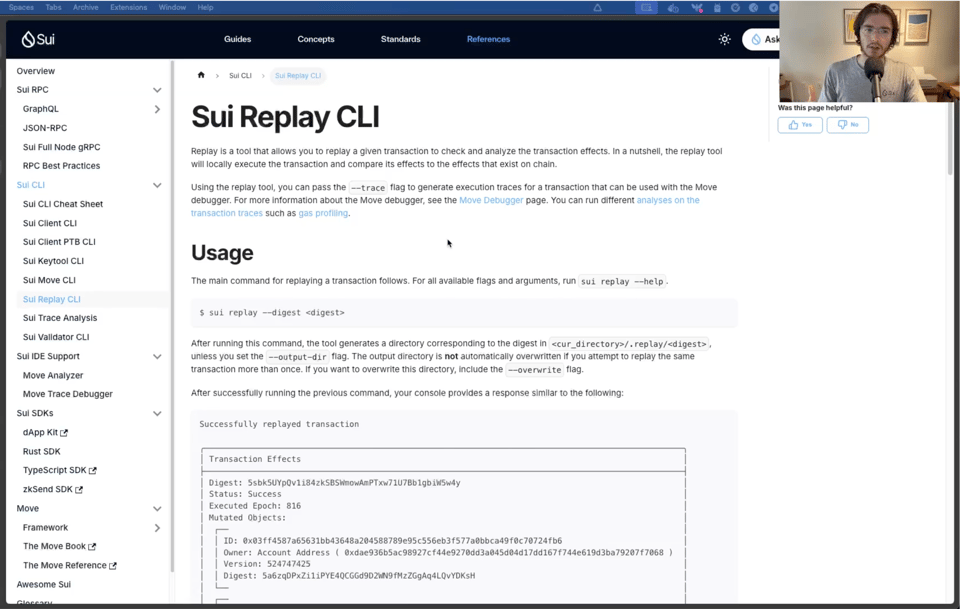
Sui is taking steps to bridge that gap with the replay tool and debugger. Together, they let developers reconstruct transactions locally, step through them line by line, and uncover not just what happened, but why it happened! This makes it a lot easier for developers to diagnose bugs quickly and deliver better, more reliable applications. And for end users, that translates to smoother, safer experiences when interacting with the Sui ecosystem.
Let’s look at the replay tool a bit closer: Imagine you wanted to reproduce a past transaction on your machine, including the precise on-chain state. You’d want to track high-level information such as state changes, gas costs, and storage rebates. The replay tool makes that possible. It gives developers a controlled environment to investigate behavior, inspect object changes, and diagnose unexpected outcomes. And it goes even further in tracing mode, capturing each step of execution, including native Sui commands and individual Move instructions.
To support this, the tool generates human-readable bytecode that can be matched with execution steps in the debugger. Importantly, it works across all historical transactions, allowing developers to use it on any activity recorded on the network.
There’s a lot more to this, so if you want an in-depth explainer or a video of these tools in action, check the link here: http://blog.sui.io/replay-debugging-tools/
Sui Payment Kit is out, standardizing payment processing on Sui.
Until recently, adding payment features like coin transfers or validation to dapps required developers to build their own solutions. This led to inconsistent and less secure payment handling across the ecosystem.
The Sui Payment Kit is a Move smart contract framework for standardizing payment processing on Sui. It lets developers build robust, secure, and verifiable payment flows without reimplementing payment logic or receipt management. Its flexible architecture features optional receipt persistence, configurable expiration policies, and built-in duplicate prevention.
The Sui Payment Kit consists of three main components:
Payment Processing Core: Handles coin transfers and validation
Registry System: Optional persistent storage for payment receipts
Configuration Layer: Dynamic, upgradeable registry configuration management
Additionally, you get robust features by default, including duplicate prevention. Duplicate payment prevention is handled using a composite key of Payment ID, Amount, Coin Type, and Receiver Address. If duplicate prevention isn't needed, use the Ephemeral payment option.
For details, see the docs or our github.
EARLY ACCESS! Move Package Management has been revamped to simplify dependency management.
Managing dependencies and building projects in the Move programming language was previously prone to inconsistencies, leading to version conflicts and unreproducible builds that created friction for developers.
To fix that, the 1.63 release of the Sui CLI will include an overhaul of the package management system that improves on the current system in several ways:
It is designed for multiple environments: a single manifest can contain different dependencies for mainnet and testnet, and you can define your own environments to manage deployments on other networks (like devnet).
It removes the named addresses feature and unifies package names and address names. This simplifies the system and allows for integrating different packages and modules with the same name.
It pins dependencies to specific git revisions and only repins them when you change your manifest. This improves predictability and also enables offline rebuilds.
It contains other improvements such as efficient git downloads, a stored upgrade capability address, and a test-publish command for easy deployment on local networks.
The new system is backwards compatible, so you can continue building and publishing your packages without changing them (though the system will automatically update your lockfile). To gain the full benefits of the new system, however, you will need to update your Move.toml file to the new format. See the migration guide for details of the changes.
Although the new system won't be officially released until January, we would love it if you could try it and share your feedback before then. You can install the new system using suiup (you will also need to update mvr):
suiup install --nightly=main sui

suiup install --nightly=ml/pkg-alt-integration mvr
NOTE: Since the new system is experimental, we don't recommend using it in production until the official release.
Please report any feedback on the new system in this GitHub issue.
A few more updates from around the Sui Stack
Sui v1.62 gas changes - Sui v1.62 makes some targeted updates to gas metering to better match execution costs for certain operations, resulting in a net reduction for most affected workloads. Dynamic fields now charge differently depending on their cache status: The first load is the most expensive, and subsequent loads are significantly cheaper. There are also additional execution-level adjustments being introduced. Overall, the majority of transactions are unaffected; those that are, in general, should see a decrease in gas costs (mean: -6%, median: -21.5%), although some may see an increase. More details to come soon, but you can click here to read the summary in our git repo.
It’s now possible to self-run GraphQL RPC Server - It's now possible to operate the GraphQL RPC service on your own, by connecting to the general-purpose indexer database, a full node, and an archival service instance. This now allows you to set the partial or full stack on your own, depending on your needs. For high-level guidance, please refer to this doc and click here for instructions on running your own GraphQL RPC server.
🎉 Community Updates
DeepSurge Platform Launched on November 6th.
DeepSurge is a global hackathon platform and hub where developers, builders, and innovators come together to create on Sui and Walrus. Participants will have the chance to join hackathons, compete for prizes and mentorship, and qualify for exclusive developer perks. Creating an account only takes a minute, and you can be looped in on all upcoming hackathons and developer activities on Sui, including some fun end-of-year activities we have planned for the platform.
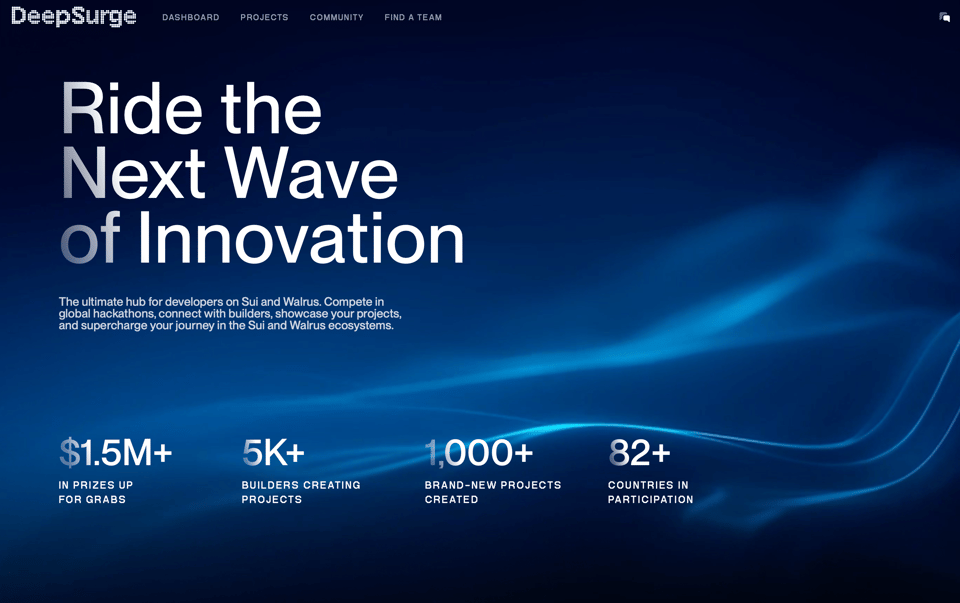
Click here to create an account and win prizes by developing on Sui: https://www.deepsurge.xyz/create-account.
Learn Sui Move using a simple-to-use platform.
Suilings is a gamified platform for learning Sui Move interactively. You can practice real exercises directly in your browser and get instant feedback, without needing any local setup. It offers hands-on exercises ranging from the basics to advanced topics like capabilities and dynamic fields. Users can also track their progress on a shared dashboard, making it easier to compare ranks and showcase their skills to potential employers.
Level up your Move skills here https://www.suilings.xyz/ or https://x.com/Suiilings.
Over on twitter, @ashen_one vibe-coded a website showcasing every single on-chain Sui element you can implement, using Replit.
Wow! This is an outstanding showcase of Sui’s features. Apparently, the app was coded in Replit in an hour.
It’s hard to believe coding an app like this can be so easy. But don’t believe us, watch the 8m walkthrough here:
I vibe-coded a website that showcases every single onchain @SuiNetwork element you can implement with @Replit
— ashen (@ashen_one) December 5, 2025
It can execute 14 different types of transactions on mainnet SUI like staking, NFT-gated pages, sponsored Txs, event polling & more with a site I made in 1 hour
It is… pic.twitter.com/bWWtH5zqv3
An in-memory Sui blockchain sandbox for testing sui dapps (without running localnet).
SUIANGRIA is an (exceptionally well-named and) exciting project with the potential to make developing on Sui even smoother. It’s an in-memory Sui blockchain sandbox for testing Sui dapps connections with move contracts, without running localnet. The sandbox simulates network & move execution environments (without consensus) and can be controlled programmatically.
One potential problem their team may face, though, is that it reimplements the whole JSONRPC server on top of their data model. As the Sui team moves to deprecate JSONRPC, the SUIANGRIA team will have to build their implementation again for gRPC and GraphQL. For a breakdown of when to use which, please click here.
All said, this is the kind of work we really love to see from the Sui Community!
Check out SUIANGRIA here: https://github.com/redstone-finance/suiangria.
👋🏻 That’s all for this week’s updates, but here are few ways you can stay up to date with us.
So, just like James Cameron, the deep-sea explorer and director of Avatar: Fire and Ash, was never truly alone on his Challenger Deep dive, you too can rest assured that no matter how far you go in your explorations, the Sui core team and developer community will be there creating tooling to make developing on Sui flow like water. 🌊
If you’re new to Sui Stack, you’ll like our “Get started developing on Sui” guide. It was made with care, just for you.
And if you want more hands-on learning, come meet us at any of these upcoming events:
Dec 13th: First Movers Vietnam Hanoi Builder Meetup. This one is purely for the builders! We’re going to gather the Vietnamese dev/builders community to celebrate the end of the year and catch up with the latest updates from us.
Jan 16th: First Movers Vietnam Sprint (HCMC, Vietnam). Come say, “hello,” at our in-person hackathon with a cash prize pool. Plus, you’ll have the chance to work for the CommandOSS engineering team.