Sui Developer Monthly Newsletter #14
Did you know the immortal jellyfish essentially lives forever by constantly reinventing itself?
This tiny, translucent creature, Turritopsis dorhnii, is the only known animal capable of cheating death indefinitely through a process called transdifferentiation.
When faced with physical threats, disease, or even old age, the adult jellyfish transforms itself from a sexually mature, bell-shaped adult back into a sexually immature polyp, beginning its lifecycle anew. While the immortal jellyfish can still fall victim to other sea creatures or disease, this creates a theoretically endless loop of youth and age, death and rebirth.
Similarly, Web3 represents a cycle of rebirth for the internet as a whole! Instead of being built around centralization, Sui developers can build technologies around decentralization, privacy, and innovation.
So in this month’s newsletter, we’re going to highlight tools we’ve developed to help you build a better web, ways our community is using these technologies, and a few events you can find us at if you want to learn more.
Onward! 🪼
🌊 Sui Stack News
gRPC is now GA, and the JSON-RPC API is deprecated.
While traditional JSON-RPC interfaces have many benefits, such as simplicity and cross-platform compatibility, it is an older, text-based format. For example, because it relies on HTTP/HTTPS rather than the newer HTTP/2 protocol, features like multiplexing, header compression, and other optimizations can’t be built into the protocol, leading to higher latency and lower throughput in many scenarios.
Sui is addressing this by deprecating its JSON-RPC API in favor of the Sui Full Node gRPC API, which offers a fast, type-safe, and efficient interface for interacting with the Sui blockchain. Designed for power users, indexers, explorers, and decentralized apps, this API provides high-performance, low-latency access to data on the Sui network. This enables faster data retrieval and real-time streaming.
This upgrade enables developers to build responsive apps that consume real-time data. Simulate and execute transactions, track live user or app activity, display NFT or token balances, and more — powered by efficient queries and subscriptions.

For more information on different methods for accessing data on Sui, please see this guide:
Mysticeti v2 is now live, enabling faster transaction processing on Sui.
Many blockchain networks suffer from high transaction latency, resulting in multi-second delays as users and developers wait for finality. This can hinder user experience and prevent the development of low-latency applications on-chain altogether.
Sui’s Mysticeti v1 protocol directly addresses this by introducing a highly optimized, low-latency algorithm to streamline the consensus process. Mysticeti v2 leverages this new consensus process and integrates transaction certification into it. Now transaction certification is done in parallel with consensus ordering, removing the need for extra signatures and message passing, which added extra CPU & reduced latency.

After upgrading to the new protocol, we observed a 35% reduction in latency on Asia-based full nodes (from ~1.00s to ~0.65s) and a 25% reduction on Europe-based full nodes (from ~0.55s to ~0.40s). These improvements mean a user performing a swap on a DEX would have transactions confirmed almost instantly, a critical step towards truly real-time applications on Sui.
Mysten Labs engineers wrote about how they made that happen here:
For our AI builders, the Sui Stack for AI enables verifiable AI, agentic payments, and more.
Traditional AI systems operated as opaque "black boxes," making it impossible to verify their actions or ensure they adhere to predefined constraints. These limitations erode user trust and limit their use in high-stakes applications.
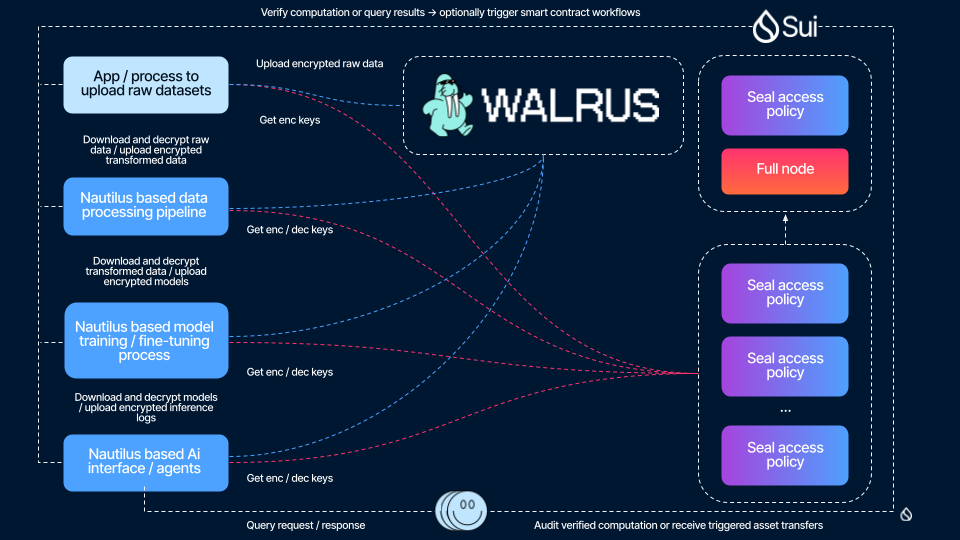
The Sui Stack (composed of Walrus, Seal, Nautilus, and Sui) represents a new foundation for AI systems that replaces assumptions with proof, spanning data, access, and execution. Now, developers can store a model's data on Walrus, enforce access control using Seal, and perform agentic inference in Nautilus with execution receipts logged on-chain for tracking. In tandem, these features provide verifiability as a control plane.
In practice, a developer might create a multi-agent pipeline in which agents fetch data from Walrus, decrypt it according to defined policies, and collaborate within Nautilus enclaves so that every input, output, and intermediate step is provable. This fusion of AI and the Sui stack unlocks new possibilities for what accountable autonomous agents can do.
If you want to know more, we've got an entire series on the blog covering this. You can find the first two articles here:
- https://blog.sui.io/verifiable-ai-data-sui-stack/
- https://blog.sui.io/verifiable-ai-control-plane/
🎉 Community Updates
A partner team created Seal KMS: Distributed Key Management Service for Nautilus Enclaves 🦭
Seal KMS is a secure key management system that generates and protects master private keys inside AWS Nitro Enclaves, leveraging Mysten Lab's Seal protocol for programmable encryption and access control.
The system provides secure key derivation services to other Nautilus enclaves, enabling them to obtain app-specific private keys via attestation-based authentication.
This contribution shows the type of security the Sui Stack empowers. Fantastic work, lockin-bot team!
Take a look at the new Rust SDK for Seal over on GitHub 🦀
seal-sdk-rs is a developer-friendly & framework-agnostic Rust client for Seal, enabling programmable encryption and access control. The crate works with any Sui setup, so you can keep the default stack (SealClient) or swap in your own HTTP transport, Sui client, signer, and cache.
seal-sdk-rs gives Rust developers a way of using Seal and interacting with Seal key servers, something that had to be done in TypeScript before.
Props to gfusee for the great work!
Walrus partner @ahboyash created an excellent write-up for why Walrus is a great option for AI and agentic commerce over on x.
Walrus: a faster, cheaper, verifiable data layer for the AI and agentic commerce era
— Ash (@ahboyash) November 13, 2025
When centralized clouds shut down, the entire internet halts as well. @WalrusProtocol was designed so data is always live by splitting content across many nodes, anchors “proofs of availability”… pic.twitter.com/u91TgpZZmX
This point goes into the intricacies of Walrus protocol, what makes it so reliable, and what makes it so fast. Plus, they offer comparisons to other distributed storage options if you’re already familiar with one of them.
The graphic alone is worth the read, but their entire post offers a wealth of knowledge for anyone interested in the overlap between on-chain AIs and decentralized storage.
Thanks for spreading knowledge @ahboyash!
👋🏻 Here are a few ways you can stay up to date with us.
There’s still a bunch more going on in the Sui Community and on the Sui Stack, but those will have to wait until next time. Hopefully, the announcements we’ve shared will give you the chance to develop products that live forever, constantly growing, changing, and evolving like an immortal jellyfish. 🪼
In the meantime, if you’re ready to get started on Sui, the new “Hello, world!” example is worth a deep dive:
And if you want to find us in the wild, we’ll be swimming around at these upcoming events:
Nov 18: Multichain Day @ Devconnect 2025
Nov 18: Sui Connect Buenos Aires
Nov 19-22: YGG Play Summit
Dec 11-13: Come find our booth @ Solana Breakpoint
Dec 12-14: Sui Warsaw X Wrocław Hackathon