
The internet in the age of verification
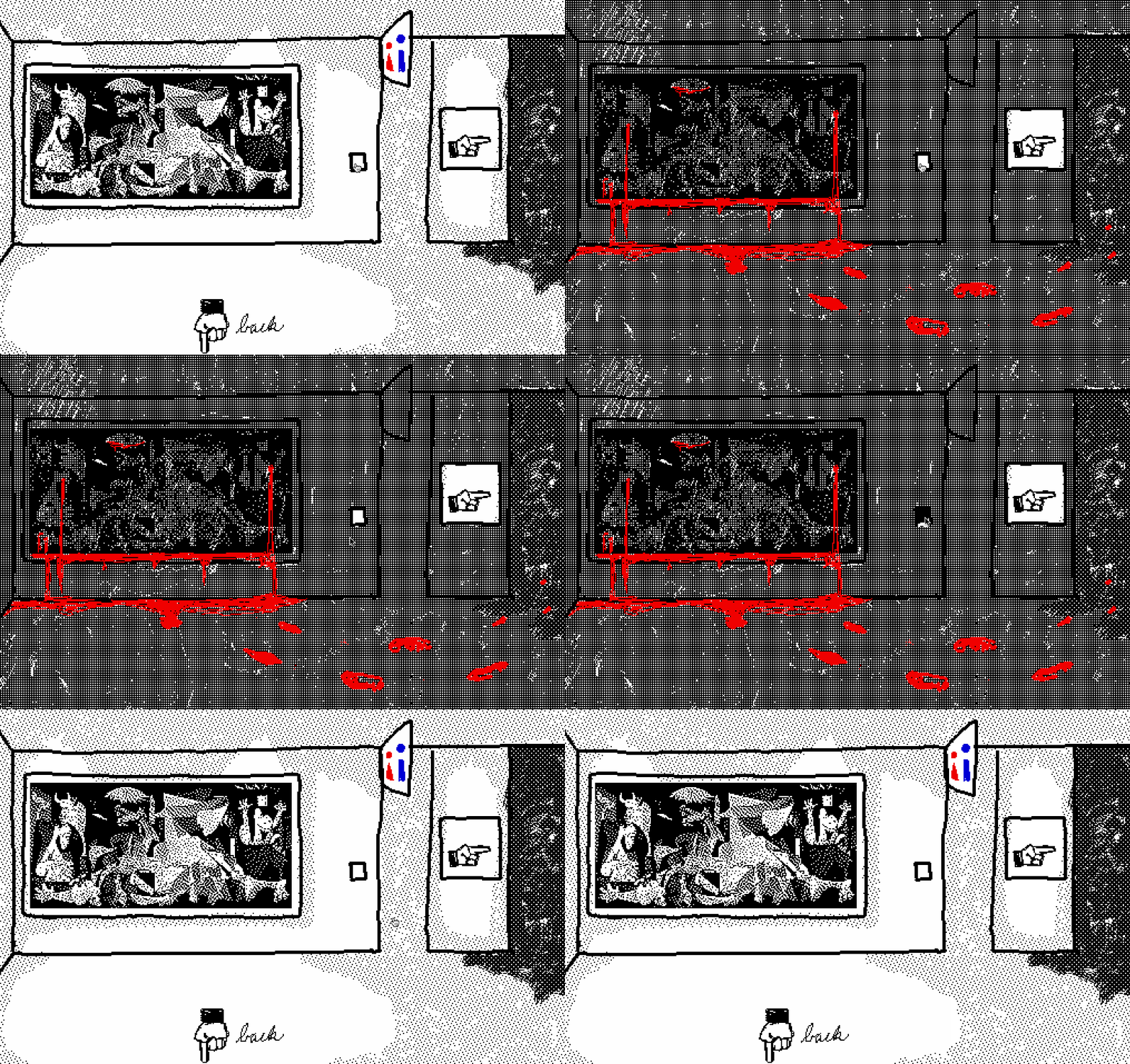
At the end of March, I released a game called Family-Friendly Online Art Musuem (F.F.O.A.M.) and in a week, it has surpassed 1,000 playthroughs.
Thank you to everyone who has played F.F.O.A.M. and especially to those who have rated and commented. To those of you who haven’t—it’s a short little browser game!
Play F.F.O.A.M. on itch.ioI made this game to hold my complicated and angry feelings about the internet in the age of verification.
Today, I’ll dive into how I made F.F.O.A.M. in Decker as well as some realizations I had after releasing the game.
Read on.
Decker is an indie engine heavily inspired by HyperCard. With most solo games I make in low/no-code engines, I try to study the engine just enough to make a prototype immediately and then start building out functionality from there.
Indie devs, myself included, tend to get “married” to an idea or a gameplay that is difficult to prototype, mess around in the intestines of a tool for a while and get discouraged. I was raised on game jams, which taught me that even if the gameplay loop or gimmick of your game is novel, if the context around it isn’t there, it’s not a game.
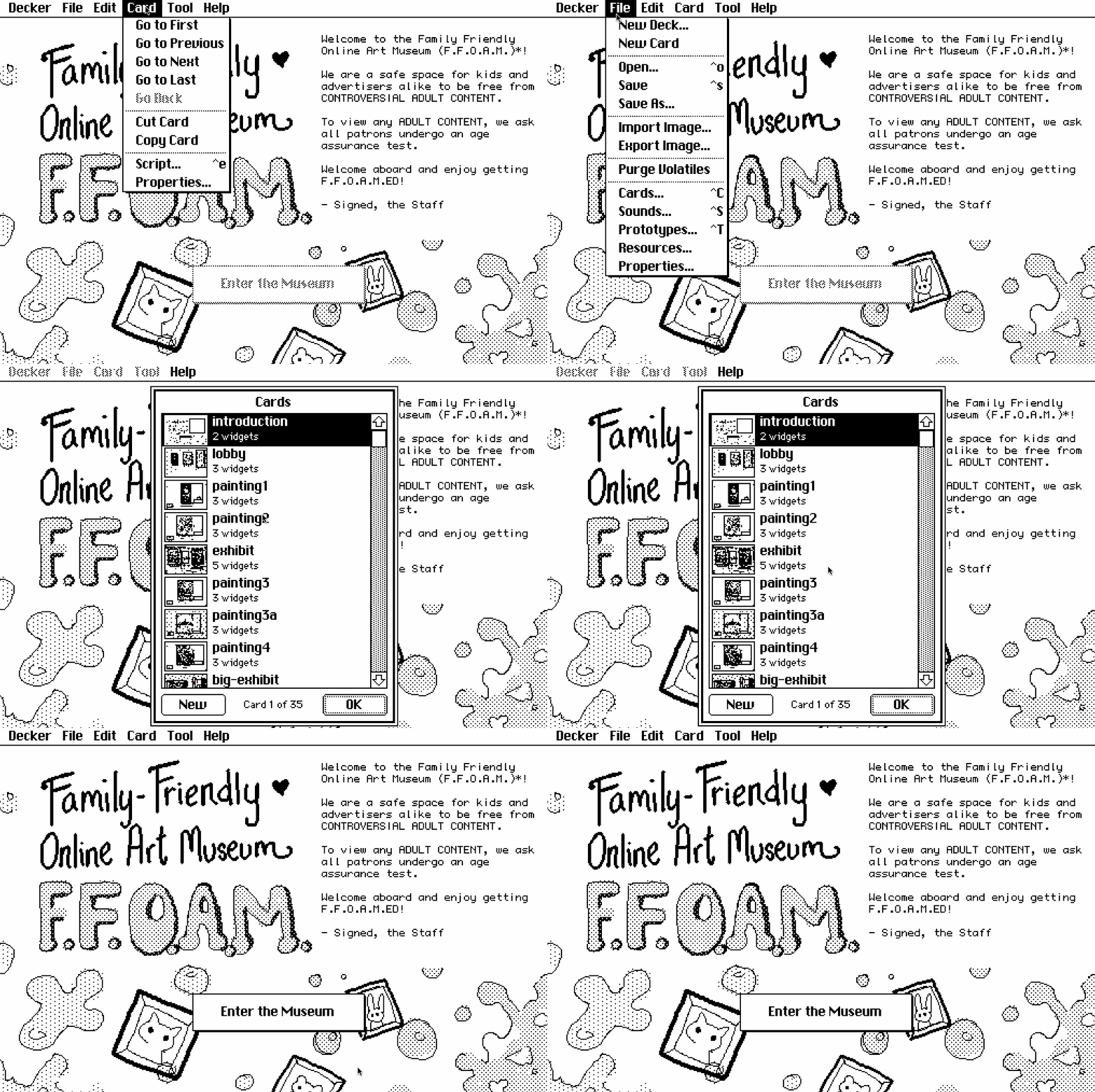
So how to make a basic game?
The basic functionality I wanted was creating a card, making a button in “Widgets…” then applying the “Invisible” setting on it so I could make a clickable canvas like a point-and-click adventure. The player then should be able to click on a painting.
Next, the paintings should have some story context without jumping to a new card, so I dug into Decker’s Dialogizer to pull out some code snippets. The very first prototype was a clickable painting that displayed a story.
Utilizing underpainting to add art
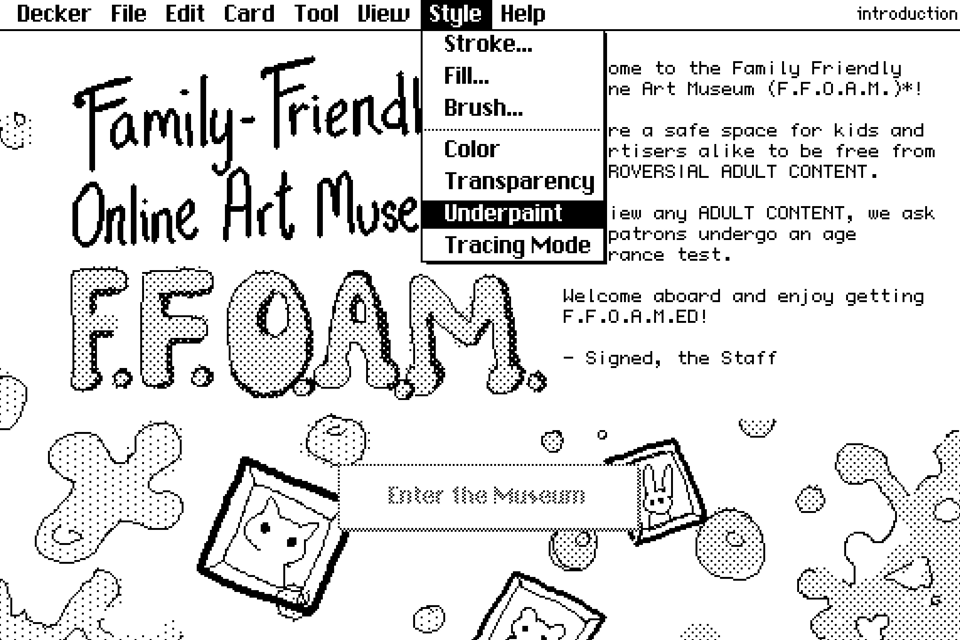
I collected a lot of nude paintings and photos from the public domain and Wikimedia Commons for inspiration. From there, I started drawing the museum. The first time I touched Decker, I hadn’t discovered the underpaint toggle where you can set brushes to layer under lineart, and was struggling with shading that didn’t paint over the lineart.
Let me tell you, underpainting is a game changer.
Cutting out overly-disturbing scenes
When looking for anti-war and protest paintings and photography that contained nudity, I encountered a lot disturbing material, some from actual war survivors.
I have complicated feelings about war photography overall. It can have a powerful effect on ending wars by appealing to people’s natural empathy. But oftentimes these photos launch the photographer into fame and rob the subject of personhood. There were war photographs I placed in the game and then removed; only Pablo Picasso’s Guernica (and what Guernica looks like with the lights out) remains.
I’m pleased with the result; I’m much more confident in Decker now, and have gotten an itch to make more lo-fi black and white games with color pops.
After releasing F.F.O.A.M. I realized two things:
One, it is complicated to answer the particular question, “so are you against age or what?” The other was what an excellent idea it was to name the in-game age verification process “the F.F.A.R.T.”
Isn’t age verification a good thing?
My feelings on age verification and tech companies “restricting kids’ access” is summed up by ethnographer and scientist danah boyd, who wrote a book about teens and their online lives, in an 2024 article:
One message I’ve been trying (and failing) to get across for almost 20 years is that: The internet mirrors and magnifies the good, bad, and ugly.
The problem is not: “Technology causes harm.”
The problem is: “We live in an unhealthy society where our most vulnerable populations are suffering because we don’t invest in resilience or build social safety nets.”
Bills (and legislation that forces tech to “design solutions”) don’t just presume that tech caused the problems youth are facing; they presume that if tech companies were just forced to design better, they could fix the problems. […] It’s a fatally flawed approach to addressing systemic issues.
This article was written in response to the Kid’s Online Safety Act, which passed with bipartisan support in 2025 in the U.S. and was the anchor for subsequent global age verification global laws.
I want…
Kids to feel safe and know that if there’s trouble at home, they have a trusted adult they can talk to who will do something to help.
What I currently get…
A government trying to take a fuzzy concept like “age-appropriateness” and define it to its most regressive meaning; tech and financial companies who have monopolies on online services forcing people to comply, en masse, to two versions of an internet—one that is “clean” for children and one that is “for adults.” I see blame heaped on individual parents, who are overworked and stretched thin, for not “watching” their kids enough. I am watching payment processors issue ultimatums to erotic authors to demonetize their work while doing jack shit about AI-generated underage porn.
Age verification is, at its most benign, a bandage on the hand of someone who can’t breathe. At its worst, it’s an excuse to censor artists, queer folks and sex workers and separate them from badly-needed income.
I try to look on the bright side of things, but on this topic, I feel particularly frustrated and helpless—and that’s why…
Humor helps.
Trying hard to pass the F.F.A.R.T.
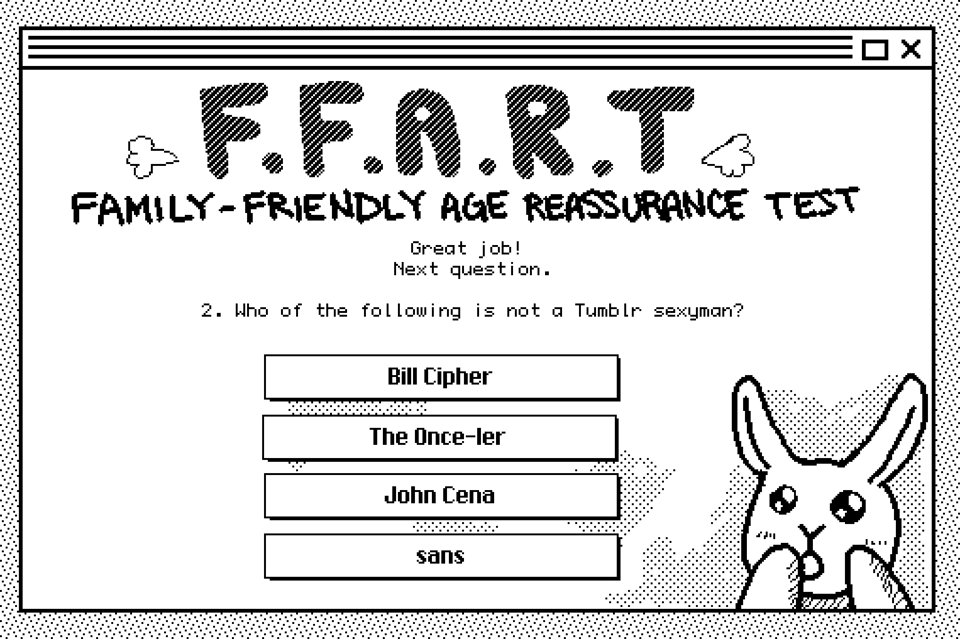
I fancy myself a mature person, but after hanging out with my nieces and nephews and niblings they have taught me a basic truth—farts are universally funny. They’re a staple part of cartoons and comedy sketches. There’s a character here called おしり探偵 (Butt Detective), whose one of many movies I watched, only to realize the final scene was of him eating an unheard of amount of sweet potatoes and blasting his rival away with a Giga Fart.
It was mabbees’ idea to name the test “the Family-Friendly Age Reassurance Test” (F.F.A.R.T.), loosely based on Discord’s “age assurance” process, rolling out late this year even though it was wildly protested.
I got texts from friends saying, “I can’t pass the F.F.A.R.T.” to which my response was, “don’t worry, passing a F.F.A.R.T. gets easier with age.”

Adding a bit of levity to an overall dark subject makes it easier to talk openly about.
The F.F.A.R.T. also proved that it doesn’t really matter how difficult the system is to restrict someone’s age to pass, someone will eventually post a guide on how to get around it (in F.F.O.A.M.’s case it took about four days).
I’m quite delighted that folks found it annoying, challenging and silly.
Thanks for reading so far.
I really appreciate you following us on this journey. Aside from this game, myself and the other folks at the studio I co-run, Studio Terranova, are currently busy at work localizing our flagship game, Terranova, into Japanese, Russian, and Brazilian Portuguese. This is a lot of work, so I'd greatly appreciate it if you could donate a few dollars on my Ko-Fi.
Buy CJ a coffeeAnd if you're interested in following our releases, we stream our game dev, art, and music progress on Twitch and YouTube every Monday. Come hang out and say hi!
Our next stream will be on April 13th, where we’ll be doing some gamedev and reading through our player comments on F.F.O.A.M.
Hope to see you there.
<3 CJ


Add a comment: