
Gift guide for grievers
Multi-sensory support for the grievers in your life this holiday season
Dear community,
The holiday season can be challenging to navigate for grievers. Especially the first or second without a loved one, where the loss is strongly felt amidst traditions and gatherings, and it remains a learning curve how to adapt old rituals and create new ones. Plus, grief is magnified during times of merriment and joy, and expectation and judgement can have their way with us before we have a moment to choose differently. Often there's not enough time devoted to individually or collectively honoring our beloved, let alone our sadness. But with some thought and preparation, there are many ways in which we can support each other during the holidays.
Inspired, I've created a non-exclusive holiday gift guide for grievers and those who love them. Since grief effects the mind and body in many ways, the guide focuses on the six senses and supports different forms of grieving and how grief asks to be expressed. In that way, it also follows the dual process model of grief, wherein a person oscillates between processing the emotional pain of the loss (loss-oriented) and adapting to the changes and challenges of life with loss (restoration-oriented). Much of the advice leans on multi-sensory experience and increasing vagal tone, which helps with whole-body healing, adaptability, and resiliency. Many of the ideas are to be done together, social balm for heart rate synchronicity and shared physiological experience.
The guide is for all, but it's written directly to the friend (or family) of a griever. I want to encourage that we get more involved in each other's death and grief care.
To those who want to support someone who is grieving, ask them what they might need, and ask again. You can also consider their character and what that person's love languages might be (quality time, acts of service, physical touch, gifts, and/or words of affirmation). Chances are it's their grief language too, and that can be a nice start for how you express your care. Think simple, meaningful, and authentic. It’s most important to demonstrate that you are there and available to them, and follow their lead.
To those grieving, special note for you down below.
I hope that this guide provides insight, creativity, and connection. Please let me know what resonates.
In support and with big trust,
Staci
Sight
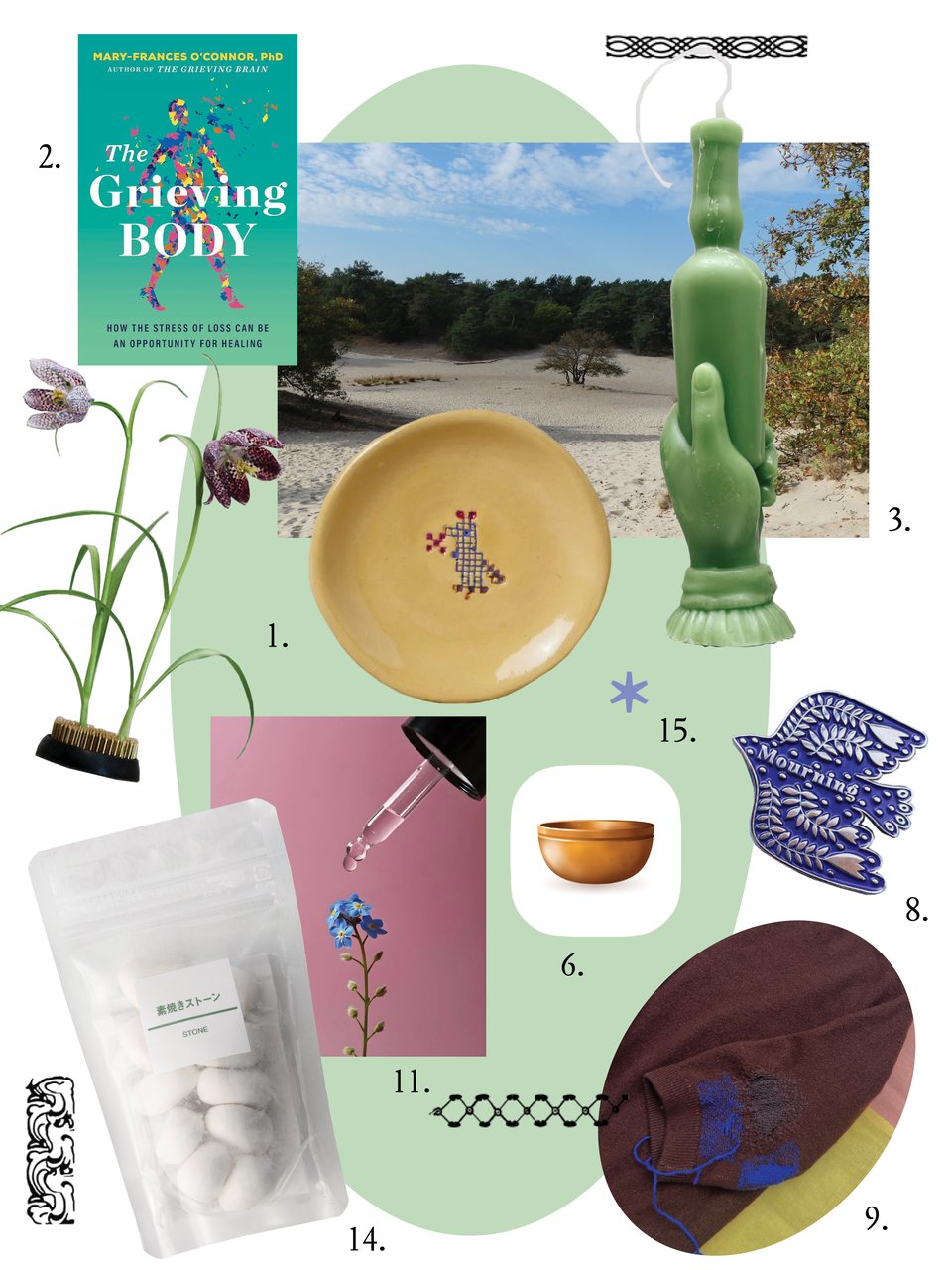
Beautiful objects for a remembrance altar - creating an altar for the dead helps strengthen our ancestral connections, and when engaged with is a place to be reminded and carefully set grief down. An altar is quite personal, but you can still help your loved one adorn their altar in a number of ways, or simply contribute a beautiful object to their life. Here are some tips: a handcrafted, sturdy candle, like from Atelier Hop; an artist-commissioned portrait painting, or printing and nicely framing a photo of their loved one; tools for flower arranging, like a kenzan flower spike; ceramics to hold small items and for rituals, like the work of Rachel Sellem or Turabi Studio.
Grief literature for shifting perception - to honor the griever, I'd get The Smell of Rain on Dust: Grief and Praise by Martín Prechtel. For those who like to know how things work, Mary Francis O'Connor's The Grieving Brain and The Grieving Body. For more connection between the personal and political, Tending Grief: Embodied Rituals for Holding Our Sorrow and Growing Cultures of Care in Community by Camille Sapara Barton.
Nature for a walk or to sit with a thermos of tea - Take your friend into the forest or to a body of water to support respiration and for lower heart rate and stress. Some place where you can see the horizon line differently gives a new perspective on life's scale, timing, and continuity. For this reason, I recommend De Loonse en Drunense Duinen in the Netherlands because the sand is evidence of the Ice Age. Welcome silence together. We are nature, so you can always turn to the elements – earth, fire, water, and air – as well as your ancestral practices for ritual inspiration.
Sound
A personalized playlist - including songs selected with them in your mind and heart; songs to singalong and dance to. Singing and dancing are some of the oldest ways to grieve. Tried and true, grief wants to move through the body and throat. Otherwise, it gets stuck and makes us spiritually-ill, causing psychosomatic troubles.
Laugh together - Life is turned upside down with loss, so why not try something unexpected? Invite your friend to do an intentional laughter meditation together. There are immense benefits for your nervous system, and play creates new perspectives. Don't be surprised when the tears come, as crying and laughing are two sides of the same coin: the body’s response to unreasonable situations (à la Helmuth Plessner), both help to regulate intense and mixed emotions.
Insight timer subscription - a go-to for guided meditations that can support us when in need and as preventive care. I also recommend iBreathe (€2.99 ad-free), a very simple app with five breathwork exercises. With this app, I have held a conscious daily breathwork practice for the past six months and the benefits are astounding. Remember – and sorry it's no fun – but anything that is as simple as this and the opposite of immediate relief is eventually going to bring the most fulfilling rewards.
Touch
Body work - schedule a massage, acupuncture, or other body care modality for your friend to promote physical release and restoration. My friend Maike recommends Roots Studio in Rotterdam for intuitive touch and fascia engagement. I really appreciate IDOU Japanese Acupuncture in Utrecht for his multi-modal approach: acupuncture, moxibustion, shiatsu, and cupping.
Mourning jewelry - wearing a symbol of your loss can feel really empowering, and represents your fidelity to love/grief no matter what situation you’re in. It is also an incredible conversation opener. This is what shifts grieving (private) to mourning (public), signaling to yourself and others that you're experiencing an altered reality from loss and deserve extra kindness. Something like Queer Death Club's mourning dove pin out of Portland can be just what is needed. Or commissioning a piece by Esther Zimmerman, a skilled craftswoman and an informed grief carer in Utrecht, that represents your friend's unique situation. This kind of gift is perfect for death anniversaries, letting your friend know that you remembered.
Repair with me - an activity with your hands grounds you in the present passing of time (thinking of that Brian Eno and John Cale song, "... with my pencil turning moments into line..."). Stitching with fabric is a great analogy for grieving, especially repairing beloved clothes. Led by Bronwen Jones and Dasha Golova, Textile Initiative's last workshop of the year is on Sunday, 23 November at Hartwig Proxy in Amsterdam. Bring broken clothes, or a garment from a loved one, and mend grief.
Sleep and rest aids - how is your friend's sleeping? Grief takes a lot of resources, so too does the holidays, and the chemical wash of our brain that happens during sleep is essential for getting through big transitions. Consider a beautifully-textured, heavy blanket; a silk pillowcase or eye mask; or this stunning sunset lamp. You can also record your own yoga nidra (non-sleep deep rest) meditation for them following a simple script.
Taste
Plant medicine - tinctures, hydrosols, dried herbs for tea, salves… plant companions are so supportive in grief. For addressing acute situations (Peach leaf, Motherwort, Skullcap, Passionflower, Stachys) as well as longterm processes (Milky Oats, Shatavari, Ashwagandha, Licorice, Reishi, Hawthorn, Rose, Tulsi, Mimosa, Sage). Search for apothecaries, herbalists and formulas that you resonate with, and consider how plants are sourced and their origins acknowledged. Sometimes befriending a plant (or animal) can be the kind of care we need when language and understanding fall short. My favorite herbalists come out of the US: Corpus Ritual, Wild Care, and my friend Meg. I've received my basic knowledge of herbalism, PTSD & traumatic stress from Solidarity Apothecary. (Please share your NL-based recommendations, if you have them!).
Grief soup - schedule an evening at your friend's house to cook a hot, salty soup for them. Shifts in appetite take place while grieving, so try to notice without judgement and focus on nourishment and easy digestion. You can also ask them about a recipe their loved one used to eat or cook for them, and try to recreate it together. It's a perfect opportunity to reminisce about their loved one and check-in how their coping. Also a chance to invite other supportive family and friends.
Smell
Scent memory jars - if it is challenging to access emotions (to "feel your feelings"), sometimes watching a sad movie can stimulate emotions to flow. Another grief technology is using scent to instigate grief’s movement. Gather some jars with your friend and fill them with scents related in some way to their beloved: a fragrance, coffee beans, motor oil, pine needles, dried cat food…
Essential oil stones - our brain forms strong connections between scent and emotional memories. Seek new plant smells and bring them into the house to accompany this novel time: cypress carries us through transitions, sweet orange calms the digestive system and anxiety, lavender provides fast relief to the nervous system, balsam fir is festive yet grounding.
Body (aka "proprioception," the sense for where our body is in space)
A session with a death and grief carer - scheduling grief care for your friend with a holistic, non-clinical practitioner is a gift that keeps giving. Informed, skilled guidance can make a difference in one's grief journey, not to solve or fix but to help process all the data they're experiencing. You can schedule a one-off session with me: I offer virtual meetings online, or if local, I can take your friend on a grief walk. Have a look at my website and send me an email. <3
New journey, new destination - exercise your creativity through crafting a ritual for/with your friend. Take them to some place new or try a different way to get to a familiar place, and do something together that involves the presence of your friend's loved one. It may feel “weird” if this is a new notion for you, but life is weird. The point is to strengthen our ecology of the seen and unseen, because death brings us to the edge of materiality, and the absence of our loved one is very much present. To help give structure to the ritual you create, consider that there are five characteristics of a ritual: timing, tools, preparation, steps, and reflection. Lead with your heart.
Move it, move it - encourage your friend to join you in a movement-related activity for practicing presence and connection. This could be as gentle as seated QiGong or as intense as HIIT depending on the phase of grief and friend's interests. Engaging your core, syncing your breath, and taking rest afterwards is simple medicine that builds confidence in handling discomfort on your own terms. Acute grief requires rehabilitation for the body and recovery takes time, so go slowly and with support. Change through protest and despair, toward pleasure and joy. As my physical therapist says, "the best movement is the next movement." And I'll add, grief and grieving is lifelong, so our intentional care can become more subtle and refined over time. There’s stillness in movement and movement in stillness; what matters is how we sense and build awareness.
*
To grievers, a special note for you,
We all deal with emotions and grieve differently, but wherever you are on your journey, if you're going through or anticipating a tough season, I really feel for you and would like to provide some gentle encouragement:
Try to notice how you're feeling, identify what you might need, and practice communicating this with those closest to you. The keyword is practice. Change is messy and grief invites us to be a patient student.
Schedule less, schedule intentionally. Unburden yourself when and where possible.
Make space for yourself and others by moving a bit slower.
Extend grace.
Routine can provide comfort, but I'd recommend resisting business-as-usual. It's not a "normal" time, so find your balance between acknowledgment and distraction.
There's a lot of attention on closing up the year and beginning the new one, and I want to recommend that you take your time against the calendar year. Living more seasonally, shifting focus to twelve week cycles, brings life into a humble perspective: seasons become more embodied and our intentions and routines more realistic.
Even if you consider yourself a "seasoned" griever, how to care for yourself and receive care also changes throughout life. This season of gathering in warmth and gratitude can be an invitation to consider the symbiotic relationship between giving and receiving. "Caretaking" has the same meaning as "caregiving:" it is give and take. If you find it difficult asking for help, it’s worth it to practice trying. Any of the gift advice above can be something you bravely ask for so you feel less alone. It's a gift for the giver, too.

