Remote IT Careers for Tier-2 and Tier-3 City Talent
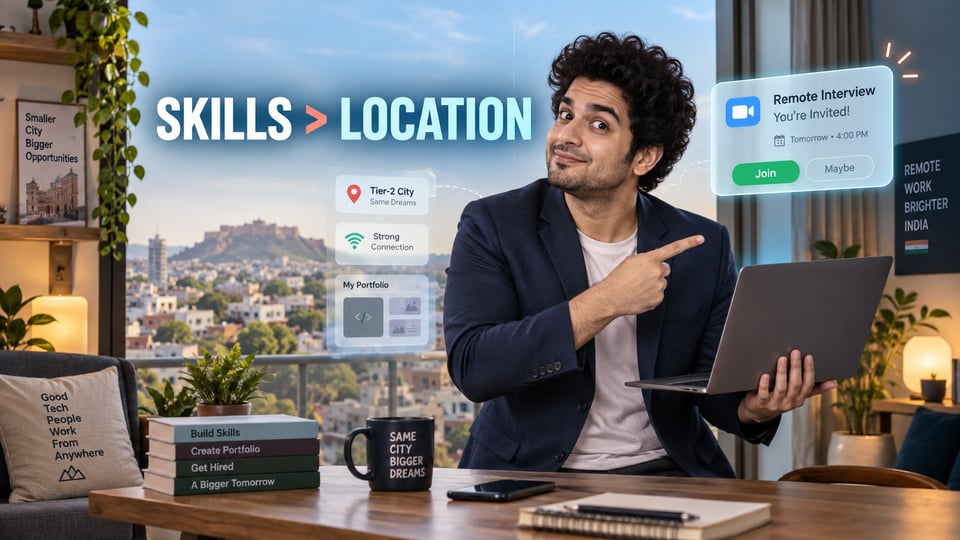 Several years back, securing an excellent IT career prospect involved an informal obligation:
“Move to Bengaluru, Pune, Hyderabad, Mumbai or Gurgaon.”
In 2026, things are different.
With remote work becoming common practice, working remotely in IT in India is enabling talent from Tier-2 and Tier-3 cities to access career prospects that were formerly only available within tech hubs.
However, there is a but.
Remote hiring takes care of the geographical factor. It does not take care of the competition.
Your PIN Code Does Not Matter Anymore. Your Portfolio Proofs Do.
Once the recruiter can no longer leverage heavily on campus reputation or physical closeness to the company, you are your own first point of contact.
It means portfolio-based recruiting in 2026 will be increasingly relevant.
Several years back, securing an excellent IT career prospect involved an informal obligation:
“Move to Bengaluru, Pune, Hyderabad, Mumbai or Gurgaon.”
In 2026, things are different.
With remote work becoming common practice, working remotely in IT in India is enabling talent from Tier-2 and Tier-3 cities to access career prospects that were formerly only available within tech hubs.
However, there is a but.
Remote hiring takes care of the geographical factor. It does not take care of the competition.
Your PIN Code Does Not Matter Anymore. Your Portfolio Proofs Do.
Once the recruiter can no longer leverage heavily on campus reputation or physical closeness to the company, you are your own first point of contact.
It means portfolio-based recruiting in 2026 will be increasingly relevant.
For example, let us imagine two Data Analyst applicants. Applicant A states: “Knowledge of Power BI, SQL and Excel.” Applicant B has a portfolio that contains a Power BI dashboard, SQL analysis, business problem statement, and brief description of insights gained. Whom would the recruiter trust? Exactly. Before the interview for remote jobs, your portfolio must answer this question: "Can this candidate do the job?" Different Skills Are Required For Remote Jobs Technical skills alone aren't enough to be efficient at remote jobs.
Remote companies operate in an asynchronous mode, which means not all employees are logged into the work simultaneously. Thus, an employee has to record his/her progress, communicate his/her problems and make decisions in the form of text messages. That's why remote IT specialists have to know such skills as: • Efficient writing skills • Problem-solving skills • Time management skills • Documentation • Ownership of tasks • Knowledge of git and collaboration tools • Skills of professional online communication It's good to be an employee who says "problem solved". It's even better to be an employee who tells about the mistake, its cause, and the way he/she coped with the problem. Don't Hide Your Place Of Residence On Your Resume Some freshers are afraid that the company won't accept their resume due to their place of residence. Why don't you make it difficult to ignore your skills? Create a resume for the ATS using outcomes, projects, and tools you've worked with. Ensure your LinkedIn profile uses relevant keywords and update your GitHub/your portfolio. Your online presence must convey the message that: “This is the problem I solved. These are the tools I used. This is the outcome.” And not: “Kindly give me an opportunity as I am a fresher.” Skills Are Becoming the New Address This is also changing the way people should train before applying for their first IT jobs. Training is no longer restricted to watching tutorials and earning certificates. Hands-on experience counts. If a person trains in Business Analytics, he should work with real datasets rather than memorizing different functionalities of Power BI. If it's about Application Support, then one should know SQL, Linux, tickets, and incidents.
A project-based learning is one of the reasons why Sparktech Pro Agile, the best IT training agencies in Pune, fits into this new trend of job-oriented learning. Interestingly, these skills can actually help people in competing with others for jobs outside Pune too. How Can You Stand Out in Remote Hiring? You should not apply to 200 remote jobs with the same resume. Develop an effective strategy: • Target one specific role. • Identify commonly desired skills. • Develop 2-3 good projects. • Quantify the project outcomes. • Revamp LinkedIn and GitHub profiles. • Tailor your applications. • Conduct virtual interviews. • Show your ability to communicate remotely. You don't need to look like someone with “experience” that you don't have. You need to look like someone ready. Your Career Does Not Need to Begin Where You Do The greatest advantage of remote first IT hiring in India is not the flexibility it offers. It's access. A good candidate in Nashik, Nagpur, Indore, Jaipur, Kochi, or any other rapidly developing city has the chance to enter a much larger job market without moving anywhere. However, access doesn't necessarily translate into getting picked. By 2026, those that get noticed will be the ones demonstrating their skills, projects, communication and execution. Your city might well be prominently featured on your resume. It will just no longer determine the height of your career.
FAQs
- Is it possible for freshers to get remote IT jobs in India? Yes. There are remote job opportunities available for freshers although there might be a stiff competition. It would help if you had relevant projects, knowledge about technology, and great communication skills.
- What are the IT roles where I can work remotely? IT roles like Software Development, QA, Data Analytics, Business Analysis, Application Support, DevOps, Cloud positions, and some technical support roles will help you to work remotely.
- Is it compulsory for me to live in Bengaluru, Pune, or Hyderabad to make my IT career? No. Although some organizations still prefer to have their workers near to the office, hiring remotely and hybrid have become quite common now.
- How can a fresher make himself different from other candidates to get remote IT jobs? A candidate can make himself different by having relevant projects, improving his CV/LinkedIn, maintaining a portfolio, and writing well.
- What is the most important characteristic for a remote worker? Good technical skills are definitely required, but asynchronous communication and ownership skills are equally important.