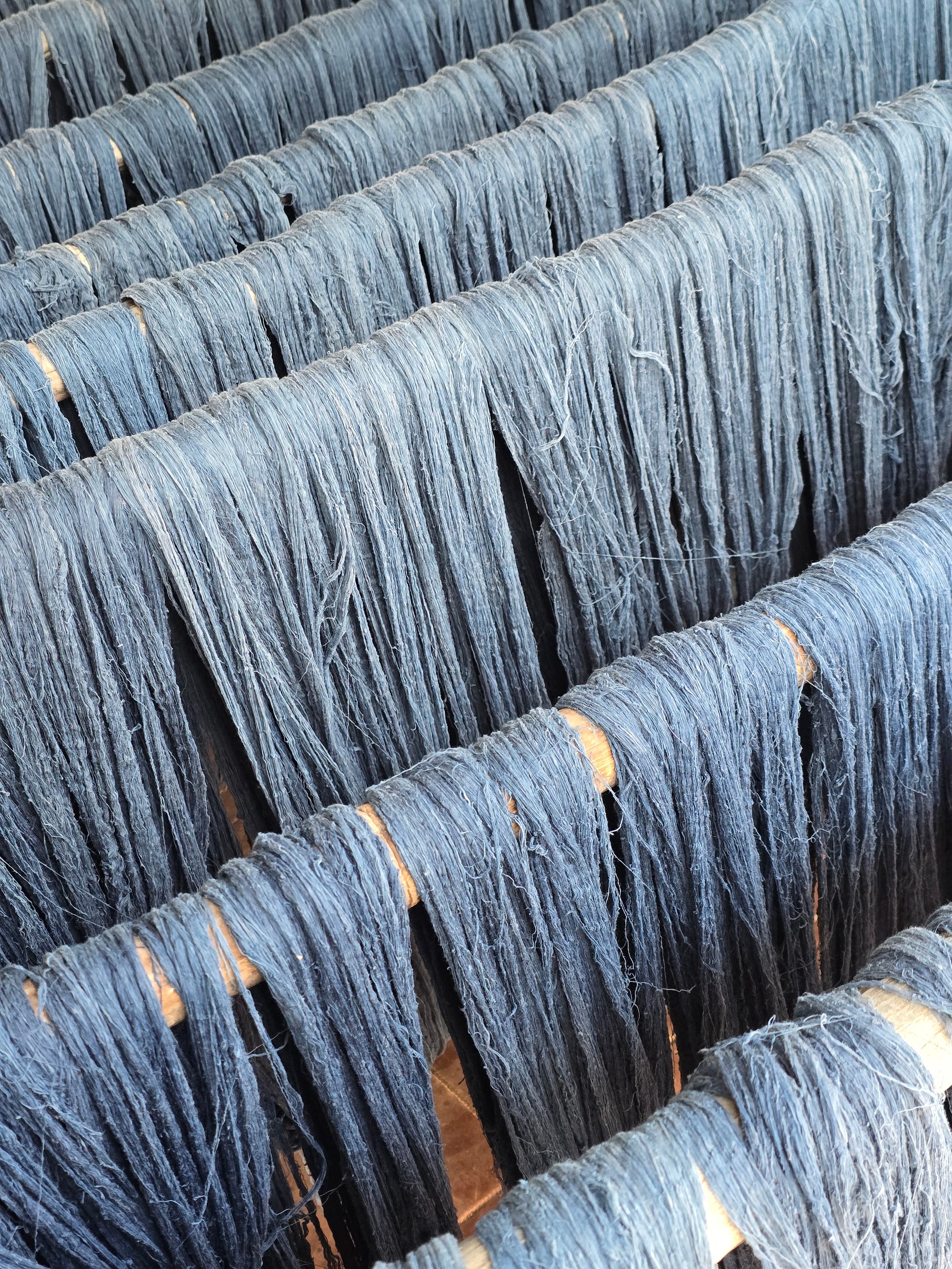
Simplicity in 3D - Shuttles Through Warp (10)
Dear all,
Growing up, I was very familiar with the borders of my father’s veshtis and mother’s sarees having what is called a temple border. Small, delicate triangles along the border, shown below. I wear some of them now. In Telugu, this kind of border is called కుప్పడం (kuppadam). By the time I found out the kind of skill it took to weave, I had taken this style of border for granted long enough that I am still not really seeing the work.
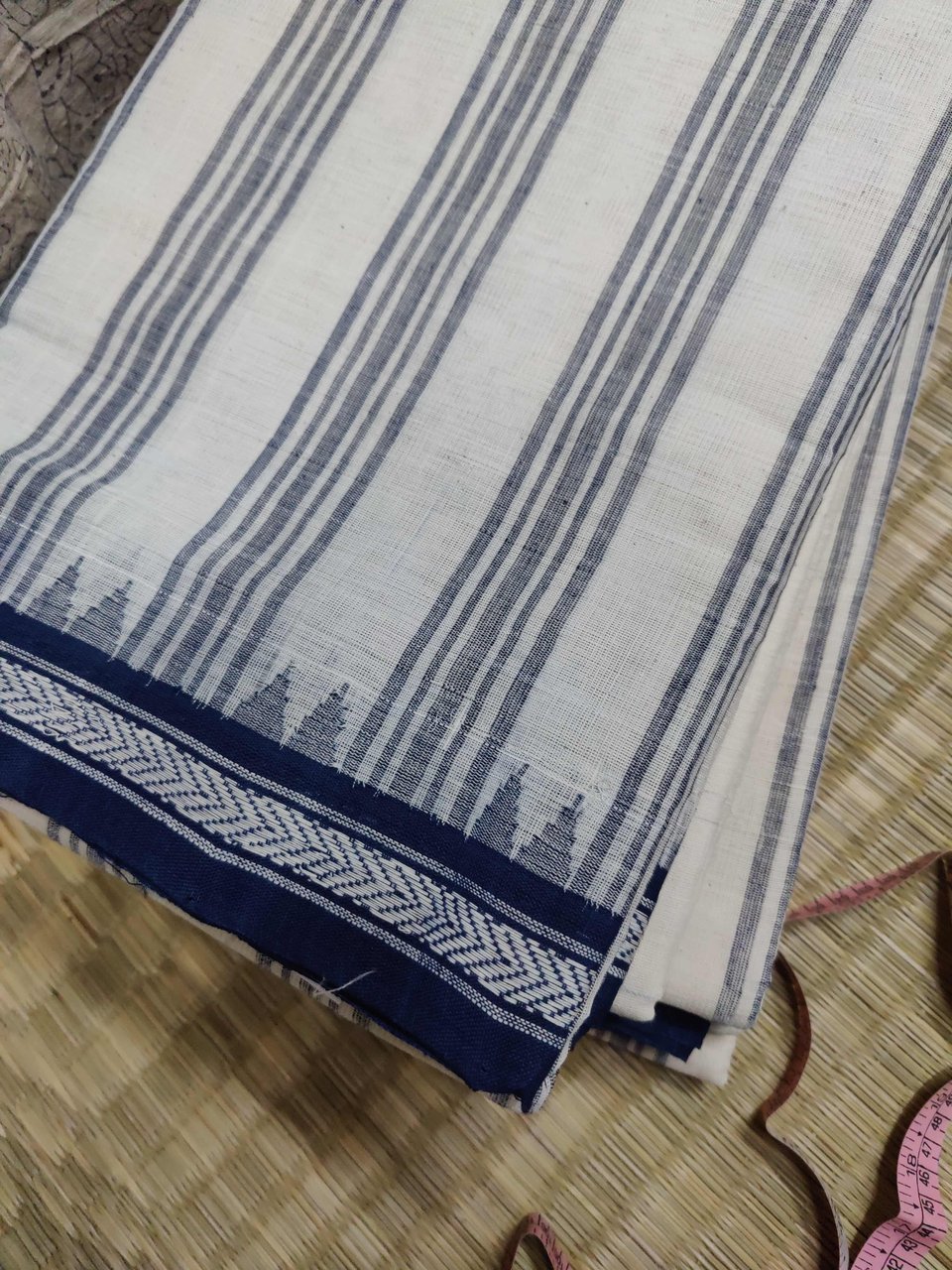
This week I finally got to see this kind of weaving. Funnily, as I write this the preview on the site I’m using appears to be broken, so I can’t see the picture as it should appear on the screen when you see it. Not that it matters, really.
A very basic primer on weaving - in order to make fabric, a weaver uses the shuttle of a loom to pass a weft thread between warp threads, some of which are raised, and others of which are lowered. Then they use the heddles of the loom to lower the raised warp threads and raise the lowered warp threads. Lastly, they beat the weft thread towards themselves with the reed. By doing this over and over, the weft threads are passed through the warp threads and are then trapped in them.
All fabric is fundamentally made this way - by using manipulating threads in three dimensions to make cloth in what is, for our intents and purposes, two dimensions. Until the invention of the power-loom, all fabric was made this way by the hands and eyes and breath of a weaver.
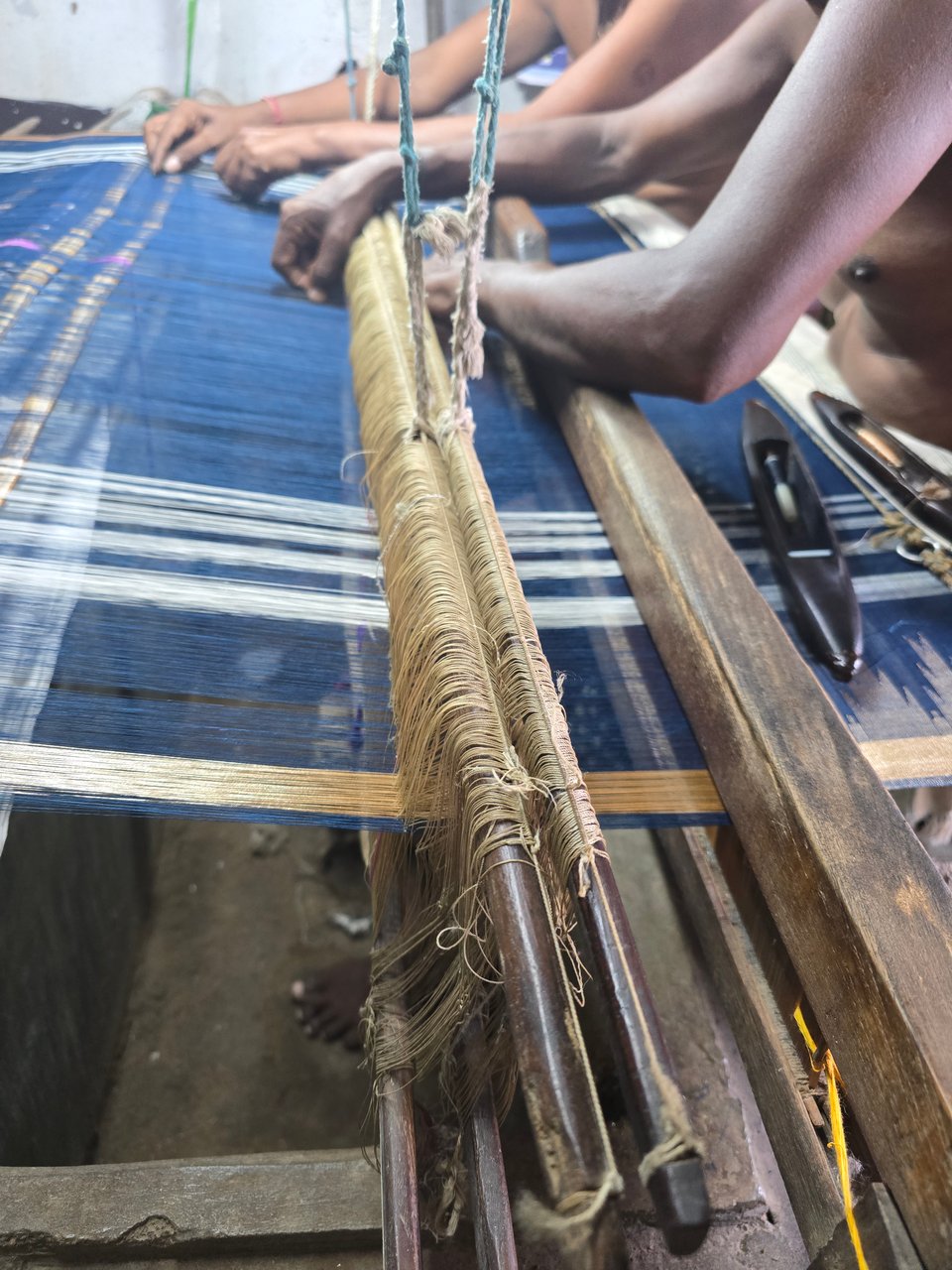
Kuppadam is a kind of weaving that requires an extra shuttle on each end of the cloth. This means that to get the border on both sides, two weavers sit side by side, passing the shuttle that has the thread of the body to each other while weaving the border on their own side. It requires a kind of synchrony that is learnt not through lesson but through practice.
I was, in a way, quite scared of going to see the weavers. Because when I see their work I am consumed with two convictions. The first is that this is a kind of skill and beauty that I should be paying to witness. Maybe not with money. But at least with my attention. The second is that a world that would disdain it is a world that must be burnt to the ground. Such beauty is a gift.
These convictions are familiar to me. I feel them whenever I see weaving. In fact, I feel them regardless of the kind of weaving, which means that I cannot really claim to discern the difference between a good weaver and a bad weaver. I can only tell the difference between my ability to pay attention and my inability to keep my mind from wandering.
So when I feel them wash over me again, I can only think - what am I doing to preserve beauty in this world? What am I doing when the people who make such beauty seem resigned to knowing that they are a dying breed? How can I not stand up, shake everyone I know by their shoulders and say to them: See! See what beauty is!
This feeling scares me, because it is the epitome of the delusion that if only I did enough, I would change the world. It is of course not in my hands to save a community, let alone hundreds of communities. Indeed, no weaver I’ve ever met has said they require saving. They only say - as so many of us do - that they require help.
Weavers know that their work is beautiful. If there’s anything I have learnt from them, it is that the artisan who knows the craft trusts themselves and the process. Validation isn’t about insecurity. It’s about something else entirely.
The Sufi saint Bhika says (I hesitate to reproduce the original Hindavi as mine is quite bad and I do not want to risk a misspelling, but you can hear the legendary Abu Muhammad render it here)
Bhika, there is a kind of matter
Which can neither be spoken nor heard
For those who know, speak it not
And those who speak, know it not
What I see when I see weaving is something I cannot speak to you, except through metaphor. I can point to it and hope that you get what it is. But I know that you know it, and so if we both know it we can bypass language entirely. Indeed, language can never communicate it. But other things can.
Validation is about this thing. In this context, it is about the mutual recognition of the way that beauty is made. More broadly, it is about knowing that even if we do not share language, history, or even our senses, that we share humanity.
Next week, an attempt to think about what it means to use money to buy money.
Cheers,
mvs
