sotto dispatch ii: new year
Hello all,
This seems like a good moment for an update.
For those new to this newsletter, welcome. This is Sotto Instruments and I’m building an acoustic piano that is smaller, lighter, quieter.
This past year has been eventful for Sotto. Outside of a summer lost due to the relocation of the workshop, the progress on the second prototype of the Pianissimo has continued nicely.
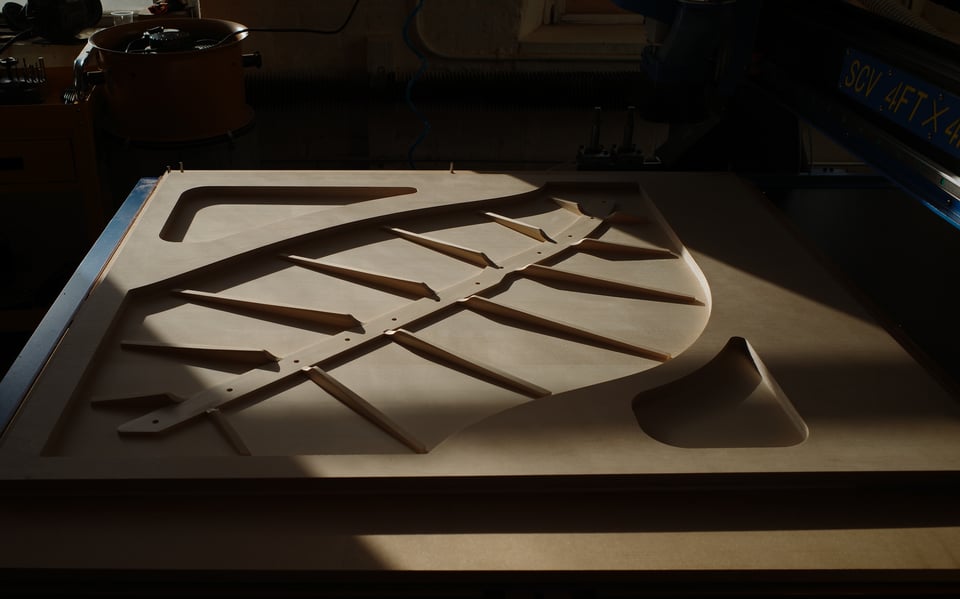
The most important part of this whole project has been designing the acoustics. As the Pianissimo uses synthetic strings instead of the normal steel, the tension the instrument has to resist is much lesser, which in turn allows the instrument to be smaller & simpler.
While the absolute forces acting upon the instrument are lesser, the relative forces become, in some ways, more complex. There is an adage among classical guitar builders that the best guitars are built on the cusp of disaster. This is, perhaps, slightly dramatic language, but it illustrates an important fact: a stringed acoustic instrument must be strong enough to resist the static forced imparted by the strings while being as responsive as possible to the dynamic forces of those strings vibrating. Over-building something like a dining table costs you nothing but material and weight, but over-building a resonant acoustic instrument can cost you the very heart of the sound.
Getting this just right can be tricky. Pianos builders, like other instrument makers that adhere closely to traditional methods, have a set of best practices and hard won insights gained over the hundreds of years in which the instrument has been refined. Even in the world of guitars, where builders tend to be more experimental, their innovations still tend to occur within a narrow envelope, mixing, matching, and adjusting proven techniques.
Aspects of this can be calculated or modeled, but these dynamic acoustic systems are complex, even on simple instruments. The tension of the strings, how they are attached to the bridge, the shape and material of the bridge, and the span/shape/thickness/weight/grain-orientation of the soundboard all play their role. It can be difficult and often practically impossible to truly isolate any single aspect in a controlled fashion.
For much of the early design process and as I searched for viable alternative string materials, these decisions were made by borrowing, blending, and scaling the conventional wisdom that informed a broad spectrum of stringed instruments traditions. Behind the design were always the twin fears of “will it sound good?” and “will it explode?”. The prototyping process has allowed me to observe these forces in action. Seeing how the soundboard and bridge interact with the strings, where and how to secure and reinforce these elements to the larger frame, and where and how the stresses of the strings move throughout the instrument.
It’s gratifying to say that the second prototype has been holding the strings at full tension for a number of weeks now. Stringing the prototype around the change of the seasons can be stressful. The drier air of winter tends to cause a reaction in the wooden elements of the instrument; adding additional stress to the wood can result in warping or cracking, but the soundboard has been holding strong. If there’s a difference sonically between this instrument and the first prototype (which sounded wonderful, but strayed a little too close to disaster), I’m unable to hear it.
This is a huge milestone. Most of the bigger leaps of design and intuition in this effort were all in service of finding solid ground acoustically for an entirely new instrument. It was possible that finding the exact right balance would end up involving many cycles of refinement, but I am pleased with where this prototype has landed.
Looking forward, I can now turn my full attention to the keyboard and action mechanisms. While these are not simple topics, the good news is their implementation on the Pianissimo is straightforward. While the acoustics of the instrument are entirely new, playing the instrument will feel familiar.
As the Pianissimo gets a keyboard and can start making music, there will be much more to share with all of you. The path as been anything but straight, but I am eager and excited to let this instrument speak for itself.
I wish a happy new year to all of you and a good and fruitful 2025.
As ever, feel free to reach out if you have any questions.
[sam]