#27: Interlude: My big fat Greek vacation
I occasionally think to myself, “I really ought to start a travel blog.” Not only because I travel so frequently, but because I’m so often seeking hidden gems and roads less traveled, and I feel some duty of care to my fellow adventure-seekers to share my findings.
Alas, I have too many ongoing projects to add another to the roster, so this will have to remain an unrealized ambition for a little while longer. In the meantime, please accept this travelogue newsletter reflecting on my most recent international travels.

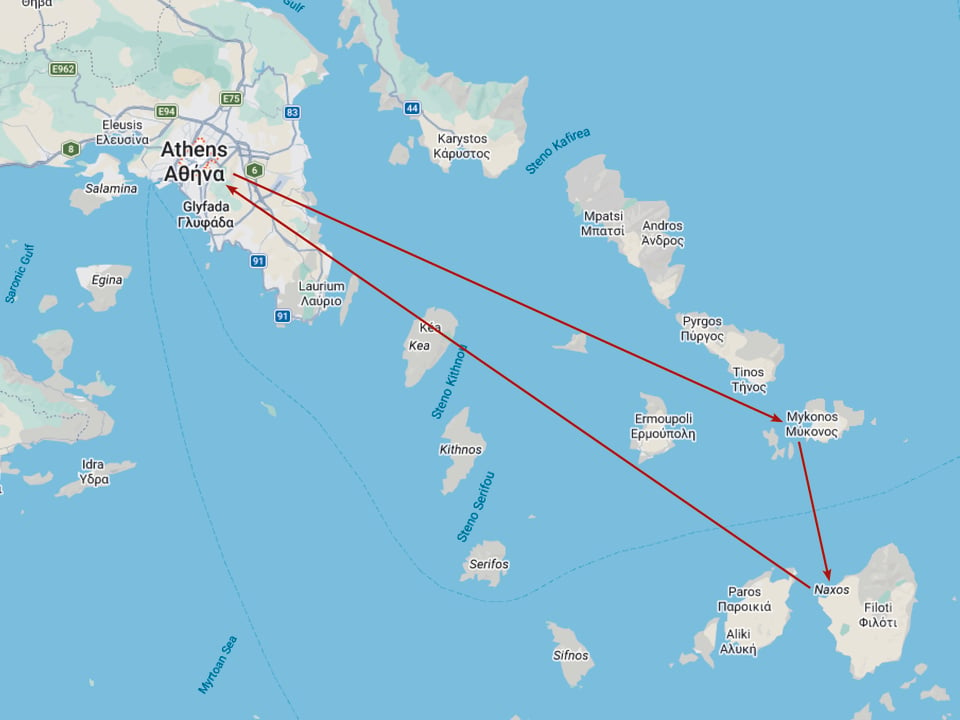
The general thrust of this trip was as follows: back in September, my parents were invited to attend a wedding in Mykonos. My sister and I, uninvited but taking advantage of our ability to work remotely, took it upon ourselves to tag along. We spent a few days in Athens as a family before island hopping to Mykonos for the wedding and Naxos afterward. Then my parents returned to the US while my sister and I spent another week in Athens.
All the while, I was working US hours, which corresponded to 4-12pm Eastern European Time, meaning our sightseeing hours were limited to mornings and occasional brief evening forays during my “lunch breaks.” It was a strange way to experience a new country, as a lot of my travel staples—evening wanders, nighttime window shopping, dinners at hole-in-the-wall restaurants—were inaccessible to me. Still, we managed to fit quite a bit into the trip.
Of course, we did the standard touristy things: an early-morning tour of the Acropolis, 2am clubbing in Mykonos, sunbathing on the beach, sunset on Filopappou Hill. But the point of this newsletter isn’t to tread the same ground detailed by every other travel blog out there. You can safely assume we had a generally decent time working through the Typical Tourist Checklist, and I’ll instead use this opportunity to share some of the more unexpected stories we picked up along this trip.
Lycabettus Funicular Railway
My father is an aerospace engineer with an abiding interest in trains of all kinds, so the Lycabettus Funicular Railway was a mandatory stop on our itinerary. Funicular railways carry passengers up and down steep inclines by means of two railway cars hooked up to a pulley, such that they serve as counterweights to one another. As one car descends, the other rises.
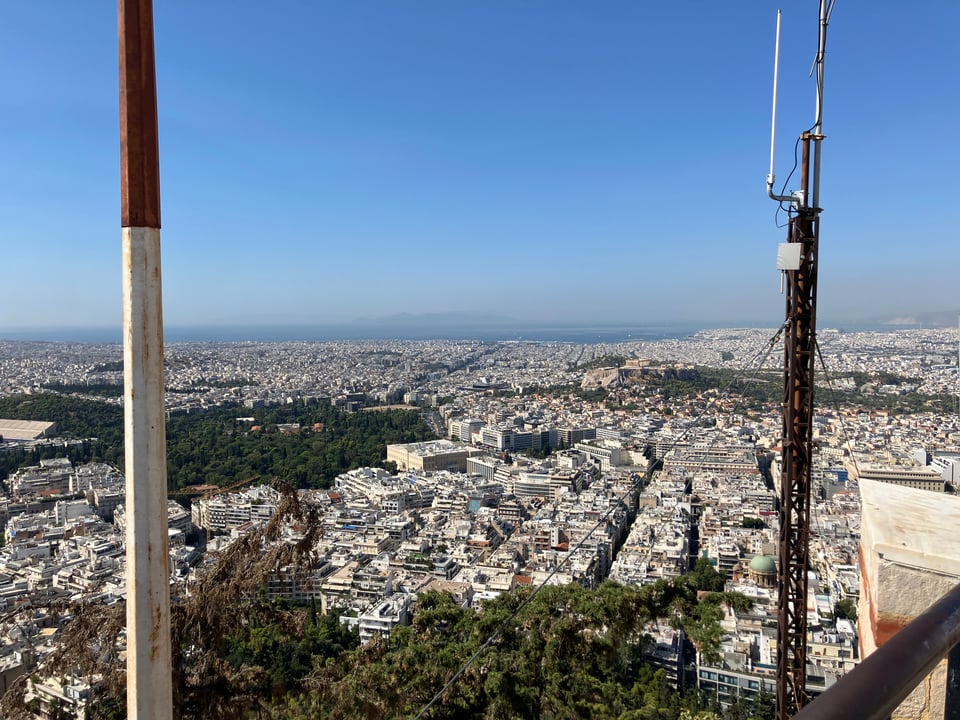
At one end—arguably the more important end—the Lycabettus Funicular deposits passengers at the summit of Lycabettus Hill, which is the highest point in central Athens and provides a panoramic view of the city from the mountains down to the Saronic Gulf. The Funicular does not, however, travel all the way to the base of the mountain, and so there is a notorious staircase that visitors must ascend in order to reach the lower terminus of the Railway. Most blogs online warn tourists to keep plenty of time and water on hand while tackling this staircase, as its 200+ steps constitute a proper workout, especially in the blazing Grecian sun.
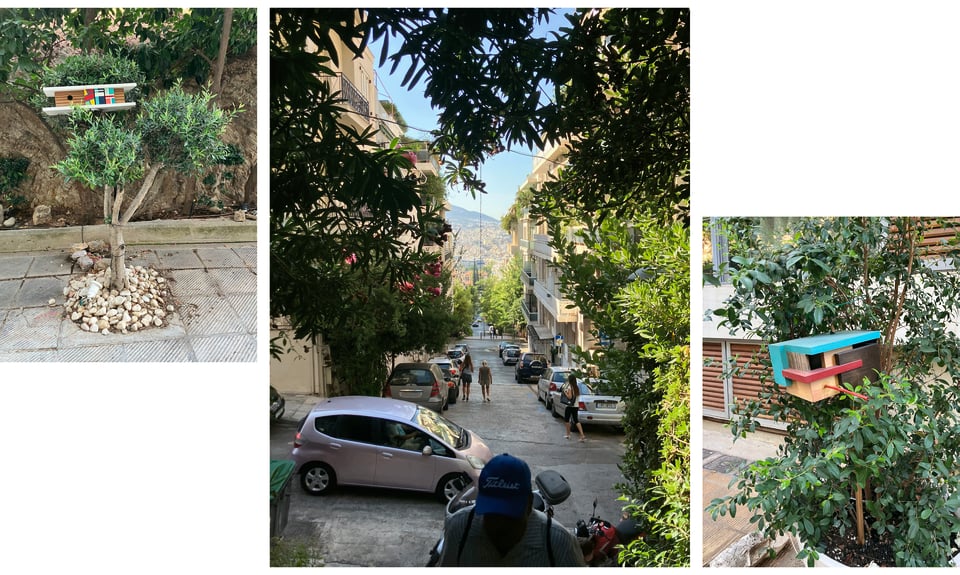
What these blogs fail to tell you is that there’s an easier way. For a less demanding and more scenic walk, you can start in Kolonaki and wend your way alternately east and north, taking the sloping streets as the mood strikes you. This spreads the ascent out over a longer distance, making it significantly less awful to undertake. And as a bonus, this route is dotted with oodles of weirdly architecturally intricate birdhouses.
I do recommend taking the staircase on the way down, though, so you can visit the next hidden gem.
War Museum of Athens
After climbing down the 200+ stairs abutting the Funicular, we spotted a bunch of old helicopters scattered across the grounds of a fenced-in marble-tiled building. My sister and I have both inherited, to varying degrees, an interest in aircraft from our father, so in unspoken agreement, we immediately began looking for a way to get inside the fence to touch those helicopters.
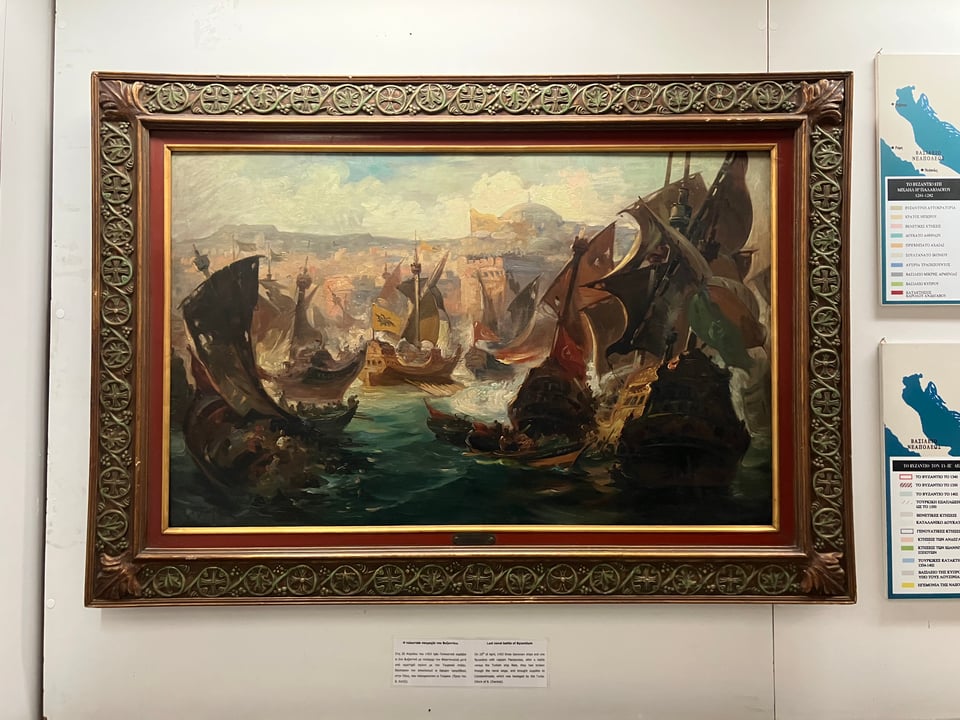
This is how we found ourselves in the War Museum of Athens, a 4-story building that seems compact at first glance but unfolds into ever more labyrinthine exhibits the deeper you go. We expected to get bored and leave within minutes but ended up spending nearly 2 hours here, and likely would have stayed longer had our stomachs not started grumbling.
The topmost floor is the most in-depth, tracking the evolution of Greek warfare from prehistoric times into the modern day, and it’s also the only floor with air conditioning, so pace yourself accordingly. But with tickets costing a mere 6€, this museum is more than worth the price of admission.
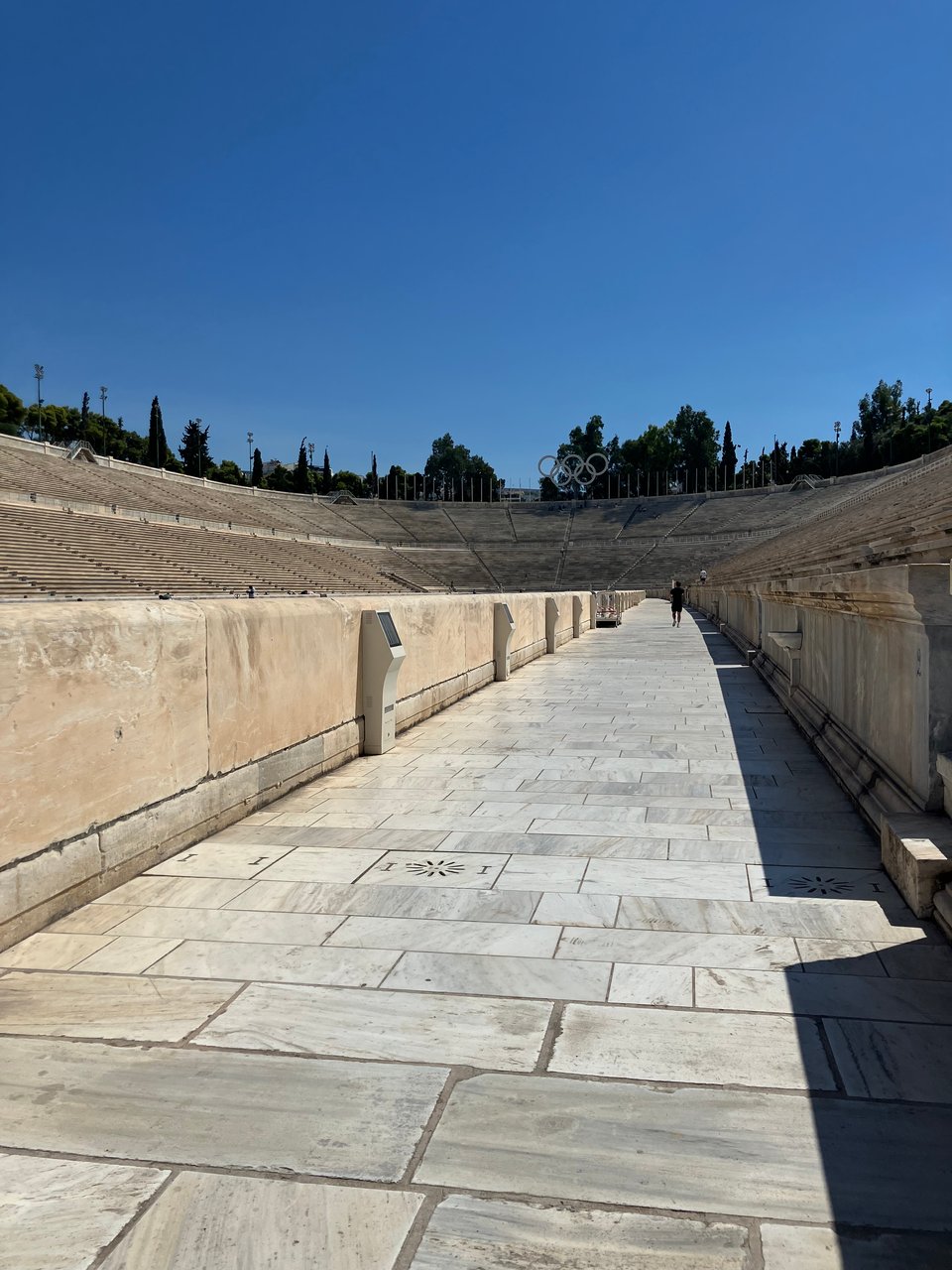
Panathenaic Stadium
Through serendipity or happenstance or perhaps just a confluence of good luck, my sister and I somehow ended up at the Panathenaic Stadium in time to learn that an Olympic ceremony was being held there just 2 days later, with admission free for all visitors. The Panathenaic Stadium is, of course, the site where the Panathenaic Games were hosted more than 2000 years ago. In modern times, this stadium served as the venue for the first modern Olympics hosted in 1896, and it also serves as the terminus for the annual Athens Classic Marathon. My sister and I couldn’t believe we had stumbled upon an opportunity to attend a bona fide Olympic ceremony at a bona fide Olympic venue; in a flurry, we rearranged the rest of our week to accommodate this event.
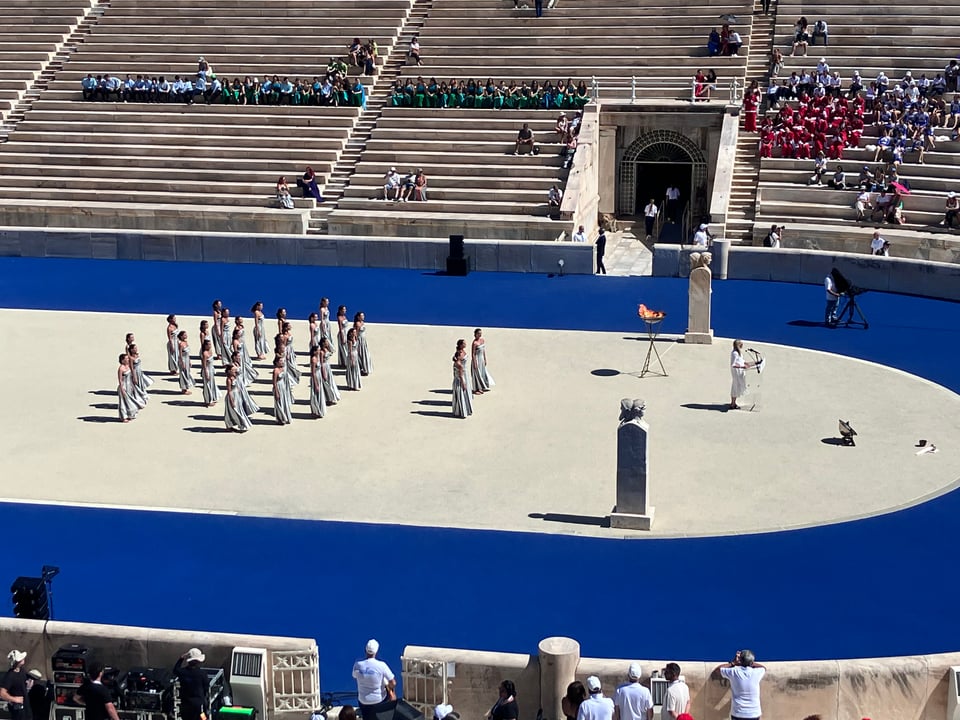
Two days later found us settling onto the marble benches of the Panathenaic Stadium, high up where the back wall cast shade over a narrow wedge of seats, in order to watch the lighting and handover of the Olympic Flame for the Dakar 2026 Youth Olympic Games. We were serenaded by the Greek and Senegalese national anthems as we climbed up to our seats. Following this, a group of young women dressed as priestesses performed a dance routine characterized by dizzyingly precise, intertwining formations. Finally, the torch was lit by one of the priestesses, handed over to a youth athlete, and conveyed around the entire perimeter of the stadium in a relay, with 6 youth athletes taking turns carrying it.
The event had little fanfare and was sparsely attended, but nonetheless the whole experience was quite surreal. I was overwhelmed by the feeling of attaching my name to a long lineage of spectacle and celebration—the knowledge that if the clock suddenly rewound 2000 years, I might not be so out of place sitting in the same seat with a celebration of human achievement unfolding before me.

And now, a brief pause to spotlight my favorite eateries and drinkeries:
🍜 Tanpopo (Monastiraki, Athens)
Tanpopo caught my eye when I was perusing the map for restaurants near our Airbnb. “What a strange coincidence!” I thought. “Surely this isn’t named for the same 1985 Japanese film I watched with friends last year.” But it is. So of course I had to go, for the bit if nothing else.
The paucity of vegetarian options on the menu primed us for disappointment, fearing we’re leave the restaurant still hungry. But the few vegetarian dishes are stunningly good, with sizeable portions, fresh and deeply melded flavors, and a balanced spice profile. If we’d had longer in Monastiraki, I would have come back here just to order the kimchi mazemen again.
What we ordered: kimchi mazemen, green mazemen, yuzu corn ribs.
🍛 Tuk Tuk Street Thai (Koukaki, Athens)
While in a cab back to the Airbnb we’d booked for our second week in Athens, my sister and I passed by a restaurant so crowded that people were spilling onto the street. This was more of an endorsement for the restaurant’s quality than any Yelp review, so we patronized it the following night, and quickly decided it may be our favorite restaurant from the whole trip.
Each dish was an explosion of flavors—some familiar and comforting in their familiarity, others unexpected yet but nonetheless appreciated. The tom yum soup, for instance, had all the brightness and zing that I love about lemongrass1, but was made with a creamy coconut-milk base that added surprising richness and warmth. Here, too, the portion sizes were enormous, yielding enough leftovers for at least 2 more meals.
What we ordered: tom yam goong soup, kaeng kiew waan neua (a green curry), a steamed lemongrass fish dish that is no longer on the menu.
🧆 Taverna (Naxos)
We likely never would have stopped by Taverna had it not been recommended to us by the host of our Airbnb (shout out Julian at the Galazia Apartments, and shout out Julian’s mom who shared the juiciest grapes from her garden with us). Everything from Taverna’s name to its storefront to its butcher-paper tablecloths is unassuming, making it easy to overlook if you don’t have an Airbnb host to steer you right.
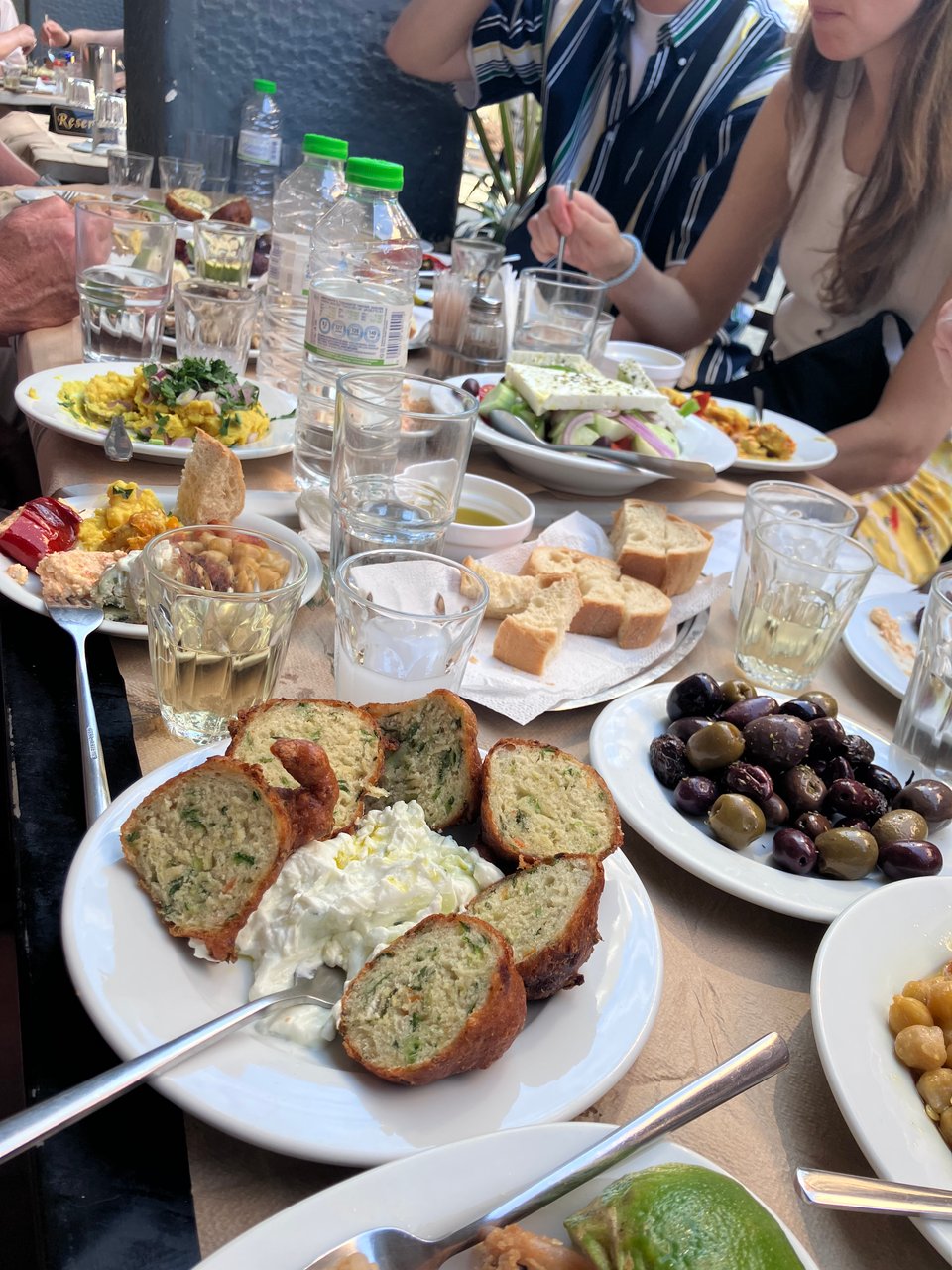
This place had the best tzatziki we ate in the whole trip. The tzatziki had the perfect texture, creamy without being too thick, and it was topped with puddles of olive oil and a smattering of dill that made it downright addictive. I’m still dreaming about this tzatziki 2 months later. If you ever find yourself in Naxos, you’ll know you’re at the right Taverna when you see a sign with pink flowers and a Waffle House next door.
What we ordered: tzatziki, tirokroketes, fried potatoes, cheese and mushroom cream ravioli.
🍩 Krinos, Falafellas, and To Kalamaki Tes Aiolou (Omonia, Athens)
On my sister’s final day in Athens (she was leaving 36 hours before me), she pulled me away from the main thoroughfares in order to visit Krinos Cafe, the oldest loukoumades shop in Athens. Krinos has been serving loukoumades since 1923, and they’ve definitely got the art down; their loukoumades have thin, crispy outer shells that give way to delicately airy insides. For us, though, the standout here was the ice cream, which was dense in texture but light enough in flavor to cut through the heaviness of the loukoumades.
If you’re not the type of person who enjoys eating dessert before dinner, stop by Falafellas and To Kalamaki on your way to Krinos. These two literal hole-in-the-wall window stalls stand side by side a scant 5-minute walk from Krinos and serve some of the best street food in Athens. Falafellas boasts enormous gyros stuffed to the brim with fillings and sauce, while To Kalamaki is a skewer stand where every 3-skewer portion is served atop a generous heaping of perfectly seasoned fried potatoes.
What we ordered: loukoumades with melted chocolate and vanilla ice cream (Krinos); falafel pocket sans eggplant (Falafellas); chicken skewers portion (To Kalamaki).
🍸 Intrepid Fox (Gazi, Athens)
In order to give Athens a proper send-off, I trekked out to Gazi, the late-night clubbing district of Athens, on my final night. To my immense disappointment, every single club I’d seen recommended online was permanently closed, and I was forced to resort to following the strains of music wafting through the air until I could find an open venue with a good crowd. This strategy led me to Intrepid Fox, a neon-lit dive bar with band posters plastering the walls and ceiling and rock music blaring loud enough to be heard from several streets over. I entered the bar intending only to get a cheap drink before striking out again in search of clubbier pastures, but the vibes were so good (and the music so comforting) that I ended up whiling away the whole night here.
What I ordered: several rum & cokes.

Stamps by Stephen Frick
In the window of Tuk Tuk Street Thai was a nondescript poster advertising a stamps exhibit, slated to open on my last evening in Athens at a venue just a quarter-mile from our Airbnb. It felt hilariously on-the-nose, like the universe was tripping over itself to send me signs and portents.
I couldn’t find much information about the exhibit or the venue online, so I assumed it would be a standard curated exhibit at a niche museum. When I went to check it out, though, I discovered it was a proper gallery exhibit, and the featured artist, Stephen Frick, was there in person.
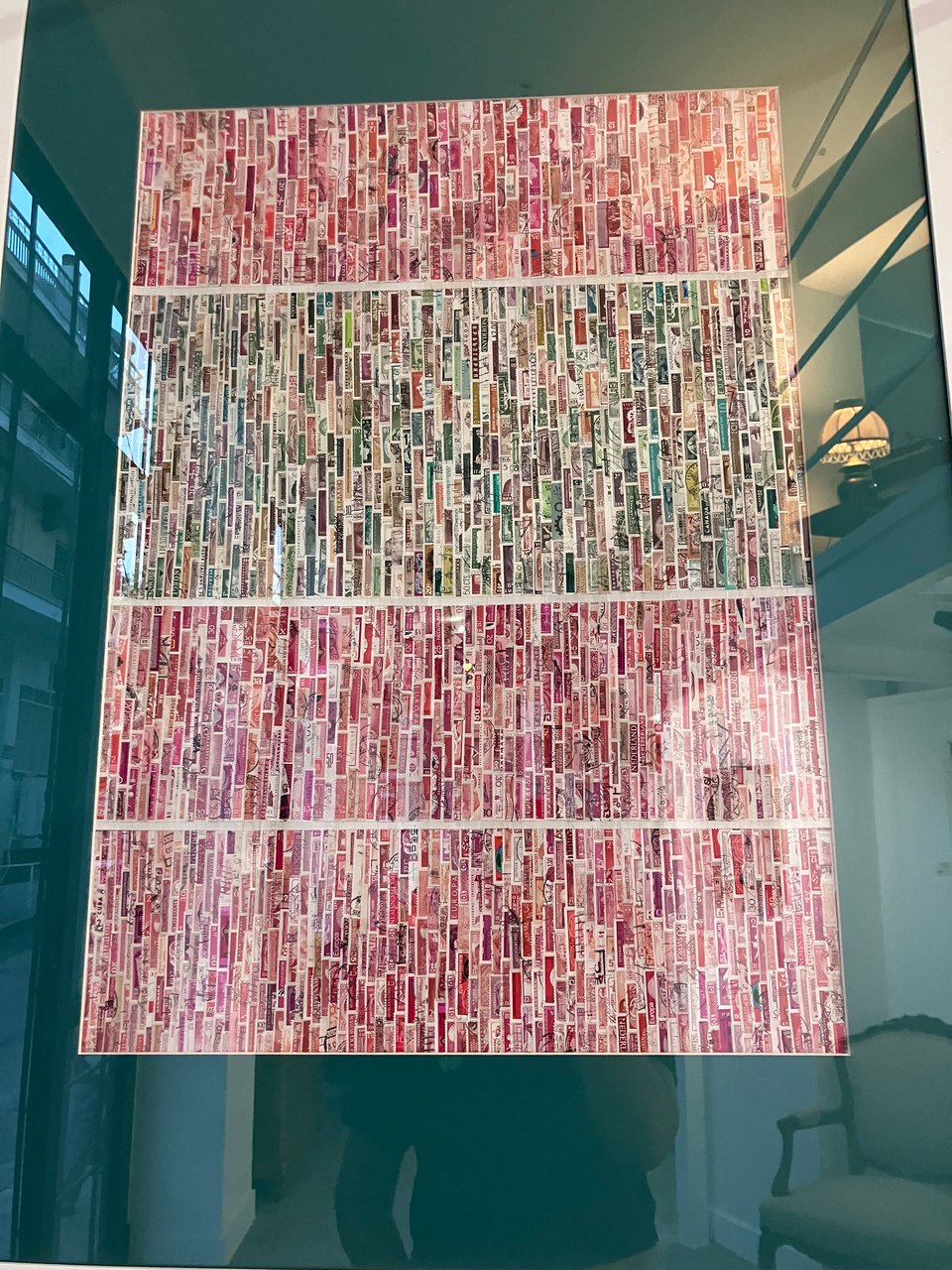
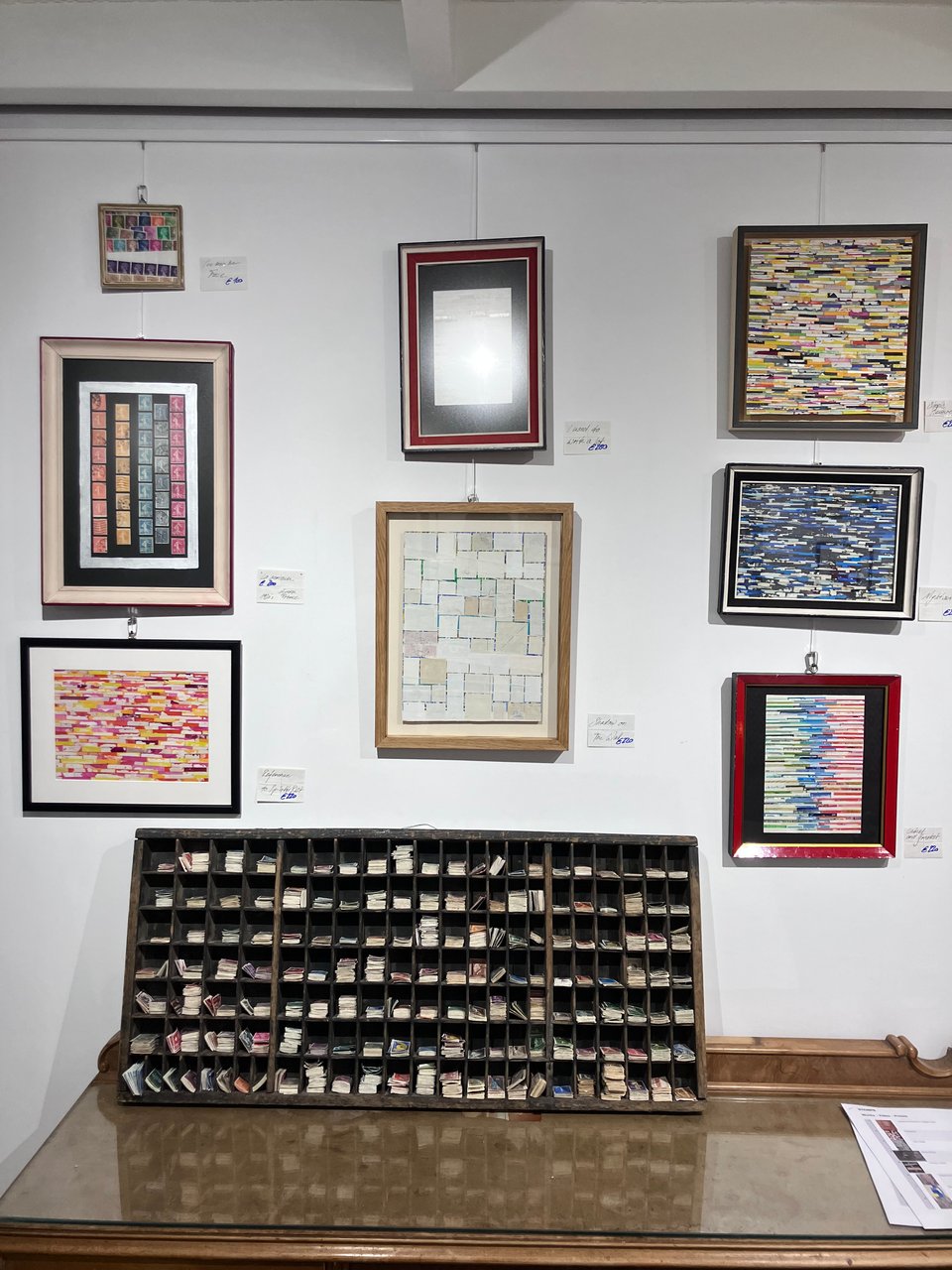
The exhibit itself featured various collages made of postage stamps. Some pieces were intricate mosaics, stamps overlaid atop each other until their details blended together into monochromatic washes of color. Other pieces were much more haphazard: unaltered lines of stamps arranged loosely on dark backing, or stamps turned on their faces so only the backs were visible. In all, I really enjoyed the collection; Frick has an eye for composition and color-washing that appeals to me immensely as both an artist and a viewer.
I’ve been trying to be more journalistically minded in pursuit of providing exclusive content within these newsletters, so I introduced myself to Frick with the vague goal of unearthing a good quote or tidbit of trivia. And he really delivered. Upon hearing that I collect stamps, the first thing he said was, “Are you shocked by my artwork? Are you offended, as a stamp collector, that I used the backs and not the fronts [of the stamps], that I covered them and used them in collage?” His tone was aggressive: he was delivering a challenge, not expressing curiosity.
His vehemence completely threw me for a loop. I’ve spoken before about the philatelic divide between preservers and users, and about how I fall squarely in the latter camp. I’d approached Frick thinking we would find common ground in collecting stamps to make art from them, and planning to leverage that mutual appreciation to interview him about his artistic process and his own relationship with philately.
Instead, it seemed that Frick wanted me to be offended—that his artwork was primarily motivated by a desire to provoke and enrage. Throughout our conversation, he framed his artistic process almost entirely in terms of rebelling against some Oppressive Philatelic Establishment populated by fanatics ready to crucify him for his desecration of postage stamps. “So many stamp collectors get offended,” he said knowingly, and paused, as if inviting me to count myself within their number.
Truthfully, I didn’t see what there was to be offended by within Frick’s artwork. He had not torn up any rare or valuable or historically interesting stamps to make his collages; instead, his art comprised the type of stamps that are so devalued that they end up scattered across tables at philatelic events, entirely free for the taking. Some of his pieces featured dozens of copies of a single stamp, quietly illustrating the commonplace nature of his materials.
Taken aback by Frick’s ragebaiting response to my sincere appreciation of his work, I said, “I actually also make collages out of stamps. I glue them into my junk journal.” He seemed surprised by this, asking if I felt like I was doing something forbidden or frowned upon. “No,” I answered. “I think a lot of people these days are collecting stamps specifically to use them on mail or paste them into journals.”
He nodded. “I don’t like them to stay in albums. I want to use them.”
“Do you have albums, then, in addition to what you use in your art?” I asked.
“Yes, I have probably 20,” he replied. “I sort them by what I like: trees, architecture, flowers, woods, animals. Also the fonts used on the stamps. So yes, I have them. But I like to make art.” I wonder if he heard, in that moment, the irony of having to first participate in this hobby in order to defy it. Something tells me he didn’t, and maybe never will.
Athens Walks Food Tour
I had a good 6 hours to kill between checking out of my Airbnb and heading to the airport to board my flight out of Athens, so I made a last-minute booking for this food tour off GetYourGuide. This was an absolutely phenomenal call. Our guide, Nasos, was gregarious and full of fun facts, overflowing with charisma matched only by his enthusiasm to stuff us full of delicious Greek food. He led us on a comprehensive culinary tour of Greece, starting with spanakopita and visiting Turkish coffee, fresh figs, souvlaki, and loukoumades from Krinos (2 days after my sister and I had visited it independently, funnily enough) en route to a final feast where the tapas and ouzo seemed to never stop flowing.
I was the only solo traveler in my crew, and I was quickly adopted by a family of 3 visiting from Florida. We discovered that the parents had spent 25 years in NYC living just blocks from where I live now; they shared their favorite haunts, which led to us discussing our favorite walking tours, which led to swapping travel recommendations more broadly. (Prague is higher on my travel bucket list now as a result.) The father and I joined forces to split the massive plates of food we received throughout the tour, and at the end, he quietly told me that I reminded him of his niece whom he adores, which filled my heart with a warmth that I carried all the way to the airport—along with the leftovers from an absolutely massive souvlaki.

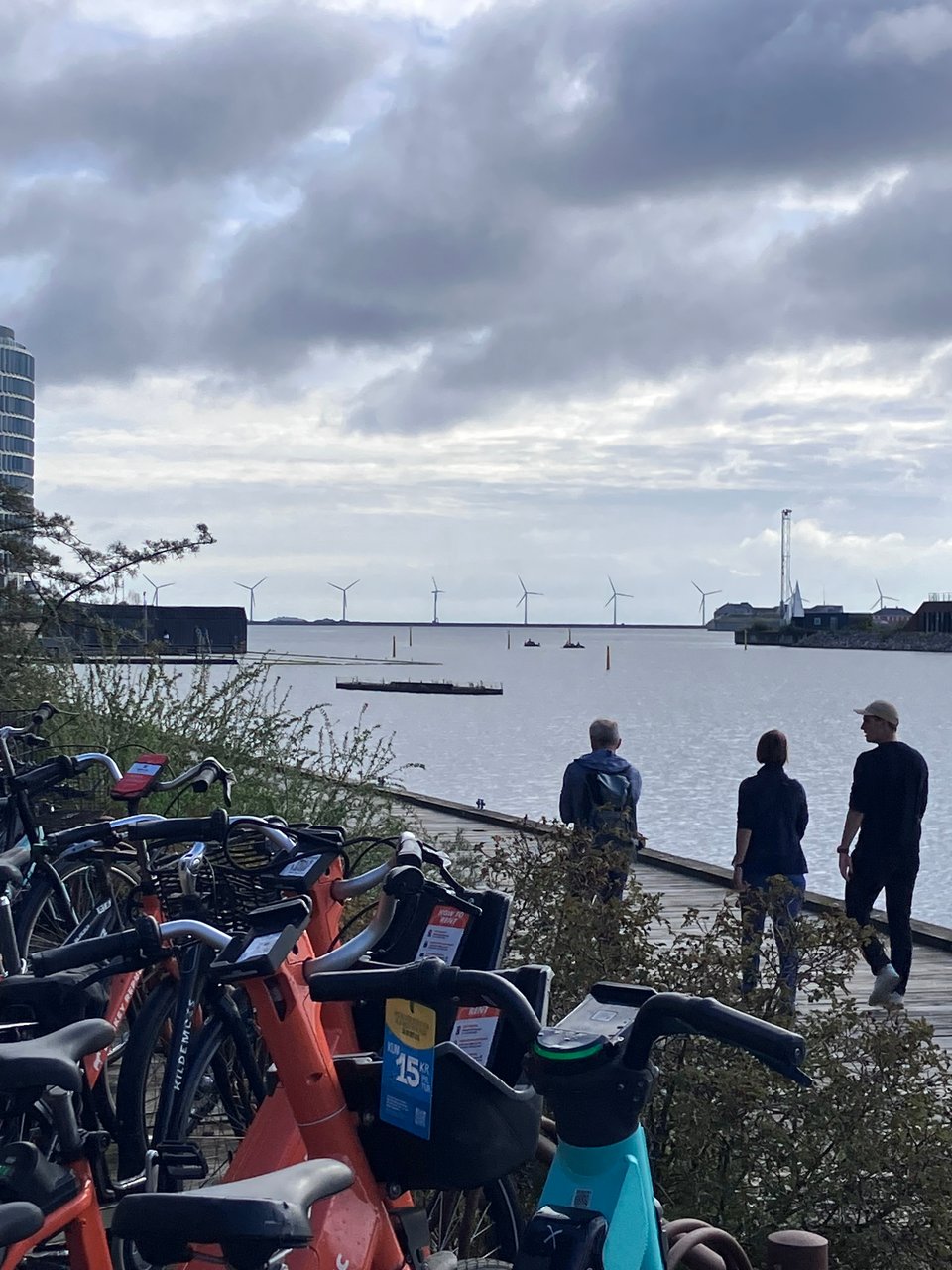
I find wind farms indescribably compelling, bordering on somewhat haunting. Wind turbines exist as dichotomies of antitheses: deceptively insubstantial when viewed from a distance but incomprehensibly large up close; always appearing in clusters but spread far enough from each other that each turbine effectively stands alone; monuments of technological advancement but utterly alien in their silhouettes; harnessing the invisible wind but visible for miles and miles. My main motivation for improving as a writer is to someday find the right words to describe the feeling that swells in my ribcage whenever I see a wind farm—a sort of primal fear tempered by an eldritch, bone-deep loneliness.
I’ve long thought that wind farms would provide a rich setting for a piece of post-apocalyptic dystopian fiction. Just imagine a ragtag crew traveling down on a highway in a world without electricity, watching with growing unease as these towering silent sentinels appear on the horizon and begin to loom ever larger. In a world where wind farms are no longer maintained or harnessed for energy, what purpose might be ascribed to them? Would they be seen as religious monuments? As grave markers? As shrines to human hubris? Or simply as ruins from an unknown era, the reason for this existence long eroded by the sands of time?
Anyway, wind farms were an unexpectedly constant companion throughout this vacation, popping up everywhere from Mykonos to Delphi and myriad places in between. When I touched down in Copenhagen for an overnight stayover and decided to walk around the harbor, it felt inevitable to look out over the water and be jumpscared by yet another wind farm breaking the horizon into periodic segments. I haven’t gotten a travel tattoo in a while, but if I was going to commemorate this vacation, a wind turbine tattoo might just be the way I did it.
For those in the know, lemongrass is a white food. Unfortunately many Thai restaurants use a tomato broth for their tom yum soup, which means I haven’t eaten a satisfying tom yum soup in probably 5 years. ↩